RTTue, 18 Jun 2019 14:58 UTC
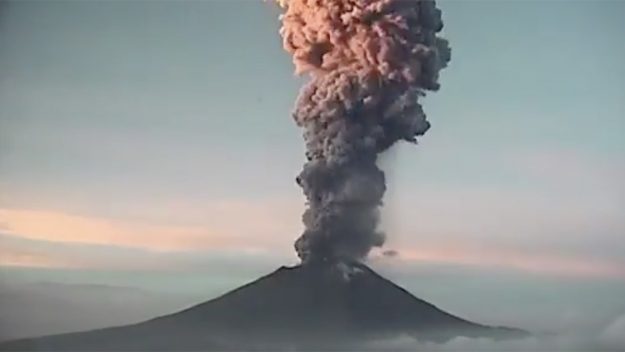
© Coordinación Nacional de Protección Civil / TwitterOn June 17, Mexico’s Popocatépetl volcano exploded and sent a large fumarole of ash, gas, and smoke into the sky.
A Mexican volcano's dramatic eruption has been captured in spectacular footage taken from inside a plane as it flew past the shocking sight.
The Popocatépetl volcano began erupting on Monday, sending large plumes of smoke and ash as high as 5km into the sky. Passengers flying near the active volcano at the time were able to get a clear view of the terrifying eruption.
Passenger Oscar Trinidad captured the stunning footage on his flight from Veracruz and posted it on Twitter, where it was widely shared and watched over 59,000 times. The video shows the volcano poking out of the clouds as it spews thick plumes of smoke into the sky.
Mexico's civil protection authorities also shared footage of the eruption, posting a dramatic timelapse clip online.
Comment: Further details from
electroverse.net:
According to the Volcanic Ash Advisory Center (VAAC) Washington, the largest eruption fired a thick ash column to an estimated 42,000 feet (12.8 km) above sea level, and comfortably into the stratosphere. Within a 24 hour window, the Popocatépetl volcano monitoring network detected 187 exhalations.
Popocatépetl, whose name means Smoking Mountain in Nahuatl, the language of the Aztecs, sprang back to life in 1994 (solar minimum of cycle 22) after half a century of quiescence.
Over the past few months, violent activity at the volcano has increased tenfold, correlating neatly with the sharp drop-off in solar activity (see 'UPTICK' below).
BACKGROUND
Stratovolcano: 5426 m / 17,802 ft
Central Mexico: 19.02°N / -98.62°W
Current status: ERUPTING (4 out of 5)
Eruption list: 1345-47, 1354, 1363(?), 1488, 1504, 1509(?), 1512, 1518, 1519-23(?), 1528, 1530, 1539-40, 1542, 1548, 1571, 1580, 1590, 1592-94, 1642, 1663-65, 1666-67, 1697, 1720, 1802-04, 1827(?), 1834(?), 1852(?), 1919-22, 1923-24, 1925-27(?), 1933, 1942-43, 1947, 1994-ongoing
UPTICK
Seismic and Volcanic activity has been correlated to changes in our sun.
The recent global uptick in earthquakes and volcanic eruptions is likely attributed to the drop-off in solar activity, coronal holes, a waning magnetosphere, and the influx of Cosmic Rays penetrating silica-rich magma.
See also:
NASA predicts weakest solar activity in 200 years




Comment: Further details from electroverse.net: See also: NASA predicts weakest solar activity in 200 years