Earthquakes
S


Bizarro Earth

Magnitude 5.6 earthquake strikes Ecuador-Peru border

temblor map of ecuador
This Temblor map shows recent large magnitude subduction zone earthquakes around the location of today’s M=5.6 quake. What is evident is that there have been earthquakes several hundred kilometers to the north and south of today’s event, but none in southern Ecuador. This could mean that the area has built up a significant amount of stress, which could be released in a large subduction zone earthquake, or that the geometry of the subduction zone prevents large events from happening.
At 4:34 p.m. local time, a M=5.6 earthquake struck Ecuador's southern border with Peru. While this part of South America is not heavily populated, shaking was felt in the city of Guayaquil, which is home to 3.5 million people. According to the USGS, only light shaking was felt close to the epicenter, while weak shaking was felt in Guayaquil. The USGS also estimates that damage from this quake should remain minimal, and that fatalities are unlikely. Based on reports coming in from South America, two people are reported to have been injured, and minor damage has been noted. Should more information come in, we will update this post.

Based on the reported depth from both the USGS (52 km) and the EMSC (60 km), and the thrust focal mechanism, this earthquake likely occurred on the subducting slab where the Nazca Plate slides beneath the South American. By examining the Slab 1.0 model from the USGS' Gavin Hayes (which is also visible in Temblor as 'Megathrust Zones'), the subducting slab should be between 50 and 60 km depth in the location of today's earthquake. Therefore, a minor slip event on the subduction zone is the likely cause of the quake.

Seismograph

Shallow 6.0 magnitude earthquake recorded in Balleny Islands region

graph
6.0 magnitude earthquake

USGS page: M 6.0 - Balleny Islands region
USGS status: Reviewed by a seismologist
Reports from the public: 0 people

2017-06-03 19:17:33 UTC 6.0 magnitude, 10 km depth
Balleny Islands

Seismograph

Magnitude 5.9 quake hits off Papua New Guinea

graph
A 5.9-magnitude earthquake hit Papua New Guinea, the United States Geological Survey (USGS) reported Saturday, adding that it was unlikely to cause mass casualties and damage.

The tremor occurred at 23:48 GMT. The epicenter of the quake was located at the depth of 190 kilometers (118 miles) and centered 91 kilometers (56.5 miles) west of Madang province.

There have been no reports of destruction or casualties caused by the earthquake so far.

No tsunami warning was issued.

Bizarro Earth

Shallow magnitude 6.8 earthquake strikes near Alaska's Aleutian Islands

Alaska Quake
© USGS
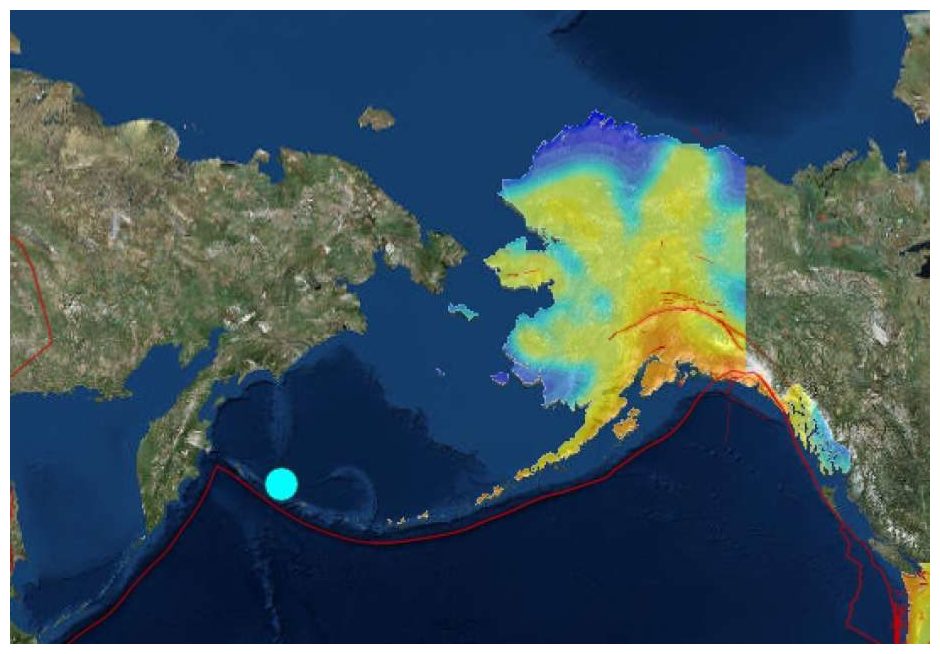
A strong earthquake with a preliminary magnitude of 6.8 has struck the Bering Sea between American and Russian islands, seismologists say. No tsunami warnings have been issued. (more)

The earthquake, which struck at 1:25 p.m. local time on Friday, was centered about 112 miles (180 kilometers) northwest of Attu Island in Alaska, or 168 miles (270 kilometers) southeast of Bering Island in Russia. It struck at a depth of about 19 miles (31 kilometers), making it a shallow earthquake.

The U.S. National Tsunami Warning Center put the preliminary magnitude of the earthquake at 6.8. "Based on earthquake information and historic tsunami records, the earthquake is not expected to generate a tsunami," the center said.

Friday's earthquake is expected to have been felt across parts of the Aleutian Islands, but damage or casualties are unlikely. The closest islands - Attu Island and Bering Island - have only a small population. Attu Island is also home to Attu Station, which was closed in 2010.

The sparsely populated region of Alaska, which sits on the so-called 'Pacific Ring of Fire', is occasionally struck by powerful earthquakes. Most notably, an enormous 9.2-magnitude earthquake struck north of Prince William Sound in Alaska on March 27, 1964, unleashing a tsunami which killed at least 143 people.

Bizarro Earth

Swarm of earthquakes rattle Bay of Plenty, New Zealand

earthquake graph image
More than 450 people felt a 'moderate' earthquake near Whakatane when it hit at 9pm yesterday. It was followed hours later with another shake in the Bay of Plenty.
More earthquakes have been felt in the Bay of Plenty. Geonet recorded four moderate quakes throughout the past 24 hours about 30km northwest of Whakatane. The last hit at 1.41am with a magnitude of 3.6 and was felt in Tauranga.

At 9.06pm yesterday a 4.2 magnitude quake struck at 10km deep. Only eight people reported feeling the early morning quake, but 454 said they felt last night's tremor. The quakes follow a 4.1 shake in the same spot at 1.35pm and another at 11.39am. Geonet recorded at least 86 "felt" reports from people describing yesterday afternoon's quake between "strong" and "light".

Seismograph

Three earthquakes in 5 minutes reported at Bárðarbunga volcano in Iceland

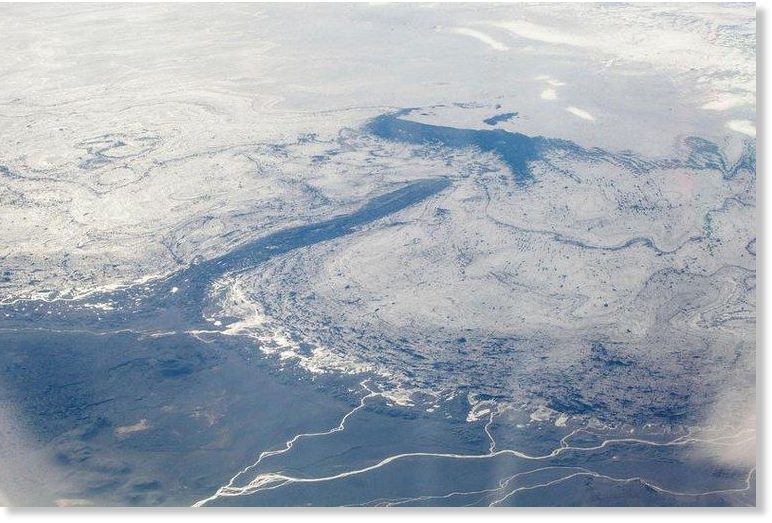
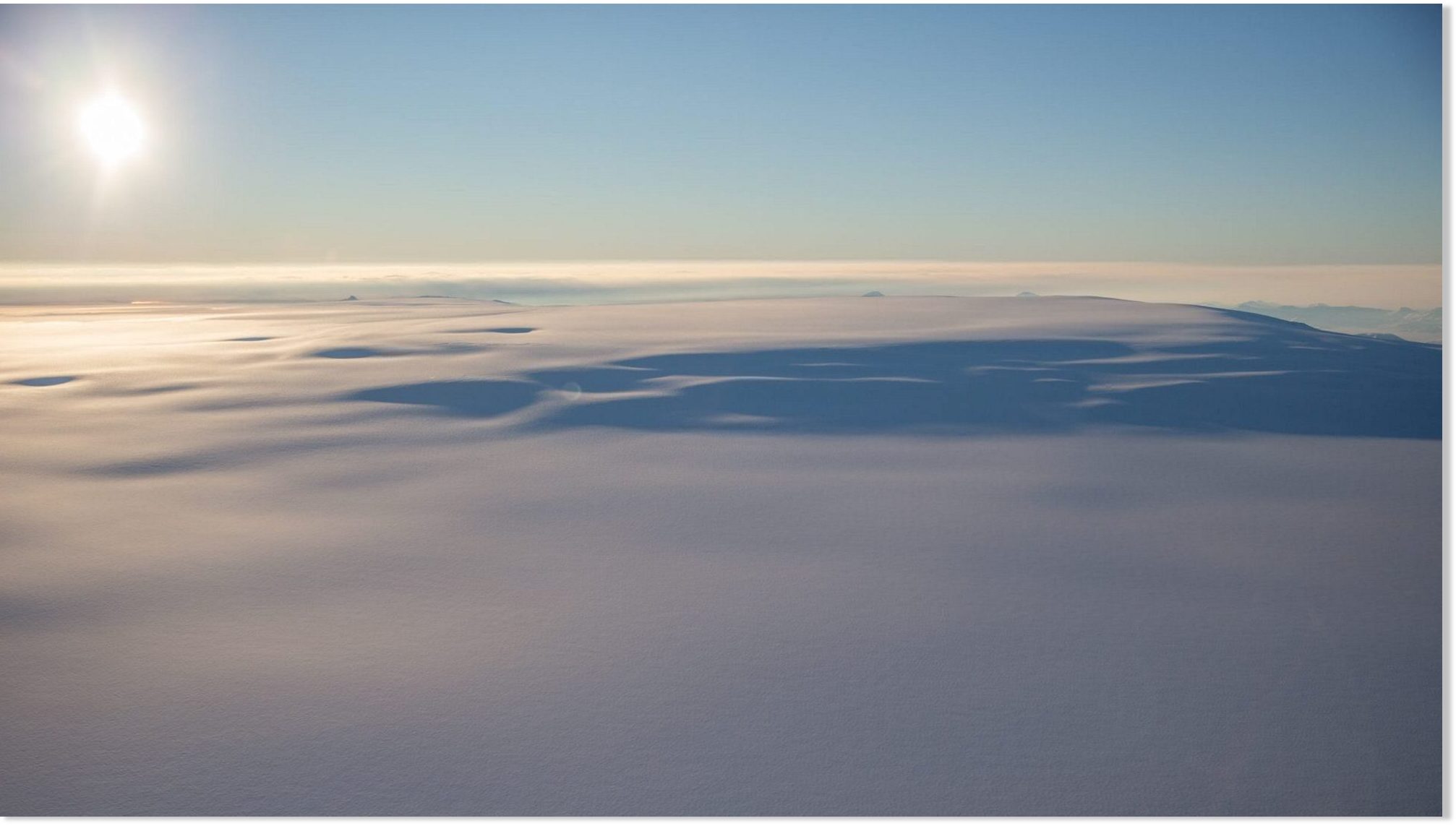
Bárðarbunga is a stratovolcano located under Vatnajökull, Iceland's largest glacier.
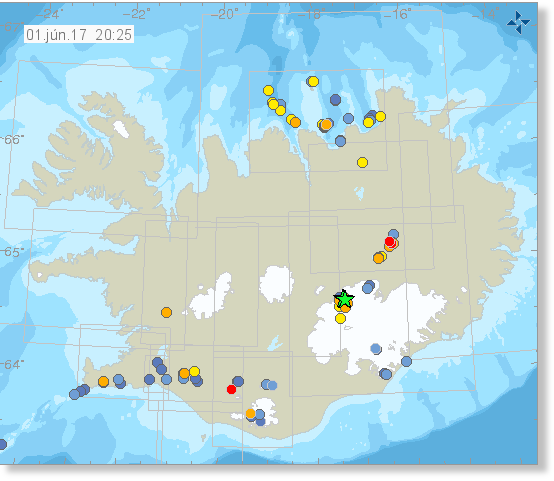
This morning, three earthquakes over the magnitude of 3 occurred in Bárðarbunga at a five minute interval.

All occurred in the northern part of the caldera, the first at 9:49, the second at 9:53 and the third at 9:54. This is reported by the Iceland Met Office.

Last week, nearly 600 earthquakes were measured in Iceland which is similar to the preceeding week. Only six of them exceeded the magnitude of 3, the largest occurring on May 27th in Bárðarbunga.

Iceland met office graph
Iceland Met Office link for current earthquake graphs

Bizarro Earth

An earthquake in the Arctic Circle?

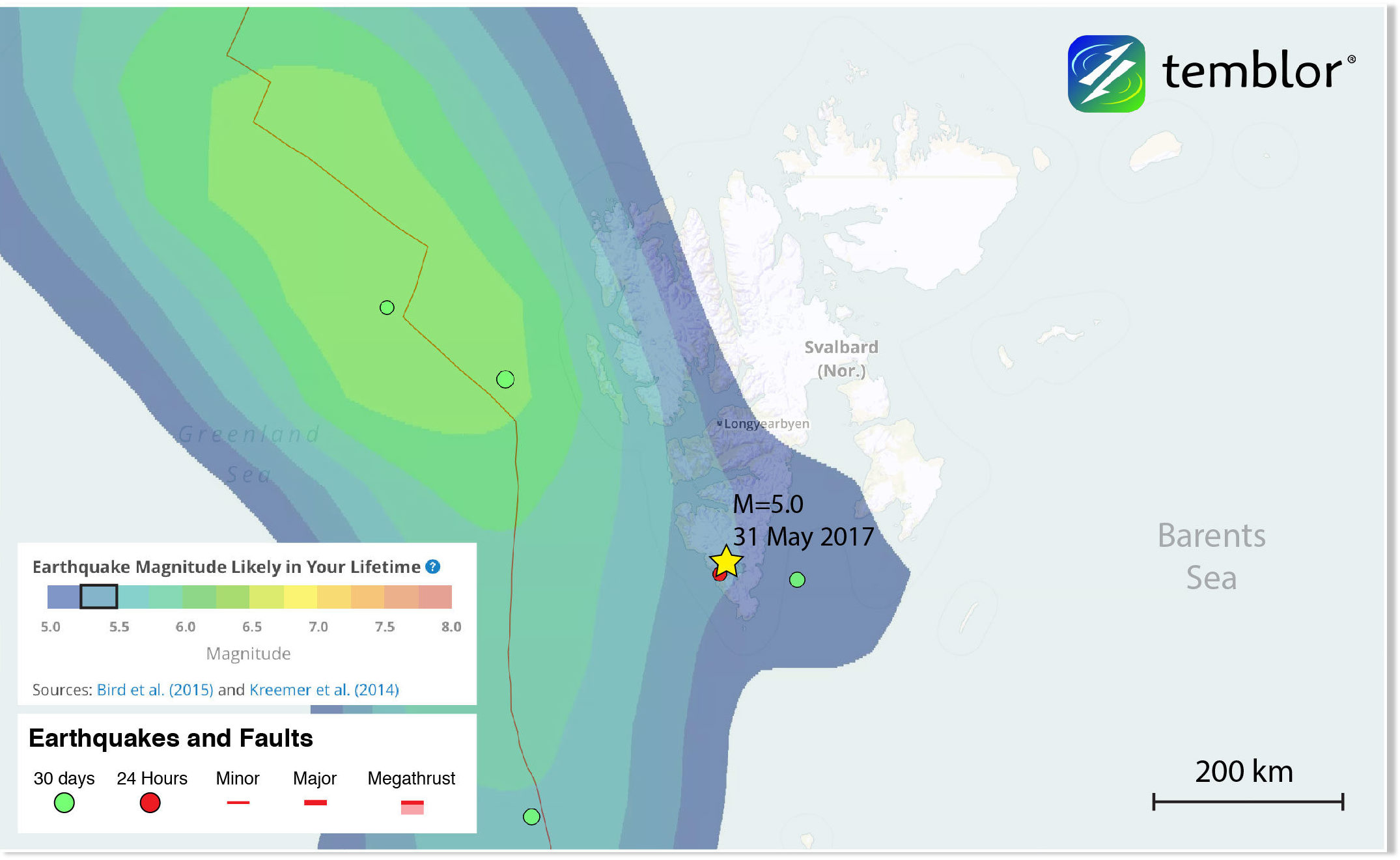
Global Earthquake Activity Rate (GEAR) model for Svalbard
This Temblor map shows the Global Earthquake Activity Rate (GEAR) model for Svalbard in the Arctic Circle. This map shows that today’s M=5.0 earthquake (magnitude from the USGS) should not be considered surprising and that the region could experience larger quakes.
At 3:59 p.m. local time, a M=5.0 earthquake shook the island of Spitsbergen, the largest island in the Svalbard archipelago in the Arctic Circle. According to the USGS, the quake occurred at a depth of 7.7 km, and was centered 133 km from Longyearbyen, the archipelago's largest settlement, which is home to a little over 2,000 people. This M=5.0 quake was preceded several hours earlier by a M=3.0. While very few people likely felt this earthquake, it highlights a lesser-known area, and the idea that seemingly inactive faults can rupture in earthquakes.

The Svalbard archipelago represents an uplifted portion of the Barents Sea, which separates Svalbard from Northern Europe. To the west of the archipelago is the Mid-Atlantic Ridge, and the Spitsbergen Fracture Zone, a divergent plate boundary between the North American and Eurasian plates. Much of the seismicity in this part of the Arctic Ocean occurs on or near the Mid-Atlantic Ridge, which has a spreading rate of approximately 2.5 cm/yr (1 inch). However, by examining the historical seismicity of the island of Spitsbergen and the rest of Svalbard, it is clear that this remote archipelago is no stranger to earthquakes.

Seismograph

Strong shallow 6.6 earthquake rocks Indonesia's Sulawesi island

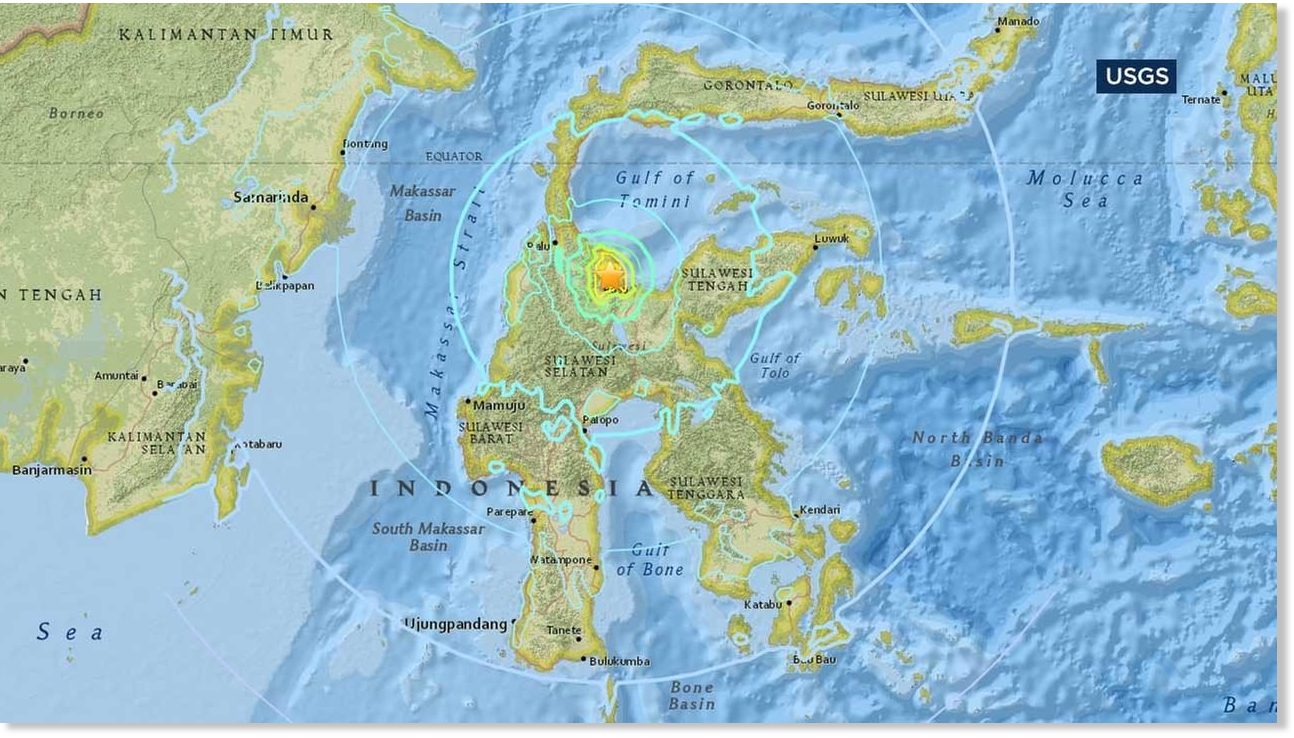
This U.S. Geological Survey map shows the location of a powerful earthquake that struck Indonesia's central Sulawesi province on Monday, May 29, 2107.
© U.S. Geological SurveyThis U.S. Geological Survey map shows the location of a powerful earthquake that struck Indonesia's central Sulawesi province on Monday, May 29, 2107.
A strong, shallow earthquake has rocked Indonesia's central Sulawesi province. There were no immediate reports of damage or casualties.

The U.S. Geological Survey says the quake Monday evening near the city of Poso had a preliminary magnitude of 6.6 and was located at a depth of 9 kilometers (6 miles).

Al Shinto radio reported that residents ran from their homes in panic.

Shallow earthquakes tend to cause more damage on the Earth's surface.

Source: AP

Attention

Another earthquake registered around Bardarbunga volcano in Iceland

Bardarbunga volcano
Bardarbunga volcano
An earthquake of 3.9 magnitude was measured in Bardarbunda caldera this morning at 9.35 (local time) according to a RUV report and according to the Icelandic Met Office around seventy tremmors and quakes were measured there last week and an additional thirty the week before that. Three of those earthquakes were above 3.0 magnitude and they all originated by the calderas edge in the evening of 20 May, last week.

A large earthquake also rocked south Iceland in early May 17 with reports of Hekla Volcano being ready to erupt.

Bardarbunga, is a volcano located under Iceland's most extensive glacier, Vatnajokull glacier to the north. Bardarbunga is the second highest mountain in Iceland and is a part of a volcanic system that is approximately 200 kilometers long and 25 kilometers wide, that system includes Hekla Volcano.

Bizarro Earth

Vinton County, Ohio has its first recorded earthquake, 20km deep and 3.8 magnitude

vinton county oh
An earthquake around 12:24 p.m. on Wednesday near Elk Township of Vinton County had worried individuals calling 911.

"People were just wondering what was going on," said William Faught, the director of the Vinton County Emergency Management Agency, who also felt a tremor from the earthquake.

"It's the first indication that we have in our catalog of any earthquake occurring in Vinton County," said Jeff Fox, a seismologist at the Ohio Department of Natural Resources (ODNR).

He classified yesterday's earthquake at a 3.8 magnitude instead of the 3.4 magnitude that was reported through the U.S. Geological Survey (USGS). John Bellini, a geophysicist at the USGS, didn't think much of yesterday's event other than it being another sporadic earthquake. Bellini says yesterday's earthquake did not reach the level of intensity to do any real damage.