Earth ChangesS


Cloud Precipitation

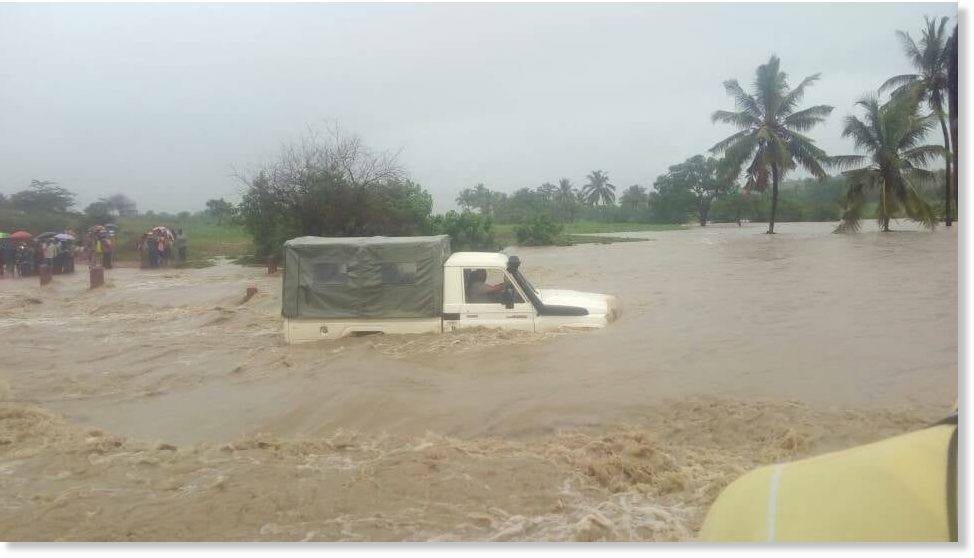
Floods kills 14, displace thousands in Kenya; 9 inches of rain in 24 hours for Mombasa

The flooding Mbadi River.
© Kenya Red CrossThe flooding Mbadi River.
Torrential rain has caused deadly flooding and landslides in southern and eastern parts of Kenya. According to WMO, 235 mm of rain fell in Mombasa in a 24 hour period between 08 and 09 May, 2017.

At least 6 people have died in Mombasa as a result of the heavy rain. Mombasa Governor H.E Hassan Ali Joho, said via Social Media, "I am deeply saddened by the death of six people who were crushed by a perimeter wall which collapsed near Mbaraki Primary due to heavy rains."

He added, "Let's all exercise great caution at this time. There have been higher than expected rains and this poses unusual stress on our infrastructure."

Local media report that over 5000 people in Taveta, Taita Taveta County near the Kenya coast have been displaced by flooding and heavy rain. Local Red Cross said that over 900 families were affected.


Attention

Grizzly bear attacks, injures man near Cody, Wyoming

Bear attack
A grizzly bear attacked and injured a man looking for shed antlers Tuesday northwest of Cody, according to the Wyoming Game and Fish Department.

The man was bitten on his arm and leg, but none of the wounds were punctures or required serious medical attention, said Brian DeBolt, large carnivore conflict coordinator for Game and Fish.

"Luckily, it was real minor injuries considering he was attacked by a bear," DeBolt said.

The man told Game and Fish officials that he was walking through a hilly, timbered area when he surprised the bear, which was likely on a day bed. The bear briefly attacked and then fled, DeBolt said.

The man walked to his vehicle and drove himself to a hospital.

Game and Fish officials will not look for the bear, as they do in some attacks, because the bear was acting naturally.

Bizarro Earth

Earthquake magnitude 5.4 along the Tashkurgan Fault takes lives in western China

village of Kuziguncun,
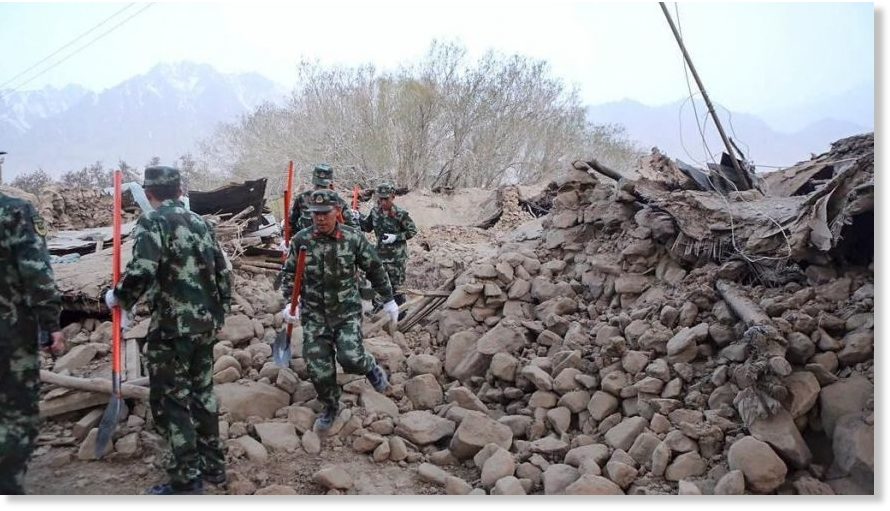
© Li Jing/Xinhua via APIn the village of Kuziguncun, 3 km north of the epicenter of today’s earthquake, many buildings collapsed. What is evident from this picture is that poor build quality was a major factor in why there was so much damage in a M=5.4 quake.
A M=5.4 earthquake at 5:58 a.m. local time (11 May 2017) struck western China's Taxkorgan county, along the border with Tajikistan. The earthquake collapsed 180 buildings and homes, and killing at least eight people, and injuring 23. According to the USGS, severe shaking was felt close to the epicenter, in what is a mountainous, sparsely populated region of China. This shallow (10 km) earthquake was primarily a normal faulting (extensional) event, though there was a very small component of strike-slip movement. But due to the remoteness of this quake, reports are still coming in as search and rescue continues.

Despite the small size and modest shaking of the M=5.4 mainshock, the poor building quality in the region meant structures were susceptible to collapse, especially close to the epicenter (see picture below). In this portion of western (Xinjiang) China, the majority of homes are made of wood, mud bricks, or rock. This illustrates how important construction quality is to earthquake resilience. Here, buildings were reduced to rubble, resulting in fatalities.

Ice Cube

'Global Warming Surprises'

earth on fire

Guest essay by Dr. Fred Singer


Exploring some of the intricacies of GW [Global Warming] science can lead to surprising results that have major consequences. In a recent invited talk at the Heartland Institute's ICCC-12 [Twelfth International Conference on Climate Change], I investigated three important topics:

1. Inconsistencies in the surface temperature record.

2. Their explanation as artifacts arising from the misuse of data.

3. Thereby explaining the failure of IPCC to find credible evidence for anthropogenic global warming (AGW).

A misleading graph

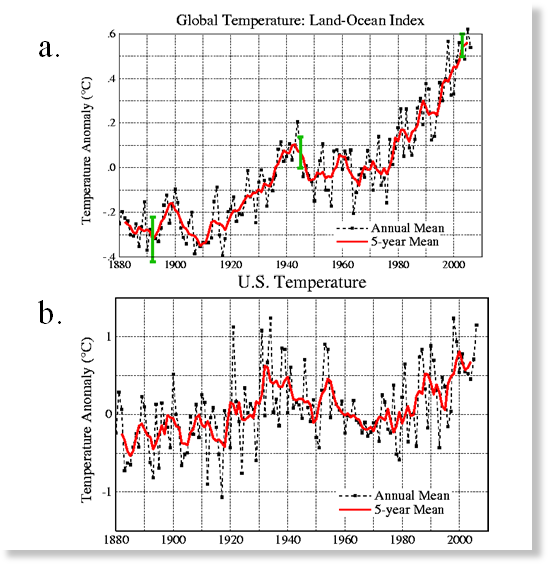
In the iconic picture of the global surface temperature of the 20th century [fig 1, top] one can discern two warming intervals — in the initial decades (1910-42) and in the final decades, 1977 to 2000.

Although these two trends look similar, they are really quite different: the initial warming is genuine, but the later warming is not. What a surprise! I wouldn't exactly call it 'fake,' but it just does not exist; I try to demonstrate this difference as an artifact of the data-gathering process, by comparing with several independent data sets covering similar time intervals.
Fig 1 20th century temps; top—global; bottom– US

Bizarro Earth

U.S. Geological Survey study discovers high levels of radon in wells across Pennsylvania

radon wells pennsylvania
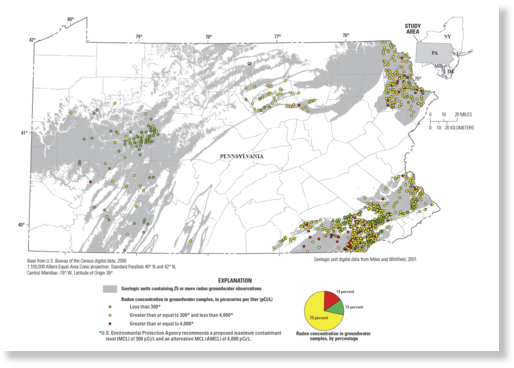
© USGSA map of Pennsylvania indicating radon concentrations of water samples collected during a multi-year groundwater radon study.
The study, which was conducted in cooperation with the Pennsylvania Departments of Health and Environmental Protection, examined 1,041 well samples and found that 14 percent had radon levels at or above the Environmental Protection Agency's proposed alternative maximum contaminant level of 4,000 picocuries per liter. While the EPA does not currently regulate radon in drinking water, it has proposed this alternative limit for public water supplies in states like Pennsylvania, which has an EPA-approved radon indoor air quality program. For states without an approved program, the EPA has proposed a lower, more protective, maximum contaminant level of 300 picocuries per liter.

Radon - which is a colorless, odorless, radioactive gas - primarily contaminates indoor air when the gas seeps through the soil under homes and buildings, but groundwater can be a notable indoor air radon source in areas where groundwater has extreme radon concentrations. Radon dissolved in groundwater used for drinking water can escape into the air as the water leaves a faucet, which adds to any radon that enters a structure through foundation cracks. Homeowners with private wells should be aware of radon's potential health risks because, according to the EPA, radon exposure is the second-leading cause of lung cancer in the United States.

Snowflake Cold

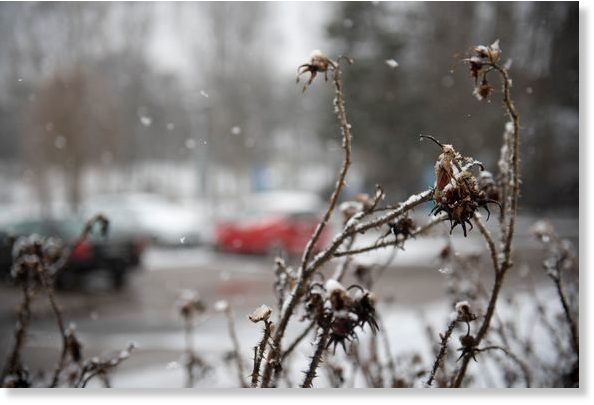
April in Finland was colder, wetter and snowier than usual

Snow Finland
The Finnish Meteorological Institute's figures show that April 2017 was colder, wetter and snowier than average, confirming the gut instincts of most of those who reside in Finland.

April was unusually damp and cold in Finland, according to the weather stats released on Tuesday by the Meteorological Institute (FMI). Across most of the country the temperature was between one and two degrees lower than average.

In the south you have to go back to 2013 to find a similarly frigid month, in the centre of the country 2003 was the last time it was this grim, and in the north it hasn't been so cold and snowy in April since 1998.

Comment: See also: Highly unusual snowfall in Finland?


Snowflake Cold

Cold weather is keeping birds from nesting and delaying blossoming of wild berry bushes in Finland's north

Ptarmigan
Ptarmigan in snow
There is still plenty of snow in the forests of Lapland, and there is ice on many of its lakes and rivers. Spring has inched forward slowly and temperatures, especially at night, are frigid. Right now, the weather in Lapland is 4C-5C below the long-term average.

The cold is being reflected in the late arrival of migratory birds. According to Jukka Jokimäki, a researcher at the University of Lapland's Arctic Centre, the institution's annual count of migratory birds is now on hold because so few have come as far north as the Arctic Circle.

"At the beginning of April it looked like we'd have an early spring, but migration has been at a standstill and is around a week and a half late. Wagtails are the only insect eaters being seen. Wading birds are missing altogether, which is understandable since all of our ponds and lakes are still covered by ice," reports Jokimäki.

Ice Cube

Headed for more than a 'little-ice age'

chen dynasty ice age
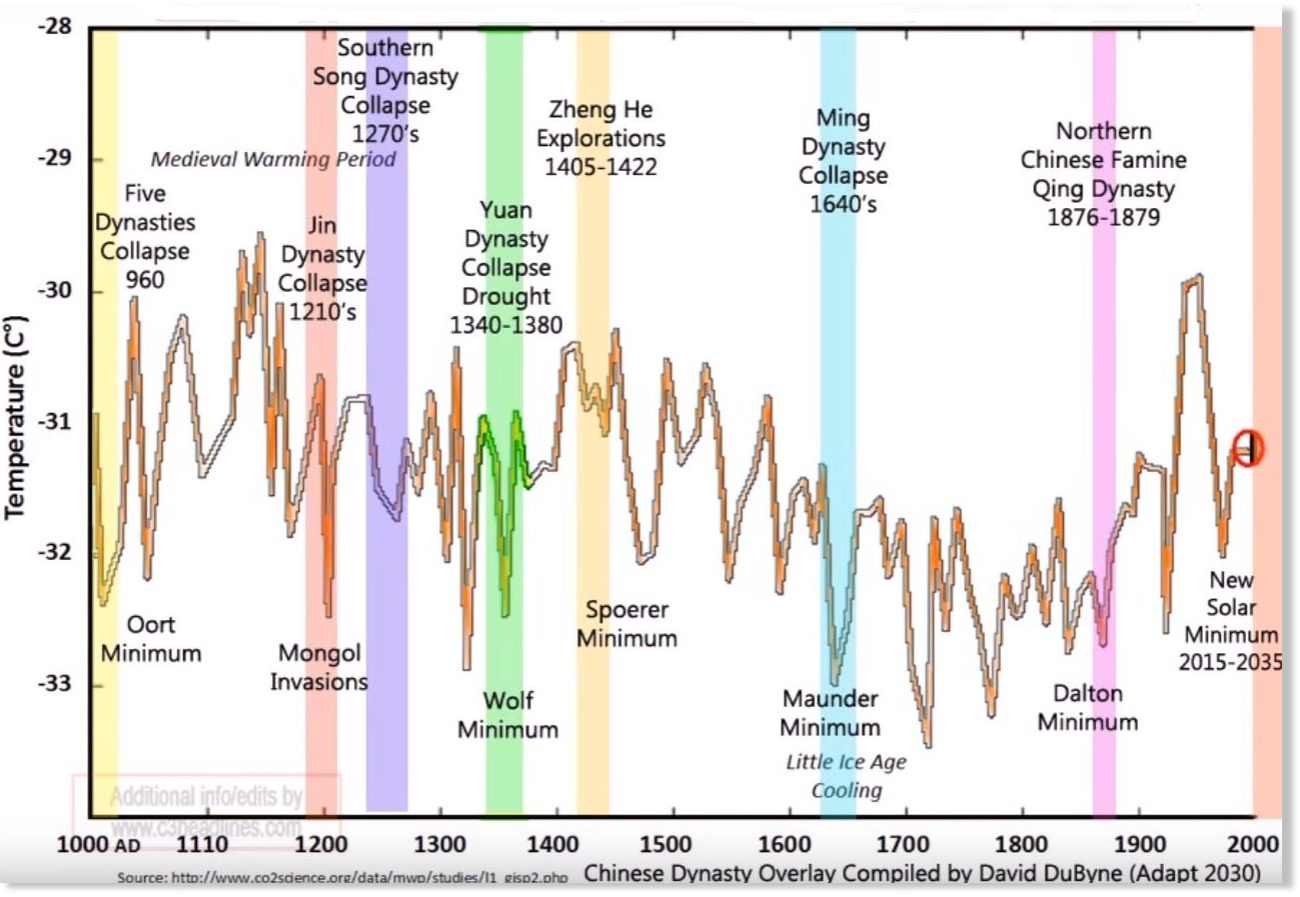
The latest Adapt 2030 video suggests something longer than a mini or little ice age. The creator of Adapt 2030, David DyByne, firmly believes this will not be a 400-year cooling event, but rather, that a 1,500- to 2,000-year cooling event is about to strike our planet.

DyByne bases his conclusion on the correlation of the sharp increases in volcanism that accompany Grand Solar Minimums. For example, a massive eruption of El Chichon in southern Mexico around 540 A.D. dumped 8-foot-deep layers of ash around Central America. The eruption brought on the 100-year Maya Dark Age and was responsible for temperature drops across the northern hemisphere when global temperatures dropped 2C.

El Chichon was just one of a chain of eruptions between 536 AD and 545 AD that caused widespread climate change, says DuByne. It had devastating effects on crop production across Europe as agricultural production declined significantly. The Rabaul volcano in New Guinea erupted at about the same time, and again, it was just part of a series of eruptions.


Comment: See also: Grand solar minimum volcanoes simultaneously collapsed Mayan, Roman & Chinese societies


Ice Cube

Highly unusual snowfall in Finland?

Finalnd snow
© Marja Väänänen / Yle
Email from reader in Finland

Hello Robert,

It's been snowing in Finland in May and it's been highly unusual. I couldn't find any English news about it yet, which seems a bit fishy to me. However, I'm sure they might report about it later on the Yle News section.

I try to keep on spreading the message about the coming mini ice age, but the mainstream media is doing a good job when it comes to pushing propaganda and lies about the "global warming". We have a spotless sun again!

Also see: "April was colder, wetter and snowier than usual"

Ice Cube

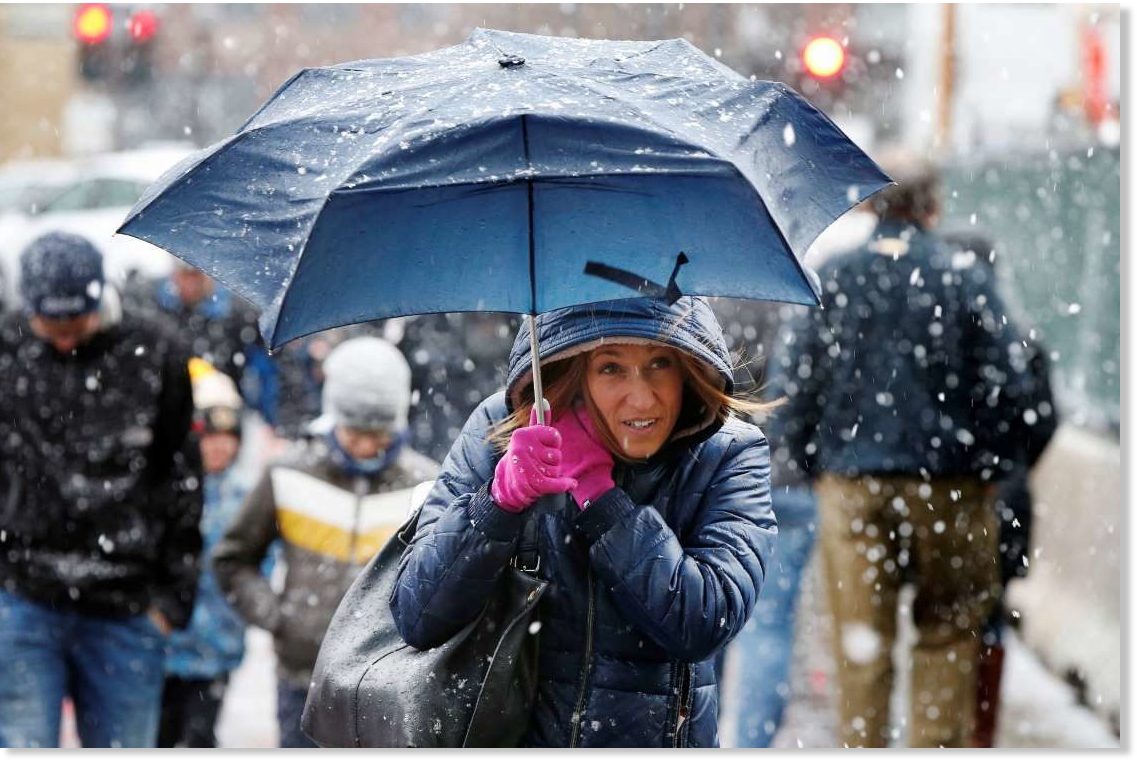
U.S. Northeast at risk for freeze - Maybe snow?

woman in snow
© Michael Dwyer/AP Photo
Conditions more typical of early April or March for an extended period. (I assume this is caused, of course, by global warming.)

A vortex could bring unseasonably chilly conditions and frost to the northeastern US into next week, according to AccuWeather.com.

Areas at risk for a frost or freeze will extend from part of the Great Lakes region to the central Appalachians and western New England early Wednesday morning.

There is even a chance of wet snow in the mountains of eastern New York state and western New England.