Earth ChangesS


Attention

3,000 Alaska earthquakes already this month; 'marked increase' say seismologists

earthquake in Whitehorse, Alaska
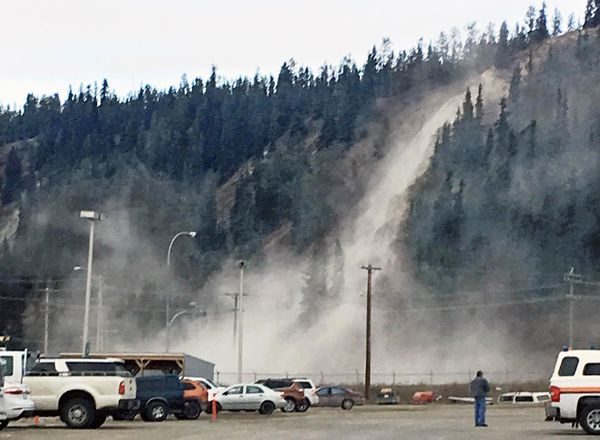
© Angie Dickson / via Yukon NewsDirt rolls down the clay cliffs across from Canadian Tire during a May 1, 2017 earthquake in Whitehorse.
A series of significant May earthquakes and their aftershocks are being examined by seismologists, who say Alaska is markedly above its usual rate of earthquakes for the month.

Alaska Earthquake Center seismologist Natalia Ruppert said Alaska typically experiences a "background level" of 35,000 earthquakes each year, plus any significant earthquakes and their aftershocks. The center typically sees about 3,000 quakes statewide in a month — but May has been well ahead of that pace, Ruppert said.

"Right now, with the aftershocks, we recorded close to the monthly average in just the first 10 days," Ruppert said.

The catalog of May temblors as of Wednesday included at least three larger than a 6, seven larger than a 5 and 50 larger than a 4 on the Richter scale, according to an overview compiled by the earthquake center's Ian Dickson.

The month began with a 6.2 quake and a 6.3 aftershock on May 1 under the Haines Highway in Canada that rattled much of Southcentral Alaska, causing significant damage in the Canadian city of Whitehorse. State seismologist Michael West said the quake struck along the Denali fault line, which extends from Southeast Alaska through Canada into the Alaska Range.

More than 800 aftershocks had been detected from the Southeast quake by Wednesday, Dickson wrote. The state also saw a 5.2 quake 10 miles north of Ninilchik on May 6 that was felt in Valdez and Palmer, as well as a 3.8 the following day northeast of the Fort Knox gold mine that was felt in Fairbanks.

Ice Cube

Satellites capture rapid movement of Arctic glacier

Arctic glacier movement
© ESA
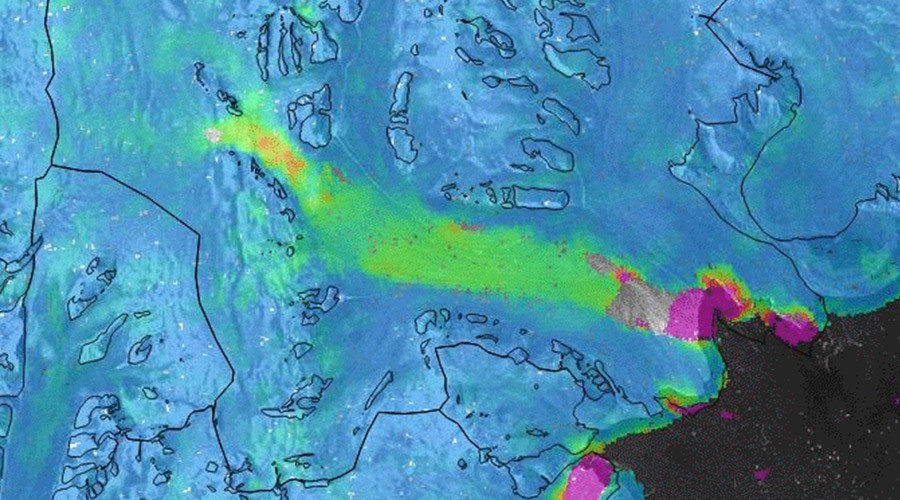
Environment monitoring satellites have captured the rapid increase in speed of an Arctic glacier as it starts moving 13 times faster than before.

The Negribreen glacier on Norway's Spitsbergen island has seen a dramatic increase in ice surface speed over the past year with the pace jumping from one meter a day to a staggering 13 meters every 24 hours.


This stunning surge in speed has been captured by the European Space Agency's (ESA) Sentinel-1 satellites which are providing round the clock radar imaging of land and ocean for the space agency's Copernicus program.

"When a glacier 'surges' a large amount of ice flows to the end in an unusually short time," the ESA explain.

The reasons behind these surges are not fully understood, but they are believed to be caused by increases in the amount of heat or water in the lowest layers of the glaciers.


Comment: Meanwhile in Antarctica, scientists have discovered a huge crack spreading across an ice shelf and thousands of blue lakes of melt water have formed on the surface of glaciers over the past decade. Yet a recent study indicates that the Antarctic peninsula has actually been cooling not warming. See also:

Antarctica, is it melting or not? Man-made global warming can't explain this climate paradox


Camera

As temperatures rise, sun halo appears in Hong Kong sky

Sun halo in Hong Kong
© Carine Lam
Optical effect reported in districts to the east of the island

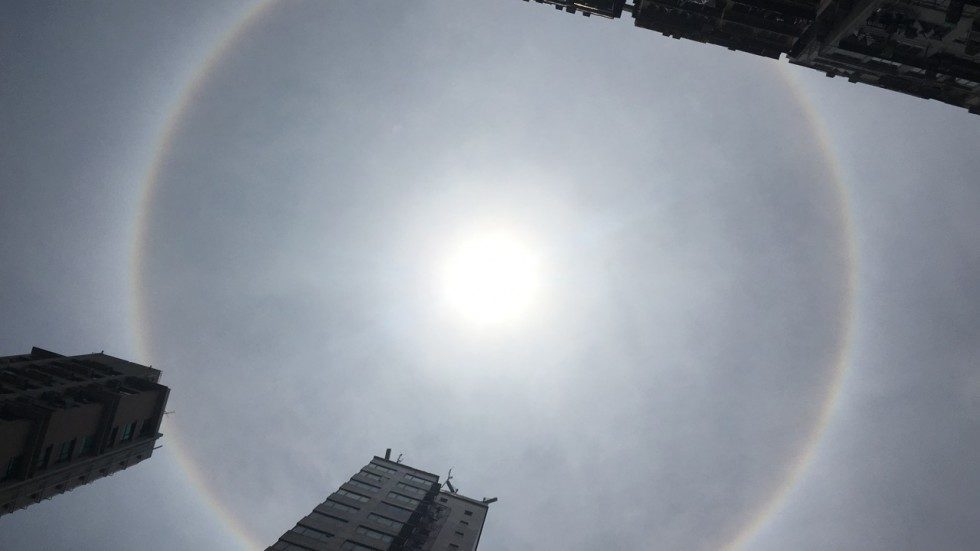
Hongkongers witnessed something special in the sky just after midday on Friday, as a "halo" appeared around the sun.

The phenomenon was reported in districts to the east of Hong Kong Island, such as Sai Wan Ho, Tai Koo and Shau Kei Wan.

As people looked up, the sun appeared surrounded by a halo or bubble. The effect was down to an optical phenomenon, as temperatures hit 31 degrees Celsius.

According to the Observatory's website, it is caused by sunlight being scattered from droplets of water in clouds or fog, set against the nearly white background of the sky.

Cloud Precipitation

Intense hailstorm in United Arab Emirates cracks car windscreens

hail
Moderate to heavy rain and hail hit different parts of the northern Emirates, including Fujairah and Ras Al Khaimah on Thursday afternoon.

Thundershowers were continuing over some parts of Hatta on Thursday afternoon, according to the National Centre for Meteorology and Seismology.

Fujairah police urged motorist to exercise extra caution while driving on the roads and to abide by traffic rules.

Police patrols have been deployed on the roads to regulate traffic as rainwater filled many interior roads and highways.

Shaikh Khalifa Road in Fujairah witnessed heavy rain and hail causing damage to several cars.


Eye 2

Enormous 71 ft carcass origins cause utter confusion in Indonesia (VIDEO & PHOTOS)

Carcass
© Patasiwa Kumbang Amalatu / YouTubeMeat from the carcass is being tested to identify the creature.
Is it a giant squid or a regular sized whale? That's the question causing considerable confusion for investigators examining an enormous 22-meter (71ft) carcass which washed up on the shores of Huamual in Indonesia.

The rotten carcass has attracted a crowd eager to debate what the mysterious carcass is - with squid and whale emerging as the front runners.

One brave man got close enough to the remains to film. Patasiwa Kumbang Amalatu posted to Facebook that he believes the remains are those of a massive whale.

Wolf

Demon dog: Killer rottweiler mauls owner to death then eats his flesh in Haryana, India

The killer dog ate his owner's flesh
© Newslions/SWNS.COMThe killer dog ate his owner's flesh
A vicious rottweiler mauled his owner to death and spent more than an hour eating his body, as police tried in vain to capture the animal.

The black dog , named Tiger, attacked his owner, by locking its jaws around his body and choked him to death.

Mani Ram, a farm caretaker, had bought the dog to guard his home, but as he went to untie him, Tiger turned and violently ran at him.

According to eye witnesses the dog didn't stop there and went on to "maul his face and feast on the flesh from his hands and chest for more than an hour".


Sun

Stunning halo seen around the sun in Milwaukee, Wisconsin

Milwaukee solar halo
What in the world is a solar halo? We got quite a few pictures sent to us today at Weather Watch 12 with a circle around the sun.

This is known as a solar halo or 22° halo. It occurs when you have a sunny day with a very thin layer of cirrus clouds overhead. Those cirrus clouds are made of ice. When the sun goes through the ice, the sunlight is refracted (bent) and can sometimes create either sun dogs or a 22° halo. This can also occur around the moon.

Bad Guys

@NPR bungles sea level rise story

NPR logo
"Data from CO2 measuring stations and from the Sewell's Point and all other tide gages may clearly refute these assertions, but NPR and its colleagues will not change their minds."

"The Sewell's Point tide gage shows that the rate of sea level rise has not changed since the gage was installed in 1927, and is unchanged from our use of fossil fuels. It's time to base our policies on sound science, instead of manmade global warming fiction and scare stories."
National Public Radio's March 31 "Morning Edition" program carried a "news" story claiming that rising seas threaten a number of U.S. coastal military bases. The commentary was so laden with factual errors that listeners might have thought it was an early April fool's joke. Unfortunately, it was not.

NPR remains so wedded to its belief that humans and carbon dioxide emissions are causing a fossil fuels - driven global warming catastrophe that its reporting has been compromised, and it is unable to think critically or report honestly without resorting to activist claims and fake news events.

Real journalism would have at least included passing references to alternative views and sources. But they were absent in this story, which in truth is a splendid example of ignorance or deception—reader's choice.

Megaphone

Strange banging noises heard throughout Abergavenny, Wales

Meteor shower
© Abergavenny Chronicle
THINGS that go boom were heard throughout Abergavenny last weekend and as of yet there has been no official explanation as to what caused them.

The Chronicle has been inundated with queries as to the nature of the loud, fierce, and persistent. bangs were which left the town all shook up on the weekend.

As many natives were nursing the last vestiges of their hangovers and settling down to watch the Antique's Roadshow last Sunday evening, the town was collectively unnerved by the mother of all bangs.

One Abergavenny resident said, "It nearly gave me an heart attack it was that loud. A first I though it was shotgun blast or a firework, but it was way too loud for that. It sounded more like a tank going off. My husband said it was probably mini meteors colliding with the earth, but have you ever heard such nonsense?"

Actually we have. The meteor story is not as far-fetched as it sounds. When a massive meteor enter the atmosphere over a specific area it makes a very distinguishable noise. The scientific term for this is 'sonic boom'.

Bizarro Earth

Magnitude 6.2 subduction zone earthquake strikes El Salvador

el salvador earthquake map
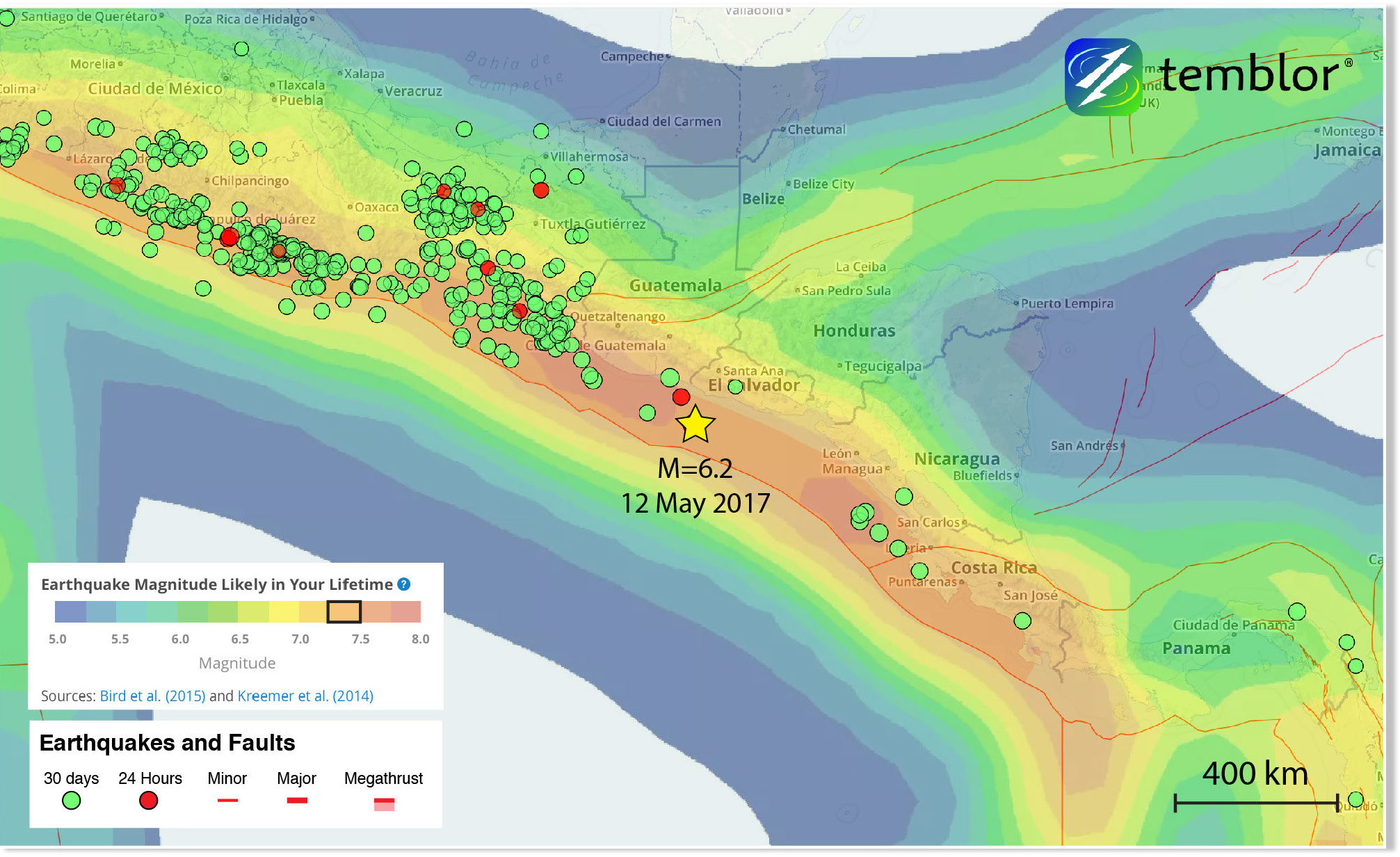
© TemblorThis Temblor map shows the location of today’s M=6.2 earthquake, as well as Global Earthquake Activity Rate (GEAR) model.
A M=6.2 earthquake struck off the coast of El Salvador at 4:41 a.m. local time this morning (12 May 2017). According to the USGS, the quake occurred at a depth of 10 km, approximately 75 km offshore. So far, no reports of damage have come in, and the USGS estimates that economic losses should remain minimal, and that there should be no fatalities as only light shaking was felt in the country, including in the capital city of San Salvador, which is home to over 250,000 people.

Even though the USGS does not have a focal mechanism, based on the earthquake's depth and location, it likely occurred on the Central American subduction zone or just above it. This analysis was also aided by using the Slab 1.0 model by Gavin Hayes at the USGS (which appears in Temblor as "Megathrust" zones). This model is a compilation of global subduction zones geometries. Based on the geometry of this subducting slab, it should be at a depth of 10-20 km in the location of today's event.

USGS data