
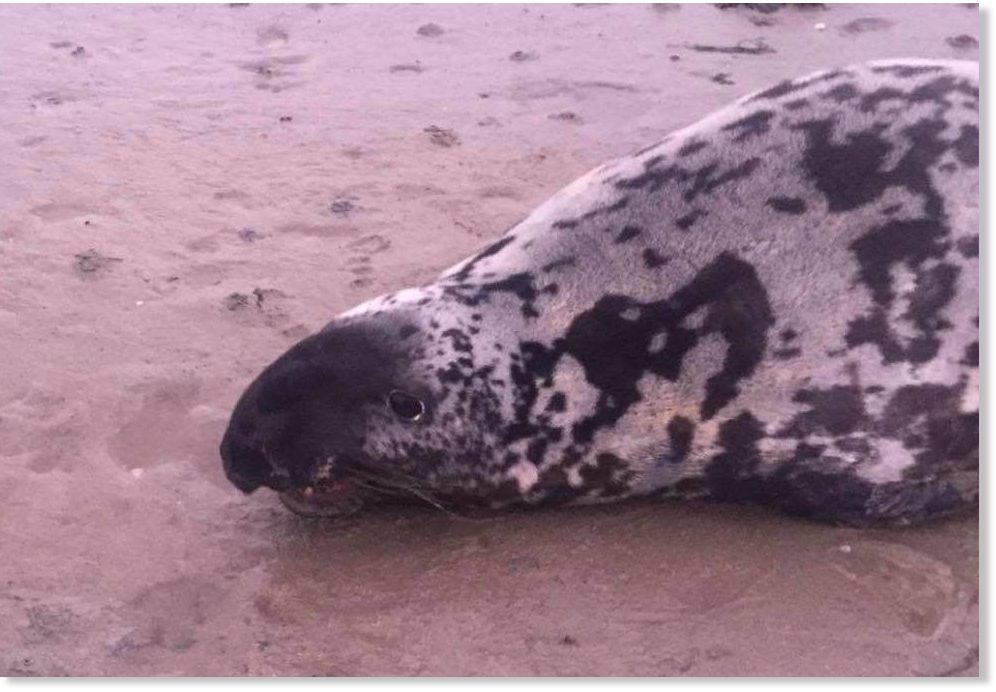
© Helen Tilson/Schull Sea SafariThe male Hooded Seal was first seen at Toormore, Co Cork, on New Year's Day
The first of these was a male Hooded Seal, which appeared at Toormore beach, west of Schull, on New Year's Day. Apparently in good health, the animal measured more than 2 metres in length and was estimated to weigh around 300 kg.
Sexed as a male due to the distinctive, elastic balloon-like nasal cavity on the top of its head, which only males possess, the seal was observed (and filmed) inflating this sack on a few occasions.
It stayed on the beach for the remainder of the day, where it was monitored by volunteers to ensure its rest was undisturbed by onlookers, before swimming off from Toormore the following day (2nd) - it hasn't returned there or been seen anywhere else since.
While principally an Arctic species, Hooded Seal spends much of its life well away from land and has been seen as far south as the Mediterranean Sea. There are six previous Irish records: two historical occurrences are cited from Co Mayo in 1836 and Co Galway in 1898, with more recent sightings involving juveniles in Co Wexford in September 2001, Co Waterford in October 2006, Co Dublin in July 2012 and Co Donegal in 2016.
Arctic Hooded Seal - in action in West Cork, Ireland
— Schull Sea Safari (@Schullseasafari) January 2, 2020
1st Jan 2020 - would really like to know if we have more data on the travels on these to Ireland ? @IrishTimes @NatureRTE @NatGeo pic.twitter.com/ESFqzXLClT












Comment: There was another unusual marine mammal migration from the Arctic region just last month: Killer whales migrate from Iceland to Italy for the first time in recorded history