
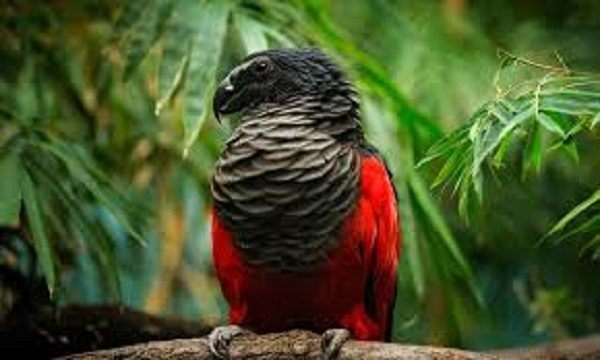
Unfortunately, the decline of the Pesquet's parrot is mainly due to poaching for its beautiful bright red and dark grey feathers which are traditionally used for ceremonial dress. The bird is also killed for meat and captured for the cage bird trade. And habitat loss now has the species listed as vulnerable.
Called the Dracula parrot by some because its plumage resemble that of Count Dracula's black attire and red silk lined cloak, although its call, described as a harsh and ''rasping growl'' in flight, and a "drawn-out scream" mostly at night, may have added to the Dracula reference.
The vulturine parrot is large and heavy, measuring around 20 inches (49 cm) and weighing between of 21-28 oz (600-800 g). It has a short black tail, brown- black breast with grey scalloped feathers, bright red lower underparts and under-wing coverts, and greater and median wing coverts red. The black bill has a vulture's shape and they eyes are a dark reddish brown. While the forepart of the head, around the eyes and beak, have no feathers, the neck feathers are bristled. Males have a red patch behind the eyes which appear to be the only distinction between the male and the female. A pair usually hatch two eggs per breading season.













Comment: Professor Valentina Zharkova explains and confirms why a "Super" Grand Solar Minimum is upon us
See also: