Secret HistoryS


Archaeology

Fifth century mummy found to have human DNA but different anatomy

mummy peru
© Jaime Maussan / Facebook
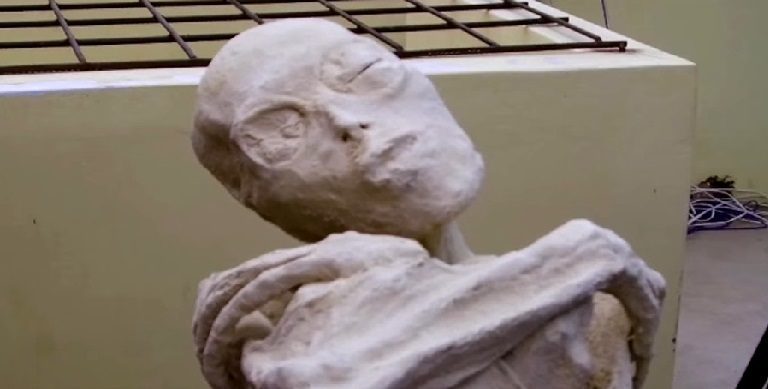
Russian researchers have analyzed tissue samples from one of the mysterious alien creatures uncovered in Peru last year. The mummy, with an elongated skull and only three fingers, has excited ufologists since its discovery.

Preliminary analysis of the tissue samples revealed that the mummy, found in a tomb near the Nazca lines of Peru and named Maria, is a "humanoid being" with 23 pairs of chromosomes - so far, so human. It dates back to about the 5th century AD, a full millennium before Europeans discovered America.

A professor of the National Research University in St. Petersburg, Konstantin Korotkov, and Natalya Zaloznaya, radiologist and specialist in computer tomography at the International Biological Systems Institute, collected the tissue samples in Peru and brought them back to St. Petersburg for analysis.

Magnify

1978: The year today's world was made

Israeli Prime Minister Menahem Begin and National Security Advisor Zbigniew Brzezinski walk in Camp David 09 December 1978
© AFPIsraeli Prime Minister Menahem Begin and National Security Advisor Zbigniew Brzezinski walk in Camp David on 9 December 1978
It was the year of Three Popes, the battle between a dove and a hawk in the US, protests against the Shah of Iran and a fateful error by the UK Labour prime minister. The events of 40 years ago have had a lasting global impact.

On January 1 1978, the world appeared to be a relatively stable place. What could broadly be described as moderate governments held sway in the West. Global economic conditions were improving following the 1973 oil price shock.

There were renewed hopes of Middle East peace.

By the start of 1981 however, the situation had changed dramatically. Détente between East and West was over. Neoliberalism had asserted itself in the US and UK. The economic situation had taken a turn for the worse, with mass unemployment returning to developed countries. The Middle East was again a region of much instability, with a full-scale war between Iraq and Iran.

Cross

Research reveals surprising origins of Middle Ages altarpieces

Kvæfjord church alter piece
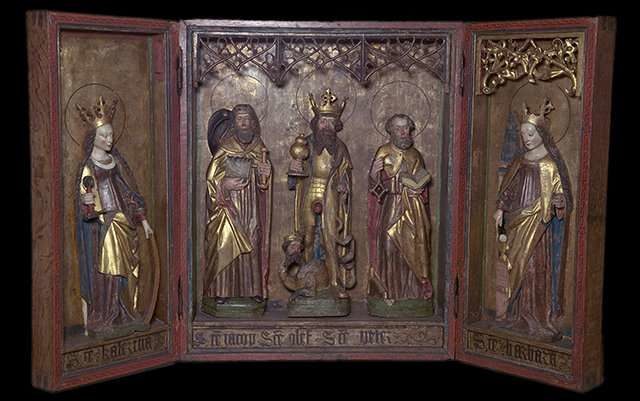
© Museum of Cultural HistoryThis altarpiece is from Kvæfjord church.
It was previously believed that altarpieces from the late Middle Ages were made in Germany. New research shows that several of them were made in Norway.

Altarpieces from the Middle Ages are a feature of many churches along the coast of Norway. They are often called Lübeck altarpieces, because it was assumed that the altarpieces were imported to Norway by the Hanseatics from Lübeck. Kristin Kausland's research shows that the ecclesiastical art is more Norwegian than previously thought. Major parts of the altarpieces were made in Norway, new analyses show.

Kausland is a postdoctoral fellow with the Department of Archaeology, Conservation and History and the first person to earn a Ph.D. in conservation at a Norwegian university. While working on her doctoral thesis, she studied more than 60 altarpieces, most of them in Norway and Germany, but also several in Sweden and Denmark. Some of the altarpieces are in museums, others in churches along the Norwegian coast.

Stormtrooper

Canadian fascists: In solidarity of Ukrainian fascism

Ukrane Fascists
Canada has a reputation for being a relatively progressive state with universal, single-payer health care, various other social benefits, and strict gun laws, similar to many European countries but quite unlike the United States. It has managed to stay out of some American wars, for example, Vietnam and Iraq, portrayed itself as a neutral "peace keeper", pursuing a so-called policy of "multilateralism" and attempting from time to time to keep a little independent distance from the United States.

Behind this veneer of respectability lies a not so attractive reality of elite inattention to the defence of Canadian independence from the United States and intolerance toward the political and syndicalist left. Police repression against communist and left-wing unionists and other dissidents after World War I was widespread. Strong support for appeasement of Nazi Germany, overt or covert sympathy for fascism, especially in Québec, and hatred of the Soviet Union were widespread in Canada during the 1930s. The Liberal prime minister, William Lyon Mackenzie King, hobnobbed with Nazi notables including Adolf Hitler, and thought that his British counterpart Neville Chamberlain had not gone far enough in appeasing Hitlerite Germany. Mackenzie King and many others of the Canadian elite saw communism as a greater threat to Canada than fascism. As in Europe, the Canadian elite—Liberal or Conservative did not matter—was worried by the Spanish civil war (1936-1939). In Québec French public opinion under the influence of the Catholic Church hoped for fascist victory and the eradication of communism. In 1937 a Papal encyclical whipped up the Red Scare amongst French Canadian Catholics. Rejection of Soviet offers of collective security against Hitler was the obverse side of appeasement. The fear of victory over Nazi Germany in alliance with the USSR was greater than the fear of defeat against fascism. Such thoughts were either openly expressed over dinner at the local gentleman's club or kept more discrete by people who did not want to reveal the extent of their sympathy for fascism.

Comment:


Video

'2001: A Space Odyssey': How Kubrick and Clarke saw into the future

Kubrick 2001
© Mary Evans/Everett CollectionA broad slate of top aerospace and computer companies were brought on board as advisers for '2001.'
Now 50 years old, the famously opaque science-fiction classic anticipated flat-screen technology and artificial intelligence (but no, HAL was not a spoof of IBM)

Fifty years ago next month, invitation-only audiences gathered in specially equipped Cinerama theaters in Washington, New York and Los Angeles to preview a widescreen epic that director Stanley Kubrick had been working on for four years. Conceived in collaboration with the science-fiction writer Arthur C. Clarke, 2001: A Space Odyssey was way over budget, and Hollywood rumor held that MGM had essentially bet the studio on the project.

The film's previews were an unmitigated disaster. Its story line encompassed an exceptional temporal sweep, starting with the initial contact between pre-human ape-men and an omnipotent alien civilization and then vaulting forward to later encounters between Homo sapiens and the elusive aliens, represented throughout by the film's iconic metallic-black monolith. Although featuring visual effects of unprecedented realism and power, Kubrick's panoramic journey into space and time made few concessions to viewer understanding. The film was essentially a nonverbal experience. Its first words came only a good half-hour in.

Question

What are some possible locations for the lost continent of Lemuria

lemuria
© Liz Leafloor: Public Domain/Deriv
The Lost Continent of Lemuria or Mu, (used interchangeably) has long lived under the shadow of its more well-known relation, Atlantis. Therefore, it may come as a surprise that for a brief moment in history, Lemuria gained a greater acceptance within the scientific and scholarly community. In fact, Lemuria was not originally an idea originating from the occult world, or from lost Ancient Egyptian sources as was Plato's Atlantis, but from the minds of leading scientific thinkers.

Lemurian Footprints Crossing the Pacific?

In the 19th century, just when Darwin's theory of evolution had achieved widespread acceptance, zoologists and evolutionary biologists observed a curious phenomenon: Across Madagascar, India, and the islands of the Pacific - lands separated by hundreds of miles of impassable oceans - lemurs were encountered.

In the late 1800s, Philip Sclater, an English zoologist and lawyer, was the first to make this observation, and proposed a theory that has since taken on a life of its own. Sclater, in concurrence with many other thinkers of the time, proposed that these landmasses, now separated by oceans, had once been a part of a larger continent in the Indian Ocean, submerged beneath the ocean. Sclater named this hypothetical missing continent 'Lemuria' after the lemur, and the name has stuck since then.

Dig

Excavation reveals ancient society buried disabled children like kings

Sunghir burial
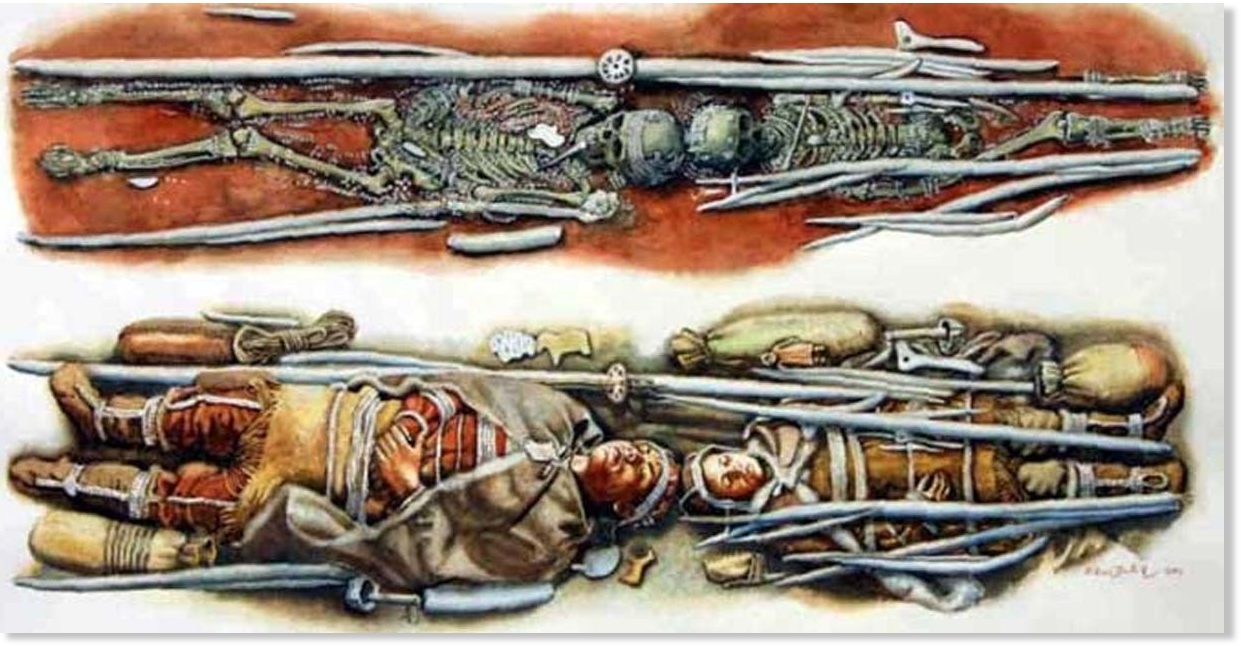
© UnknownThe skeletons and a depiction of what the grave may have originally looked like
About 34,000 years ago, a group of hunters and gatherers buried their dead - including two boys with physical conditions - using the utmost care. However, these dead were buried in fairly different ways, a new study finds.

The roughly 10- and 12-year-old boys were buried head to head in a long, slender grave filled with riches, including more than 10,000 mammoth ivory beads, more than 20 armbands, about 300 pierced fox teeth, 16 ivory mammoth spears, carved artwork, deer antlers and two human fibulas (calf bones) laid across the boys' chests, the researchers said.

In contrast, the remains of a roughly 40-year-old man, an individual who would have had more time and physical ability to contribute to the group, had far fewer treasures: about 3,000 mammoth ivory beads, 12 pierced fox canines, 25 mammoth ivory arm bands and a stone pendant.

"From the point of view of the mortuary behavior, the burial of the adult is, in fact, very different from the burial of the children," study co-lead researcher Erik Trinkaus, a professor of anthropology at Washington University in St. Louis, told Live Science.

Boat

Primeval navigation indicates language began 1.5M years earlier than thought

Female Homo-floresiensis
© CC by 4.0Reconstruction-of-female-Homo-floresiensis
Were our primeval ancestors skilled mariners who sailed thousand of miles to distant islands using language, or did they grunt at each other while holding onto tree trunks being blown randomly on the waves of tsunamis? That is the big question!

Having emerged in Africa more than 1.8 million years ago, Homo erectus fossils discovered as far afield as China, Indonesia and Southern Europe tell us it was the first archaic human to leave the continent. Some scientists even believe that the little hominid Homo floresiensis, discovered on the island of Flores in 2003, could be descended from H. erectus, but others fiercely disagree.

Revitalizing winds have been blown into the glowing embers of this centuries long debate after Daniel Everett, professor of global studies at Bentley University and author of How Language Began, addressed a meeting of the American Association for the Advancement of Science in Austin, saying of Erectus. "He travelled all over the world, travelled to the island of Flores, across one of the greatest ocean currents in the world," as was reported in Archeology New Network .

Further antagonizing the old brigade Everett continued, "They sailed to the island of Crete and various other islands. It was intentional: they needed craft and they needed to take groups of twenty or so at least to get to those places." Accepting that 200,000 year old primates developed sea going vessels and had developed what must have been advanced sailing skills, one must also assume that they also had language. And this is where things get controversial.

X

Bayeux revisited: A tale of medieval art and Victorian censorship (VIDEO)

bayeux tapestry
Regional museums: a delightful hotch-potch, a veritable Granny's-Front-Room with accompanying cafe, shop and starry-eyed curator.

We pottered off to Reading Museum: a random outpouring of stories old and quaint. It is a Regional Curator's task to put the beloved claptrap of centuries into context.

On the first floor, one exhibit dominates all the others; and this is its story.

Allow me to transport you back to the nineteenth century, the heyday of florid romanticism, when Tennyson was altering the historical evidence with every line of poetry he wrote and Dickens was keepin' it real.

William Morris was at the centre of a craft revolution: 1861 saw the opening of his epoch-making firm Morris, Marshall, Faulkner & Co, which among many fortes boasted the design of tapestries. The influence of the mediaeval was strong here: much as Tennyson adored the ancient stories, Morris borrowed and created a 19th century interpretation of mediaeval times.

Comment: The above mentioned censorship was made into a short 3 minute video by the BBC.
Why did Victorians censor the Bayeux Tapestry

Bayeux Tapestry nudity censored by Victorian English

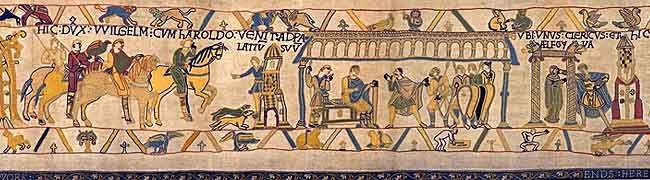
There's a copy of the Bayeux Tapestry in Reading, Berkshire.

But why did the Victorians who made the copy of the famous French tapestry censor it?

This video was inspired by the BBC series Civilisations. Video journalist: Adam Paylor


It seems that all too frequently our understanding of the past is thrown into disarray when curious artefacts are discovered that don't fit our expectations of life at the time. Mainstream historians admit that we're very much in the dark about how life was for people in the middle ages - aka the dark ages - but there are pieces of evidence here and there that demonstrate that while they were able to create masterful works, whether they be the great feats of engineering and art seen in the cathedrals of Europe or the eras painters and poets, for some at least, they were also a people in touch with the wonder of life all the while also allowing space for humour and fun.

It appears we have lost not only the skills of that time but also that sense of self - censored in the Victorian era only to become a caricature in our own.


What else in history has been censored to appease the norms of the time or distorted for purposes of propaganda, and serving to disconnect us from our heritage.

See Also:


Dig

Archaeologists discover Roman military commander's sprawling residence beneath subway system

Roman military commander's home in Rome
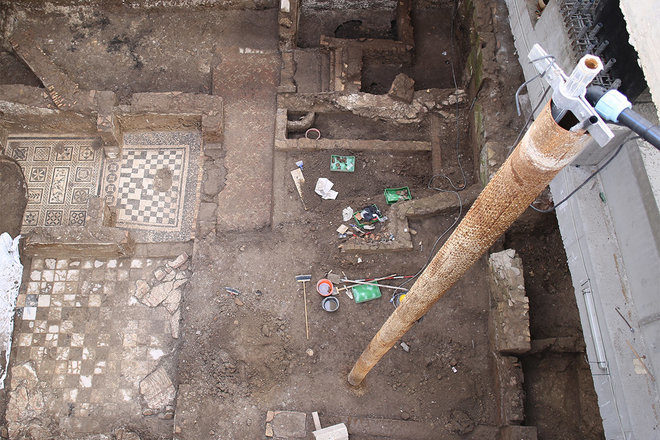
© Ministero Dei Beni E Delle Attività Culturali Del TurismoInside the military commander's house, archaeologists found the remains of mosaic floors made with white marble and grey slate. Many of the mosaics were decorated with geometric patterns.
Archaeologists in Rome have discovered the remains of a sprawling residence of a Roman military commander dating back 1,900 years and holding several rooms covered in ornate mosaic floors with geometric patterns, along with pools and fountains.

They discovered the "domus" about 40 feet (12 meters) underground during construction work to expand the Metro C line of Rome's subway system, a team of archaeologists from Rome's Superintendency for Archaeology announced recently.

The commander's residence was uncovered alongside the remains of a military barracks used by Roman soldiers that was discovered in 2016 during this same subway construction.