Secret HistoryS


Bulb

The metric system: Child of the French Revolution

France metric system
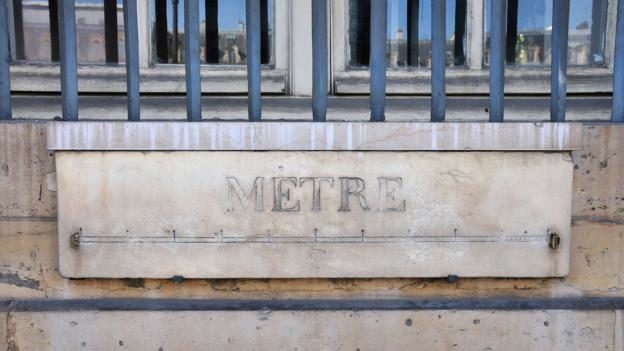
© PjrTravel/AlamyOne of the last remaining 'mètre étalons', or standard metre bars, can be found below a ground-floor window on the Ministry of Justice in Paris
It is one of the most important developments in human history, affecting everything from engineering to international trade to political systems.

On the facade of the Ministry of Justice in Paris, just below a ground-floor window, is a marble shelf engraved with a horizontal line and the word 'MÈTRE'. It is hardly noticeable in the grand Place Vendôme: in fact, out of all the tourists in the square, I was the only person to stop and consider it. But this shelf is one of the last remaining 'mètre étalons' (standard metre bars) that were placed all over the city more than 200 years ago in an attempt to introduce a new, universal system of measurement. And it is just one of many sites in Paris that point to the long and fascinating history of the metric system.

"Measurement is one of the most banal and ordinary things, but it's actually the things we take for granted that are the most interesting and have such contentious histories," said Dr Ken Alder, history professor at Northwestern University and author of The Measure of All Things, a book about the creation of the metre.

Dig

Love birds? Mysterious Egyptian 'love spell' deciphered after 1,300 years

egypt love spell
© Twitter: LiveScience
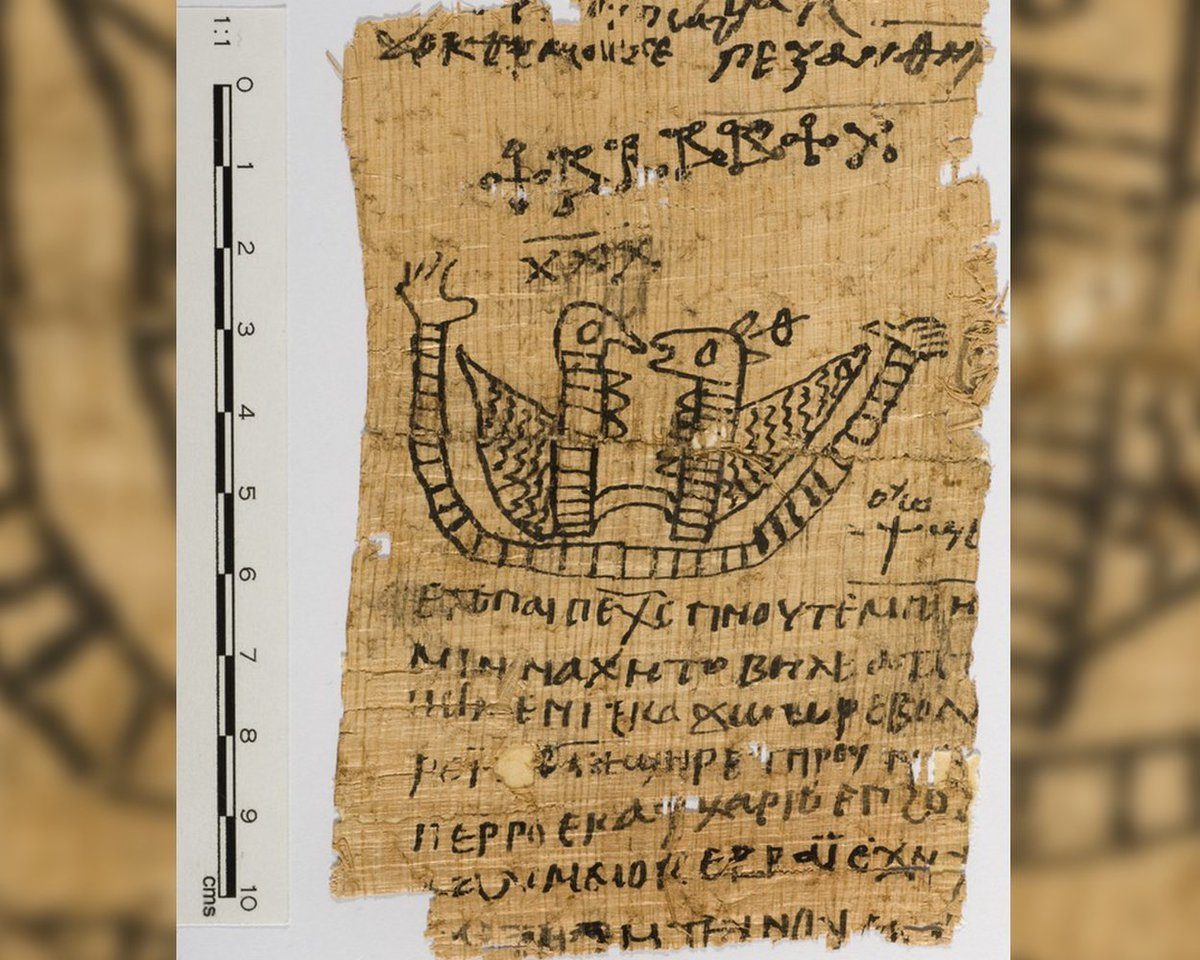
An ancient Egyptian papyrus, depicting bird-like creatures connected via what appears to be a phallus, has been deciphered after 1,300 years, revealing what researchers say is likely an incantation or magic 'love' spell.

"The most striking feature of [the papyrus] is its image,"said Dr Korshi Dosoo, of Julius Maximilians Universitaet of Wuerzburg in Germany, who has published the papyrus in the Journal of Coptic Studies.

The scroll, which dates back to the Christian period of Egypt's history, depicts an image of two winged-creatures, one with its beak in the others' mouth, bound by what could be a chain, bond or possibly a penis, and with feathers or scales on the front of their bodies.

"From an observer point of view, we could say that the image might have enhanced the performative aspect of the spell - the client might find the weird drawings an impressive addition to the overall atmosphere and impression created by the ritual," Dosoo adds.

Comment: See also:


Archaeology

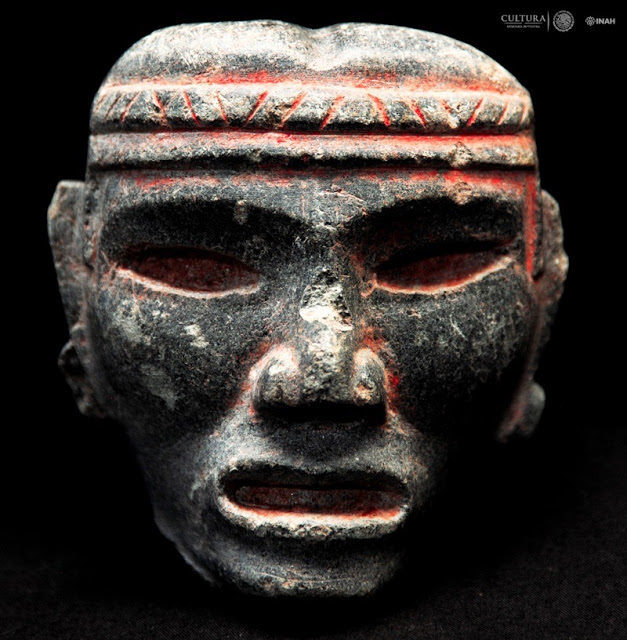
New finds reveal Mayan elite lived in Teotihuacan, "City of the Gods" - 1000km from center of civilization

Mayan mask Teotihuacán
© Mauricio Marat, INAH
A team of archaeologists has uncovered evidence indicating that Mayan elites lived in the pre-Hispanic city of Teotihuacán, located northeast of Mexico City more than 1,000 kilometers from the center of their civilization.

The National Institute of Anthropology and History (INAH) said in a statement that the remains of a Mayan-style mural and offering as well as fragments of Mayan ceramics and bones of thousands of sacrificed people were found in the Plaza of the Columns, which is positioned between the Pyramids of the Sun and Moon.

The discoveries confirm the existence of a relationship between the Mayan and Teotihuacán civilizations, which were geographically separated by 1,300 kilometers, INAH said.

The project to explore the site began four years ago under the supervision of Saburo Sugiyama, Verónica Ortega Cabrera, Nawa Sugiyama and William Fash.

Comment: See also:


Sherlock

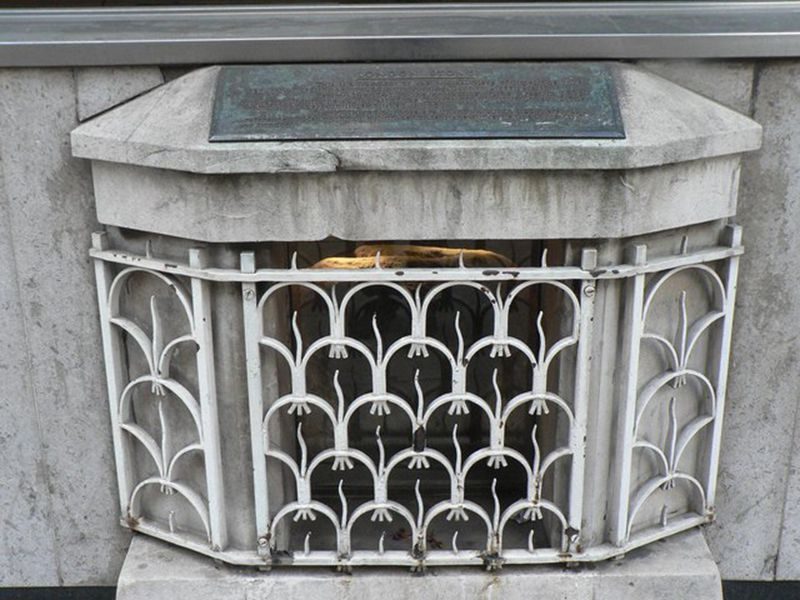
London's storied 'Lucky Stone' - referenced by Shakespeare, Blake and others, set to return to rightful place

London stone lucky
© Wikimedia CommonsLondon Stone sat largely unnoticed behind this iron grill for roughly 50 years
There are a host of theories surrounding the origins of the London Stone-an unassuming, nearly two-foot wide chunk of limestone that's been linked for centuries with the changing fortunes of England's capital city. Is it a remnant of a Roman monument? An ancient altar employed in Druidic human sacrifice? Or could it even be the stone that yielded King Arthur's legendary Excalibur?

Despite all of the enigma surrounding it, the London Stone has lived a relatively quiet life in recent years; as the Guardian's Charlotte Higgins reports, it has been nestled behind a protective iron grill on a Cannon Street building (which was, in various incarnations, a Bank of China office, a sporting goods store and, most recently, the stationery chain WHSmith) since 1962. In 2016, ongoing construction forced authorities to temporarily move the stone to the Museum of London, but as Mark Brown reports for a separate Guardian story, the historic block of limestone is now set to return to 111 Cannon Street on October 4.

Info

Roman-era painted tomb unearthed in Jordan

Ancient Painting
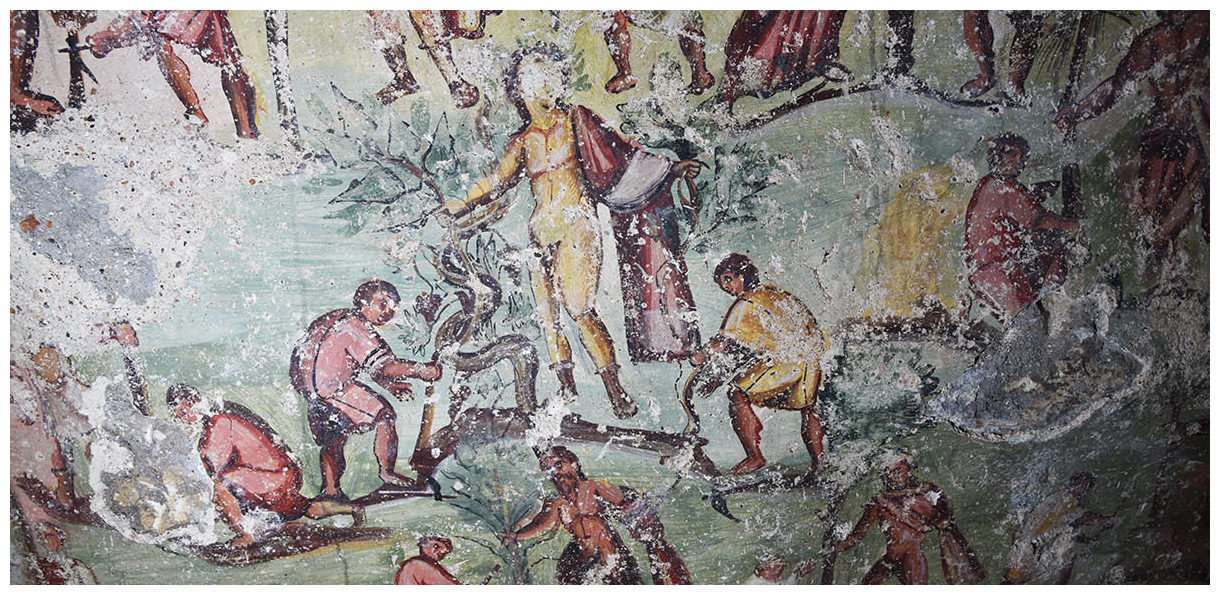
© Julien ALIQUOT/HiSoMA 2018 ShareThe clearing of the site of Capitolias, with the assistance of Dionysos and other gods.
In northern Jordan, a Roman-era painted tomb has been unearthed by the Department of Antiquities. An extraordinary document of religious, political, and social history that three historians and epigraphists have had an opportunity to examine, and are striving to interpret.

The archaeologists cannot bless roadwork enough. Especially in Jordan. It's just that certain thrusts of the mechanical shovel, such as the one in late 2016 at the school entrance in the village of Bayt Ras, in the north of the country, have a knack for unearthing secrets from the depths of the past. In the present case, it is a Roman tomb that was dug into the side of a hill, and whose existence was just revealed by the Department of Antiquities of Jordan, after securing access to the site.

"This tomb, which consists of two funerary chambers and contains a very large basalt sarcophagus, is in an excellent state of conservation, even though it appears to have already been 'visited.' It is part of a necropolis located to the east of an imposing theater that was recently unearthed," says with enthusiasm Julien Aliquot, one of the three researchers from the research unit Histoire et sources des mondes antiques (HiSoMA),1 which had investigated this hypogeum in the spring of 2017 and 2018, as part of two on-site surveys. "The tomb is located on the site of the ancient city of Capitolias, which was founded in the late first century CE, and was part of the Decapolis, a region that brought together Hellenized cities (provided with Greek-style institutions but belonging to the Roman Empire) in the southeastern area of the Near East, between Damascus and Amman."

Book

New book gathers high-level testimony that CIA/NSA actively prevented sharing of intel that would stop 9/11

watchdogs didn't bark
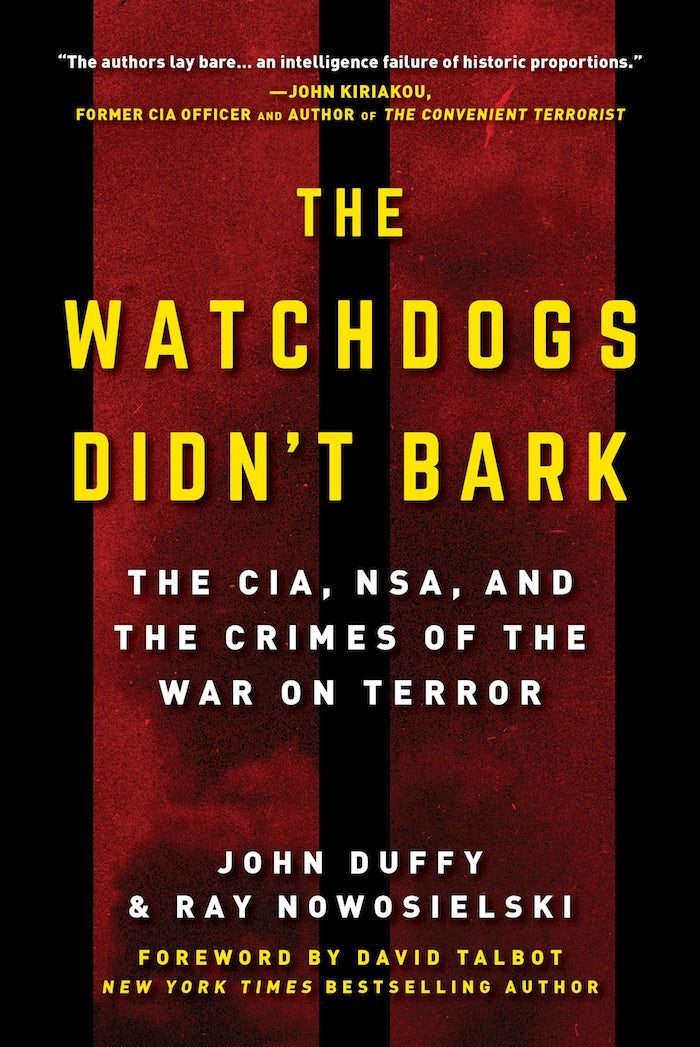
The book The Watchdogs Didn't Bark by John Duffy and Ray Nowosielski, with new insider interviews and documentary evidence, convincingly establishes that named people at the CIA and NSA actively prevented the FBI from learning information that could have disrupted the 9/11 plot. Principals at these agencies manipulated government investigations to cover up responsibility, and to exploit the public's fear after 9/11 in order to justify the so-called 'war on terror', the Iraq invasion, torture, the NSA's massive warrantless domestic spying programs, indefinite detention and extrajudicial killing even of Americans. The authors don't claim to have proved that US government officials deliberately allowed or facilitated the 9/11 plot, but that's what the actions and inactions of key people accomplished, and the Establishment has rewarded their incompetence or criminality. The authors quote Stafford Beer: "The purpose of a system is what it does." While 'serendipity' for the Military-Industrial Complex may be in the range of theoretical possibility, official responsibility for 9/11 and its evil consequences remains an urgent issue for the People of the US and the world, along with establishing effective public oversight of government and elite power.

This case has been made effectively by others*, but the Duffy-Nowosielski Watchdogs book is significant, as it's the kind of book that 'serious people' take seriously. So seriously, that when the authors posted their Richard Clarke video "Interview #7" in 2011, DCI George Tenet, CTC Director Cofer Black and CIA Alec Station (Bin Laden Unit) Chief Rich Blee released a joint public statement denying Clarke's shocking allegations - that they had been running an illegal domestic CIA spy operation with Saudi help. So seriously, in fact, that the CIA threatened the authors with criminal prosecution if they revealed some of the names in this book (7-9, 239-245). Other journalists have declined to name these public officials, while reporting on their criminal involvement.

Attention

Dalai Lama's recent remarks on migrants follow a CIA, Nazi and slavery-linked history

Tibetans
© unknownTibetans celebrating Serfs Emancipation Day.
This past week the 14th Dalai Lama, Tibet's 83-year old self-declared spiritual leader in exile, made controversial remarks at a press conference in Malmö recognizing the 80th anniversary of the founding of Individual Humanitarian Aid, a Swedish development and philanthropic assistance program that took in Buddhist refugees after the Chinese annexed Tibet in 1959. His comments came as he addressed the European migrant crisis and his choice of words immediately sparked criticism because they seemed to express an attitude typically shared by the European Union's far right. With the exception of his detractors, the views he expressed to most were unexpected coming from a monk known for preaching enlightenment and inner peace around the globe. "His Holiness", AKA Tenzin Gyatso, stated:
"Recently large numbers of refugees, many from the Middle East, have fled to Europe in fear for their lives. They have been given shelter and support, but the long-term solution should include providing training and education, particularly for their children, so they can return to rebuild their own countries when peace has been restored.I think Europe belongs to the Europeans. ... Receive them, help them, educate them ... but ultimately they should develop their own country."

Briefcase

The Skripal Saga's prequel: Britain investigates 'the Great Forgery' of 1924

Grigory Zinoviev
© RIA NovostiGrigory Zinoviev
The publication of the book of the famous British archivist and historian Gill Bennett The Zinoviev Letter: The Conspiracy That Never Dies became a noticeable event in the West. Practically all major newspapers responded with reviews. And this is understandable: firstly, Bennett is a world-wide recognised specialist on the investigation into one of the most loud scandals in the history of Britain; secondly, in the current conditions of anti-Russian sanctions and noise apropos "fake news", a reminder about a similar plot from the 1920's is more than actual.

In October, 1924 the so-called Zinoviev Letter (or "red letter", as it was christened back then in the English press) indeed shook the foundations of British society and directly affected the results of parliamentary elections, as a result of which the first government of Labourists was disbanded.

The letter represented an instruction to British communists from the head of Comintern Grigory Zinoviev, the Scottish communist Arthur McManus, and the leader of the Finnish labor movement Otto Kuusinen. The letter speaks about the need to "hype up the inert mass of the British proletariat", organise sabotage in England, and start preparation for the creation of the "red army" for the purpose of beginning a "class war" both in Britain and in its colonies. And all of this for the sake of "exposing the foreign policy" of the Labour government of Ramsey McDonald and forcing him to ratify the trade agreements that were already signed by Moscow and London.

Comment: The "red letter ploy appears to have its U.S. counterpart.

'Golden Showers': Repeat of 1924 Zinoviev letters that damaged UK Labour party?


Gold Coins

Unique medieval Venetian coin found in abandoned Swedish port intrigues scientists

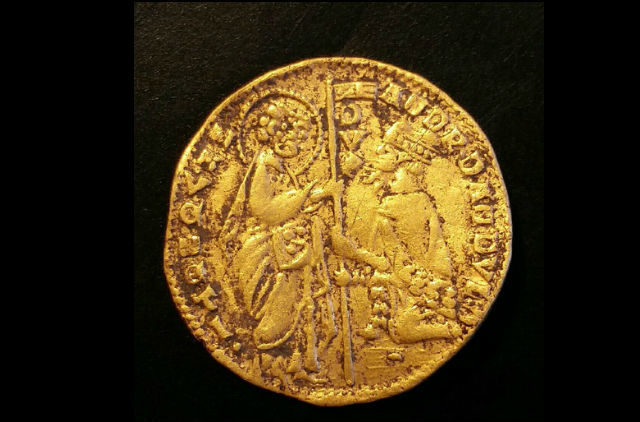
The ducat shows St Marcus passing over a standard to the doge Andrea Dandalos.
© Blekinge MuseumThe ducat shows St Marcus passing over a standard to the doge Andrea Dandalos.
Archaeologists in Sweden have discovered a gold ducat from early medieval Venice in Elleholm, a once thriving port that has now entirely disappeared.

The ducat was minted during the reign of Doge Andrea Dandalos, who ruled the powerful Italian city state from 1343 to 1354.

"To find the first coin ever found in Sweden from the medieval Venice here, suggests it was an international trading port," Marcus Sandekjer, head of Blekinge Museum, told The Local.

The Archbishop of Lund controlled the city from 1450 right up until the reformation in 1536, when it was passed to the Swedish crown.

"Of course when you find coins from Italy in the Archbishop's city, it's tempting to think that it has something to do with ties to Italy and to the Pope," Sandekjer said. "But that is just a hypothesis."

Comment: It's finds like these that remind us of how much we have yet to learn about the medieval world:


Info

Fossil found in Russia closes case on mystery of "world's oldest creature"

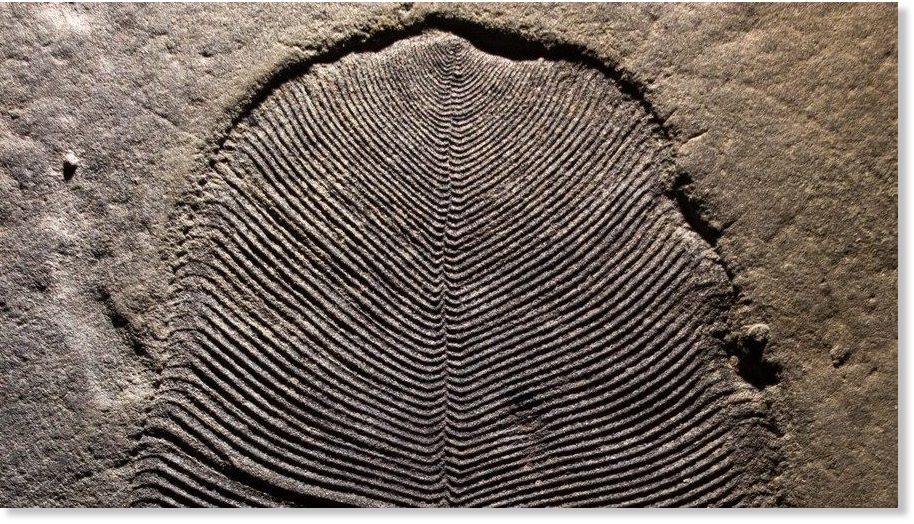
A Dickinsonia fossil
© ANUA Dickinsonia fossil
The decades-long mystery surrounding a creature that lived on Earth over half a billion years ago has finally been settled, thanks to fossils found in Russia which are so well preserved they still contain fat molecules.

The true identity of the Dickinsonia fossils has been the center of a heated debate since it was first described in 1947. The 558 million-year-old animal is unlike any we have on Earth today - it's up to 1.4 meters (4.6ft) in length, is flat, oval in shape, and ribbed.

Over the years, scientists have put forward arguments that the creature is a form of jellyfish, bacteria, worm, mushroom, coral, algae - and the list goes on. But the recent discovery of cholesterol in a Dickinsonia fossil determined that the creature is most definitely an animal.