Secret HistoryS


Boat

Shipwreck of Australian coast reveals shipbuilding secrets of 17th-century Dutch seafaring domination

batavia shipwreck australia Dutch East India company
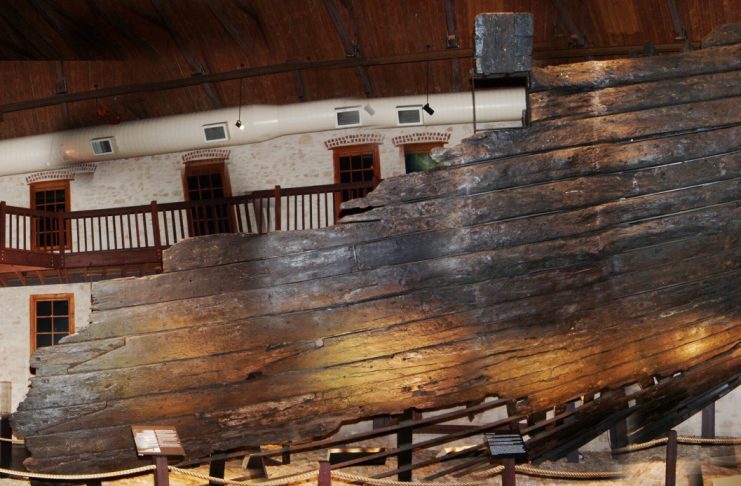
© Patrick E. Baker, Western Australian MuseumThe national heritage listed shipwreck, Batavia
Many Dutch ships passed the West Australian coast whilst travelling to Southeast Asia in the 1600s - and the national heritage listed shipwreck, Batavia, has revealed through its timbers the history of the shipbuilding materials that enabled Dutch East India Company (VOC) to flourish against major European rivals for the first time.

Built in Amsterdam in 1626-1628 and wrecked on its maiden voyage in June 1629 on Morning Reef off Beacon Island (Houtman Abrolhos Archipelago), Batavia epitomises Dutch East India (VOC) shipbuilding at its finest in a Golden Age, experts reveal in a study led by Flinders University archaeologist Associate Professor Wendy van Duivenvoorde with co-authors, Associate Professor and ERC grantee Aoife Daly at the University of Copenhagen and Marta Domínguez-Delmás, Research Associate and VENI Fellow at the University of Amsterdam.

Attention

Climate change fueled witch hunts....Then and now

Witch Burns
© Landover Baptist Church
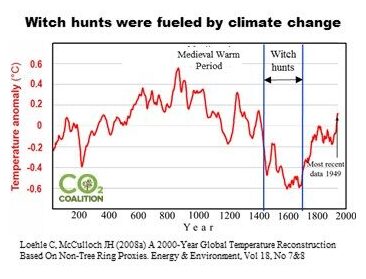
European witch hunts of the 15th to 17th centuries targeted witches that were thought to be responsible for epidemics and crop failures related to declining temperatures of the Little Ice Age. A belief that evil humans were negatively affecting the climate and weather patterns was the "consensus" opinion of that time. How eerily similar is that notion to the the current oft-repeated mantra that Man's actions are controlling the climate and leading to catastrophic consequences?

Inquisitor Kramer
© CO2 Coalition
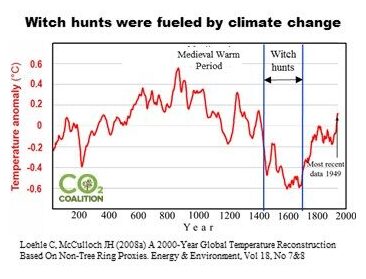
The first extensive European witch hunts coincided with plunging temperatures as the continent transitioned away from the beneficial warmth of the Medieval Warm Period (850 to 1250 AD). Increasing cold that began in the 13th century ushered in nearly five centuries of advancing mountain glaciers and prolonged periods of rainy or cool weather. This time of naturally-driven climate change was accompanied by crop failure, hunger, rising prices, epidemics and mass depopulation.
Climate Change Witch Hunts
© CO2 Coalition
Large systematic witch hunts began in the 1430s and were advanced later in the century by an Alsatian Dominican friar and papal Inquisitor named Heinrich Kramer. At Kramer's urging, Pope Innocence VIII issued an encyclical enshrining the persecution and eradication of weather-changing witches through this papal edict. The worst of the Inquisition's abuses and later systemic witch hunts were, in part, empowered by this decree.

This initial period of cooler temperatures and failing crops continued through the first couple of decades of the 16th century, when a slight warming was accompanied by improvements in harvests. Clearly, the pogrom against the weather-changing witches had been successful!

Unfortunately for the people of the Late Middle Ages, the forty years or so of slight warming gave ground to a more severe bout of cooling. The summer of 1560 brought a return of coldness and wetness that led to severe decline in harvest, crop failure and increases in infant mortality and epidemics. Bear in mind that this was an agrarian subsistence culture, nearly totally dependent on the yearly harvest to survive. One bad harvest could be tolerated, but back-to-back failures would cause horrific consequences, and indeed they did.

Archaeology

Domestic horses' mysterious origins may finally be revealed

mongolian horses
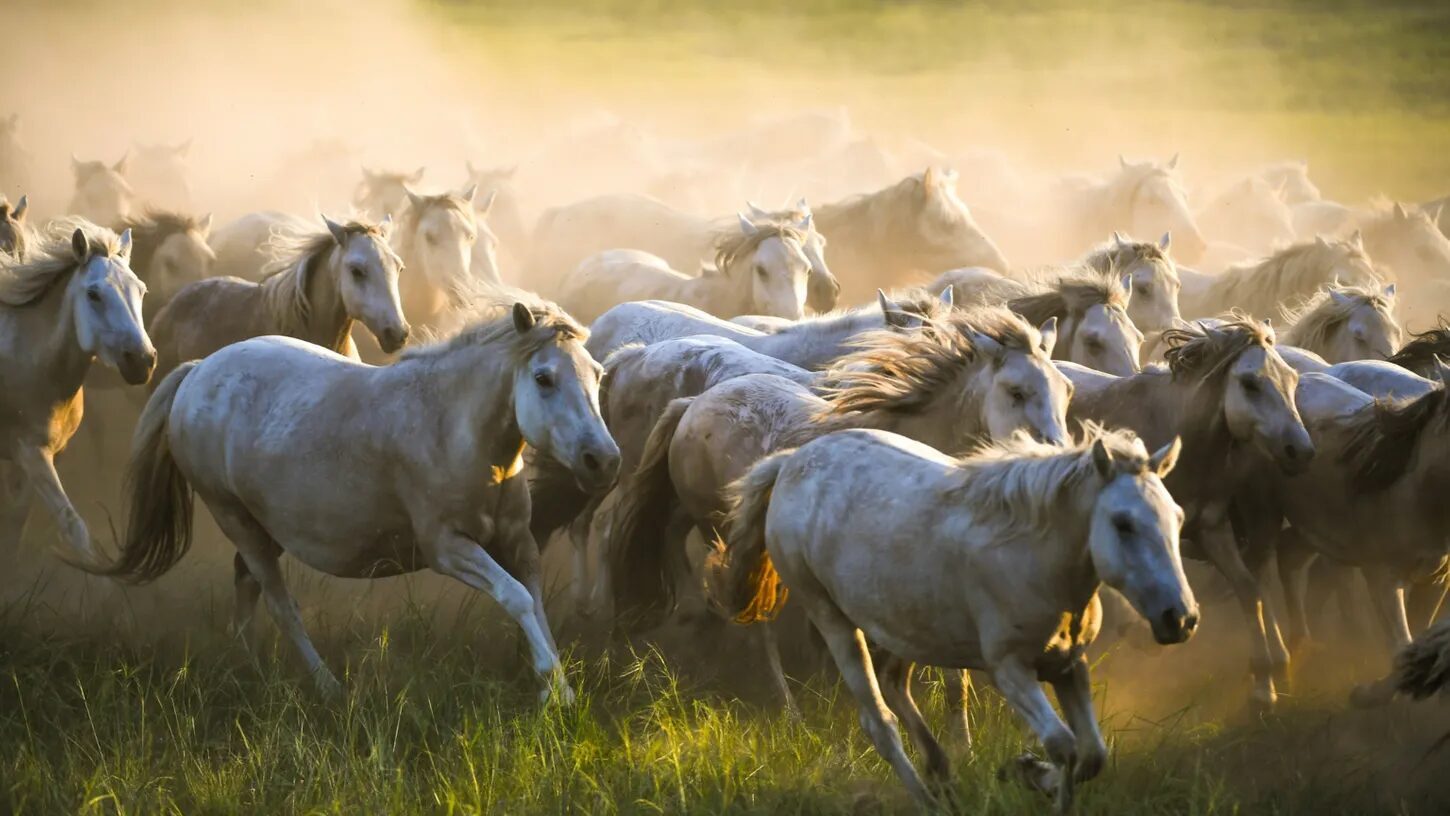
© Peng Yuan/Xinhua via GettyHorses gallop during a cultural demonstration at a breeding center in West Ujimqin Banner in Inner Mongolia.
4,200 years ago, horseback riding allowed people to travel farther and faster than ever before, spurring migration throughout Europe and Asia.

For thousands of years, horses have played critical roles in human societies around the world. These equines helped early farmers plow their fields, transported people farther and faster, and gave warriors a competitive edge in battle. But experts have long puzzled over the deceptively simple question of where domestic horses actually came from.

It took a two-continent collaboration among over a hundred scientists to home in on the answer: southern Russia.

The discovery provides strong evidence that of three main locations in contention — Anatolia, Iberia, and western Eurasian steppes — the last is likely the birthplace of modern domestic horses, Equus caballus.

Blue Planet

Vikings beat Portugal to the Azores, new study reveals

Viking
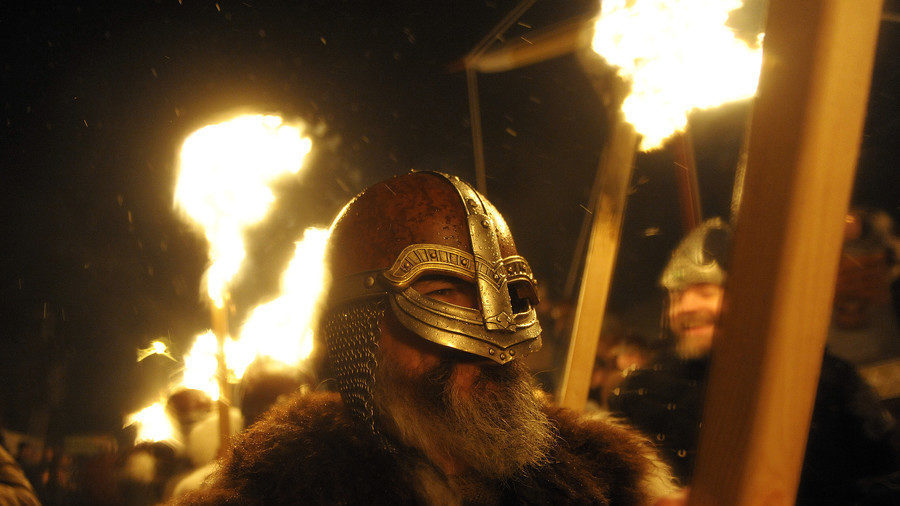
© AFP / Andy BuchananExperts now believe they settled in the Azores between 700 and 850 AD.
They came from the land of the ice and snow and the midnight sun - but still ended up in some balmy destinations. This is the conclusion of researchers who have discovered evidence to support the idea that the Vikings settled on the clement shores of the Azores several hundred years before the Portuguese arrived in 1427.

Given that the Vikings are usually associated with the frozen north, the claim is startling. Nevertheless, it is based on solid science, says a group of international researchers who recently analysed lakebed sediments in the Azores, an archipelago in the mid-Atlantic.

These were found to be rich in organic compounds that are found in cow and sheep faeces. At the same time, these samples were also found to contain high levels of charcoal but were low in pollen from native trees.

Comment: This comes on the heels of another discovery showing that the Vikings were 'the first' to (re)discover the New World of North America: Vikings present in North America in 1021 C.E., new dating in Newfoundland suggests

Note that the Azores are believed to have been inhabited by another group of people long before the Vikings: Drone finds lost tomb with 72 ancient skeletons from extinct Canary Islands civilization


Robot

Pierre Teilhard de Chardin's Transhumanism and the Cult of the Fourth Industrial Revolution

Chardin
© Editorials 360/Wikimedia Commons/French Jesuit Archives/KJNPierre Teilhard de Chardin: "The Human species will be on the threshold of a new kind of existence. It will at last be consciously fulfilling its real destiny."
While Chardin is certainly a racist, in his defense he believed in vastly expanding eugenics for all races, and called for employing the best of science to improve the human gene pool, Matthew Ehret writes.

As we approach the long-awaited COP26 summit in the UK, one gets a sense of a creepy cultish mode of speaking among some of the top echelons of imperial thinkers setting the cultural tone for the proceedings which profess to profoundly transform a new epoch in human history. World Economic Forum shining stars like Yuval Harari, Klaus Schwab, and Ray Kurzweil speak giddily about an impending evolutionary shift where human society will become something more than human.

Renowned futurist and lead Google Engineer Ray Kurzweil gave this moment of bifurcation a name: "The Singularity". In 2005, he described this moment saying:
"Our version 1.0 biological bodies are likewise frail and subject to a myriad of failure modes... The Singularity will allow us to transcend these limitations of our biological bodies and brains... The Singularity will represent the culmination of the merger of our biological thinking and existence with our technology, resulting in a world that is still human but that transcends our biological roots. There will be no distinction, post-Singularity, between human and machine or between physical and virtual reality."
Kurzweil and Harari even predicted the date 2050 to be the magical moment which the new age of human-machine unification will be consolidated, as artificial intelligence, bio-engineering babies with CRISPR technology, and interfacing our brains with microchips in the 'internet of things' will finally see the birth of a new species.

Blue Planet

Relationship between the Olmec and Mayan cultures revealed by similarities of ceremonial centres

Aguada Fénix
© Professor Takeshi InomataAguada Fénix
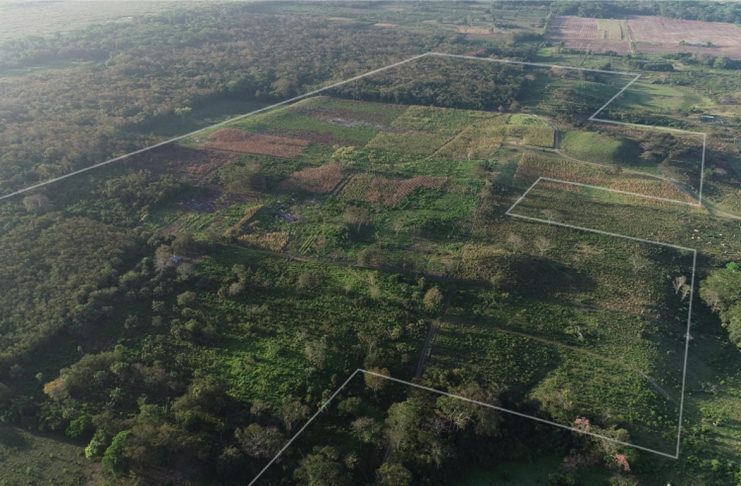
A study using laser mapping technology or LiDAR in the states of Veracruz and Tabasco could transform our notions about the origins of Mesoamerican civilisations.

The study published in the journal Nature Human Behaviour, authorised by the National Institute of Anthropology and History (INAH), in collaboration with the School of Anthropology from the University of Arizona has used Lidar to examine an area of 85 thousand square kilometres.

The LiDAR data has revealed 478 ceremonial centres that date from around 1100 and 400 BC, prior to the apogee of the Mayan civilisation in the Classic period (250 - 950 AD).

Comment: See also: And check out SOTT radio's:


Star of David

Why Israeli fascists are more honest than liberal Zionists

Damascus Gate gathering
© Amir Levy/Getty ImagesIsraelis near Damascus Gate • June 15, 2021
The Palestinian citizens of Israel "are here by mistake — because Ben-Gurion didn't finish the job and throw you out in 1948."

That was the latest rant this week from fascist Israeli lawmaker, Bezalel Smotrich, in Israel's parliament. Speaking from the Knesset podium, Smotrich was attacking Palestinian lawmakers from the Joint List. He accused them of being "enemies" and "terror supporters."

Speaking out on Twitter, Joint List lawmaker, Aida Touma-Sliman, explained how "we are putting up with this filthy fascism every day at the Knesset." She appealed in Hebrew for Israelis to
"think about how every Arab citizen in Israel feels when such things are said offhandedly in parliament, how a young Arab feels when the right threatens to start a second Nakba."
Touma-Sliman's appeal to reason is unlikely to meet a receptive audience in Israel. All the Zionist parties are united in opposing Palestinian equality with Israeli Jews. Israel is, after all, "the Jewish State" — in other words, it is a sectarian, ethno-nationalist settler-colony. In both law and in practice, it systematically discriminates against the Palestinians, the indigenous population of Palestine.


Info

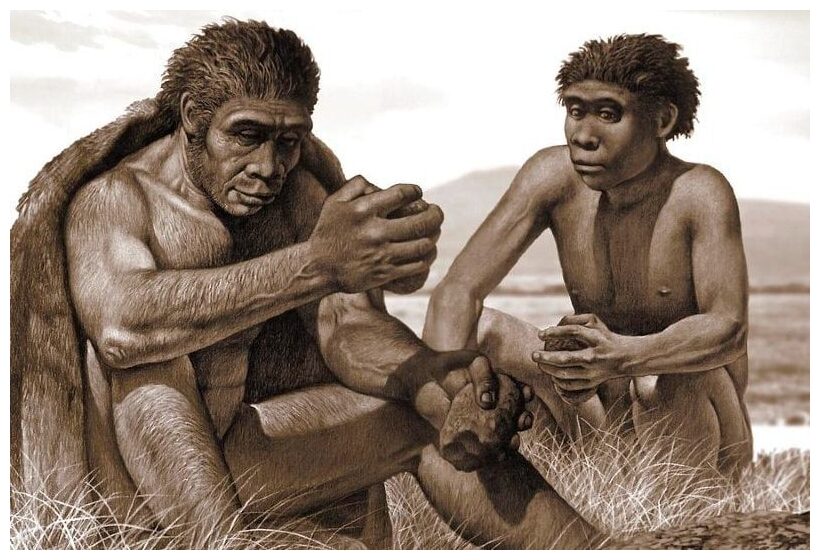
New study suggest Homo Bodoensis may be the ancestor of modern humans

Homo Bodoensis
© Oggito
Although modern humans are the only surviving human lineages, their kinship with other human species that roamed the world is still controversial. Scientists have now identified a new species that could be the ancestor of modern humans.

In a newly published study, scientists describe H. bodoensis as a new species and suggest it as the ancestor of Homo sapiens.

Researchers examined human fossils dating from around 774,000 to 129,000 years ago in the latest study (once known as the Middle Pleistocene and now renamed the Chibanian). Previous research claimed that modern humans evolved in Africa around this period, whereas Neanderthals arose in Eurasia. However, much about this pivotal period in human development remains unknown - a situation paleoanthropologists refer to as "the mess in the middle."

Human fossils from the Chibanian period from Africa and Eurasia are frequently attributed to one of two species: Homo heidelbergensis or Homo rhodesiensis. However, these species frequently held variously and frequently conflicting, descriptions of their skeletal features and other attributes.

Recent DNA research has indicated that certain H. heidelbergensis bones discovered in Europe were really from early Neanderthals. As a result, the scientists recognized that H. heidelbergensis was a redundant designation in such circumstances.

SOTT Logo Radio

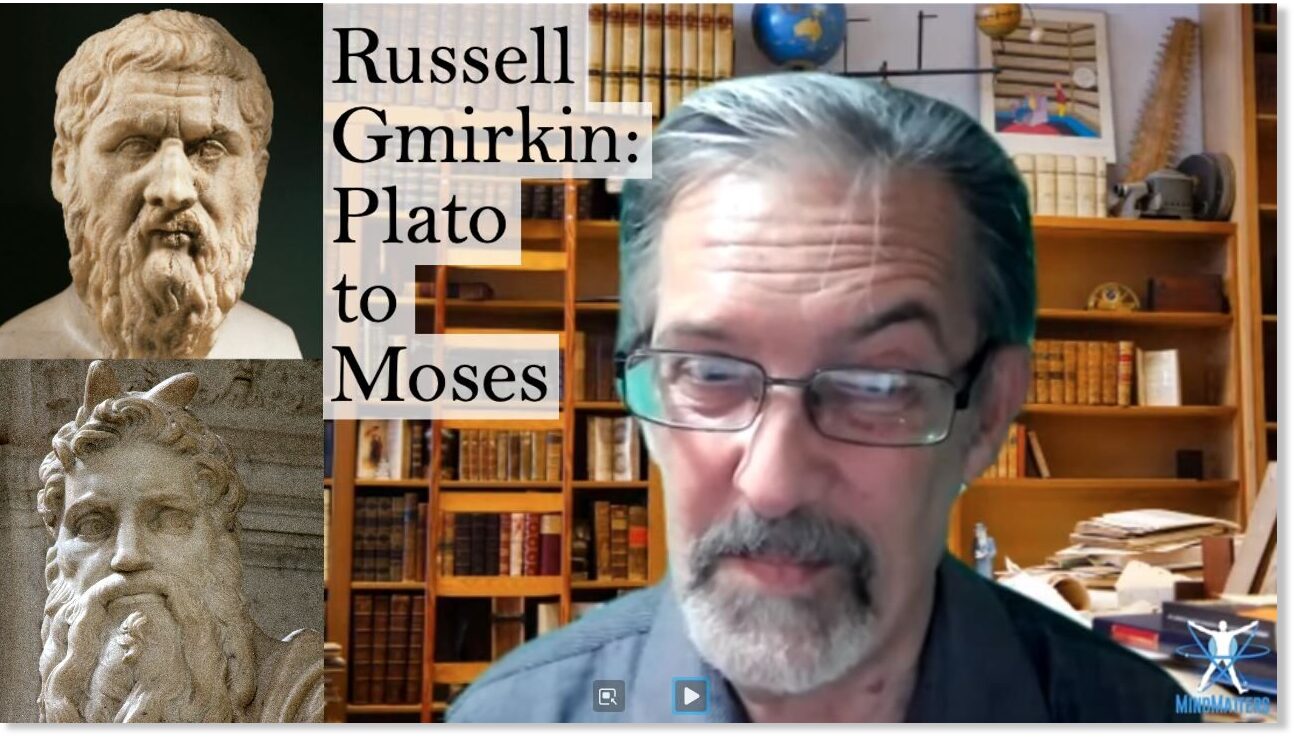
SOTT Focus: MindMatters: Plato All the Way Down: Solving Biblical Mysteries with Russell Gmirkin

gmirkin
What happens when you combine the investigative mentation of Sherlock Holmes with the adventurous spirit Indiana Jones? Join MindMatters today as we find out! We are joined by solver of mysteries and detective of antiquities Russell Gmirkin, author of two groundbreaking books on the composition of the Old Testament, and another soon to be published. In his first book, Russell boldly argued that the Old Testament is a Hellenistic book, composed in the early third century BC. In his second, he showed the reliance of the biblical laws on Plato's. His next, titled Plato's Timaeus and the Biblical Creation Accounts: Cosmic Monotheism and Terrestrial Polytheism in the Primordial History, will show the reliance of the Genesis creation accounts on Timaeus and Critias.

Join us as we talk about all these topics, plus forays into Russell's academic papers on the Dead Sea Scrolls, the historical basis for King Solomon, and the documentary hypothesis, as well as the roots of Western civilization and what it was like to be the son of the closest thing the CIA had to a James Bond. All this and more on this episode of MindMatters.

Running Time: 01:34:25

Download: MP3 — 86.4 MB


Comet 2

Best of the Web: 536 AD, the year the sky went dark

moon eclipse
© NASA/Hinode/XRTThe moon passing in front of the sun during an annular solar eclipse on Jan. 4, 2011.
You wake up to a dark, dreary, glum-feeling, Monday-type of morning. For the 547th consecutive day.

Just 18 months prior, you were a hard-working farmer gearing up for another bountiful crop season.

But then the skies went dark.

From early 536 to 537, they stayed dark. Across much of eastern Europe and throughout Asia, spring turned into summer and fall gave way to winter without a day of sunshine. Like a blackout curtain over the sun, millions of people across the world's most populated countries squinted through dim conditions, breathing in chokingly thick air and losing nearly every crop they were relying on to harvest.

This isn't the plot of a dystopian TV drama or a fantastical "docufiction" production.

This was a harsh reality for the millions of people that lived through that literally dark time or, as some historians have declared, the very worst year ever to be alive.

Comment: It's a shame to see the research trend of 15-20 years ago veer off course away from comets as the likely cause of sudden catastrophic climate change. However, it's good to see that at least some climate science acknowledges that the only climate change worth really worrying about is the sudden, NATURALLY-CAUSED kind.

We get it though. Comets are just too much for people. It's scary to contemplate, and disturbs too many beliefs.