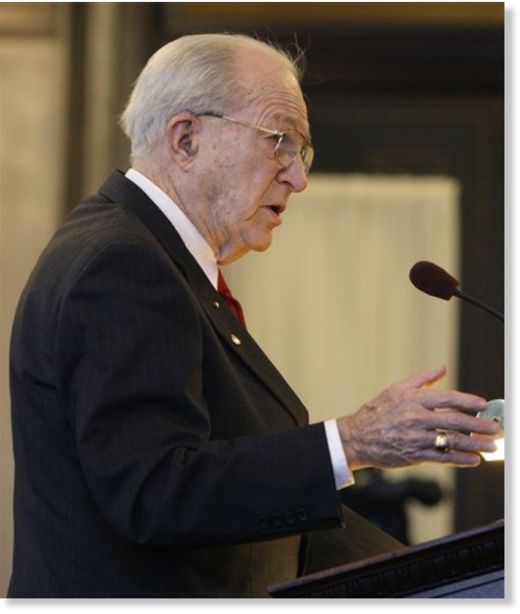
© The Associated Press/Jay LaPreteDec. 7, 2011 file photo, Dr. Jack Willke, founder of National and Ohio Right to Life, testifies during a Health, Human Services & Aging Committee hearing in Columbus, Ohio. The discredited notion that a woman’s body can resist conception in a sexual assault has persisted in anti-abortion circles for decades, largely because of the efforts of Willke, a Cincinnati obstetrician who is considered a godfather of the movement.
The discredited notion that a woman's body can resist conception in a sexual assault has persisted in anti-abortion circles for decades, largely because of the efforts of a Cincinnati obstetrician who is considered a godfather of the movement.
Dr. John C. "Jack" Willke founded the National Right to Life Committee and wrote the influential 1971
Handbook on Abortion, which has shaped the thinking of generations of anti-abortion activists.
Rep. Todd Akin's comments this week on rape and pregnancy helped upend a Senate race and roiled the Republican Party in a tough election year. But they reflect ideas that the 87-year-old Willke began peddling years ago.
"There's no greater emotional trauma that can be experienced by a woman than an assault rape," Willke wrote in 1999 in the journal
Christian Life Resources. "This can radically upset her possibility of ovulation, fertilization, implantation and even nurturing of a pregnancy."
To anti-abortion activists, Willke is a revered figure. To abortion-rights activists, the onetime sex education lecturer perpetuates myths, eschews facts and ignores science. And to fellow physicians, his ideas are pure fiction.
After Akin's remarks, the American Congress of Obstetricians and Gynecologists said a woman who is raped "has no control over ovulation, fertilization or implantation of a fertilized egg. ... To suggest otherwise contradicts basic biological truths."





















Comment: CCTV footage of the incident has been published: