RTMon, 21 Oct 2019 20:42 UTC
Protests and demonstrations have rocked every corner of the world in recent days, with tax hikes, corruption and supposed environmental injustice all raising public anger. But why have they spread?
Watching the news over the last week, one would be convinced that the world has devolved into a series of flashpoints, with corrupt governments across the political spectrum facing the wrath of their enraged citizens. To be fair, that's not far from the truth.
Four continents have seen anti-government demonstrations over the last week, many of them sparked by seemingly innocuous taxes or changes to the law. In Lebanon, protesters have set Beirut
ablaze in response to a proposed fee of 20 cents per day on internet voice calls, dubbed the
"WhatsApp tax." Chileans set metro stations on
fire following a $1.17 increase in public transport fares, and the streets of Ecuador are filled with rubble after a planned removal of fuel subsidies triggered mass
unrest.
Comment: By the way, the above was not an exhaustive list of the rebellions that have erupted in the last few weeks/months. There's Haiti, Iraq, Indonesia, the ongoing stand-off in Venezuela of course, Algeria...
Each protest movement is motivated by different things of course. Still, many of them have much in common, especially where they involve mass resistance against onerous taxation and so-called austerity measures. That and the fact that people in almost all countries are subject to overwhelming barrages of fake news on a daily basis.
Other protest movements lack an 'internal logic', as is the case in Hong Kong, where extremists are now calling for full independence from China - where no such political demand existed just several weeks ago. These ones are geopolitical in nature, a form of 'proxy warfare' substantially directed from without.
Then there are entirely fake movements, like the 'Extinction Rebellion' in London, an elite-driven project. However, as deluded as the middle class participants in this latter movement are, they might - in a roundabout way - be the most 'on topic'.
Whatever their outward, stated rationale for protesting, it strikes us that people generally are 'acting out' because they sense that something is seriously 'amiss' with the world. Greta got one thing right y'know: we are living through the Sixth Extinction (except it's NOT man-made)...
Kristin Tate
The HillSun, 20 Oct 2019 06:00 UTC
© aliexpress.com
The conventional wisdom in American politics is that the coasts represent the economic future of the United States. Higher incomes and potential growth seem to be with cities like San Francisco, New York, and Seattle. Even in the aftermath of her 2016 loss,
Hillary Clinton famously dismissed flyover country, saying, "I won the places that represent two-thirds of American gross domestic product. So I won the places that are optimistic, diverse, dynamic, moving forward."In many ways, however,
the coastal regions that Clinton lauds represent the equivalent of a personal finance ponzi scheme. While many topline statistics like average income seem to show much higher standards of living in states like New York and California,
a deeper dive into the numbers tell a different story altogether.Poor policy decisions in blue states, including higher taxes on both the wealthy and working people, housing barriers, and higher prices due to regulatory burdens,
mean that higher incomes vanish upon closer inspection. When accounting for the cost of food, housing, and commodities, the dollar goes significantly further in red states than in it does in blue states. A hundred dollars in cash will get you less than $90 worth of goods and services in New York and California. In Texas, Florida, and the rest of the mountain west except for Colorado, a Benjamin Franklin will buy you more than its value of $100. Across the midwest, the value actually exceeds $110.
RTMon, 21 Oct 2019 15:29 UTC
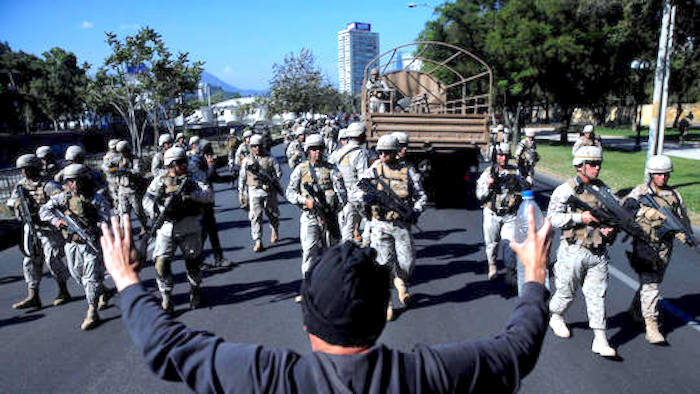
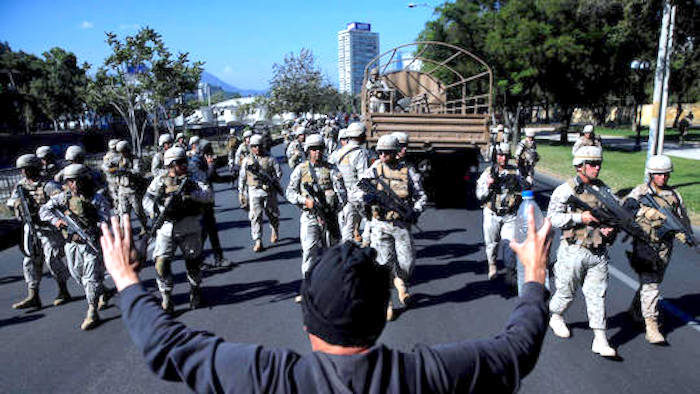
© Reuters/Edgard GarridoChilean armed soldiers advance during a protest in Santiago, Chile, October 20, 2019.
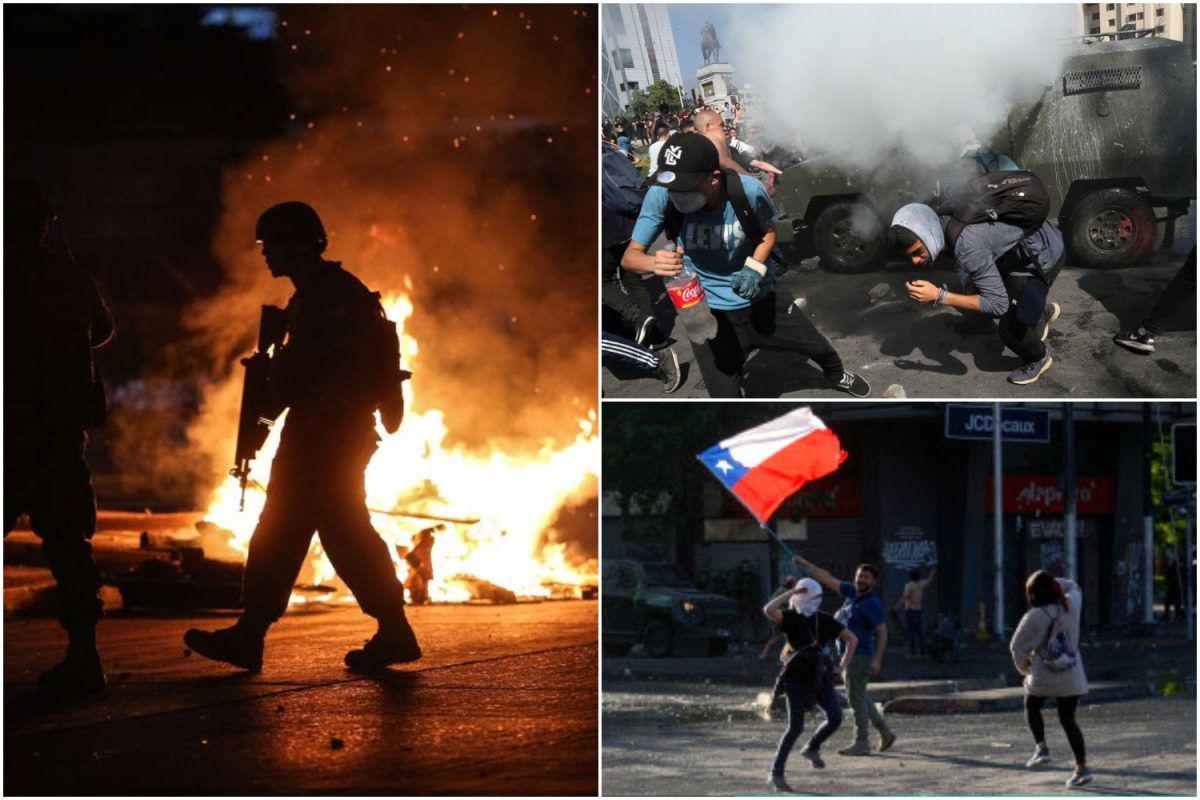
The Chilean Army has declared another curfew as it struggles to contain violence that was triggered by transport fare hikes in Santiago,
but has since spilled over beyond the capital, fueled by outrage over social inequality.To prevent looting and arson attacks,
thousands of armed troops have been patrolling the capital over the weekend, under the state of emergency introduced in Chile for the first time since the military dictatorship of Augusto Pinochet. Following another day of clashes with protesters, the general in charge of security in Santiago announced an extension of the curfew until 6am on Monday morning.
RTMon, 21 Oct 2019 10:14 UTC
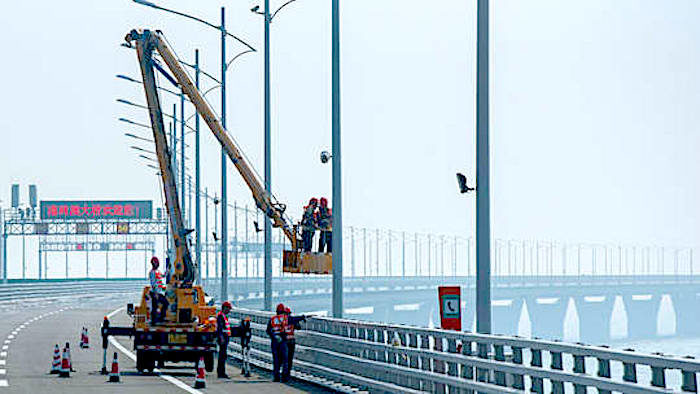
© AFP/Philip FongConstruction work on a section of the Hong Kong-Zhuhai-Macau Bridge in Zhuhai, China
The move aims to stabilize the Chinese economy amid the ongoing trade conflict with Washington.
The National Development and Reform Commission (NDRC) has
approved 21 projects, worth at least 764.3 billion yuan ($107.8 billion), according to
South China Morning Post (SCMP) calculations. The amount is more than double the size of last year's 374.3 billion yuan ($52.8 billion) in approvals recorded over the same period, which included 11 projects such as railways, roads and airports.
Three of the infrastructure projects approved by the NDRC are worth more than 100 billion yuan ($14 billion). The most expensive on the list is the
new high-speed railway network linking Chongqing and Kunming in southwest China. The project is worth a total of 141.6 billion yuan ($19.9 billion).
Sichuan province has been given the green light to spend 131.8 billion yuan ($18.4 billion) to
build a new airport. Zhengzhou, the capital of Henan province, will be allowed to spend 113.9 billion yuan ($16 billion) to continue with the third phase of its urban rail transit network.
Comment: It's extraordinary how they just 'keep calm and carry on' amidst the global hysteria and rebellions. A great example for individuals to follow: keep focused on building something real and long-lasting, lest the Wave drown you.
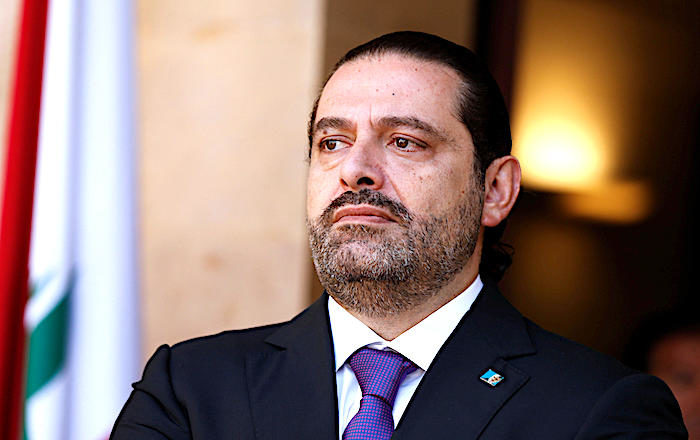
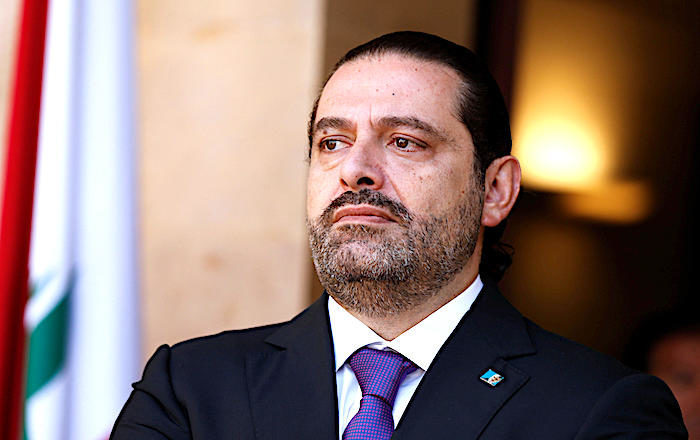
© WSJLebanese PM Saad Hariri
Lebanese Prime Minister Saad Hariri stated earlier that he was considering halving ministerial salaries and abolishing some government committees in a bid to save money.
Lebanon's Cabinet, headed by President Michel Aoun at the Baabda Palace, has approved the package of reforms, as well as the 2020 budget, including halving ministers' wages in order to ease the economic crisis in the country, Prime Minister Saad al-Hariri has stated.
The only controversial issue in the package was the power sector reform that has been under discussion for several hours. According to the PM, protests across the country restored Lebanon's national identity and broke sectarian barriers.
Cabinet Secretary-General Mahmoud Makkiyeh stated at a briefing that the
Ministry of Information is to be abolished as part of measures aimed at tackling the financial crisis.
"The set of measures also envisions the abolition and merger of a number of [other] ministries and departments, including the abolition of the Ministry of Information, and instructions to the relevant authorities to prepare the necessary documents by 30 November 2019, at most."
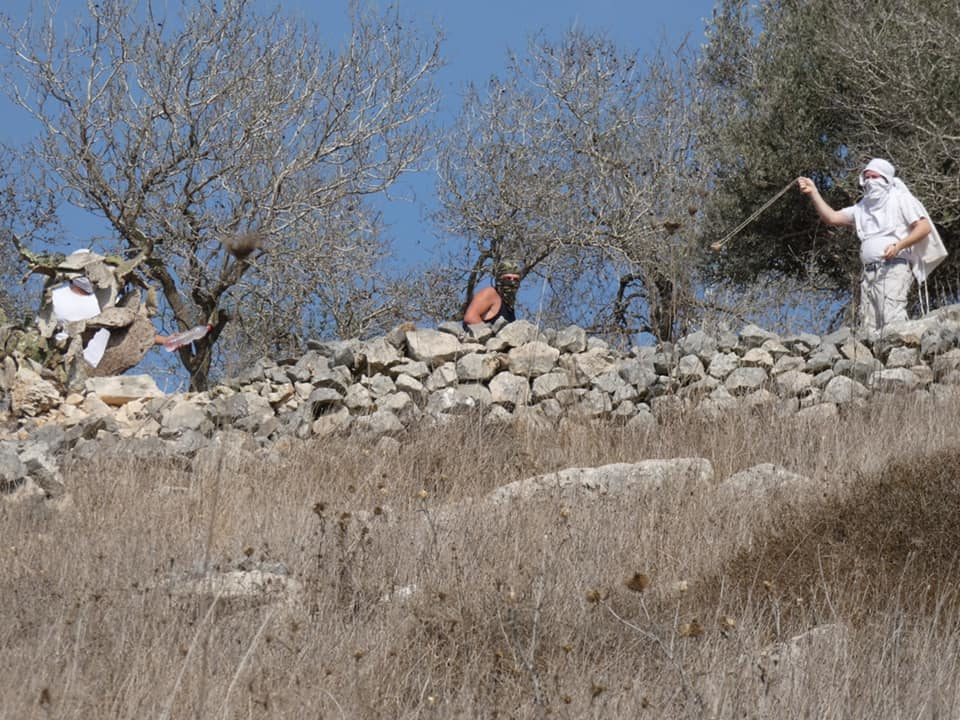
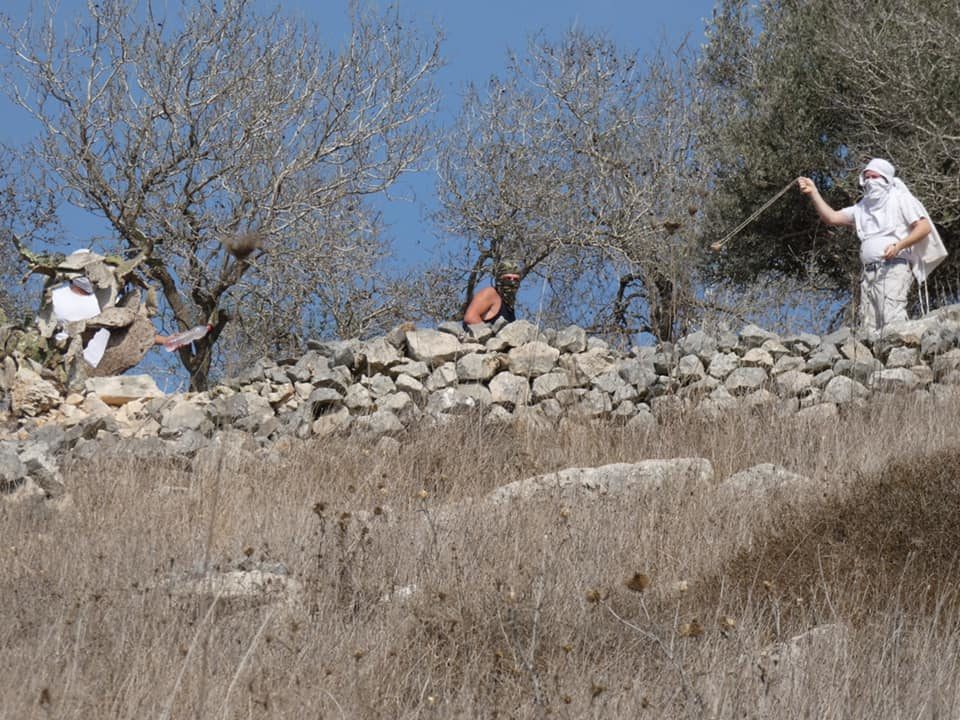
© FacebookIsraeli settlers attack farmers in the Nablus area village of Burin, October 2019
Every year, without fail, Palestinians mark the beginning of autumn with the olive harvest. A sacred cultural event, families from across the country leave their towns and cities and head for their olive groves, passed down to them from the generations before.
And every year, without fail, much of the harvest is characterized by attacks on Palestinian farmers and families by Israeli settlers and armed soldiers. This year is no different.
Since the harvest began in early October, several incidents of settler attacks on farmers and their crops have been reported by activists and organizations in the occupied West Bank.
RTMon, 21 Oct 2019 15:58 UTC
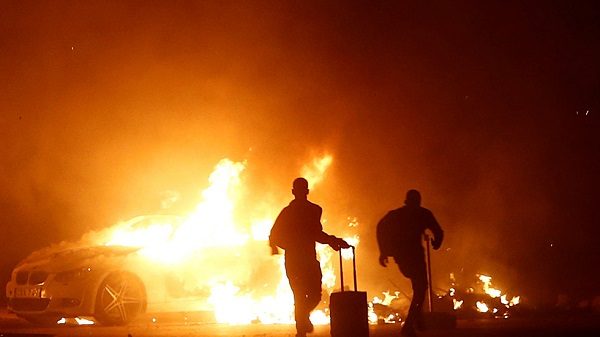
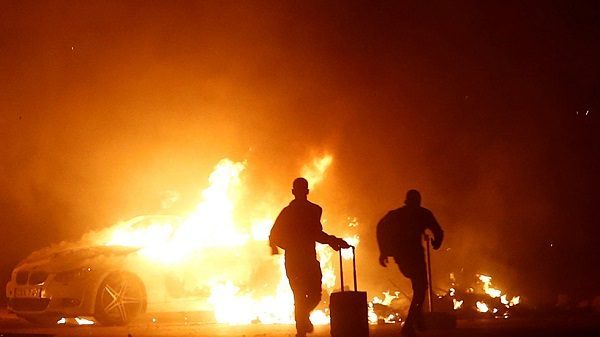
© Reuters/Darrin Zammit LupiPeople run while a vehicle burns during riots at Hal Far Open Centre migrant camp in Hal Far, Malta, October 21, 2019
The riot took place late Sunday evening in a Hal Far camp occupying a former British army barracks near island's main airport. The migrants torched several rooms and staff cars and, as a result, managed to take control over a part of the compound for a while.
The riot was contained only in the early hours of Monday, after the detention center called for the Rapid Intervention Unit of Malta Police Force. The police later said an officer was slightly injured during the operation.

© Chip Somodevilla/Getty ImagesDonald Trump Jr.
Allowing biologically male athletes who identify as transgender to compete in female athletics "will destroy women's sports," Donald Trump Jr. said Monday.
The president's oldest son was reacting to a Daily Caller News Foundation story on a biologically male cyclist
winning a women's world championship Saturday.
"This BS will destroy women's sports and everything so many amazing female athletes have worked their entire lives to achieve," Trump wrote on Twitter. "I couldn't care less how you identify, but this isn't right."
Graham Dockery
RTSun, 20 Oct 2019 16:17 UTC

© ScreenshotChildren of all races, including white ones, attend the school featured in The Guardian's piece
The
Guardian's latest piece on modern schoolchildren trying to make sense of 20th-century tech is indicative of the times in more ways than one. None of the kids can use a rotary phone - and none of them are white, either.
The
Guardian has published a feel-good article describing how modern-day 15-year-olds try to complete everyday tasks using old-timey equipment (actually, it's not even all that old-timey, it was mostly still widely in use in the 1990s). It's a tried and trusted trope - Youtube is full of 'modern teens react' videos - that stokes older readers' nostalgia, employed in a light-hearted manner, with kids even given grades for their (lack of) success in adapting to old tech.
But there's a subtler aspect to it as well. Intentionally or not, none of the six "kids these days" fumbling around with clunky old phones and cassette players in the
Guardian's pictures are white.
Michael McCaffrey
RTMon, 21 Oct 2019 16:06 UTC

© YouTube / HBO ; Reutrs/Christian Mang(L) the Sparrows from Game of Thrones. Screenshot from season 6 trailer - (R) “The Red Brigade" activists take part in the Extinction Rebellion protest in Berlin, Germany October 9, 2019.
The similarities between the eco-moralists of Extinction Rebellion and the Sparrows cult from
Game of Thrones are uncanny.
I have a long held a theory that film and television can be tools of prophecy used to glimpse into the future.
Game of Thrones in particular is a bellwether when it comes to entertainment as prophecy. The show's first episode, 'Winter is Coming,' aired in 2011 and that phrase quickly became the series tagline. Billboards warning that
"Winter is Coming," portending an invasion by undead White Walkers and their zombie minions, soon loomed ominously over cities and towns across America. In the ensuing years, a metaphorical winter did indeed descend upon the US, as the cold wind of political correctness swept across the land while an army of mindless 'woke'
scolds waged war on free expression and diversity of thought.
Game of Thrones ended this past May, but with every passing day its creator George R.R. Martin looks more and more like Nostradamus. Take, for example, the recent
Extinction Rebellion climate crisis protests.














Comment: By the way, the above was not an exhaustive list of the rebellions that have erupted in the last few weeks/months. There's Haiti, Iraq, Indonesia, the ongoing stand-off in Venezuela of course, Algeria...
Each protest movement is motivated by different things of course. Still, many of them have much in common, especially where they involve mass resistance against onerous taxation and so-called austerity measures. That and the fact that people in almost all countries are subject to overwhelming barrages of fake news on a daily basis.
Other protest movements lack an 'internal logic', as is the case in Hong Kong, where extremists are now calling for full independence from China - where no such political demand existed just several weeks ago. These ones are geopolitical in nature, a form of 'proxy warfare' substantially directed from without.
Then there are entirely fake movements, like the 'Extinction Rebellion' in London, an elite-driven project. However, as deluded as the middle class participants in this latter movement are, they might - in a roundabout way - be the most 'on topic'.
Whatever their outward, stated rationale for protesting, it strikes us that people generally are 'acting out' because they sense that something is seriously 'amiss' with the world. Greta got one thing right y'know: we are living through the Sixth Extinction (except it's NOT man-made)...