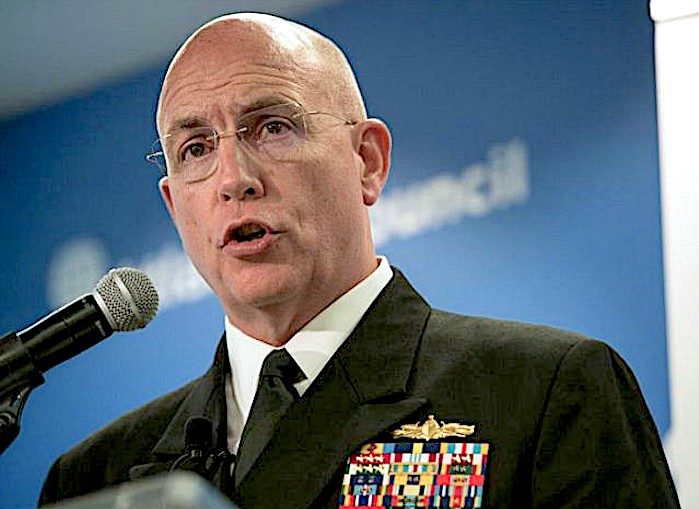
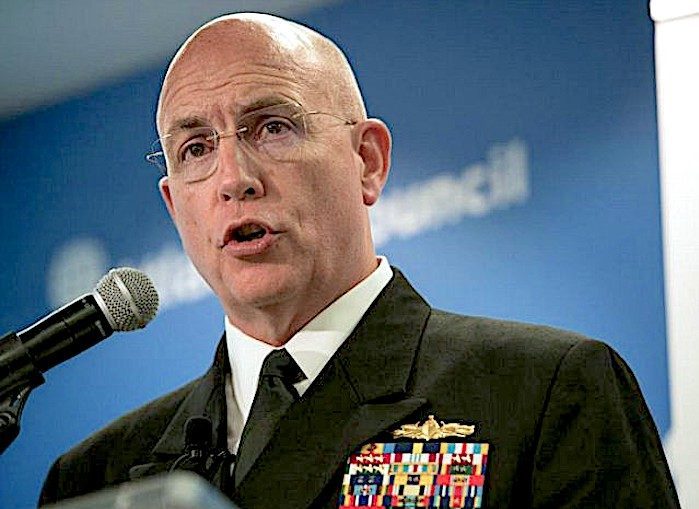
© Getty ImagesAdmiral Kurt Tidd, SOUTHCOM
Beijing's decision to extend its ambitious
multitrillion-dollar trade initiative to Latin America creates "security vulnerabilities" for the United States, said the chief of the US Southern Command (SOUTHCOM), Kurt Tidd.
Talking at a Senate Armed Services Committee
meeting, he said
China has already pledged $500 billion in trade funds with various Latin American countries and $250 billion in direct investment over the next decade."Increased economic cooperation - such as the extension of the 'One Belt, One Road' initiative to Latin America, one of the nodes to
support China's vision of a competing global economic initiative - and the continued provision of financing and loans that appear to have 'no strings attached' provide ample opportunity for China to expand its influence over key regional partners and promote unfair business and labor practices."
Tidd added that
"Increased reach to key global access points like Panama create commercial and security vulnerabilities for the United States, as do Chinese telecommunications and space ventures with dual-use potential, which could facilitate intelligence collection, compromise communication networks, and ultimately constrain our ability to work with our partners."
According to the SOUTHCOM commander, China is intensifying its role as a US rival in Latin America.
"The larger strategic challenge posed by China in this region is not yet a military one. It is an economic one, and a new approach may be required to compete effectively against China's coordinated efforts in the Americas. Some of the most critical elements needed in this effort are not ones that [SOUTHCOM] can bring to bear," he said.
Comment: The US influence is slip-sliding away. China is building economies to increase its trade partners and influence. The US siphons off economies resulting in destitution and military occupation, then wonders why it doesn't work. A new leaf is turning.
To round out the picture, more from
Breitbart:
[Tidd] also noted that the U.S. military remains concerned about activities linked to the long-term presence of Iran and its Shiite narcoterrorist proxy Hezbollah in SOUTHCOM's area of responsibility (AOR), which includes Latin American countries below Mexico and the Caribbean.
Adm. Tidd did not contest assertions from Sen. David Perdue (R-GA) that, "in Latin America, Russia, today, is supplying 40 percent of the arms sales. China is the second-largest trading partner in Latin America. Iran is in there through Hezbollah."
Tidd also pointed out that Islamic State (ISIS/ISIL) recruiting activities in Latin America and the Caribbean present a menace to the United States.
"Groups such as the Islamic State and others will likely continue recruiting fighters or inspiring others to carry out attacks in their home countries," he said, noting that "criminal and extremist threat networks" remain the region's "primary challenges."
The admiral further warned that North Korea's presence in the region could potentially threaten the United States, telling the Senate panel:
North Korea may use its small presence in Latin America to do us harm while also looking to develop expanded economic and diplomatic partnerships. We remain concerned that Pyongyang could use its limited footprint in the region to collect or plot against us.
Given the permissive environment in the region, North Korean efforts to generate revenue, and its history of working with supporters like Cuba to circumvent sanctions, North Korea is likely to engage in some form of illicit activity in Latin America.
Despite all the challenges facing the U.S. military in Latin America in the Caribbean, the commander said SOUTHCOM lacks the resources to carry out its mission.
"Our global security responsibilities outpace the resources available to meet them, we have had to make a series of tough choices, resulting in compounding second and third order effects," he said.















Comment: The US isn't interested in peace in Afghanistan, or anywhere else in the Middle East: