OF THE
TIMES

Responding to the revised Brexit agreement, brokered between UK and EU officials at the European Council summit in Brussels on Thursday, Farage ostensibly dismissed the proposals, saying they represented a "very bad" deal for Britain.Juncker rules out an extension - even though he doesn't have the power to do so:
Notably, in what may raise a few eyebrows among Brexiteers, he believes a delay to the UK exiting the bloc is preferential to accepting the deal.
"Would I rather accept a new European treaty that is frankly very bad for us? Or would I prefer for us to have an extension and a general election? I would always prefer the latter option."
Northern Ireland's Democratic Unionist Party (DUP), a key ally of Johnson's government, has also rejected the deal and stated that their MPs will vote against it. The party is upset that the deal doesn't include a unionist veto in Northern Ireland's Assembly.
Unsurprisingly perhaps, reaction from EU officials has been markedly different, with Michel Barnier, their chief Brexit negotiator, in upbeat mood. He declared that he was confident that the deal agreed can be ratified by the October 31 deadline.
Barnier told reporters that he sees Thursday's agreement as "the best possible one." He also revealed that Johnson had told President of the European Commission Jean-Claude Juncker that he was "confident" he could gain enough support in the UK's parliament to see the deal signed off.
Barnier confirmed that the recent meeting between Johnson and Taoiseach (Irish PM) Leo Varadkar in the Wirral, England, where the two agreed that there would be no customs checks on the island of Ireland, was crucial in securing a settlement.
Labour leader Jeremy Corbyn criticized the new UK-EU Brexit deal, claiming that it was a "sell out" agreement that "won't bring the country together and should be rejected."
"The best way to get Brexit sorted is to give the people the final say in a public vote," he added.
If popularity polls are anything to go by, the public do not support Corbyn's proposal: Polls show Corbyn is the most unpopular opposition leader since 1977
Scotland's First Minister Nicola Sturgeon announced that her party, the SNP, would be voting against it, when it's put to UK MPs on Saturday to debate.
" For Scotland, this deal would take us out of EU, single market and customs union - all against our will."
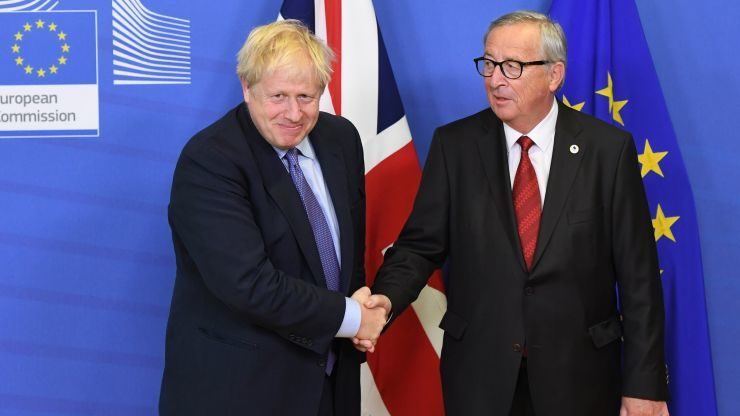
Earlier on Thursday, Juncker announced via Twitter that a "fair and balanced agreement" had been struck between the two sides. Meanwhile, Johnson declared that a "great new deal that takes back control" had been brokered and urged the UK parliament to sign it off on Saturday.
President of the European Commission Jean-Claude Juncker has ruled out another delay to Brexit, declaring that "we have a deal" and there is no need for a further extension to the intractable process.Tusk seems deliriously confident in the deal:
London and Brussels agreed a new Brexit deal on Thursday morning with both sides lauding the achievement. UK PM Boris Johnson is still facing the prospect of being forced to ask for an extension from the EU if British MPs fail to back the agreement in the House of Commons on Saturday.
However, on the subject of an extension request, Juncker told reporters in Brussels that no further delays would be granted.
"We have a deal. So why should we have a prolongation (extension)?"
In reality, Juncker does not have the power to unilaterally refuse a request from the UK government for another extension to Article 50; that decision rests with the 27 EU leaders.
Asked what happens if UK MPs vote down the new agreement on Saturday, Junker simply replied: "I'm not in charge of Westminster."
Northern Ireland's Democratic Unionist Party (DUP), a key ally of Johnson's government, has rejected the deal and stated that their MPs will vote against it. The party is upset that the deal doesn't include a unionist veto in Northern Ireland's Assembly.
It means Johnson may struggle to gain the support of 320 MPs, the threshold required to win the vote, barring any abstentions. He'll be hoping that he can convince enough former Tory 'rebels,' as well as Labour MPs who represent 'Leave' constituencies, to back his deal.
Speaking after final negotiations wrapped up, Tusk said the deal become possible because it was "positively assessed by Ireland."
The key change in the new deal is that British PM Boris Johnson agreed to replace the backstop with a four-year regulatory alignment between Northern Ireland and the EU. This was always a major sticking point in negotiations, with British Conservatives an unionists in Northern Ireland opposed to having the region treated differently to the rest of the UK.
Tusk said the new deal ensures the integrity of the single market, avoids chaos and safeguards peace and stability on the island of Ireland.
The European Council president said he was happy and relieved that a deal had finally been struck but "sad" because he will "always be a remainer." He added that if the UK decides to return one day, Europe's door "will always be open."
The task now is the wait for votes in the UK an European Parliaments.
Irish PM Leo Varadkar said he too had mixed feelings and regretted that Britain was leaving the EU, but that the negotiations had taught him about the "strength of unity" in the bloc.
The new solution to the Northern Ireland issue could become permanent with the consent of the Stormont assembly in NI, according to Varadkar.
Britons had grown sick and tired of Brexit negotiations dragging on with seemingly no end in sight for the past two years. The issue sparked deep divisions in both society and parliament, even costing former PM Theresa May and a number of government ministers their jobs.

Comment: See also: