Puppet MastersS


Pirates

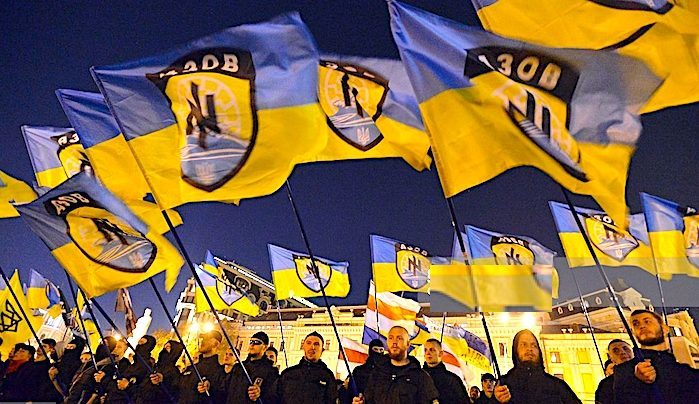
Flashback US Congress stops funding for Ukraine's war-criminal, neo-Nazi Azov Battalion

Azov Battalion
© Getty ImagesNeo-Nazi Azov Battalion

Comment: US Congress had this rare and short-lived moment of sanity almost 6 years ago - before the full brunt of anti-Russia hysteria and demonization took hold...


Ukraine's notorious volunteer Azov Battalion has been guilty of some of the most heinous war crimes against the people of Donbass. Details of just some of the disgusting acts perpetrated by the Azov Battalion can be found in a lengthy OSCE report from April of last year.

The atrocities committed by the Azov Battalion have proved too much for even the US Congress who issued the following stipulation to the agreement to fund the increasingly destitute Ukraine regime.

A US Congressional document accompanying the appropriation bill for the Pentagon reads,
"The funds provided for by this law cannot be used to supply arms, conduct training or provide any other assistance to the Azov battalion".
Although many are troubled that the US continues to give any money to the rogue regime in Kiev, this is a small step in the right direction.

Comment: Yes. The least the US Congress could do is not make something worse. Calling it a step in the right direction may be overstating.


Russian Flag

Ukraine solution possible only if Russia's security interests are considered, Putin tells Macron

flag putin
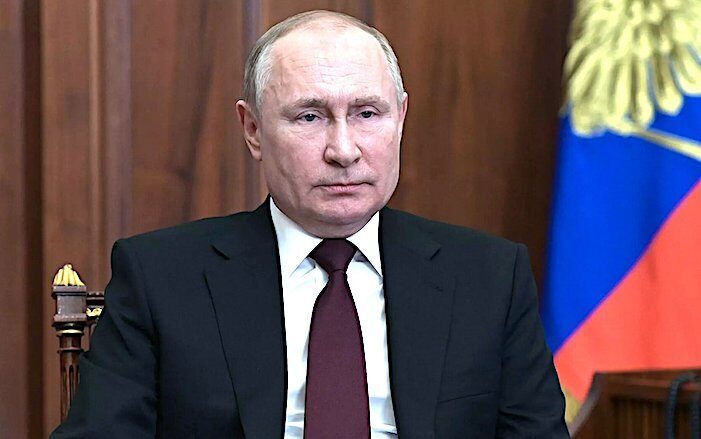
© Sputnik/Alexey Nikolsky/Go to the photo bankRussian President Vladimir Putin
Russian President Vladimir Putin noted that Russian troops are not a threat to civilians nor are they conducting strikes against civilian targets in Ukraine.

The Russian side is open to negotiations with Ukraine's representatives and hopes that these talks will yield the desired results, Russia's President Vladimir Putin said during a phone conversation with French President Emmanuel Macron on Monday.

While the French head of state expressed hope for the swift resolution of the ongoing conflict in Ukraine via dialogue and talks with Kiev, Putin pointed out that such a resolution would only be possible if Russia's legitimate security interests are taken into account, such as recognition of Russia's sovereignty over the Crimean Peninsula, as well as demilitarisation and denazification of the Ukrainian state and ensuring its neutral status. According to the Kremlin's press service:
"The threat comes from Ukrainian nationalists who use civilians as human shields, deliberately deploy offensive weapon systems in residential districts and intensify shelling of the cities in Donbass."

Comment: Even if Putin and Zelensky somehow manage to get on the same page, the West will do everything in its power to not let it proceed.

See also: Zelensky: Ukraine and Russia to meet for peace talks 'without preconditions'


Snakes in Suits

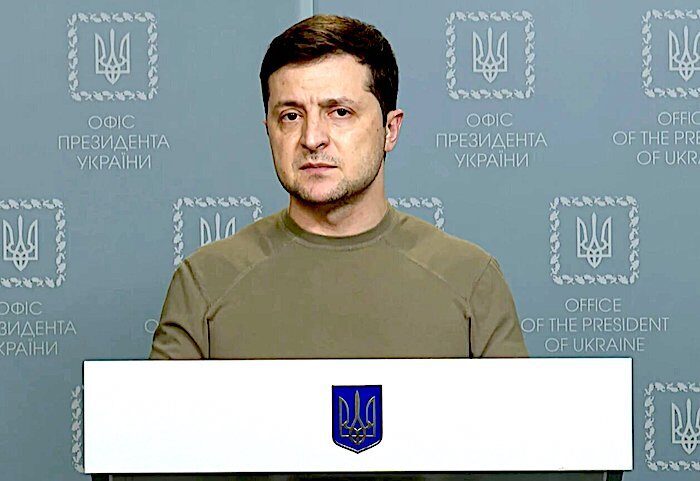
Zelensky: Ukraine and Russia to meet for peace talks 'without preconditions'

Zelensky
© Ukrainian Presidency/Anadolu Agency/Getty ImagesUkraine President Volodymyr Zelensky announcing upcoming peace talks
Ukraine has agreed to meet Russian officials for peace talks, President Volodymyr Zelensky announced Sunday — before quickly admitting he expects any discussions to prove futile.

A top Ukraine official adding that the talks are set for Monday. Zelensky said in a statement:
"We agreed that the Ukrainian delegation would meet with the Russian delegation without preconditions on the Ukrainian-Belarusian border, near the Pripyat River."
But within hours of making the announcement, Ukraine's defiant president openly questioned the chances of success in his latest video address.
"I do not really believe in the outcome of this meeting, but let them try. So that later not a single citizen of Ukraine has any doubt that I, as president, tried to stop the war, when there was even a small, but still a chance."
He was not alone in his pessimism.

Comment: "Pride goeth before a fall."


Life Preserver

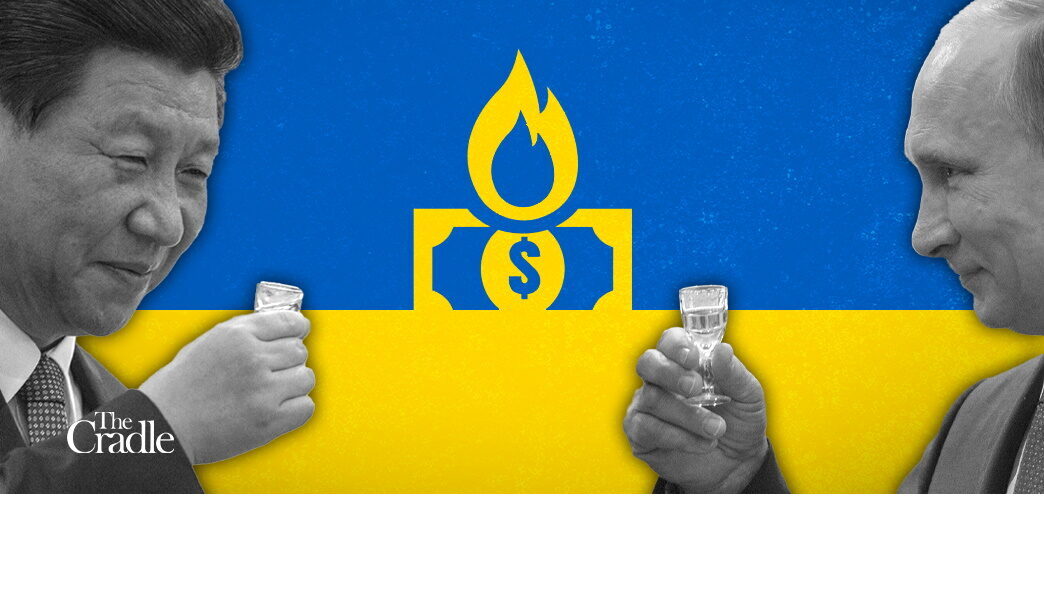
Escobar: Follow the Money - How Russia will bypass Western economic warfare

Putin and Xi
© The Cradle
The US and EU are over-reaching on Russian sanctions. The end result could be the de-dollarization of the global economy and massive commodity shortages worldwide.

So a congregation of NATO's top brass ensconced in their echo chambers target the Russian Central Bank with sanctions and expect what? Cookies?

What they got instead was Russia's deterrence forces bumped up to "a special regime of duty" - which means the Northern and Pacific fleets, the Long-Range Aviation Command, strategic bombers and the entire Russian nuclear apparatus on maximum alert.

One Pentagon general very quickly did the basic math on that, and mere minutes later, a Ukrainian delegation was dispatched to conduct negotiations with Russia in an undisclosed location in Gomel, Belarus.

Meanwhile, in the vassal realms, the German government was busy "setting limits to warmongers like Putin" - quite a rich undertaking considering that Berlin never set any such limits for western warmongers who bombed Yugoslavia, invaded Iraq, or destroyed Libya in complete violation of international law.

While openly proclaiming their desire to "stop the development of Russian industry," damage its economy, and "ruin Russia" - echoing American edicts on Iraq, Iran, Syria, Libya, Cuba, Venezuela and others in the Global South - the Germans could not possibly recognize a new categorical imperative.

Comment: A departure from reality by the Western elite and an engagement in wishful thinking will cause the collapse of the Western Anglo - Saxon empire. Despite the pain this will cause to many, there will also be a great relief by many when this pathocratic regime collapses.

See also: NewsReal: The Truth About The Russia-Ukraine War


Toys

FIFA bans Russian venues & flag, official says it's about 'politics and big money', some teams refuse to play against Russia

Fifa
© FifaA State Duma deputy has criticized FIFA's sanctions against Russia
FIFA's decision to force Russia to play football matches at a neutral venue and without its flag and anthem is based on political motives, according to State Duma Deputy Dmitry Svishchev.

Under pressure to issue an outright ban on Russia from international football, FIFA stopped short of that step on Sunday but announced a series of measures against the country because of the military operation in Ukraine.

That included ordering Russian national teams to play at a neutral venue and compete under the name of 'Football Union of Russia (RFU)', without the flag or anthem.

Countries including 2022 World Cup playoff rivals Poland, Sweden and Czech Republic had earlier announced that they would refuse to play Russia.

Comment: It's rather revealing that this is the 'worst' FIFA have chosen to punish Russia with, it was a similar story with the 'significant' sanction threats concocted by the West: Wall Street warns US against barring Russia from Swift payments network


Black Magic

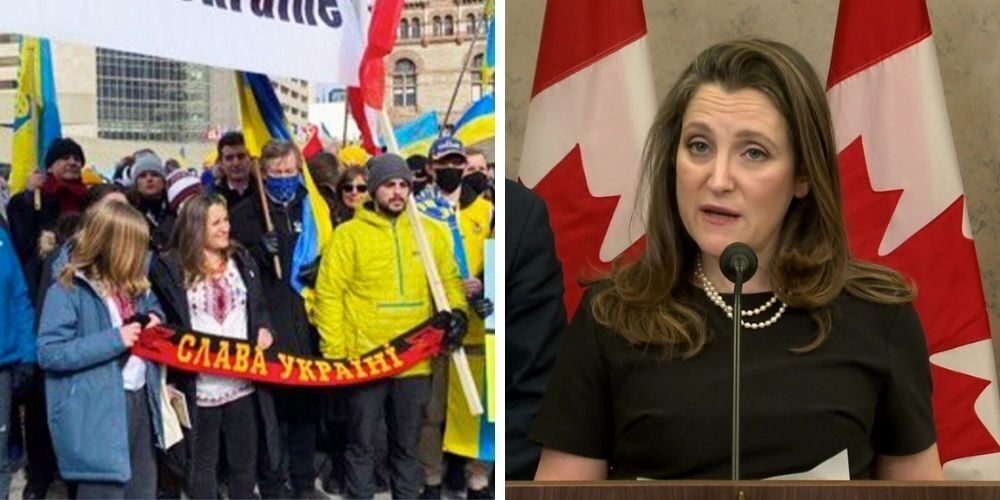
Trudeau's deputy PM participated in protest featuring pro-Nazi banners and flags

Canadian Deputy Prime Minister Chrystia Freeland
The picture comes after only weeks ago, Prime Minister Justin Trudeau and the media were quick to label the trucker Freedom Convoy "Nazis." Trudeau even accused a Jewish Conservative MP of standing with "people who wave swastikas."

On Sunday, Canadian Deputy Prime Minister Chrystia Freeland was photographed at a rally for Ukraine with a red and black scarf that appears to represent the colours of the Bandera movement, a far-right Ukrainian Nationalist movement linked to Neo-Nazis.

Comment: In this bizarre world, unfortunately, nazism is alive again. They are accusing normal people for what they are doing and what they are. For the so-called "elite" who rules this world Nazism is a natural state, something that they like and enjoy.

In the present circumstances we can better interpret the statement of the Russian President Vladimir Putin when he said that he needed to "De-Nazify" Ukraine. It looks like we need to "De-Nazify" the whole "western civilisation."

See also:


Display

US banks claim they're preparing for cyber attacks after latest Russia sanctions

hacker
© REUTERS/Kacper PempelU.S. banks are preparing for retaliatory cyber attacks after Western nations slapped a raft of stringent sanctions on Russia for invading Ukraine, cyber experts and executives said.
U.S. banks are preparing for retaliatory cyber attacks after Western nations slapped a raft of stringent sanctions on Russia for invading Ukraine, cyber experts and executives said.

Tensions between Russia and the West escalated on Saturday as the United States and its allies moved to block some Russian banks from the SWIFT international payment system and placed curbs on the Russian central bank's international reserves.

Western governments have warned for weeks that the tensions could spark massive cyber attacks from Russia or its supporters. Some executives said the latest measures may be the trigger.

Comment: If Russia was going to hack US banks they'd have done it by now, the pitiful sanctions the West conjured up are of little concern. Now, if we're looking for potential suspects, those calling for a Great Reset and who have been warning (threatening?) that a 'cyberpandemic' is up ahead have a more compelling motive:

See also:


Footprints

Will Russia launch a full military invasion of Ukraine?

zelenskiy
© Reuters/Brookings InstitutionUkraine President Volodymyr Zelensky
As Russian troops gather on Ukraine's borders, the outstanding question is whether Russian President Putin is prepared to bear the domestic and international costs of a full-scale invasion or if he'll stop at pressuring NATO and the West for political concessions. Steven Pifer explains why a military incursion in 2022 will not be as easy for Russia as annexing Crimea in 2014, and where there are avenues for dialogue to defuse the brewing confrontation.

PITA: In recent weeks, U.S. intelligence reports have shown increased Russian troop movements toward its border with Ukraine, a buildup that has provoked fears of a large-scale invasion of Ukraine, potentially early next year. Since Russia invaded and annexed Ukraine's Crimean peninsula in 2014, the slow-burning conflict has displaced over two million people and killed more 14,000.

Here with an update on what's happening in Ukraine and whether there's a diplomatic off-ramp to stave off further military escalation is Steven Pifer, a nonresident senior fellow here at Brookings and the William J. Perry fellow at the Center for International Security and Cooperation at Stanford University. Steve, thanks so much for talking to us today.

PIFER: Happy to do it.

PITA: Since Russia annexed Crimea back in 2014 there was a 2015 agreement that put a lid on a lot of the large-scale fighting, although it has continued to continue to smolder since then. Maybe you could catch us up on what's been happening in eastern Ukraine for the past six years. I think for a lot of the general public, once the threat of larger-scale war wasn't imminent anymore, I think it dropped off a lot of people's radars. So, how did we get to where we are now?

Comment: The Brookings Institution is a highly influential left-leaning, corporate-funded, nonprofit public policy organization based in Washington, DC.

A lot has happened since December 2021.

See also:


Arrow Up

Bravo Russia for defending Donbass

tank and men
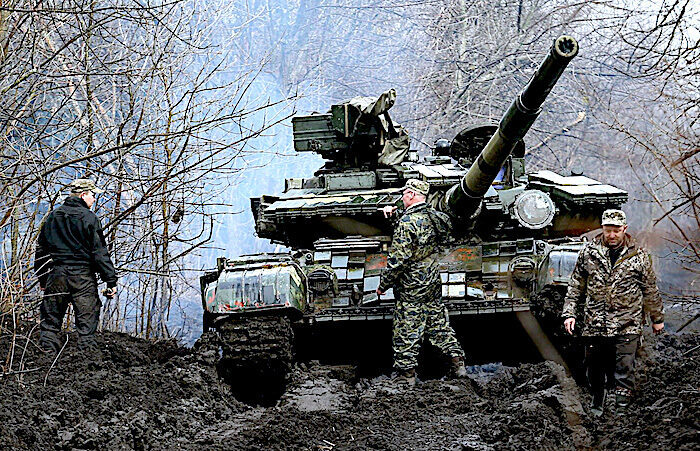
© AP/Getty ImagesServicemen in Lysychansk, Eastern Ukraine
The truth is Russia had no choice but to recognize the breakaway republics of Donetsk and Lugansk. By doing so, Moscow is affording the territories a critical security guarantee that might spare them from the criminal aggression of the NATO-backed Kiev regime.

This was made necessary because of the mounting offensive coming from the NATO-backed Kiev regime. Since last week, thousands of mortars and shells have hit the self-declared Donbass republics, fired by the US and NATO-backed Ukrainian forces. Many of these forces are open supporters of Neo-Nazi beliefs that view the ethnic Russian people in Donbass as "Untermenschen". If you don't know that already, you have been reading too much Western media disinformation.

Moscow had stuck with a political process for nearly seven years to give peace in Ukraine a chance. The so-called Minsk agreement was never implemented by the Kiev regime despite it being a signatory to an international, legally binding accord. The Donetsk and Lugansk breakaway regions were not given the autonomy that the 2015 Minsk deal mandated. Instead, the populations in those regions have been under relentless siege for all these years from the Kiev regime.

Russian Flag

Analyst: Russia seeks to neutralise Ukraine's geopolitical status to solve dangerous security crisis

Tanks
© unknown
As Russia launched a special military operation in Ukraine in order to protect the Donbass republics and demilitarise the country, which seeks to join NATO, two major Asian powers, China and India, have remained cautious in taking sides. An expert reckons the crisis will send a ripple effect in Europe and shape a new order in the Asia Pacific.

Dr. Zorawar Daulet Singh, a Delhi-based historian, strategist, and author of a recently released book Powershift: India-China Relations in a multi-polar World has deliberated about NATO's future and the ripple effect of the Russia-NATO row over the Indo-Pacific while talking to Sputnik during an interview.

Sputnik: In a broader context, how do you assess the developments in Ukraine, which Russia says is an attempt to prevent a global war?

Dr. Zorawar Daulet Singh: This point has been raised by President [Vladimir] Putin on several occasions recently, when he said the possibility of a major confrontation between Russia and US-NATO would have taken on a very different meaning had Ukraine already been a member state of NATO. Putin even raised the spectre of a nuclear crisis in the hypothetical scenario of Ukraine inside NATO's tent.

Therefore, Russia is seeking to neutralise Ukraine's geopolitical status to solve the dangerous security crisis in Europe.