
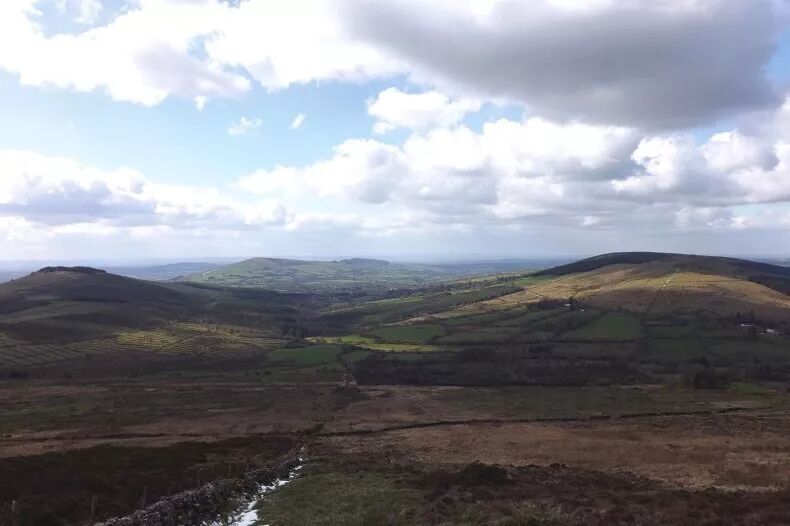
© James O’Driscoll/Antiquity Publications LtdA view of the Baltinglass landscape in County Wicklow, Ireland. An archaeological survey of the region has revealed various previously unknown monuments.
These enigmatic monuments, consisting of either elongated earthworks or lines of wooden posts that sometimes stretch as far as six miles in length, have been found as part of some of the best-known prehistoric sites, including Stonehenge.
The new cluster of monuments, numbering as many as five, was discovered using LIDAR technology. It's the largest cluster yet found in Ireland, where not even 20 examples are known throughout the country.
At least four of them were associated with important solar events linked to annual farming cycles, which clarifies the purpose of these little-understood structures. What's more, at least three of them are aligned with significant burial complexes, suggesting that the cursus monuments may have marked out a physical path that the deceased traveled into the afterlife.
"These monuments illuminate the complex ritual and ceremonial aspects of the Baltinglass landscape and the importance that Neolithic communities placed in the sun, their dead and in seasonal agricultural cycles," says James O'Driscoll, a research fellow in the archaeology department at the University of Aberdeen in a paper in the journal Antiquity in which he published his findings.
O'Driscoll's lidar survey dramatically increased the number of ancient structures known to have stood in the area, including a "massive" Bronze Age fort, early medieval ringforts and an assortment of prehistoric burial structures.
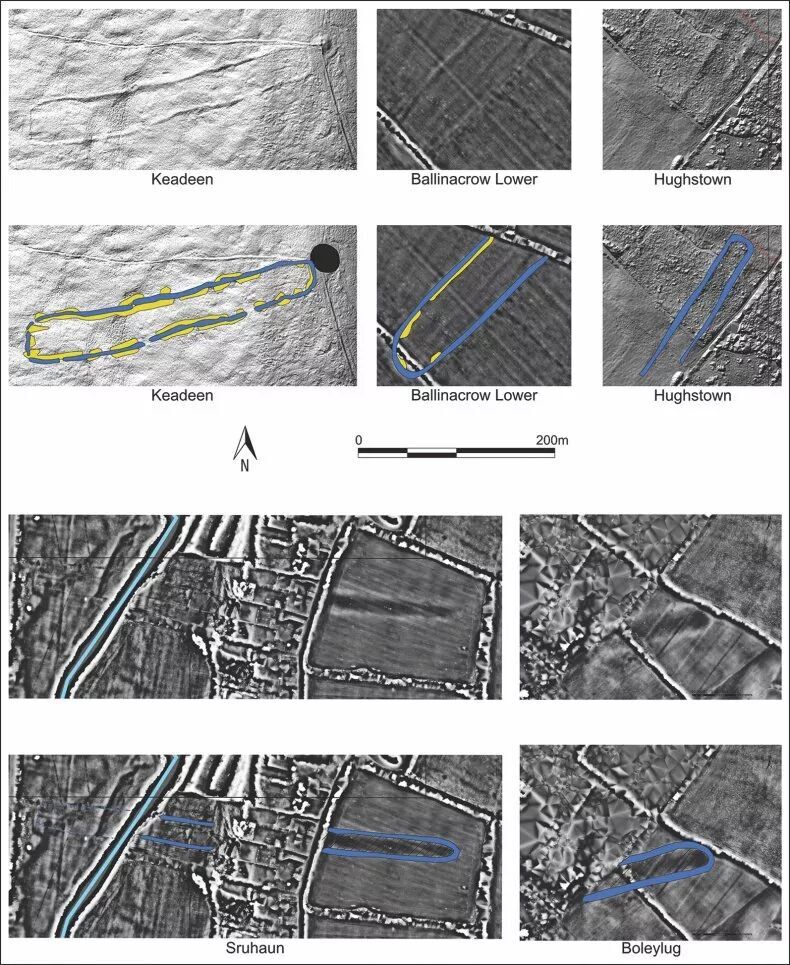
© James O’Driscoll/Antiquity Publications LtdThe cursus monuments of Baltinglass uncovered by the LiDAR survey. These types of monuments are "incredibly rare" in Ireland.
O'Driscoll's next step, he told Newsweek, is to find support for further research.
"It is the first focused investigation of this monument type in Ireland," he said, "and it provides a platform for future study — key to which will be excavation and scientific dating of these monuments, if we can find the funding!"
Baltinglass is rich with historical attractions, including a Stone Age grave whose walls are finished in chalk that is not native to the area, as well as the ruins of a monastery said to date from about 700 C.E.
Courtesy James O'Driscoll.




you say they were associated with something without offering the data and evidence to justify your hypothesis ... are you hoping people will believe your statement point blank ?