Science & TechnologyS


HAL9000

Record-breaking quantum computer has more than 1000 qubits

largest quantum computer 1000 qubits
© Atom ComputingThe largest quantum computer yet built, created by Atom Computing
Atom Computing has created the first quantum computer to surpass 1000 qubits, which could improve the accuracy of the machines

The world's first quantum computer to exceed 1000 qubits has more than double that of the previous record holder, IBM's Osprey machine, which has 433 qubits. Though having more qubits doesn't necessarily mean better performance, large numbers of them will be needed for future error-free quantum computers that are useful, unlike today's noise-filled research machines.

The largest quantum computers, such as those from IBM and Google, use superconducting wires cooled to extremely low temperatures for their quantum bits, or qubits. But the record-breaking machine from California-based start-up Atom Computing, which has 1180 qubits, uses neutral atoms trapped by lasers in a 2-dimensional grid.

One advantage of this design is that it is easy to scale up the system and add many more qubits into the grid, says Rob Hays, CEO of Atom Computing. Any useful quantum computer in the future that is free of errors, a feature called fault tolerance, will need at least tens of thousands of dedicated error-correcting qubits working alongside the programmable qubits, he says.

Crusader

Flashback SOTT Focus: Witches, Comets and Planetary Cataclysms

witch1
© Dot Connector Magazine
When you think of Halloween, what is the first image that comes to mind? I took a little informal poll among my friends, family and associates. Guess what image came in first? Jack-o-lanterns! Bet you thought I was going to say "witches". Well, I sure thought it would be witches, but they only came in a close second!..

When I think of Halloween, I think of grade-school art projects where we cut out silhouettes of witches to paste onto large yellow moons made of construction paper. The witch was always on a broom with her black dress flying in the wind, accompanied by a black cat sitting on the back of the broom. I wondered even then how the cat managed to stay on and why anybody would think that straddling a broomstick as a seat would be even remotely comfortable.

Cassiopaea

First-ever mouse embryos grown in Space, Japan scientists report

mouse embryo space
© Wakayama et al., iScience, 2023Mouse blastocysts that were developed in microgravity.
As humanity eyes the strange frontiers beyond Earth's borders, making its first tottering steps towards the stars, new questions about our future begin to emerge.

One thing that has yet to be tested is the propagation of the species. Will we, as we boldly go, be able to continue to reproduce, to grow new humans in the microgravity and radiation environment beyond Earth's atmosphere?

According to a new experiment, the answer is a resounding maybe.

Comment: What are the chances that, as with GMOs (as just one in a litany of examples), these experiments probably won't turn out to be as 'successful' as they hope they will be?


Galaxy

Uranus aurora discovery offers clues to habitable icy worlds, gas planets hotter than models predict

aurora uranus
© NASA, ESA and M. ShowalterAn artistic representation of how the northern infrared aurora would have looked like in 2006 (marked in red). The darker red locations indicate confirmed aurora locations, with fainter red used to mark possible aurora locations.
The presence of an infrared aurora on the cold, outer planet of Uranus has been confirmed for the first time by University of Leicester astronomers.

The discovery could shed light on the mysteries behind the magnetic fields of the planets of our solar system, and even on whether distant worlds might support life.

The team of scientists, supported by the Science and Technology Facilities Council (STFC), have obtained the first measurements of the infrared (IR) aurora at Uranus since investigations began in 1992. While the ultraviolet (UV) aurorae of Uranus has been observed since 1986, no confirmation of the IR aurora had been observed until now. The scientists' conclusions have been published in the journal Nature Astronomy.

The ice giants Uranus and Neptune are unusual planets in our solar system as their magnetic fields are misaligned with the axes in which they spin. While scientists have yet to find an explanation for this, clues may lie in Uranus's aurora.


Comment: Clues for that mystery can be found here: The Seven Destructive Earth Passes of Comet Venus


Comment: As noted in Moons of Uranus might be swarming with deep oceans:
"When it comes to small bodies - dwarf planets and moons - planetary scientists previously have found evidence of oceans in several unlikely places, including the dwarf planets Ceres and Pluto, and Saturn's moon Mimas," she said in a statement . "So there are mechanisms at play that we don't fully understand."
See also:


Galaxy

Russia to have space station in orbit by 2027, ISS is 'getting old' - Putin

putin russia space
The first module of Russia's new orbital space station — one sign of the dark and less cooperative new era in space set to follow the end of the International Space Station (ISS) in 2030 — will launch in 2027, Putin told space industry officials Thursday in a televised meeting
President Vladimir Putin said on Thursday the first segment of Russia's new orbital station, which Moscow sees as the next logical development in space exploration after the International Space Station (ISS), should be put into operation by 2027.

In a meeting with space industry officials, Putin also vowed to proceed with Russia's lunar programme despite the failure in August of its first moonshot in 47 years, Russian news agencies reported.

Putin said Moscow's decision to extend to 2028 its participation in the ISS, now 25 years old, was a temporary measure.

Comment: Russia's recent moon landing failure was rather suspect considering how, in many ways and in many fields, Russia's technological abilities are far superior to the US, and India (India who successfully achieved a moon landing just a short time later). For example, Russia has been supplying the US with the rockets its space craft needs for launches for many years now:


Syringe

Brazil scientists developing new 'vaccine' for cocaine addiction

calixcoc
View of a vial of Calixcoca, a vaccine for cocaine and crack addiction being developed at the Federal University of Minas Gerais in Brazil.
Scientists in Brazil, the world's second-biggest consumer of cocaine, have announced the development of an innovative new treatment for addiction to the drug and its powerful derivative crack: a vaccine.

Dubbed "Calixcoca," the test vaccine, which has shown promising results in trials on animals, triggers an immune response that blocks cocaine and crack from reaching the brain, which researchers hope will help users break the cycle of addiction.

Put simply, addicts would no longer get high from the drug.

Galaxy

Neutron star collision caught forging heavy metals in a JWST first

the site
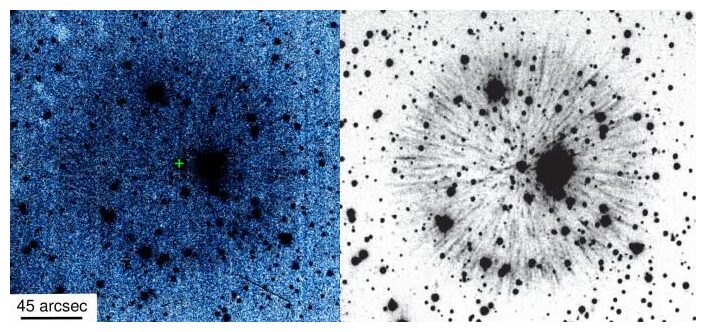
© NASA, ESA, CSA, STScI, A. Levan/IMAPP, Warw, A. Pagan/STScIThe site of the gamma-ray burst and kilonova
The kilonova explosion that resulted when two neutron stars slammed into each other a billion light-years away turned out to be factory for rare heavy elements.

It's the first time the James Webb Space Telescope has probed such an event; and, in the aftermath of a colossal gamma-ray burst that emerged on 7 March 2023, the telescope's data revealed evidence of tellurium - a rare metal too heavy to be forged in the hearts of stars by the process of fusion.

There was also a suggestion of other metals, such as tungsten and selenium. The discovery, researchers say, confirms neutron star mergers as a source of heavy elements, an important piece of how our Universe makes material and spreads it across space.

"There are only a mere handful of known kilonovas, and this is the first time we have been able to look at the aftermath of a kilonova with the James Webb Space Telescope," says astrophysicist Andrew Levan of Radboud University, who led the analysis.

He adds, "Just over 150 years since Dmitri Mendeleev wrote down the periodic table of elements, we are now finally in a position to start filling in those last blanks of understanding where everything was made."

graph
© NASA, ESA, CSA, J. Olmsted/STScIThe spectrum observed y JWST, with the signature of tellurium.

Mars

Curiosity rover finds new evidence of ancient Mars rivers, a key signal for life

Curiosity
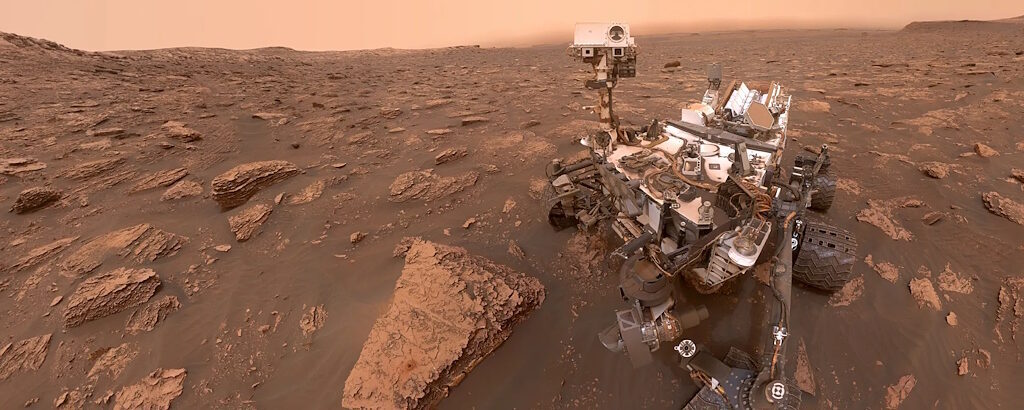
© NASANASA’s Curiosity Mars rover used two different cameras to create this selfie.
New analysis of data from the Curiosity rover reveals that much of the craters on Mars today could have once been habitable rivers.

"We're finding evidence that Mars was likely a planet of rivers," said Benjamin Cardenas, assistant professor of geosciences at Penn State and lead author on a new paper announcing the discovery. "We see signs of this all over the planet."

In a study published in Geophysical Research Letters, the researchers used numerical models to simulate erosion on Mars over millennia and found that common crater formations — called bench-and-nose landforms — are most likely remnants of ancient riverbeds.

The study was the first to map the erosion of ancient Martian soil by training a computer model on a combination of satellite data, Curiosity images and 3D scans of the stratigraphy — or layers of rock, called strata, deposited over millions of years — beneath the Gulf of Mexico seafloor. The analysis revealed a new interpretation for common Martian crater formations which, until now, have never been associated with eroded river deposits.

Info

Ancient landscape not seen for 14 million years discovered beneath Antarctic ice

Antarctica Below the Ice
© Stewart Jamieson
Researchers have uncovered an ancient landscape that remained hidden beneath the East Antarctic Ice Sheet (EAIS) for at least 14 million years, using new satellite data and radar imaging.

This newly discovered landscape consists of ancient valleys and ridges, not dissimilar in size and scale to the glacially-modified landscape of North Wales, UK.

With ice-penetrating radar and satellite data, Durham University glaciologist Stewart Jamieson and colleagues mapped the topographic features of the landscape hidden beneath the East Antarctic Ice Sheet, to get a better understanding of how the ice sheet has fluctuated over time.

The researchers say preserved landscapes like this provide a rare opportunity to examine past ice conditions, but warming temperatures mean we are on track to return to the climate conditions that existed before the landscape was frozen, and it is possible that the East Antarctic Ice Sheet will retreat enough to change the landscape for the first time in at least 14 million years.

"The land underneath the East Antarctic Ice Sheet is less well known than the surface of Mars," explained study author Professor Stewart Jamieson in a statement. "And that's a problem because that landscape controls the way that ice in Antarctica flows, and it controls the way it might respond to past, present and future climate change."

Mars

New study reveals source of largest ever Mars quake

mars with sunrise marsquake research
© Elen11, Getty Images.A new study led by the University of Oxford suggests that the planet Mars is much more seismically active than previously thought.
A global team of scientists led by the University of Oxford have announced the results of an unprecedented collaboration to search for the source of the largest ever seismic event recorded on Mars. The study rules out a meteorite impact, suggesting instead that the quake was the result of enormous tectonic forces within Mars' crust. The results have been published today in the journal Geophysical Research Letters.

The quake, which had a magnitude of 4.7 and caused vibrations to reverberate through the planet for at least six hours, was recorded by NASA's InSight lander on Wednesday 4 May 2022. Because its seismic signal was similar to previous quakes known to be caused by meteoroid impacts, the team believed that this event (dubbed 'S1222a') might have been caused by an impact as well, and launched an international search for a fresh crater.

Although Mars is smaller than Earth, it has a similar land surface area because it has no oceans. In order to survey this huge amount of ground - 144 million km2 - study lead Dr Benjamin Fernando from the University of Oxford's Department of Physics sought contributions from the European Space Agency, the Chinese National Space Agency, the Indian Space Research Organisation, and the United Arab Emirates Space Agency. This is thought to be the first time that all missions in orbit around Mars have collaborated on a single project.