
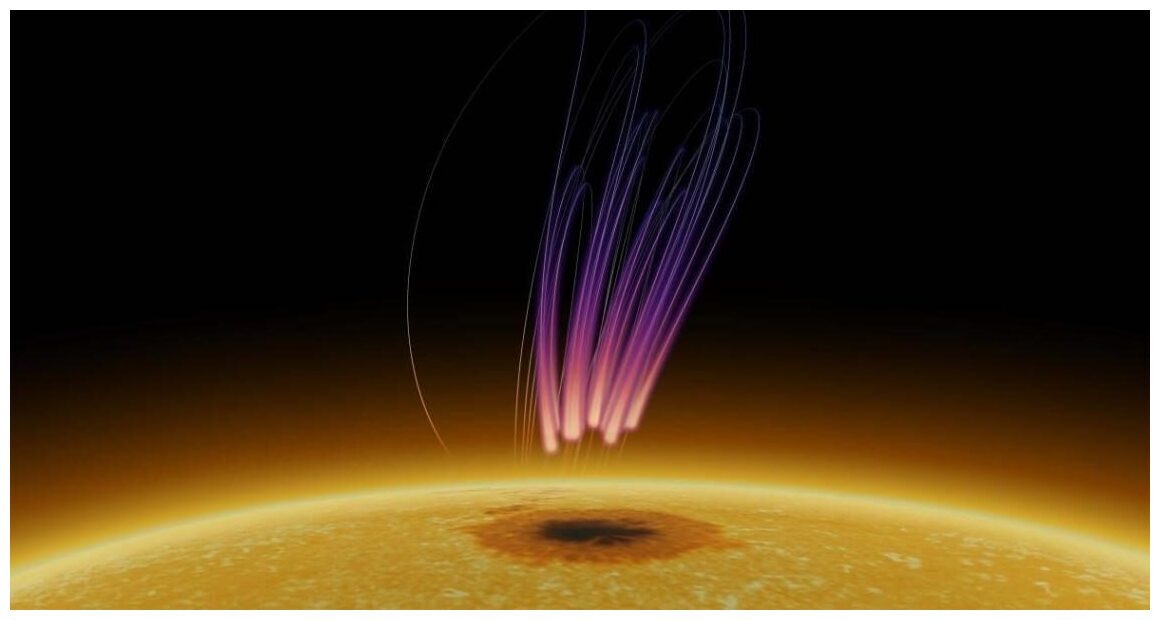
© Sijie YuScientists uncover prolonged radio emissions above a sunspot, akin to those previously seen in the polar regions of planets and certain stars, which may reshape our understanding of intense stellar radio bursts.
Researchers say the novel radio emission shares characteristics with the auroral radio emissions commonly seen in planetary magnetospheres such as those around Earth, Jupiter and Saturn, as well as certain low-mass stars.
The discovery offers new insights into the origin of such intense solar radio bursts and potentially opens new avenues for understanding similar phenomena in distant stars with large starspots, according to the study's lead author and NJIT-CSTR scientist, Sijie Yu.
"We've detected a peculiar type of long-lasting polarized radio bursts emanating from a sunspot, persisting for over a week," said Yu. "This is quite unlike the typical, transient solar radio bursts typically lasting minutes or hours. It's an exciting discovery that has the potential to alter our comprehension of stellar magnetic processes."
Famous auroral light shows that are visible across the sky of Earth's polar regions, like the Aurora Borealis or Aurora Australis, occur as solar activities disturb Earth's magnetosphere, which facilitates the precipitation of charged particles to the Earth's polar region where the magnetic field converges, and interacts with oxygen and nitrogen atoms in the high atmosphere. Accelerating toward the north and south poles, such electrons can generate intense radio emissions at frequencies around a few hundred kHz.
















Comment: More on Lynas: Have you heard about the famous anti-GMO scientist who switched sides and is now pro?