
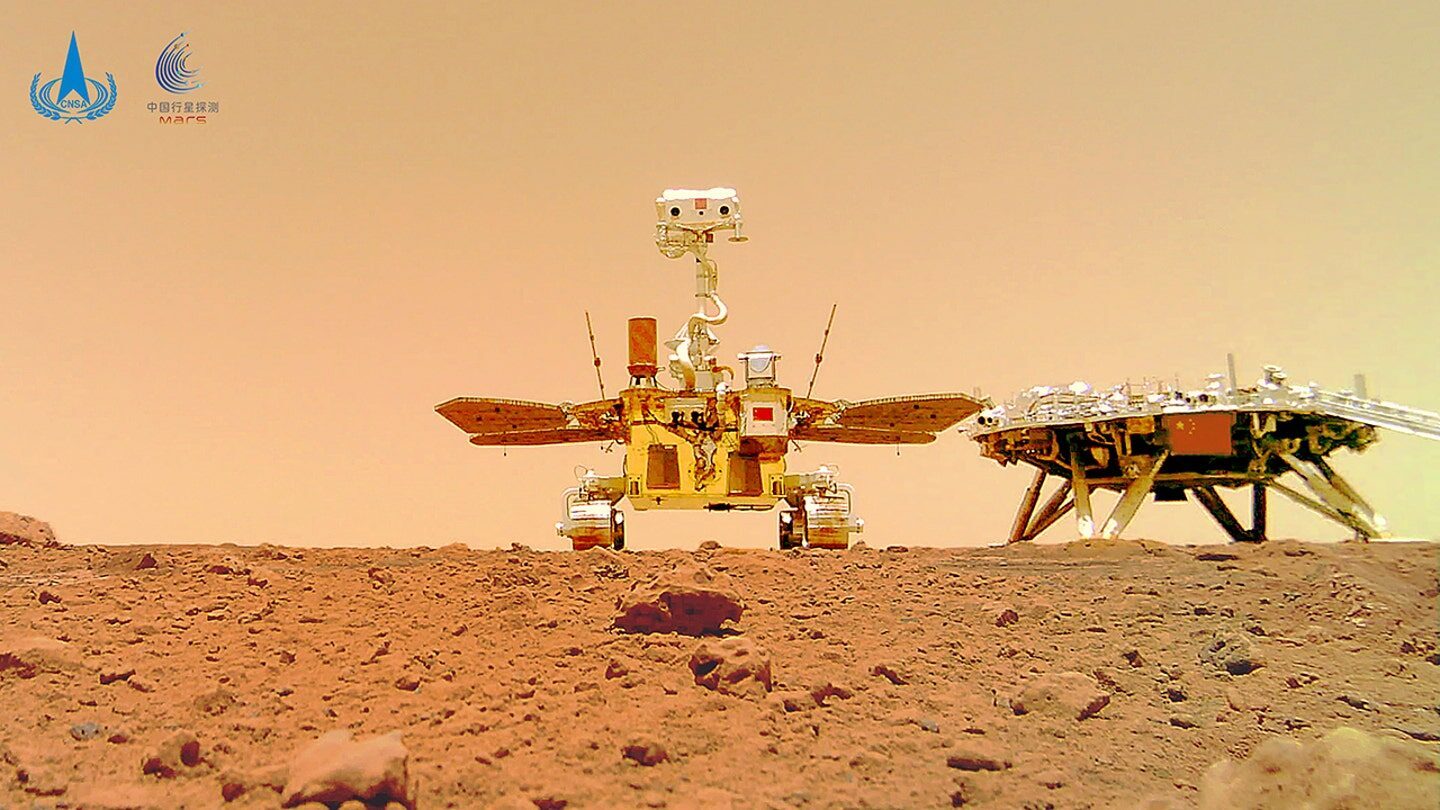
© CNSA via APChina's Mars rover, Zhurong, is seen near its landing platform during a mission to the planet in 2021.
A robotic space chemist could create oxygen on Mars using materials from the planet's surface, Chinese researchers behind the project say.
A refrigerator-sized machine equipped with artificial intelligence and a robotic arm broke down material from five meteorites and analyzed it to identify a chemical formula that creates a substance that can cause oxygen to separate from water. Researchers said it would have taken a human 2,000 years to find that formula.
"Oxygen supply must be the top priority for any human activity on Mars, because rocket propellants and life support systems consume substantial amounts of oxygen, which cannot be replenished from the Martian atmosphere," the researchers wrote. "Here we demonstrate a robotic artificial-intelligence chemist for automated synthesis and intelligent optimization of catalysts for the oxygen evolution reaction from Martian meteorites."
Creating oxygen from Martian materials and ice would remove the need for astronauts to bring oxygen-creating supplies to the planet from Earth. Further, a robotic chemist could eliminate the need for humans to oversee the processes.
"We have developed a robotic AI system that has a chemistry brain," said University of Science and Technology of China in Hefei scientist Jun Jiang, who led the study. "We think our machine can make use of compounds in Martian ores without human guidance."
This was not the first experiment to test how to create oxygen on Mars.
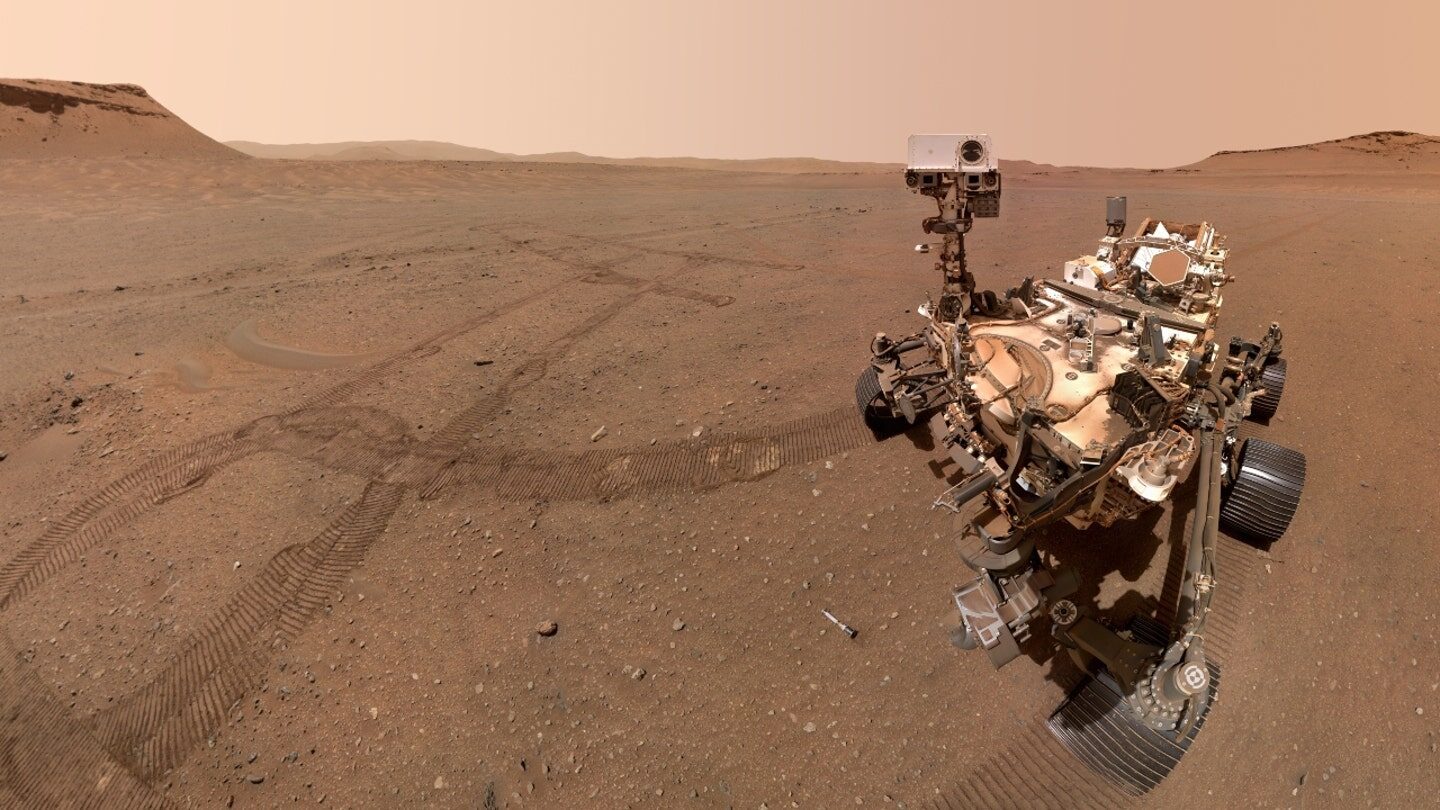
© NASA/JPL-Caltech/MSSSNASA's Perseverance rover on the surface of Mars.
"There's zero obstacle to scaling this up," Michael Hect, the head of MOXIE told Nature, adding "you can produce two to three kilograms an hour."
Each astronaut aboard the International Space Station needs about 840 grams of oxygen a day to survive, according to NASA.
Meanwhile, Jiang said his robot could form more than just oxygen.
"Different chemicals can be made by this robot," he said, noting that it could create a method to produce plant fertilizer.
"Maybe lunar soil is another direction," Jiang added.



Reader Comments
Still can’t plumb the human condition on this realm & people placing mental focus on an abstract idea that has yet to be proven in any tangible rational logos/ethos only imagined.
Stupefying ignorance
Lest anyone think this is a step towards geo-engineering, Mars doesn't have sufficient magnetosphere to stop any potential atmosphere from simply being blown away by solar wind. Mars is dead.
The picture at the top of this article looks a lot like Antarctica or Greenland viewed through a filter.
With absolutely zero tangible proof using Law of Parsimony or Occam’s Razor vs. a known fraud NASA & their track record off we go into the wild blue yonder with our imagination's.
Stupefying ignorance
China's Mars rover completes primary mission, continues to explore red planet [Link]
Video of Mars landing looks like a Roger Corman B movie
Insulting to human intelligence by a gigaparsec
At least NASA and the Italians use real locations for their simulations (even if they get the odd bird, lemming or puddle in the pic).
Another thing that gets me, that NASA helicopter drone on Mars. How does that operate in an atmosphere that's about 1% as dense as earth's? Again, I suspect it's down in Antarctica.
Brains are ours but the Operation System is theirs - The Matrix they manage it completely.