Science & TechnologyS

Info

Researchers track the creation of giant underwater volcano in the Indian Ocean

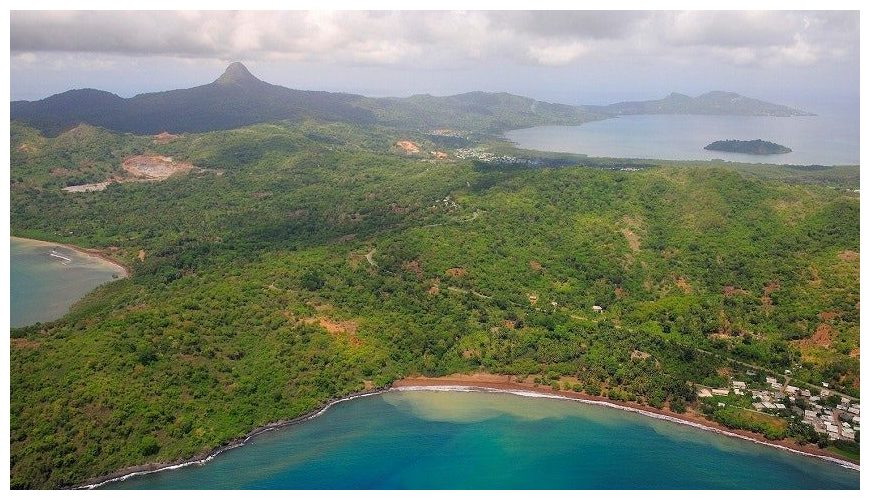
Mayotte Main Island
© Peter Giovannini / GETTY IMAGESAllโ€™s quiet onshore. Mayotteโ€™s main island, Grande Terre.
Scientists are unravelling the dramatic events that created a huge underwater volcano off Mayotte in the Indian Ocean in 2018 - an event not confirmed until the following year.

An international team led by Simone Cesca from Germany's GeoForschungsZentrum (GFZ) is reconstructing the partial emptying of what it says is one of the deepest and largest active magma reservoirs ever discovered in the upper mantle.

And, the researchers report in the journal Nature Geoscience, it's rather as they expected.

Mayotte's two islands are part of the Comoros archipelago, which lies between Africa and Madagascar.

Unusual seismic activity in the area began with a swarm of thousands of "seemingly tectonic" earthquakes, the researchers say, culminating in an earthquake of magnitude 5.9 in May 2018.

From June, however, a new form of earthquake signal emerged and the 20-to-30-minute signals - known as Very Long Period (VLP) signals - are so strong that they can be recorded up to a thousand kilometres away.

Comet 2

New Comet C/2019 Y1 (ATLAS)

CBET 4708 & MPEC 2020-A72, issued on 2020, January 05, announce the discovery of a comet (magnitude ~18) in the course of the "Asteroid Terrestrial-Impact Last Alert System" (ATLAS) search program, in images taken on 2019, Dec 16 with a 0.5-m reflector + CCD. The new comet has been designated C/2019 Y1 (ATLAS).

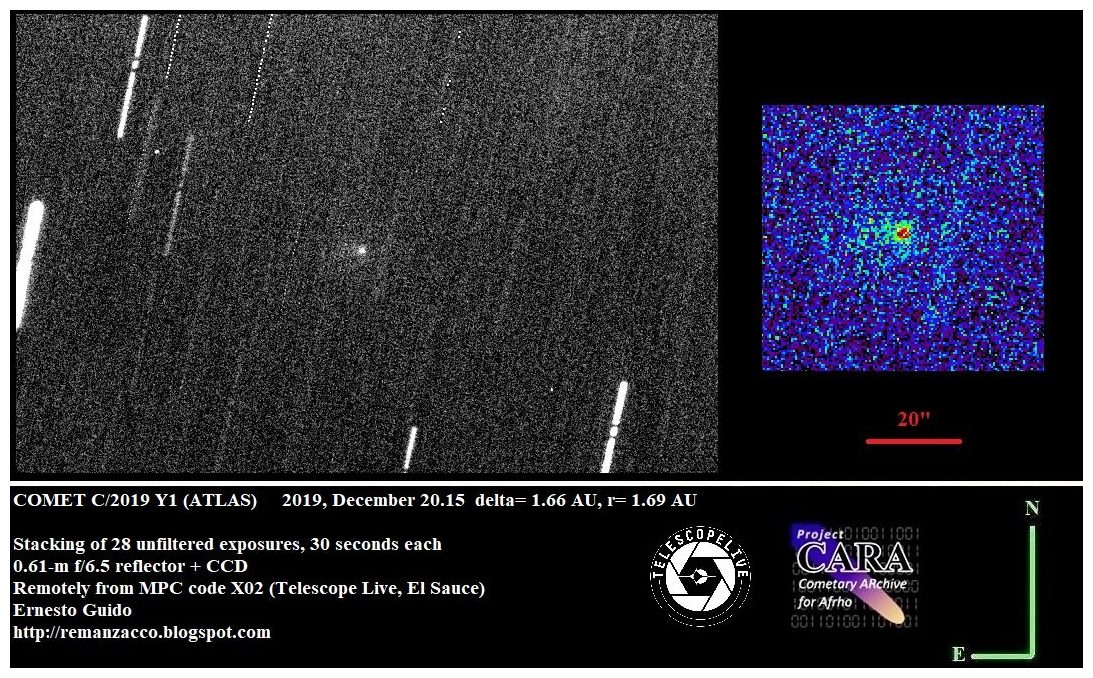
I performed follow-up measurements of this object while it was still on the PCCP webpage. Stacking of 28 unfiltered exposures, 30 seconds each, obtained remotely on 2019, December 20.15 from X02 Telescope Live network (El Sauce, Chile) through a 0.6-m f/6.5 reflector + CCD, shows that this object is a comet with a sharp central condensation and a diffuse irregular coma about 15 arcsec in diameter elongated in PA 90.

My confirmation image (click on it for a bigger version)
Comet C/2019 Y1 Atlas
© Remanzacco Blogspot

Comet 2

Rare shooting star adds flair to Russian northern lights display

Northern lights Murmansk Russia
While residents in the Russian city of Murmansk will by now be well used to the beautiful northern lights displays each year, the 2020 version featured an incredibly rare shooting star to add a little flair to the proceedings.

The northern lights, or aurora borealis, is a natural phenomenon in which disturbances in the magnetosphere caused by solar wind create stunning and hypnotic light shows of varying color and complexity, as breathtaking video from Murmansk, northwestern Russia, taken on Saturday night, shows.


Comet

Potentially hazardous asteroid 2019 UO to pass by Earth this week

Asteroid approaching Earth
© CCO
Despite its massive size and the high speed it travels at, the space rock is expected to pass our planet at a distance of over 4 million kilometers.

It seems that our planet is about to have yet another relatively close encounter with a massive space rock as an asteroid designated by NASA as 2019 UO is expected to pass by Earth on 10 January.
As the Daily Express points out, the rock, labeled as a "potentially dangerous asteroid" by the space agency, measures between 250 and 550 meters in diameter, potentially putting its size on par with such terrestrial landmarks as Ostankino TV Tower in Moscow in terms of height.

Comment: Incoming swarm: NASA detects FOUR more asteroids headed our way


Vader

The Pentagon lusts for killer robots: Expect endless wars and civilian massacres to become the norm

Killer Robots
© YouTube
When human troops are replaced by robots on the battlefield, it won't be because the Pentagon's had some revelation about the value of human life - it'll be an effort to defuse anti-war protests by minimizing visible casualties.

US military commanders are itching to get their hands on some killer robots after an Army war game saw a human-robot coalition repeatedly rout an all-human company three times its size. The technology used in the computer-simulated clashes doesn't exist quite yet - the concept was only devised a few months ago - but it's in the pipeline, and that should concern anyone who prefers peace to war.

"We reduced the risk to US forces to zero, basically, and were still able to accomplish the mission," Army Captain Philip Belanger gushed to Breaking Defense last week, after commanding the silicon soldiers through close to a dozen battles at Fort Benning Maneuver Battle Lab. When they tried to fight an army three times their size again without the robotic reinforcements? "Things did not go well for us," Belanger admitted.

Comment:


Boat

Color-changing fibers help reveal mysteries of how knots work

knot
© Joseph SandtColor-changing fibers reveal areas with high strain (yellow and green) in a knot. Experiments with these fibers helped scientists understand what makes one knot stronger than another.
Deciding whether a knot is fit to be tied just got a bit more scientific.

Some knots are stronger than others, but scientists have struggled to explain why. Now, with the help of color-changing fibers, researchers have developed simple mathematical rules that can determine the relative strength of various knots based only on the knots' topology โ€” the geometry of how the knot is tied.

"Despite the fact that [knots] have been around for thousands of years, not much is known about why they work the way they do," says applied mathematician Vishal Patil of MIT.

Comment: See also:


Network

US government limits exports of artificial intelligence software

Artificial intelligence
The Trump administration took measures on Friday to crimp exports of artificial intelligence software as part of a bid to keep sensitive technologies out of the hands of rival powers like China.

Under a new rule which goes into effect on Monday, companies that export certain types of geospatial imagery software from the United States must apply for a license to send it overseas except when it is being shipped to Canada.

"They want to keep American companies from helping the Chinese make better AI products that can help their military," said James Lewis, a technology expert with the Washington-based Center for Strategic and International Studies think tank.

Bullseye

The case for Intelligent Design: Why random processes cannot produce information

intelligent design
This is the important question ID raises against the neo-Darwinian claim that life came about by random processes. Here I offer some thoughts about the connection between information in the form of digital codes and the products they code for. I thus hope to support the argument for ID and for what seems to me the inescapable fact of teleology in nature.

If a random number generator were set to produce eight digit numbers, and it coincidentally spat out 87958007, which happens to be my phone number, would it then have produced information? Or if a prebiotic soup randomly produced a functional protein, or a string of DNA that coded for a protein (ignoring the low probability of such occurrences), would the soup have produced information?

I would argue no.

The specific sequences that carry information, phone numbers, for example, can only be defined as information in relation to the whole system of which they are a part. There needs to be a translation system with defined rules that sorts out which sequences contains information and which do not.

To claim that information in DNA could arise by random chance is therefore nonsense. A functional sequence could not be regarded as information until we have a complete set of rules which defines that certain sequences are functional and all others are nonfunctional gobbledygook.

Comment: More on Intelligent Design:


Bug

The crazy story of how Soviet Russia bugged an American embassy's typewriters

spy bug russia
© Stuart Bradford
Every engineer has stories of bugs that they discovered through clever detective work. But such exploits are seldom of interest to other engineers, let alone the general public. Nonetheless, a recent book authored by Eric Haseltine, titled The Spy in Moscow Station (Macmillan, 2019), is a true story of bug hunting that should be of interest to all. It recounts a lengthy struggle by Charles Gandy, an electrical engineer at the United States' National Security Agency, to uncover an elaborate and ingenious scheme by Soviet engineers to intercept communications in the American embassy in Moscow. (I should say that, by coincidence, both Haseltine and Gandy are friends of mine.)

This was during the Cold War in the late 1970s. American spies were being arrested, and how they were being identified was a matter of great concern to U.S. intelligence. The first break came with the accidental discovery of a false chimney cavity at the Moscow embassy. Inside the chimney was an unusual Yagi-style antenna that could be raised and lowered with pulleys. The antenna had three active elements, each tuned to a different wavelength. What was the purpose of this antenna, and what transmitters was it listening to?

Gandy pursued these questions for years, not only baffled by the technology, but buffeted by interagency disputes and hampered by the Soviet KGB. At one point he was issued a "cease and desist" letter by the CIA, which, along with the State Department, had authority over security at the embassy. These agencies were not persuaded that there were any transmitters to be found: Regular scans for emissions from bugs showed nothing.

Apple Green

For your post-holiday enjoyment, healthy ID snacks

lotus leaf
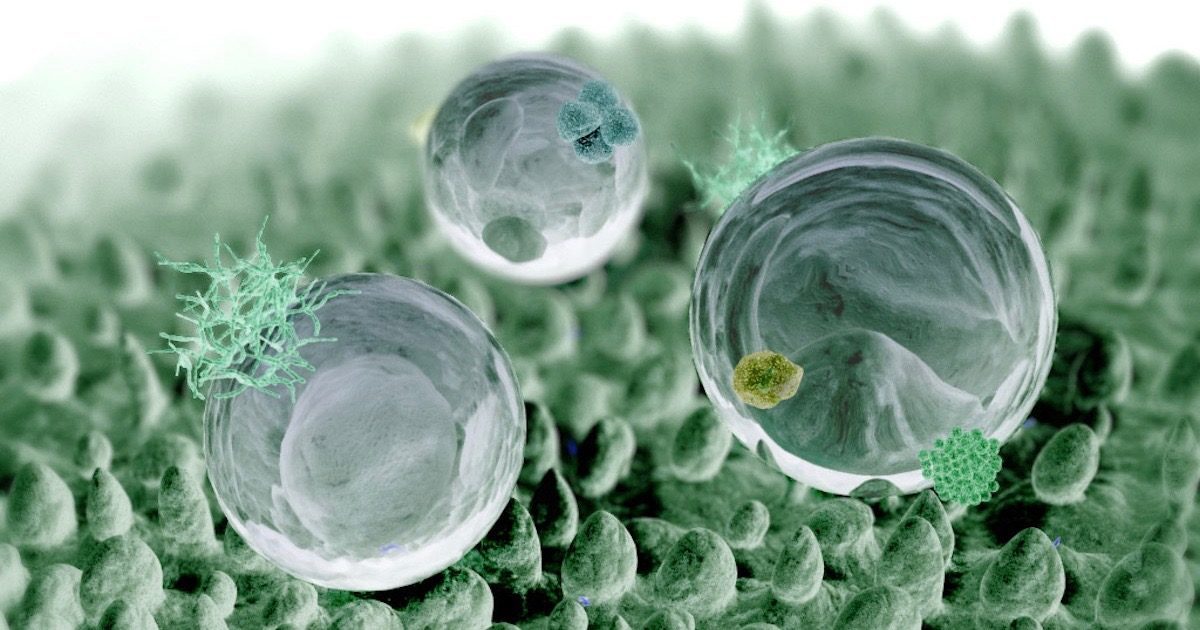
© William ThielickeSpecial repellent properties of the lotus leaf inspired the "ultimate non-stick coating"
Yesterday, Evolution News offered appetizers for 2020. But maybe you are bothered already by overeating during the recent holidays. No problem. Here are healthy nuggets with an ID flavor to snack on.

Better Suction Cups

Those plastic suction cups we use on glass fall off after a while. One would never think of getting them to stick to uneven rock. How about fastening them to rock underwater in a strong current? Impossible? The aquatic larvae of the net-winged midge do it. To the amazement of biologists from the University of Cambridge, these larvae even move around the rocks without losing their grip while subjected to "absolutely enormous" forces trying to pull them off, reports Phys.org.
The larvae have the ability to quickly detach and reattach to underwater rocks in torrential alpine rivers that can flow as fast as three metres per second. Their highly specialised suction organs are so strong that only forces over 600 times their body weight can detach them. [Emphasis added.]
The investigators had difficulty balancing while standing knee deep in the river, but they found the larvae "grazing on the underwater rocks, apparently oblivious to the torrents bearing down on them." The larvae possess the highest attachment strength ever recorded in insects. What's their secret?

Comment: See also: