
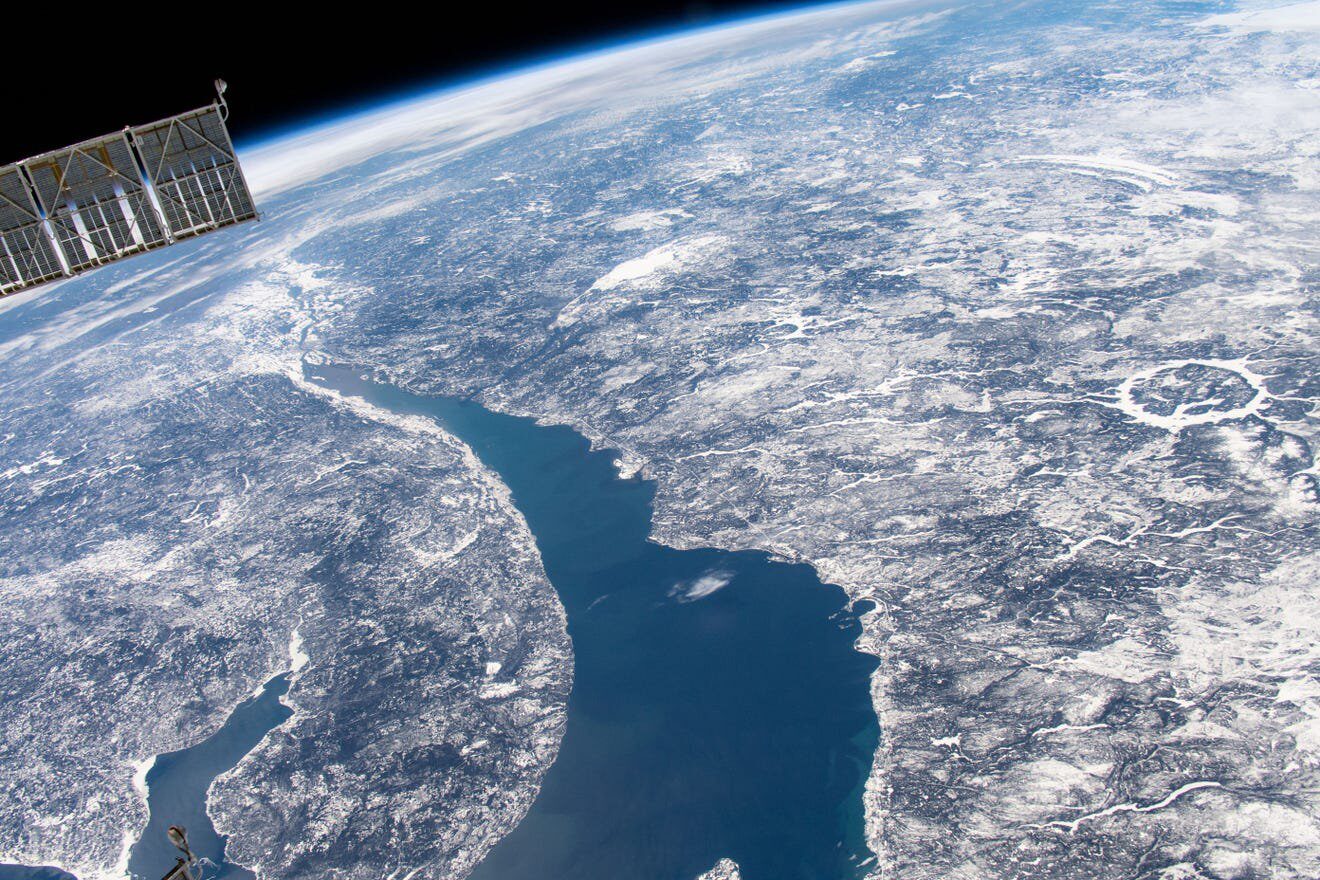
© NASA, International Space Station Expedition 59This image was captured by the International Space Station Expedition 59 crew as they orbited 400 kilometers above Quebec, Canada. Right of center, the ring-shaped lake is a modern reservoir within the eroded remnant of an ancient 100 kilometer diameter impact crater, which is over 200 million years old.
During the week of April 26, members of NASA's Planetary Defense Coordination Office (PDCO) will participate in a "tabletop exercise" to simulate an asteroid impact scenario. The exercise depicting this fictional event is being led by NASA's Jet Propulsion Laboratory's Center for Near Earth Object Studies (CNEOS), allowing NASA's PDCO and other U.S. agencies and space science institutions, along with international space agencies and partners, to use the fictitious scenario to investigate how near-Earth object (NEO) observers, space agency officials, emergency managers, decision makers, and citizens might respond and work together to an actual impact prediction and simulate the evolving information that becomes available in the event an asteroid impact threat is discovered.
The fictitious impact scenario will occur during the 7th IAA Planetary Defense Conference, hosted by the United Nations Office for Outer Space Affairs in cooperation with ESA (European Space Agency), and will evolve over the five days of the conference, starting Monday, April 26. At several points in the conference program, leaders of the exercise will brief participants on the latest status of the fictitious scenario and solicit feedback for next steps based on the simulated data that is "discovered" each day. These type of exercises are specifically identified as part of the National Near-Earth Object Preparedness Strategy and Action Plan developed over a three-year period and published by the White House in June 2018.
















Comment: Meanwhile a record number of asteroids were observed flying past Earth in 2020 - Despite lockdowns interrupting surveys.