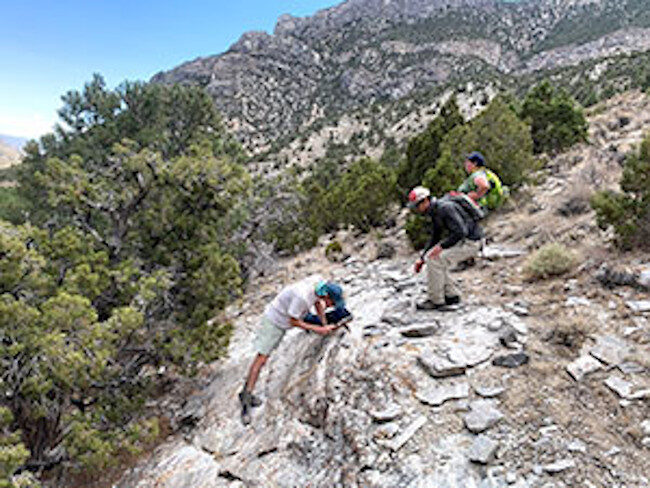
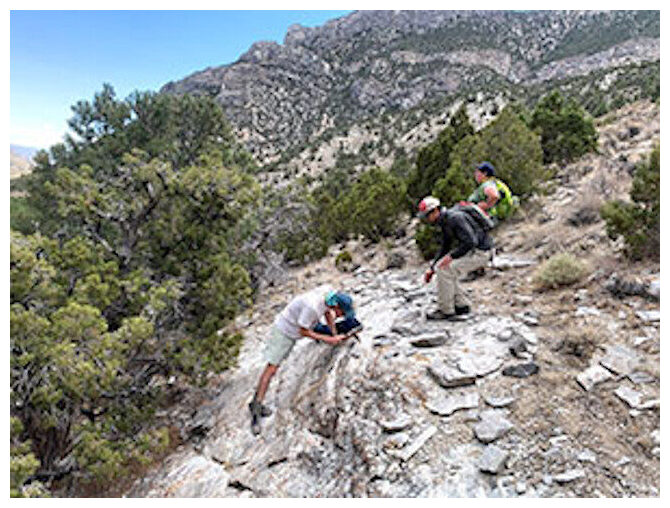
© Jay Chapman PhotoFrom left, UW students Shane Scoggin, Adam Trzinski and Jessie Shields are part of new research investigating crustal melting in western North America. Here, they examine igneous rocks in the Snake Range of Nevada.
A group of University of Wyoming professors and students has identified an
unusual belt of igneous rocks that stretches for over 2,000 miles from British Columbia, Canada, to Sonora, Mexico.The rock belt runs through Idaho, Montana, Nevada, southeast California and Arizona.
"Geoscientists usually associate long belts of igneous rocks with chains of volcanoes at subduction zones, like Mount Shasta, Mount Hood, Mount St. Helens and Mount Rainer," says Jay Chapman, an assistant professor in UW's Department of Geology and Geophysics. "What makes this finding so interesting and mysterious is that this belt of igneous rocks is located much farther inland, away from the edge of the continent, and doesn't contain any evidence for producing volcanoes. In fact, all of the melting to generate the igneous rocks originally took place deep underground, five to 10 miles beneath the surface."
Chapman is lead author of a paper, titled "
The North American Cordilleran Anatectic Belt," which was published online in February in the journal
Earth-Science Reviews. The print version will be published this month.
The paper is a result of a special course taught by Simone Runyon, an assistant professor in UW's Department of Geology and Geophysics, and Chapman. Runyon, six UW graduate students and one undergraduate student, who took part in the course, are co-authors of the paper.
"It was really fascinating to start with a scientific question in a classroom, then collect and analyze data, and eventually publish our results," says Cody Pridmore, a UW graduate student from Orange, Calif., and co-author of the paper. "It's a process most college students don't get to experience."
















Comment: Maybe not from Mars, but the evidence does show that viruses from space may indeed already have been involved in pandemics on Earth:
- New Light on the Black Death: The Viral and Cosmic Connection
- Book Review: New Light on the Black Death by Mike Baillie
- Coronavirus Came From Meteor Which Hit China Last Year, Claims Scientist
- Viruses from space & evolution: Dr. Wickramasinghe explains it all in new video
Also check out SOTT radio's: