Science & TechnologyS


Blackbox

What's the point of being warm-blooded?

Image
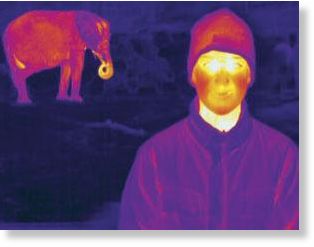
© Ted Kinsman / Photolibrary.comCouldn't the food that warm-blooded animals burn to stay toasty be put to better use?

If you stopped eating today, you wouldn't survive more than two months. A crocodile, on the other hand, might live for a year or more. Why the difference? You waste most of the food you eat generating heat.

The evolution of warm-bloodedness, or endothermy, is one of life's great mysteries. Sure, there are some advantages - staying active in the cold, keeping young cosy and warm, and avoiding having to go out into the open to soak up heat from the sun.

The thing is, you could get much the same advantages by turning up the heat only when and where in the body it is needed, as many animals do. So why do most birds and mammals keep the furnaces burning 24/7? Staying warm - which for birds means 40 °C on average - comes at a price. Some warm-blooded animals have to eat as much in one day as similarly sized reptiles do in a month, a dangerous and time-consuming strategy.

Info

How the fetal brain wires up for action

Before a fetus is born, its brain undergoes the complex process of refining the connections between its different regions. Now a computer model is showing us how.

Although our genes provide an initial blueprint for the way different neurons connect together, the developing brain must still refine the wiring and prune out any redundant connections. "It's a big challenge to have a system that is ready by the time of birth so that newborns can begin experiencing the world right away," says Jean-Philippe Thivierge from Indiana University, Bloomington.

Neuroscientists suspect the brain achieves this by sending out waves of spontaneous electrical activity that cascade across groups of neurons, helping it to scout out the relative positions of neurons and forge the most efficient network.

Health

Wireless RFID tag flags Alzheimer's

A device developed by researchers at the University of South Florida (USF) may help identify patients with early dementia. Most dementia is not detected until memory loss has already occurred. Symptoms are very subtle and usually overlooked. The RFID transponder evaluates the way people walk. Researchers were looking for unusual walking patterns that might indicate impending Alzheimer's Disease .

An RFID (Radio Frequency Identification Device) tag is a microchip attached to an antenna that sends signals to, and receives signals from, a reader. Each tag has a unique serial number, but can contain other information, such as a patient's name. Tags come in many forms. The ones used in this test were part of a small device the patients wore on their wrist. Signals indicating the patient's movements in three spatial dimensions were captured by receivers in their care facility. The tendency to wander, veer suddenly, or pause frequently can be an indication of cognitive decline.

Crusader

Why the Catholic church can't ignore science

Piazza San Pietro and St Peter's Basilica Rome, Italy
© Johannes Simon / WestEnd61 / RexPiazza San Pietro and St Peter's Basilica Rome, Italy

In December, with great fanfare, the Vatican released Dignitas Personae, its latest report on bioethics. Sad to say, the document demonstrates once more that a morality rooted in outdated, pre-scientific understanding is not appropriate to modern realities.

I refer not to the hot-button issues of abortion or stem cell research but to the Catholic church's continued opposition to a decidedly pro-life medical intervention: in vitro fertilisation. The moral basis of the Vatican's opposition seems to be twofold: that only conception achieved through the sexual union of a man and a woman is sacred, and that the fertilised cell that results from such a union has a soul and therefore the dignity of a person.

Even before IVF was attempted, the Catholic church opposed it with the suggestion, as I understand it, that a baby conceived by this method would not have a soul. This objection was dropped after the first IVF babies were born and found to be like all other babies, growing up to be normal human beings indistinguishable from their non-IVF counterparts.

But while empirical evidence is the basis of science, faith has different foundations. The pope remains opposed to IVF on the grounds that sexual union is sacred, and therefore only conception achieved through sexual union accords sufficient dignity to the end product. I have to wonder, though, whose dignity is enhanced by withholding medically viable methods that have allowed infertile couples, now numbering in the millions, to conceive and give birth to children they will love.

Display

Barack Obama Comes to Street Fighter Video Game

Obama fighter
© UnknownObama character in Street Fighter video game.
No, he's not unlockable in Street Fighter 4, sadly. But he's going to be playable in the oddball Japan-only Street Fighter Online: Mouse Generation, and it looks like he can sling fireballs with the best of them.

Sporting a debonair tuxedo and cartoonishly big teeth (yeah, I don't know), Obama seems like a force to be reckoned with in Street Fighter Online. You can make him say "YES WE CAN" in a gigantic word bubble, and he's got a standard fireball attack too. He also looks like he's been training with Balrog - Virtua Fighter 2 looking graphics aside, this version of the Commander In Chief is decidedly beefy. He'll be arriving in the game on Valentine's Day as part of a promotion that also includes playable chocolate figurine chracters and a Zangief who has what look like clam shells for shoulder guards?

Comment: This brings a disturbing example of the development surrounding Obama's popularity: books written by Obama, posters/t-shirts of him, his appearance in Spider-Man comic books, and school and streets named after him. And now, he's in a video game, throwing fireballs?


Meteor

Cosmic Dust Interferes with Astronomical Observations

Space dust interferes with the observation of distant stars and annoys astronomers just as much as the household variety does.

"We not only do not know what the stuff is, but we do not know where it is made or how it gets into space," said Donald York, professor in astronomy at the University of Chicago.

But now York and University of Toledo's Adolf Witt and their collaborators have observed a double-star system that displays all the characteristics that astronomers suspect are associated with dust production.

Magnify

Oldest Human Hair Discovered in Fossilized Hyena Poop

A new study has suggested that strands discovered in fossil hyena poop found in a South African cave, could be the oldest known human hairs.

According to a report in National Geographic News, researchers discovered the rock-hard hyena dung near the Sterkfontein caves, where many early human ancestor fossils have been found.

Each white, round fossil turd, or coprolite, is roughly 0.8 inch (2 centimeters) across. They were found embedded in sediments 195,000 to 257,000 years old.

Footprints

Are We Bringing Our Germs to Mars?

Star Trek fans know it as the Prime Directive: that there should be no interference with the internal affairs of other civilizations. (Given the frequency with which captains Kirk, Picard, et. al., violate it, however, the Prime Directive seems more like a Prime Suggestion.) Since human beings have yet to explore very far beyond Earth, pondering an interplanetary noninterference policy of our own may seem a little premature - at least until we've mastered warp drives and phasers.

But in fact, such a directive already exists in some form - the international Outer Space Treaty of 1967, which governs the legal framework for activities in space. Best known for banning governments from putting nuclear weapons into orbit, the treaty also requires space-faring nations to avoid "harmful contamination" of other worlds while exploring the solar system. Human beings have yet to set foot on other planets, so the risk today comes from bacteria that can hitch a ride on unmanned spacecraft like NASA's Mars Phoenix Lander, which arrived on the red planet's surface last May. (See pictures of the Mars Rover's five years in space.)

Oscar

The Unraveling of the Ethanol Scam

On its website, Wisconsin-based Renew Energy says it is the "biofuels industry leader for innovation and efficiency." It goes on, saying that its new 130 million gallon per year ethanol plant in Jefferson, Wisconsin is "the largest dry mill corn fractionation facility in the world" which uses 35 percent less energy and 33 percent less water than similar ethanol plants.

That would be impressive but for one fact: Renew Energy just filed for bankruptcy.

The failure of Renew is the latest bankruptcy in the corn ethanol industry, a sector that despite billions of dollars in federal subsidies, hasn't been able to prove its long-term economic viability. About 9 percent of all the ethanol plants in the US have now filed for bankruptcy and some analysts believe the numbers could go as high as 20 percent.

Even if the 20 percent figure is never reached, it's readily apparent that billions of investment dollars will be lost on the corn ethanol scam, a darling of farm state legislators. Today, about four years after Congress increased the mandates on the use of corn ethanol in gasoline, the US is nowhere close to the much-promised goal of "energy independence." Instead, the increasing use of corn to make motor fuel has caused a myriad of problems. Chief among them: increased food prices.

Sun

Two Suns Found in Distant Planetary System

South Korean researchers say they've discovered a planetary system that has two suns.

Lee Jae-woo and Kim Seung-ri of the Korea Astronomy and Space Science Institute and Kim Chun-hwui of Chungbuk National University said the planetary system, which they've named HW Vir has had the two suns since its birth, unlike other planetary systems in which a second sun was drawn by gravitational attraction, South Korea's Chosun Ilbo newspaper reported Friday.