Dust is everywhere in space, but the pervasive stuff is one thing astronomers know little about. Cosmic dust is also elusive, as it lasts only about 10,000 years, a brief period in the life of a star. "We not only do not know what the stuff is, but we do not know where it is made or how it gets into space," said Donald York, a professor at the University of Chicago. But now York and a group of collaborators have observed a double-star system, HD 44179, that may be creating a fountain of dust. The discovery has wide-ranging implications, because dust is critical to scientific theories about how stars form.
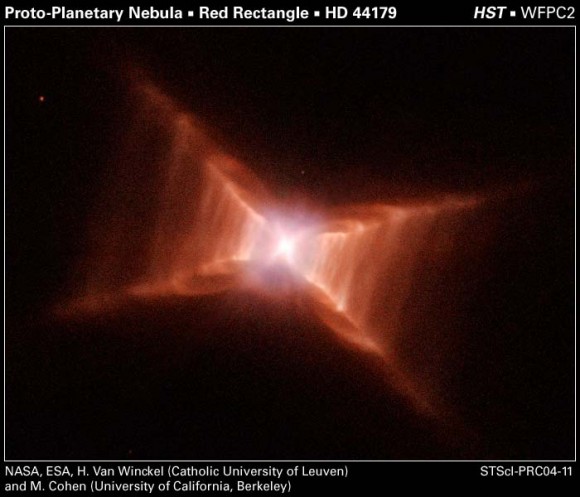
© NASAHST image of the Red Rectangle.
The double star system sits within what astronomers call the Red Rectangle, a nebula full of gas and dust located approximately 2,300 light years from Earth.
One of the double stars is a post-asymptotic giant branch (post-AGB) star, a type of star astronomers regard as a likely source of dust. These stars, unlike the sun, have already burned all the hydrogen in their cores and have collapsed, burning a new fuel, helium.