Science & TechnologyS


Telescope

How will the solar system end?

Image
© Raghvendra Sahai and John Trauger (JPL) / WFPC2 science team / NASAMyCn18 is a young planetary nebula, located about 8,000 light-years away. Planetary nebulae are shells of gas and dust, which stars eject when they run out of fuel. This Hubble image reveals the true shape of MyCn18 to be an hourglass with an intricate pattern of "etchings" in its walls.

We live in uninteresting times. Since the ructions that created the planets in the solar system's first 100 million years and apart from an early migration of the giant planets and the odd colliding comet not swept safely aside by Jupiter - nothing much has really been happening. The planets circle like clockwork, the sun burns steadily, and even delicate life has survived on at least one world.

It cannot last. Something unpleasant is bound to shatter this comfortable calm.

Our sun will die, of course, about six billion years from now. But things could get ugly long before that. The steady gyrations of the solar system today may conceal the seeds of chaos. Even the tiniest of irregularities can build up over time, gradually altering the paths of the planets. Between now and final sundown, it has been calculated, there is a roughly 2 per cent chance of catastrophe. Mars might drift too close to Jupiter and be thrown out of the solar system. If we're very unlucky, hot-headed Mercury could run wild and smash into Earth.

Telescope

Planet quest gets small

hatnet, alien earth, extrasolar planet, planet, red dwarf
© David A. Aguilar / CfAThis artwork shows the "super-Neptune" planet.
Normally blue in color, its
red hue is caused by the
illumination from the
nearby dwarf star.
A network of small telescopes has bagged its smallest prize yet - and that's great news for astronomers.

HATNet's discovery of an extrasolar world only slightly bigger than Neptune helps prepare the way for an even more capable planet-hunter that could find alien Earths.

HAL9000

IBM develop 'most realistic' computerised voice

Scientists at IBM have developed a computerised voice that is almost indistinguishable from a human.

The voice is made even more convincing because it has been programmed to include verbal tics such as "ums", "ers" and sighs.

Computer experts at IBM have invented the technology to be used on telephone helplines, satellite navigation systems and even on cameras or iPods.

It is so sophisticated that the devices will be able to pause for effect or cough to attract the users' attention, spelling an end to the irritating monotone voices that have become a part of everyday modern life.

Telescope

Massive asteroid collision may have sent the moon into a spin

Moon closeup
© AP
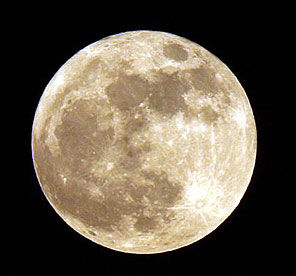
Around 4 billion years ago, was this the far side of the moon?
A study of lunar craters suggests the side of the moon that now faces Earth was once facing in the opposite direction

The man in the moon may once have faced out to space, until a chance collision with a giant asteroid billions of years ago, scientists have found.

A study of the heavily cratered surface has revealed evidence of a huge impact early in the moon's history that may have been powerful enough to set it spinning, making its far side periodically point towards Earth.

Magnify

Teleporter Sends Ions on Long-Distance Journey

We may never zap Jeff Goldblum across a room, but this feat of quantum teleportation is impressive nevertheless.

A team in the US has built a teleporter capable of sending the state of ytterbium ions from one side of the lab to the other; something that until now had only been possible with photons. The team say the technique could dramatically increase the distance over which quantum information can be sent.

Before this, teleportation came in two forms, both with severe limitations. Physicists could teleport quantum states between photons. But photons cannot be stored and so cannot form the basis for any quantum information device that needs a memory. In other experiments, the state of an ion has been teleported to another ion held within the same trapping device, a few micrometres away.

Sherlock

Pagan Cult Mosaic Found Under Cathedral

Mosaic
© UnknownIvy Crown.
A Roman mosaic floor filled with scenes depicting pagan rites and oriental gods has emerged from the ground of a Catholic church in Italy, archaeologists announced.

The mosaic pavement, which measures 13 square meters (140 square feet) and dates to the fourth century A.D., was unearthed at a depth of about 4 meters (13 feet) below the the ground's surface during archaeological investigations in the crypt of the Cathedral of Reggio Emilia, in central-northern Italy.

"The size and design of the mosaic pavement suggest that it formed the floor of a huge room. We believe this was the residence of a wealthy Roman," Renata Curina, the archaeologist in charge of the dig, told Discovery News.

Saturn

Did Asteroids Spark Mars' Magnetic Field?

Mars
© Discovery News
Before they brought destruction, a series of huge asteroids orbiting Mars four billion years ago may have sparked its magnetic field, giving the planet its greatest chance for harboring life.

Mars has no magnetic field today. Cosmic radiation ravages its atmosphere and surface, a big reason why it is thought to be inhospitable to life. But between 4.5 and 4.0 billion years ago, its core of liquid iron and rock churned with intense heat, creating a dynamo that raised a protective magnetic force field around the planet.

Then the magnetic field abruptly disappeared, and no one knows why.

Saturn

Alien World is Slimmest and Fastest Known

Exo-7
© COROT/Tautenburg Observatory/Klaudia EinhornThe small planet Exo-7b (lower centre) was discovered by the way it dimmed its host star's light when it passed between the star and Earth.
Astronomers have found an extrasolar planet with the smallest diameter yet measured - it is no more than twice as wide as Earth. The rocky body is also the fastest known, whipping around its star in less than a day.

The planet, known as Exo-7b, lies about 390 light years away and orbits a star slightly smaller and cooler than the Sun. It was found by the French satellite COROT, which looks for the dimming caused when planets pass in front of, or transit, their parent stars.

The method revealed the world's tiny size, but could not pin down its mass precisely. To do that, researchers must search for the subtle wobbles the orbiting planet induces in its host star, a difficult task since the star's own roiling activity can mask the subtle gravitational tugs of a lightweight planet.

Cell Phone

Man killed by 'exploding mobile phone'

A man has died after his mobile phone exploded, severing a major artery in his neck, according to reports.

The man, thought to be a shop assistant in his twenties at a computer shop in Guangzhou, China, died after he put a new battery in his phone. It was believed that he may have just finished charging the battery and had put the phone in his breast pocket when it exploded.

According to the local Chinese daily Shin Min Daily News, the accident happened on January 30 at 7.30pm. An employee at the shop told Chinese media that she heard a loud bang and saw her colleague lying on the floor of the shop in a pool of blood. The employee said the victim had recently changed the battery in his mobile phone.

HAL9000

US to build fastest computer on planet for managing nuclear arsenal

A supercomputer with the processing power of two million laptops is to be built by IBM for the US government to help manage its nuclear arsenal.

IBM announced it was developing the technology for its "Sequoia" system, which will be easily the fastest computer on the planet, with delivery to the Department of Energy (DOE) scheduled in 2011.

According to IBM, Sequoia will be able to achieve performance speeds of up to 20 petaflops or 20,000 trillion calculations a second. IBM estimates that the computing power of the Sequoia system will be greater than that of every one of the current systems on the Top 500 supercomputer rankings combined.