
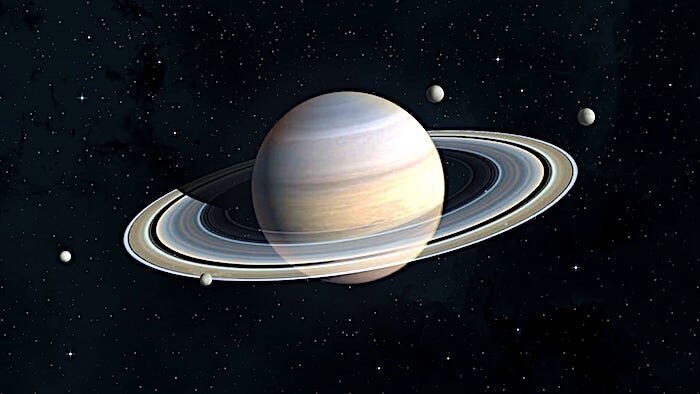
© Star Walk 2Planet Saturn and moons
But a new modeling study by astronomers at MIT and elsewhere has found that, while the two planets may have once been in sync, Saturn has since escaped Neptune's pull. What was responsible for this planetary realignment? The team has one meticulously tested hypothesis: a missing moon.
In a study appearing in Science, the team proposes that Saturn, which today hosts 83 moons, once harbored at least one more, an extra satellite that they name Chrysalis. Together with its siblings, the researchers suggest, Chrysalis orbited Saturn for several billion years, pulling and tugging on the planet in a way that kept its tilt, or "obliquity," in resonance with Neptune.
But around 160 million years ago, the team estimates, Chrysalis became unstable and came too close to its planet in a grazing encounter that pulled the satellite apart. The loss of the moon was enough to remove Saturn from Neptune's grasp and leave it with the present-day tilt.
What's more, the researchers surmise, while most of Chrysalis' shattered body may have made impact with Saturn, a fraction of its fragments could have remained suspended in orbit, eventually breaking into small icy chunks to form the planet's signature rings.
















Comment: