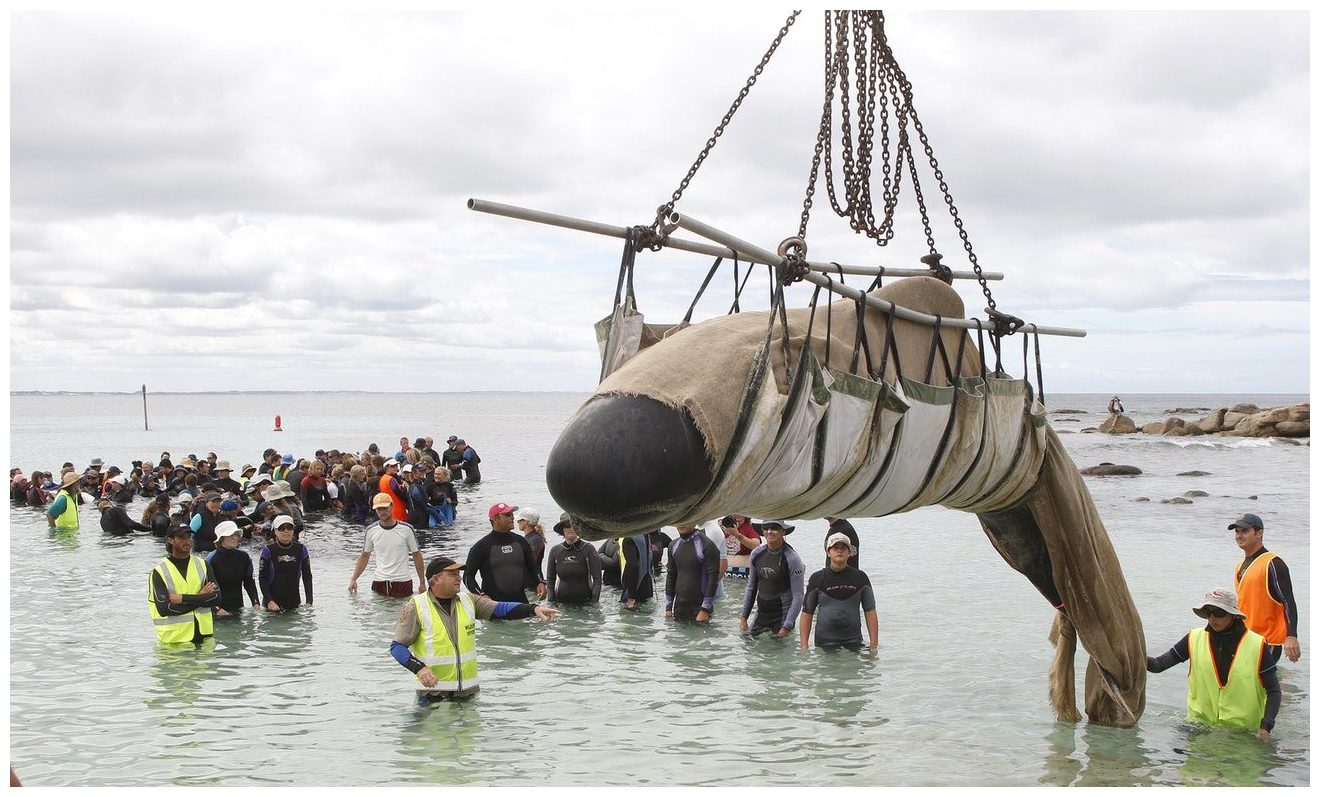
© Tony Ashby/Stringer/Getty ImagesA whale rescue effort in Perth, Western Australia, in 2009. Research suggests multiple causes behind strandings.
Researchers suggested a recent explosion of toxic red algae could be behind the mysterious phenomenon, but they couldn't say for sure.
The following year, more than 80 short-finned pilot whales beached themselves on the coast of the Bay of Bengal in India, seemingly unable to navigate away from the shoreline.
When rescuers managed to move 36 of them back to sea, they appeared disoriented, and struggled to rejoin their pod. Some even found their way back to the beach and stranded themselves once more.
And in February 2017, in what has become one of the biggest mass stranding events in New Zealand history, 416 pilot whales beached themselves on the South Island's Farewell Spit beach, followed by roughly 240 more that ran aground between the settlements of Puponga and Pakawau. This time, many of them were refloated.
Potential explanations abound, including solar storms, military sonar, and even the Moon's gravitational pull, but what's become increasingly clear each time is that no one really knows what's going on.
And that's not necessarily a bad thing, according to Mark Hindell, professor of marine science at the University of Tasmania in Australia.