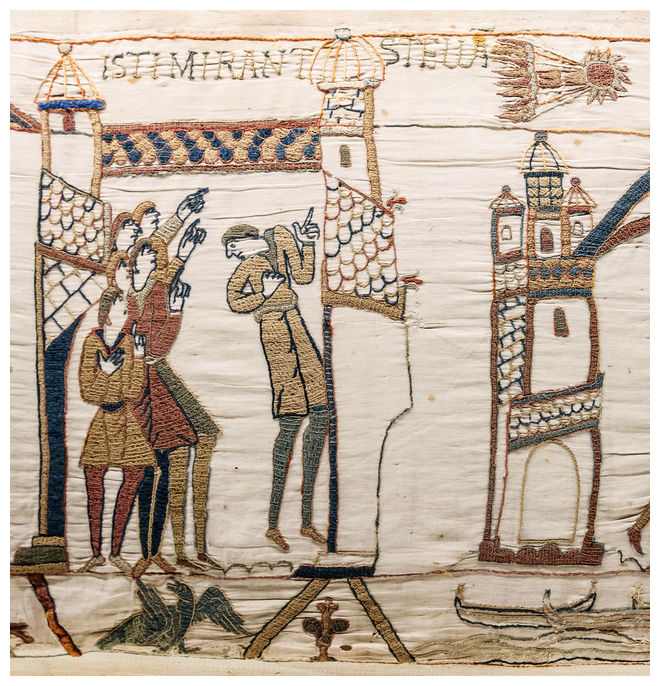
Comets


Galaxy

Rupert Sheldrake: Science Set Free

Part 1 of a talk by Rupert Sheldrake at the conference Electric Universe 2013: The Tipping Point, in Albuquerque, New Mexico:


Many scientists like to think that science already understands the ways of the natural world. The fundamental questions are answered, leaving only the details to be filled in. The impressive achievements of science seemed to support this confident attitude. But recent research has revealed unexpected problems at the heart of physics, cosmology, biology, medicine and psychology.

Meteor

Meteor fireballs, 'loud booms' and 'strange sky sounds' reported over Oklahoma

Image
© SOTT.net
On January 24th, 2014, a meteor fireball was seen by many above Oklahoma and Texas, with reports also coming in from Arkansas.


The following day, on January 25th, in Tulsa, Oklahoma thousands reported feeling and hearing a very loud boom. It was loud enough to be heard indoors and it shook windows and rattled doors.

Comment: See also: Fire in the Sky - SOTT Summary 2013


Comet

What killed the woolly mammoth? UCSB Professor finds evidence to support comet collision

Nanodiamond
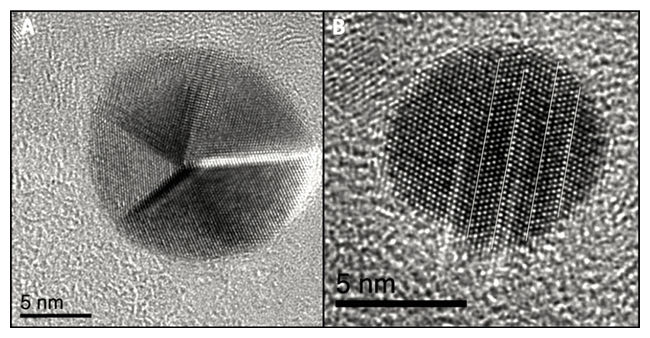
© UCSBNanodiamond textures observed with high-resolution transmission electron microscopy: A) star twin and B) multiple linear twins.
Could a comet have been responsible for the extinction of North America's megafauna - woolly mammoths, giant ground sloths and saber-tooth tigers? UC Santa Barbara's James Kennett, professor emeritus in the Department of Earth Science, posited that such an extraterrestrial event occurred 12,900 years ago.

Originally published in 2007, Kennett's controversial Younger Dryas Boundary (YDB) hypothesis suggests that a comet collision precipitated the Younger Dryas period of global cooling, which, in turn, contributed to the extinction of many animals and altered human adaptations. The nanodiamond is one type of material that could result from an extraterrestrial collision, and the presence of nanodiamonds along Bull Creek in the Oklahoma Panhandle lends credence to the YDB hypothesis.

Comet

Mainstream science slowly catching on: a comet may have caused the winter of 536 to last for 10 years

Game of thrones
Winter is coming....
Oh, that's why it's called the Dark Ages

General consensus is that the Dark Ages were the worst of all the ages. Unicorns went extinct, you were either a witch or had the plague, and oh yeah, winter lasted for ten years once.

A recent article in New Scientist is giving some scientific validity to the big chill recounted in ancient medieval texts such as this one:
"And it came about during this year that a most dread portent took place. For the sun gave forth its light without brightness, like the moon, during this whole year, and it seemed exceedingly like the sun in eclipse, for the beams it shed were not clear nor such as it is accustomed to shed" - Procopius (Wars, 4.14.5)

Comment: Back in 2004 another team of scientists came to this conclusion and gave even more information:
The surprising result of the new work is just how small a comet is needed to cause such dramatic effects. The scientists calculate that a comet not much more than half a kilometre across could cause a global nuclear winter effect. This is significantly smaller than was previously thought.

Dr. Ward-Thompson said: "One of the exciting aspects of this work is that we have re-classified the size of comet that represents a global threat. This work shows that even a comet of only half a kilometre in size could have global consequences. Previously nothing less than a kilometre across was counted as a global threat. If such an event happened again today, then once again a large fraction of the earth's population could face starvation."

The comet impact caused crop failures and wide-spread starvation among the sixth century population. The timing coincides with the Justinian Plague, widely believed to be the first appearance of the Black Death in Europe. It is possible that the plague was so rampant and took hold so quickly because the population was already weakened by starvation.


Comet 2

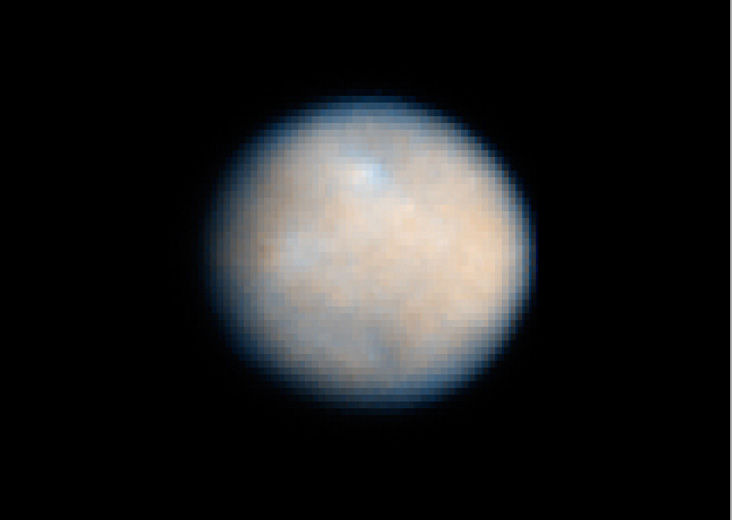
Is first 'asteroid' discovered in modern times, Ceres, turning into a 'comet'? Solar system's 'biggest' asteroid is 'spewing jets'

Image
Ceres: Asteroid, planet, comet, moon? Do official scientists really have any clue?
Observations of the Solar System's biggest asteroid suggest it is spewing plumes of water vapour into space.

Ceres has long been thought to contain substantial quantities of ice within its body, but this is the first time such releases have been detected.

The discovery was made by Europe's infrared Herschel space telescope, and is reported in the journal Nature.

Scientists believe the vapour is coming from dark coloured regions on Ceres' surface, but are not sure of the cause.

One idea is that surface, or near-surface, ice is being warmed by the Sun, turning it directly to a gas that then escapes to space.


Comment: This is absurd. If it is water and ice they're seeing, it cannot be "warmed" into a gas in the near-absolute zero of space! Ceres would have no atmosphere, remember?...


Comment: Since when is it "widely known" that asteroids hold water?

Until ten years ago, these same scientists believed water was only found on Earth!

Far more likely is that Ceres is electrically discharging...

Why didn't Comet ISON melt in the Sun? How NASA and Official Science got it all wrong (again)


Snowflake

U.S. Snow flight cancellation tally: 4,400 and growing

Stranded air passengers
© Michael Ein, The Press of Atlantic City/APStranded air passengers wait in line for refunds at the Atlantic City International Airport on Jan. 21, 2014, after snow caused delays and cancellations.
Air travelers face another rough travel today as airports dig out from the East Coast snowstorm that snarled flights Tuesday.

Flight-tracking service FlightAware.com says more than 1,400 flights nationwide have been canceled as of 7:30 a.m. ET this morning, a total that's likely to inch up during the day.

The bulk of those cancellations come at airports that bore the brunt of the snow, particularly the three big New York City-area airports, Boston and Philadelphia.

Igloo

What caused a 10-year winter starting in AD 536?

Winter
© io9
A winter that lasts years isn't just a problem in Game of Thrones. Roughly 1500 years ago, our world was turned upsidown by a winter that witnesses say "never ended." Now there is scientific evidence that there really was a decade of winter.

Scholars writing in Europe and Asia at the time reported that the year 536 and the years following were bitterly cold. They described conditions that reminded them of an eclipse, and claim that the sun remained "small," with ice frosting up crops even in summer. That year and the decade following were also times of great famine, plague and war - possibly connected to the devastating harvests that left many people hungry, angry, and wandering in search of more fertile lands.

Over at New Scientist, Colin Barras has a terrific article about the scientific quest to discover whether these reports have any basis in reality. For years, scientists have studied tree rings and ice cores, looking for clues that could reveal whether the weather change was caused by a supervolcano (which have been known to cool the planet considerably).

Some promising evidence suggests there may have been a supereruption in El Salvador, which could help explain why Maya settlements nearby mysteriously stopped producing written records for a few years. But that wouldn't explain why the planet remained cold for many years. Usually a supervolcano only affects the weather for a year at most.

Meteor

Penny finally drops for mainstream astronomy: 'Mars moon Phobos may be a captured asteroid'

Image
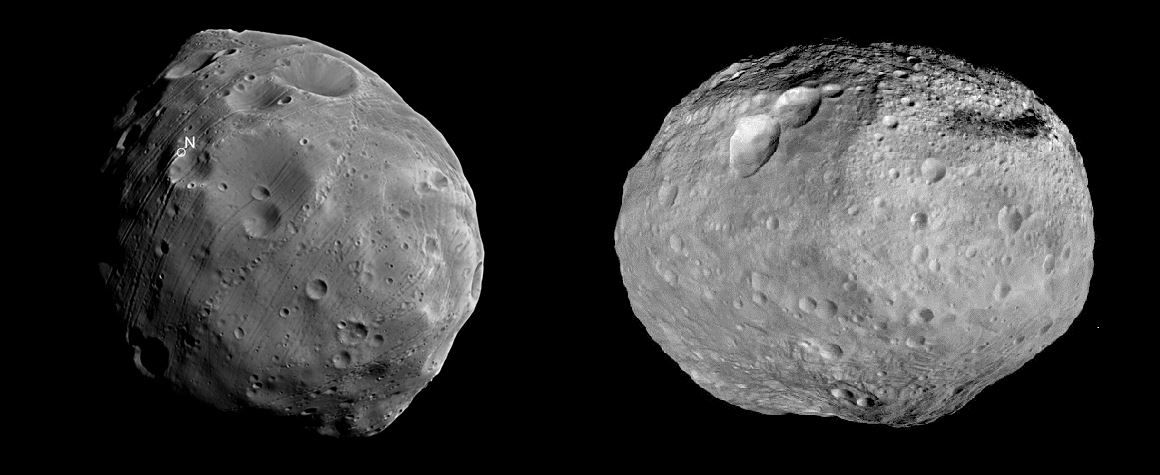
One of these is 'asteroid' Vesta... the other is 'moon' Phobos. Not easy to tell them apart, is it?
The origin of the two small moons of Mars, called Phobos and Deimos, have been shrouded in mystery since their discovery in 1877. The surface of the moons and their orbits hint at different origins. But new models provide stronger suggestions that Phobos, at least, may be a captured asteroid.

An international team of astronomers modeled the ultraviolet light reflected from the surface of Phobos and compared it to the asteroid 624 Hektor and the Tagish Lake meteorite found on Earth. They found that it bore strong similarities to both.

"This provided more additional support for compositional similarities between Phobos and D-type asteroids," primary investigator Maurizio Pajola of the University of Padova in Italy told SPACE.com by email.

Comment: FINALLY!

Now if they can just keep going until they realize that all space rocks are essentially the same - comets, asteroids, moons, meteors - just varied in size and electrical activity...

Solar system-wide 'climate change': Tally of Jupiter's moons goes up and down

NASA's Hubble sees 'asteroid' spouting six comet-like tails "dust radiating from it like spokes on a wheel"


Comet 2

New Comet: P/2014 A3 (PanSTARRS)

Discovery Date: January 9, 2014

Magnitude: 21.1 mag

Discoverer: Pan-STARRS 1 telescope (Haleakala)

Comet p/2014 A3 PanSTARRS
© Aerith Net
The orbital elements are published on M.P.E.C. 2014-B02.

Fireball 4

Bright green fireball caught on video from UK and Holland, 18 January 2014

Image
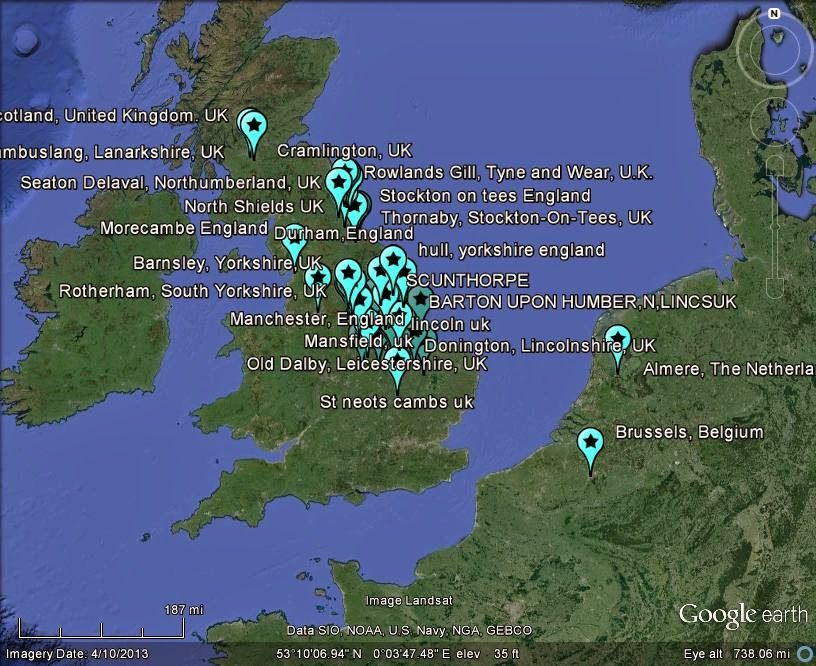
© LunarMeteoriteHunter / Google EarthUK / Holland / Belgium Fireball Meteor/s, approx. 20:20 GMT, 18 January 2014
Initial Meteor Sighting Reports

18 January 2014 - Jim, Almere, The Netherlands 21:32 GMT
1, 2 seconds top to bottom. Quick drop, rainbow trail, bright flash. Exceptionally bright black trail in the sky after 3 minutes. White colour, impressive.
18 January 2014 - Tim North, Shields, UK 20:18 approx
2 seconds duration. Facing east, track Northwest to Southeast over sea, to right of Moon. Barium green, small amount white. Slightly brighter than the moon. No fragmentation, just one discontinuity. Have CCTV video available.
18 January 2014 - James Cambuslang, Lanarkshire, UK 20:00 UTC approx
2 seconds duration. Seen to the east of my location, falling to Earth in southerly direction. Green trail, twice as bright as Sirius.

All 43 meteor sighting reports can be seen here.