Comets


UFO

SOTT Focus: The Missing Times: The media, UFOs, COINTELPRO and comets

missing times
© Terry Hansen
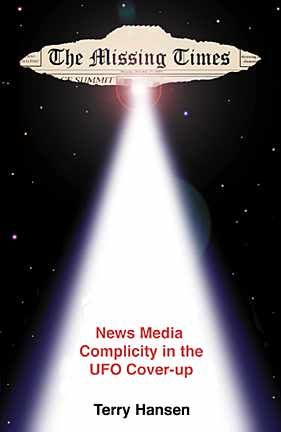
The Missing Times: News Media Complicity in the UFO Cover-Up is a book written by independent journalist Terry Hansen in 2000. Having seen it referenced in several books on UFOs from the last decade or so and recommended by several experts in the field, I decided to check it out. As our regular readers will know, we at Sott.net like to keep up to date on the various oddities, anomalies, and instances of 'high strangeness' that pop into our reality on a regular basis. And, being an alternative news website that analyzes and comments on mainstream media coverage (i.e., propaganda) of everything from weather to warfare, the book's focus on the inner workings of media coverage on the topic suggested it might be right up our alley, so to speak. As it turns out, The Missing Times is a great resource for information on censorship and propaganda in general, not just UFOs and media, and it has some far-ranging applications, as we'll see.

First of all, a bit of an overview of the book itself: it begins with a short introduction on the way news media has covered (or not covered) big UFO stories, particularly the 1975 Malmstrom Air Force Base UFO/ICBM encounters. Widely reported in the local and regional press, it took a full two years for these highly sensational (i.e., newsworthy) events to reach the national news.

Hansen observes that there are two realities in media: the official reality, represented by major national news corporations (which reflect official government views), and folk reality, which is often represented in local or regional, 'small-town' reporting. UFO stories, in particular, often make it into the local press, where they're reported fairly accurately, but rarely if ever do they get serious coverage in the national press. And when they do, it's usually because the story has already become so large that they need to cover it or risk looking like they are censoring it. Even then, their reporting is rarely if ever serious or objective. Rather, it's loaded with 'spin', name-calling, and 'wink-and-nod' levity. What's the reason?


Fireball

First meeting of international group tasked with reacting to asteroids

Image
© ESAA new international group meets for the first time in February to coordinate efforts to predict and prevent major asteroid impacts.
Next week in Germany, representatives of all mankind's space-faring nations will get together in a room to begin coordinating efforts to prevent the end of the world...or at least to figure out how to identify and prevent really big space rocks from smacking us around like that meteor that hit Russia last year.

We've all watched those scenes in science fiction movies where the leaders of the planet (or planets) all sit around a large table and come to a consensus about the best way to confront the latest existential threat. I'm always left wondering where the heck they get such a huge table, and how they managed to come up with a unanimous plan of action in less than 5 minutes. It's a little different from the endless gabfest of political posturing translating to minimal real-world action that is a meeting of today's United Nations.

Or is it? The first ever meeting of the Space Mission Planning and Advisory Group (SMPAG, pronounced "same page" -- see what they did there?) set to be hosted by the European Space Agency on February 6 and 7 sounds a little more like the Hollywood version of consensus-making, just with less melodrama and fewer ridiculously beautiful people everywhere.

Meteor

'U.S. and Russia plan to jointly fight asteroid threat', but will they walk the talk?

Image
© Cfa.harvard.eduRussia, US Plan to Jointly Fight Space Threats.
Russian and US experts are planning to join efforts in protecting our planet against thousands of potentially hazardous near-Earth space bodies, Russia's emergencies minister said.

"The collision with the Chelyabinsk meteorite last year showed that space threats could be real and as destructive as huge fires or natural disasters on Earth," Vladimir Puchkov said in an interview with Rossiiskaya Gazeta to be published on Tuesday.

The minister said a joint working group would be set up in the near future to develop solutions to counter space threats.

A meteorite entered the Earth's atmosphere undetected by existing space-monitoring systems and slammed into Russia's Ural Mountain region last February, accompanied by a massive sonic boom that blew out windows and damaged thousands of buildings around the city of Chelyabinsk, injuring over 1,500.

NASA estimated the meteorite was roughly 50 feet (15 meters) in diameter when it entered the atmosphere, traveling many times faster than the speed of sound, and exploded into a fireball brighter than the sun.

Comment: Well, well. In three years it's gone from 'once a millenium', to 'once a century' to 'once a decade'... how long before we hear it's always been 'once a year'?!


Fireball

New Comet: C/2014 B1 (Schwartz)

Discovery Date: January 28, 2014

Magnitude: 19.9 mag

Discoverer: Michael Schwartz (Tenagra Observatory near Nogales, AZ, U.S.A.)

C/2014 B1
© Aerith Net
The orbital elements are published on M.P.E.C. 2014-C03.

Fireball 3

New Comet: 2014 AA52

Discovery Date: January 11, 2014

Magnitude: 19.8 mag

Discoverer: Catalina Sky Survey

2014 AA52
© Aerith Net
The orbital elements are published at the MPC Ephemerides and Orbital Elements.

Fireball 5

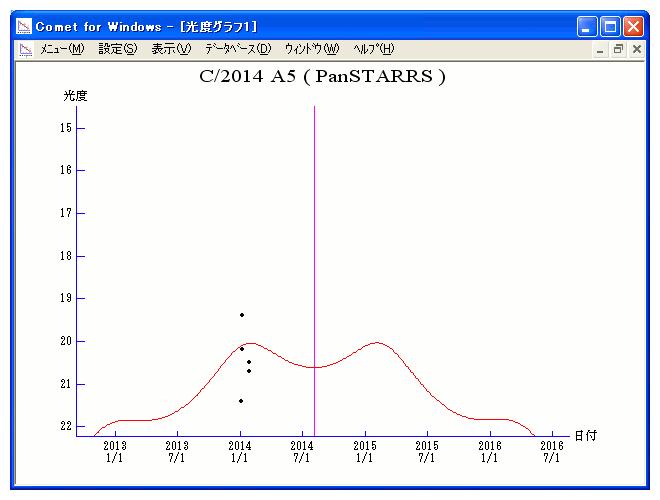
New Comet: C/2014 A5 (PanSTARRS)

Discovery Date: January 4, 2014

Magnitude: 21.4 mag

Discoverer: Pan-STARRS 1 telescope (Haleakala)
C/2014 A5
© Aerith Net
The orbital elements are published on M.P.E.C. 2014-B54.

Meteor

World space agencies gather to discuss what to do about asteroid threat

Image
With a mandate from the UN, space agencies from all over the world are about to establish a high-level group to help coordinate global response should a threatening asteroid ever be found heading towards Earth.

Of the more than 600,000 known asteroids in our Solar System, more than 10 000 are classified as near-Earth objects, or NEOs, as their orbits bring them relatively close to our path.

The Space Mission Planning and Advisory Group (SMPAG - pronounced 'same page') was established by Action Team 14, a technical forum with a mandate from the UN Committee on the Peaceful Uses of Outer Space (UNCOPUOS) to develop a strategy on how to react on a possible asteroid impact threat.

Comment: Comment: Along with a rise of Near Earth Objects, 2013 saw a remarkable rise in meteor fireballs. See the following articles for the year in review: Fire in the Sky: SOTT Summary of Meteor Fireballs in 2013
2013 saw a dramatic increase in meteor fireballs - What does 2014 have in store?


Fireball 2

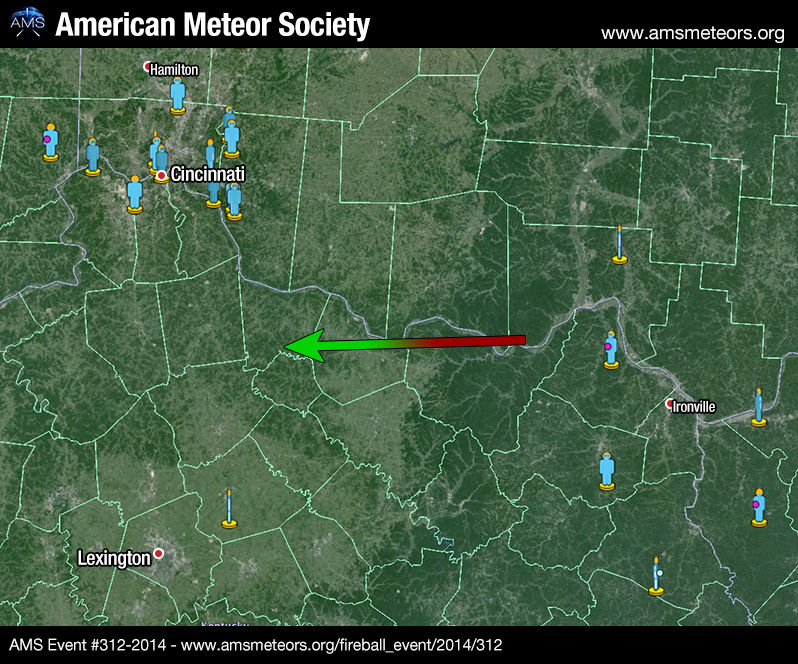
AMS receives hundreds of reports of 4 separate meteor fireballs seen over U.S., 28 January 2014

The American Meteor Society has received over 100 reports of a bright fireball seen from mid western states at approximately 8:30 PM local eastern time. Witnesses from Ohio, Indiana, Illinois, West Virginia, Kentucky, Michigan and Pennsylvania reported an extremely large and bright bluish green ball of light followed by a bright white tail. Sighting reports clustered the start and end point of the meteor near the Ohio and Kentucky border, heading from the east almost due west.

From Bill Cooke (Meteoroid Environments Office, NASA)
Time of this fireball was January 29 at 01:17:39 UTC (Jan 28 - 8:17pm EST.)
Best trajectory estimation:
Start location: 83.397 W, 37.809 N at 93 km altitude
End location: 84.278 W, 37.162 N at 70 km altitude
Speed: 36 km/s +/- 7 km/s
Radiant: RA 172.1 +/- 2 deg, Dec +40.8 +/- 0.4 deg
Image
© AMSAMS Event #312-2014 – "Mid West Fireball" – January 28th, 2014 – 2D Trajectory

Comet 2

Major increase in asteroid activity sees MIT astronomers 'upgrade' solar system from 'stable' to 'dynamic' - Time to revive the Nemesis Twin Sun theory?

Image
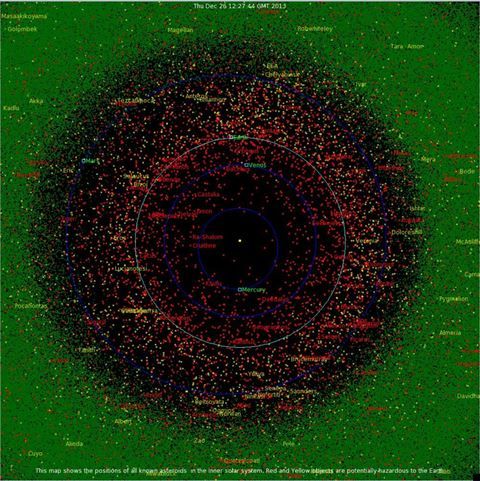
© Armagh ObservatoryAll observed asteroids by 2010. The green are those in stable orbits... but more and more of them are turning red, potentially on earth-crossing orbit...
Scientists from MIT and the Paris Observatory claim that rogue asteroids are more common than previously thought.

Previously, scientists believed that asteroids were static and remained near the sun. However, observations in the last decade have revealed that asteroids show up in unexpected places in space.


Comment: Yeh, like being discovered right as they fly past or into us!


"That [theory] has been completely turned on its head," Francesca DeMeo, who did much of the mapping as a postdoc in MIT's Department of Earth, Atmospheric and Planetary Sciences, said in a statement. "Today we think the absolute opposite: Everything's been moved around a lot and the solar system has been very dynamic."

Researchers developed a map that charts the size, composition and location of more than 100,000 asteroids throughout the solar system. The new maps suggests the early solar system could have undergone dramatic changes before the planets laid claim to their current alignment.

Comment: What if it's not "early" pin-balling of asteroids?... What if it's repetitive pin-balling of asteroids, knocked in by an as-yet-to-be-discovered Twin Sun? What if the reason they've discovered a "river of asteroids" recently is because a river of asteroids is currently streaming into the inner solar system? What is it's not a question of "pin-balled asteroids" having had an impact on Earth, but "pin-balled asteroids" CURRENTLY having an impact on Earth?

Notice anything about fireball activity in our skies lately?

Goldilocks is in for a fright; something wicked this way comes...


Fireball 2

Meteor fireball lights up night sky in Kentucky, 28 January 2014

Image
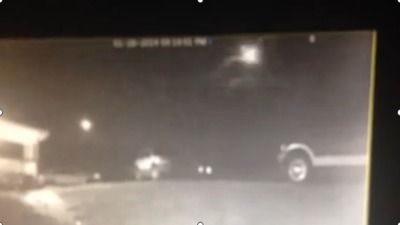
Screencapture of a meteor fireball over Kentucky, 28 Jan. 2014, from a security camera.
It's something that has puzzled people across Michiana... what lit up the sky Tuesday night?

While outside with his dog last night, something in the night sky caught Jason Goss' eye.

"I just saw this great big ball of fire basically coming from the north heading to the south and it disappeared behind the building," Goss said.

That ball of fire was big, big enough to be seen as far away as southeastern Kentucky where a security camera caught it lighting up the sky before fading away.

"It happened so quick I didn't know what to think," Goss said.