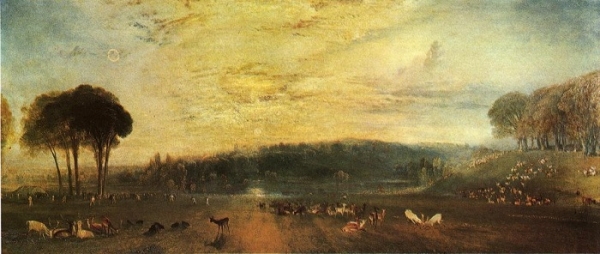
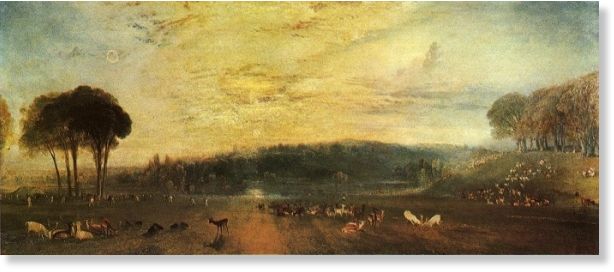
© WikiPaintings via European Geosciences UnionOld World artists captured the state of the climate in their paintings of the world centuries ago, according to a new study. Pictured is "The Lake, Petworth: Sunset, Fighting Bucks", by J. M. W. Turner (c. 1829)
Old World artists captured the state of the climate in their paintings of sunsets centuries ago, according to a new study.
Writing in the journal
Atmospheric Chemistry and Physics, a team of Greek and German researchers report that the colors of sunsets painted by artists in centuries past can be used to estimate pollution levels in Earth's past atmosphere.
The researchers cite the 1815 eruption of Tambora volcano in Indonesia, the largest volcanic eruption in recorded history. The
event sent a huge plume of volcanic ash and smoke into the air, and the particulate matter ejected by the volcano scattered sunlight in a particular way, making sunsets appear more bright red and orange in Europe for a number of years.
"Nature speaks to the hearts and souls of great artists," said lead study author Christos Zerefos, a professor of atmospheric physics at the Academy of Athens in Greece. "But we have found that, when coloring sunsets, it is the way their brains perceive greens and reds that contains important environmental
information."
For their study, Zerefos and his team studied high-resolution photographs of paintings of the sunset made between the years 1500 and 2000. In this 500-year period, the world saw more than 50 large volcanic eruptions.











Comment: Unfortunately these astronauts are a day late and a dollar short, and asteroid defense systems seem somewhat of a pipe dream. Speaking of pipe dreams, perhaps a better defense would be to kick the psychopaths out of power, learn to create a more just, honest world, and start living by the rules of the universe.
Xenophobic Self-Destruction Or, How the Odyssey and the Old and New Testaments Can Predict Our Future
Celestial Intentions: Comets and the Horns of Moses