Comets


Comet 2

New Comet: C/2014 J1 (CATALINA)

Cbet nr. 3868, issued on 2014, May 16, announces the discovery of an apparently asteroidal object (~ magnitude 18.2) on CCD images taken on 2014, May 09.3 by R. J. Sanders with the Catalina Sky Survey's 0.68-m Schmidt telescope. This object has been found to show cometary appearance by observers elsewhere. The new comet has been designated C/2014 J1 (CATALINA).

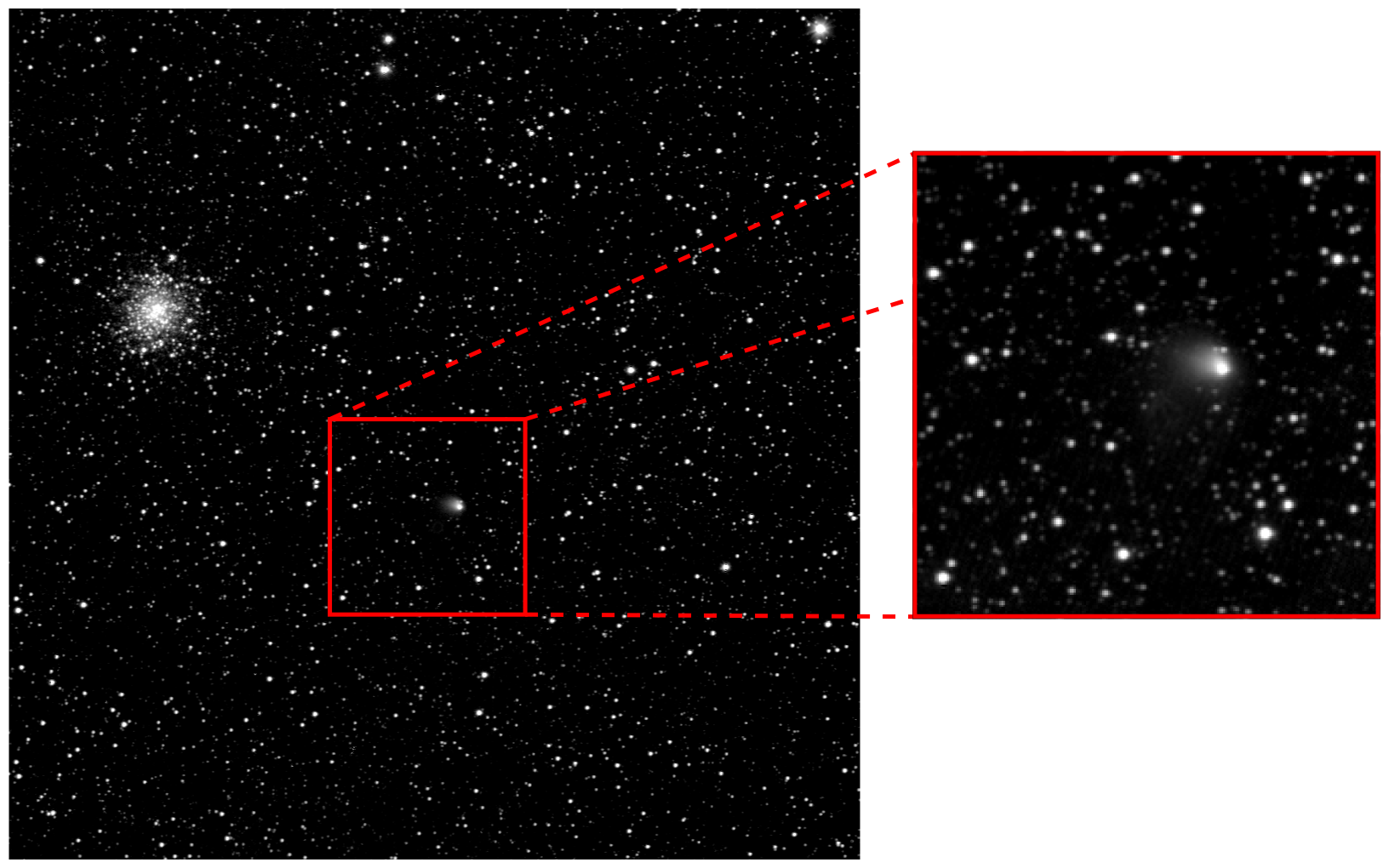
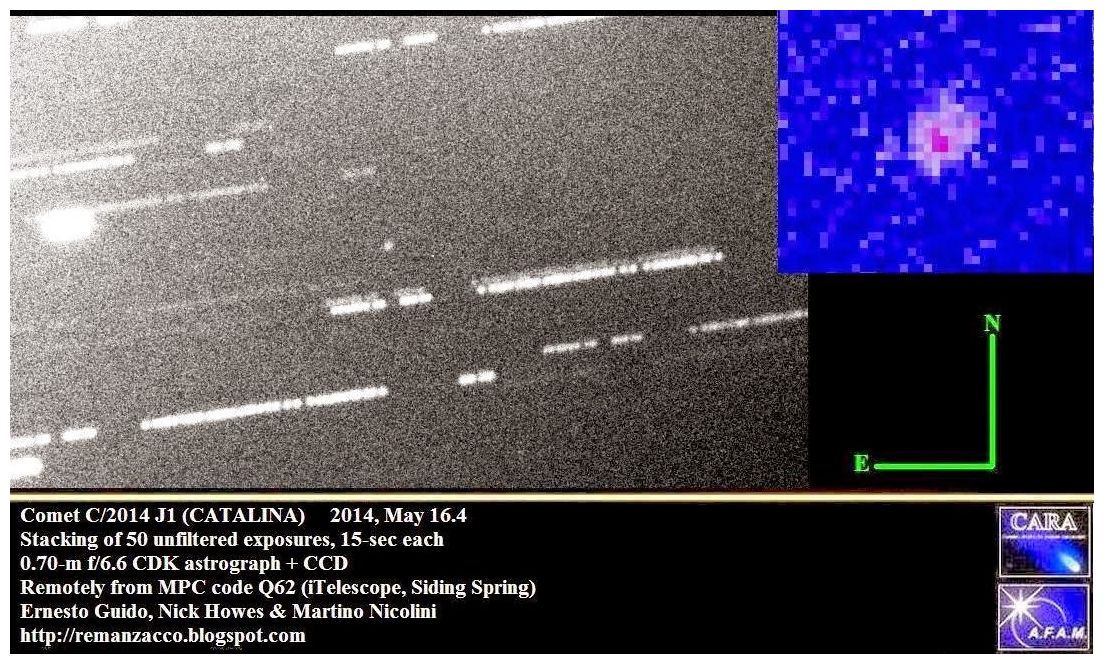
We performed follow-up measurements of this object, while it was still on the neocp. Stacking of 50 unfiltered exposures, 15-sec each, obtained remotely on 2014, May 16.4 from Q62 (iTelescope network, Siding Spring) through a 0.70-m f/6.6 CDK astrograph + CCD, shows that this object is slightly diffused. The FWHM of this object was measured about 20% wider than that of nearby field stars of similar brightness (at the moment of our imaging session the Moon - 0.98 phase - was just about 40 degree away from the comet).

Our confirmation image (click on it for a bigger version)
Comet C/2014 J1 (Catalina)
© Remanzacco Observatory
M.P.E.C. 2014-K04 assigns the following parabolic orbital elements to comet C/2014 J1: T 2014 June 13.44; e= 1.0; Peri. = 191.98; q = 1.74; Incl.= 160.18.

Comet

Rosetta's comet flares as it approaches the Sun

Comet 67P
© ESA/Rosetta/MPS for OSIRIS Team MPS/UPD/LAM/IAA/SSO/INTA/UPM/DASP/IDAA close-up of comet 67P/Churyumov–Gerasimenko taken from 1.24 million miles (2 million km) away. The image was obtained by the Rosetta spacecraft in April 2014 as it approached the comet for a close-up view.
Wow! This image shows the target comet for the Rosetta mission starting to develop a tail. This bodes well for the European Space Agency spacecraft, which is on its way to study Comet 67P/Churyumov - Gerasimenko later this year to learn more about the origins of the solar system.

"It's beginning to look like a real comet," stated Holger Sierks, principal investigator for OSIRIS (Optical, Spectroscopic and Infrared Remote Imaging System.)

"It's hard to believe that only a few months from now, Rosetta will be deep inside this cloud of dust and en route to the origin of the comet's activity," added Sierks, who is with the Max Planck Institute for Solar System Research in Germany.

The picture was one of a series taken over six weeks, between March 27 and May 4, as the spacecraft zoomed to within 1.24 million miles (two million kilometers) of the target. You can see the full animation by clicking here.

Bacon

SOTT Focus: Are you prepping your diet?

Image
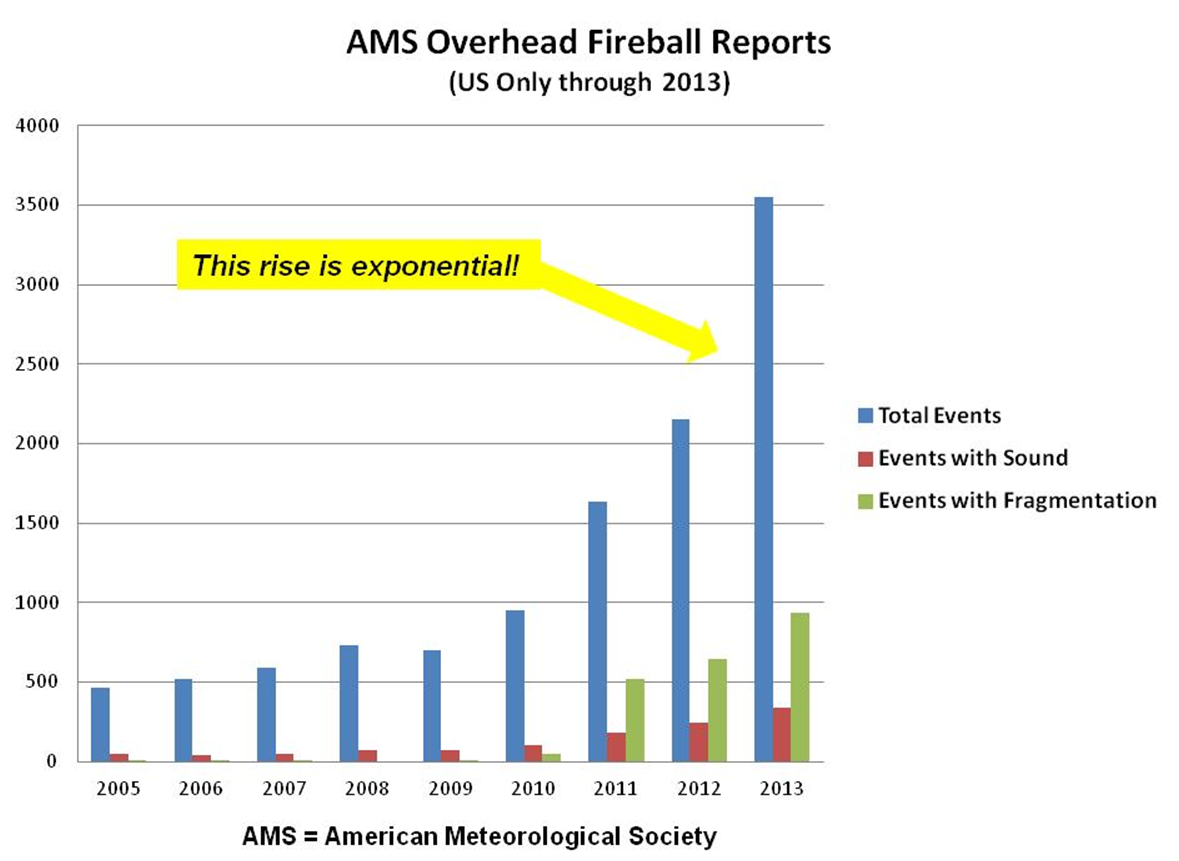
© sott.netAMS fireball reports through 2013
If you are a regular SOTT reader, you are certainly aware of the many areas that are building towards potential disaster - from environmental earth changes and overhead bombardment to growing Fascism and impending economic collapse. The good thing is that you do not need to pick one of these threats to begin preparing yourself, family and local community. The basic requirements for getting prepared apply to all these possible occurrences and more.

The prepping web community has grown in massive proportion to what it was just a decade ago. Blog, prepper and survivalist websites abound and many offer very good ideas that can be applied or adapted to your own situation and needs. But it is rare to see any of these resources address the question of prepping your diet. If prepping your diet confers significant advantages in a disaster/survival situation, then it will have a significant impact on your food storage strategy and what to look out for during an extended disaster.

The question is, does prepping your diet yield enough advantage to suggest changes to your current diet now? And if so, how does this impact your food storage and preparation plan? The answer to the former question, I think, is yes. An answer to the latter is below.

Comet 2

Asteroid 2013 UQ4 suddenly becomes a dark comet with a bright future

Comet C/2013 UQ4
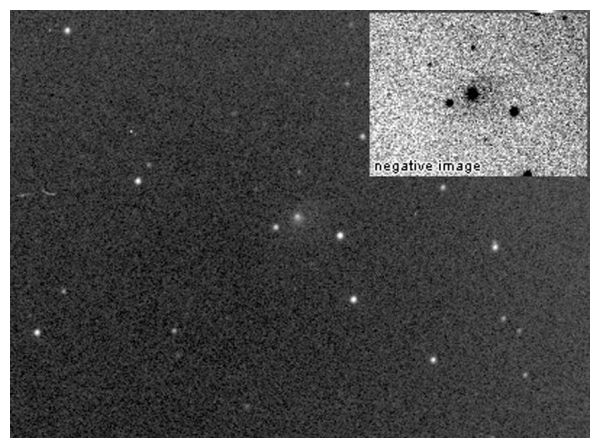
© Artyom Novichonok and Taras PrystavskiComet C/2013 UQ4, originally discovered as an asteroid, now shows the characteristic coma of a comet. This photo was made on May 7, 2014 from a telescope in Australia.
On October 23, 2013, astronomers with the Catalina Sky Survey picked up a very faint asteroid with an unusual orbit more like a that of a comet than an asteroid. At the time 2013 UQ4 was little more than a stellar point with no evidence of a hazy coma or tail that would tag it as a comet. But when it recently reappeared in the morning sky after a late January conjunction with the sun, amateur astronomers got a surprise.

On May 7, Comet ISON co-discoverer Artyom Novichonok, and Taras Prystavski used a remote telescope located in Siding Spring, Australia to take photos of 2013 UQ4 shortly before dawn in the constellation Cetus. Surprise, surprise. The asteroid had grown a little fuzz, making the move to comethood. No longer a starlike object, 2013 UQ4 now displays a substantial coma or atmosphere about 1.5 arc minutes across with a more compact inner coma measuring 25 arc seconds in diameter. No tail is visible yet, and while its overall magnitude of +13.5 won't make you break out the bottle of champagne, it's still bright enough to see in a 12-inch telescope under dark skies.

Comet 2

New Comet - C/2014 H1 (Christensen)

Discovery Date: April 24, 2014

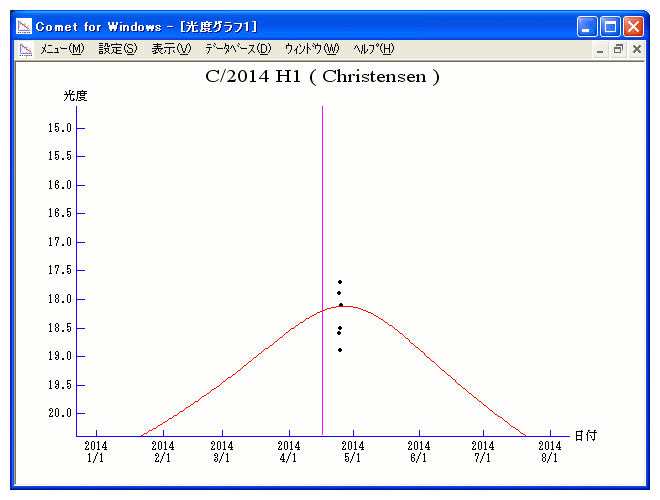
Magnitude: 17.9 mag

Discoverer: Eric J. Christensen (Mount Lemmon)
C/2014 H1
© Aerith NetMagnitudes Graph
The orbital elements are published on M.P.E.C. 2014-H33.

Comet

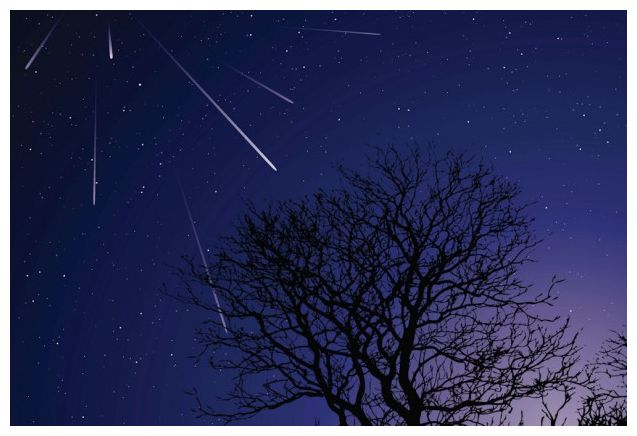
Upcoming meteor shower in May could rival The Perseids

Fireball
© Thinkstock
May isn't exactly known for its meteor showers. In fact, this month's Camelopardalid meteor shower, caused by dust from periodic comet 209P/LINEAR, has technically never even been seen before. However, astronomers have predicted that May 2014 could see a Camelopardalid meteor shower that rivals the year's biggest display - the Perseids of August.

This year could be such a historic display, NASA's head of its Meteoroid Environment Office, Bill Cooke, said, adding that he plans to head out and see the display with his own two eyes, instead of simply reviewing images of the meteor shower captured by the space agency's nationwide network of fireball cameras.

"There could be a new meteor shower, and I want to see it with my own eyes," Cooke said. "Some forecasters have predicted more than 200 meteors per hour."

When a comet crosses Earth's orbit as it circles the Sun, it leaves behind streams of debris for the Earth to plow through around the same time every year. The relatively faint comet behind the Camelopardalids, Comet 209P/LINEAR, was discovered in 2004 and was found to orbit the Sun once every five years.

Comet

Comet Jacques brightens: How to see it in May

Comet Jacques_6
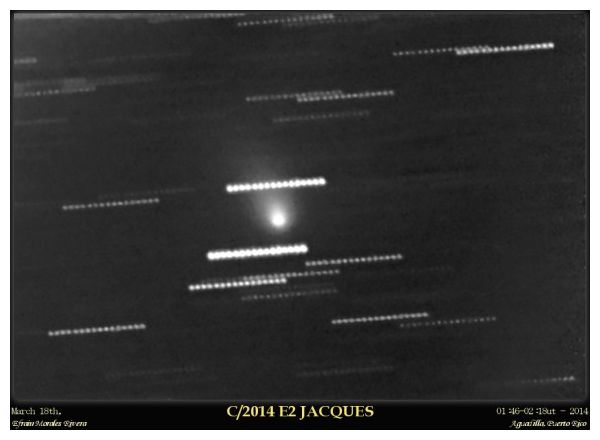
© Efrain Morales RiveraComet Jacques as imaged on March 18th, shortly after discovery.
A recently discovered comet is headed northward and is set to put on one of two fine performances for binocular observers in 2014 starting this week.

Comet C/2014 E2 Jacques was discovered on March 13th 2014 by Cristóvão Jacques, Eduardo Pimentel and João Ribeiro de Barros while observing from the Southern Observatory for Near Earth Asteroids Research (SONEAR) facility located near Oliveira, Brazil.

The comet was just about at +15th magnitude at the time of discovery as it glided across the southern hemisphere constellation of Centaurus.

While a majority of comet discoveries are destined to remain small and faint, Comet Jacques was immediately shown to be something special. Upon discovery of any new comet, the first task is to gain several observations hours or nights apart to accurately gauge its distance and orbit. Are astronomers looking at a small, garden variety comet close up, or a large, active one far away?

Fireball 5

Dark matter could send asteroids crashing into Earth: New theory

Impact Event
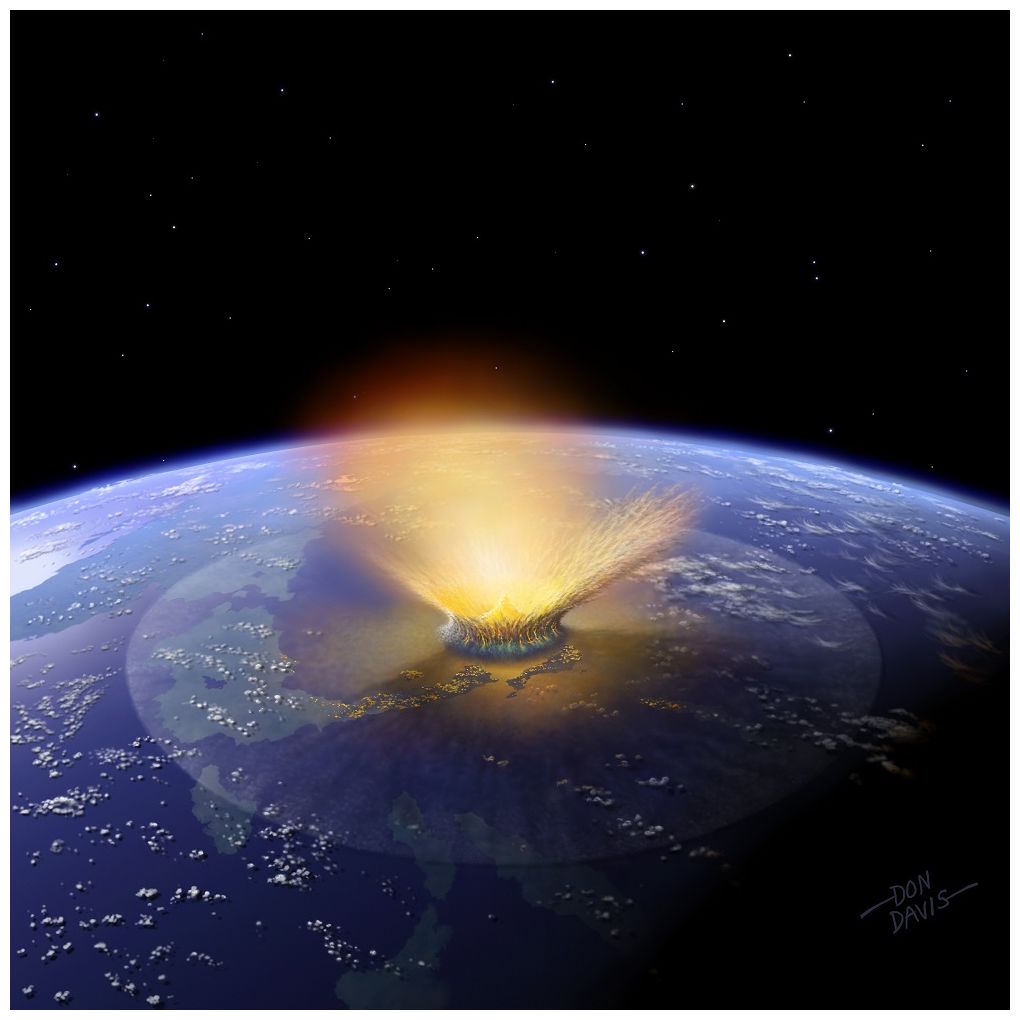
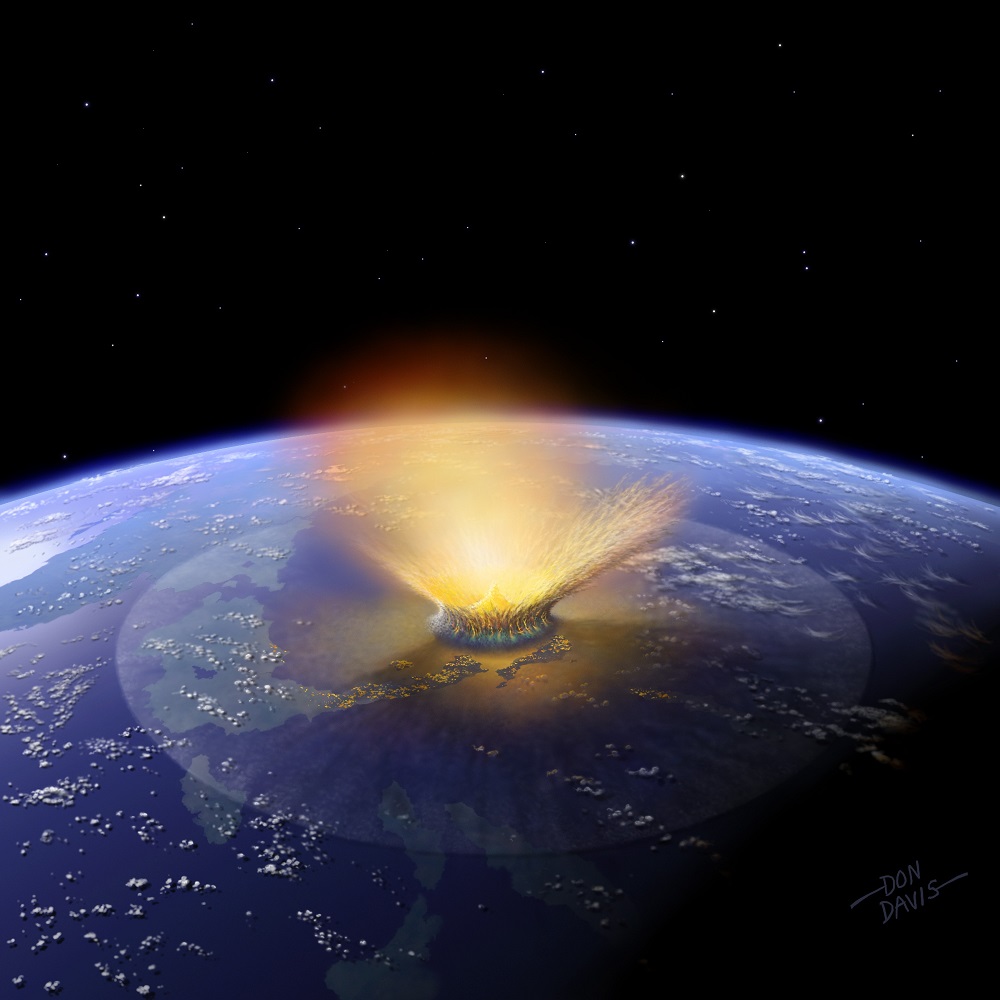
© Don DavisArtist’s impression of a 6-mile-wide asteroid striking the Earth. Scientists think approximately 70 of these dinosaur killer-sized or larger asteroids hit Earth between 3.8 and 1.8 billion years ago.
Dark matter could sling lethal meteors at Earth, potentially causing mass extinctions like the cataclysm that ended the Age of Dinosaurs, Harvard scientists say.

Physicists think the mysterious, invisible substance called dark matter makes up five-sixths of all matter in the universe. It was first detected by the strength of its gravitational pull, which apparently helps keep the Milky Way and other galaxies from spinning apart, given the speeds at which they whirl.

Scientists have recently suggested that a thin, dense disk of dark matter about 35 light-years thick lies along the central plane of the Milky Way, cutting through the galaxy's disk of stars. The sun travels in an up-and-down, wavy motion through this plane while orbiting the center of the galaxy.

Researchers suggest this disk of clouds and clumps made of dark matter might disturb the orbits of comets in the outer solar system, hurling them inward. This could lead to catastrophic asteroid impacts on Earth, of the kind that likely ended the Age of Dinosaurs, said theoretical physicists Lisa Randall and Matthew Reece at Harvard University.

Comet

Comet PANSTARRS K1 swings by the Big Dipper this week, sprouts second tail

Comet C/2012 K1
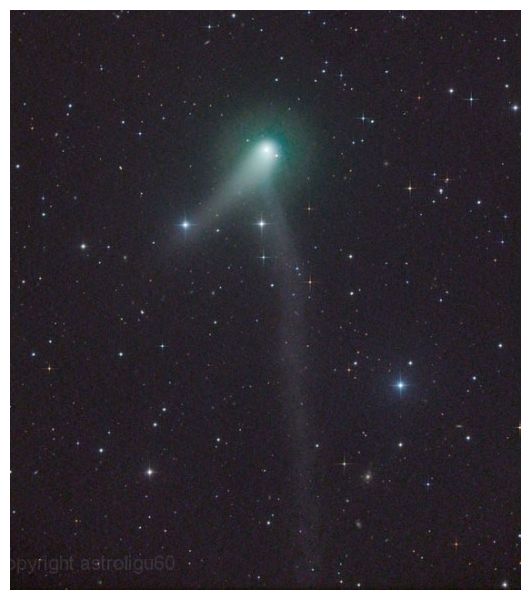
© Rolando LigustriComet C/2012 K1 PANSTARRS displays two tails in this excellent image taken remotely with a telescope in New Mexico. The shorter, brighter spike is the dust tail; the longer is the ion tail with distinct kinks caused by interactions with the solar wind.
Comets often play hard to get. That's why we enjoy those rare opportunities when they pass close to naked eye stars. For a change, they're easy to find! That's exactly what happens in the coming nights when the moderately bright comet C/2012 K1 PANSTARRS slides past the end of the Big Dipper's handle. I hope Rolando Ligustri's beautiful photo, above, entices you roll out your telescope for a look.

Comet

Asteroid study group revises city-destroying threat-level down from 1-in-3000 year events to 1-in-100 years

Image
Lots more where that came from
Space rocks big enough to destroy a city hit the Earth much more often than thought, according to an estimate by a private group devoted to preventing disaster from such orbital killers.

It took a space rock the size of San Francisco to finish off the dinosaurs 65 million years ago, but a decent-sized metropolis could be reduced to smoldering ruins by a boulder that could fit inside a soccer field. The strike rate for such large space rocks, properly known as asteroids, has been estimated at once every 3,000 years, but the B612 Foundation, a planetary defense group, says the true figure could be as high as once a century. Outside scientists say that frequency is plausible but could well be too high.

"There are people who say, 'Oh, once every million years we have something we have to worry about.' That couldn't be more wrong," says physicist and former space shuttle astronaut Ed Lu, chief executive officer of the B612 Foundation. "Eventually you're going to get hit, because it's just a matter of time."