Comets


Comet 2

New Comet: C/2014 A4 (SONEAR)

Cbet nr. 3783, issued on 2014, January 16, announces the discovery of an apparently asteroidal object (discovery magnitude ~18.1) by Cristovao Jacques, Eduardo Pimentel, and Joao Ribeiro de Barros on CCD images obtained on Jan. 12.0 UT with a 0.45-m f/2.9 reflector of the Southern Observatory for Near Earth Research (SONEAR) at Oliveira, Brazil. The object has been found to show cometary appearance by CCD astrometrists elsewhere and then also by Jacques et al. The new comet has been designated C/2014 A4 (SONEAR).

We performed follow-up measurements of this object, while it was still on the neocp.
Stacking of 19 unfiltered exposures, 90-sec each, obtained remotely from MPC code Q62 (iTelescope, Siding Spring) on 2014, January 13.4 through a 0.50-m f/6.8 astrograph + CCD, shows that this object is a comet: small coma nearly 5 arcsec in diameter with a hint of elongation toward North-East.

We observed the object again on January 14.5: stacking of 25 R-filtered exposures, 30-sec each, obtained remotely from MPC code E10 (Faulkes Telescope South) on 2014, January 14.5 through a 2.0-m f/10.0 Ritchey-Chretien + CCD (operated by Las Cumbres Observatory Global Telescope Network), shows that this object is a comet: diffuse coma nearly 8 arcsec in diameter slightly elongated toward North-East
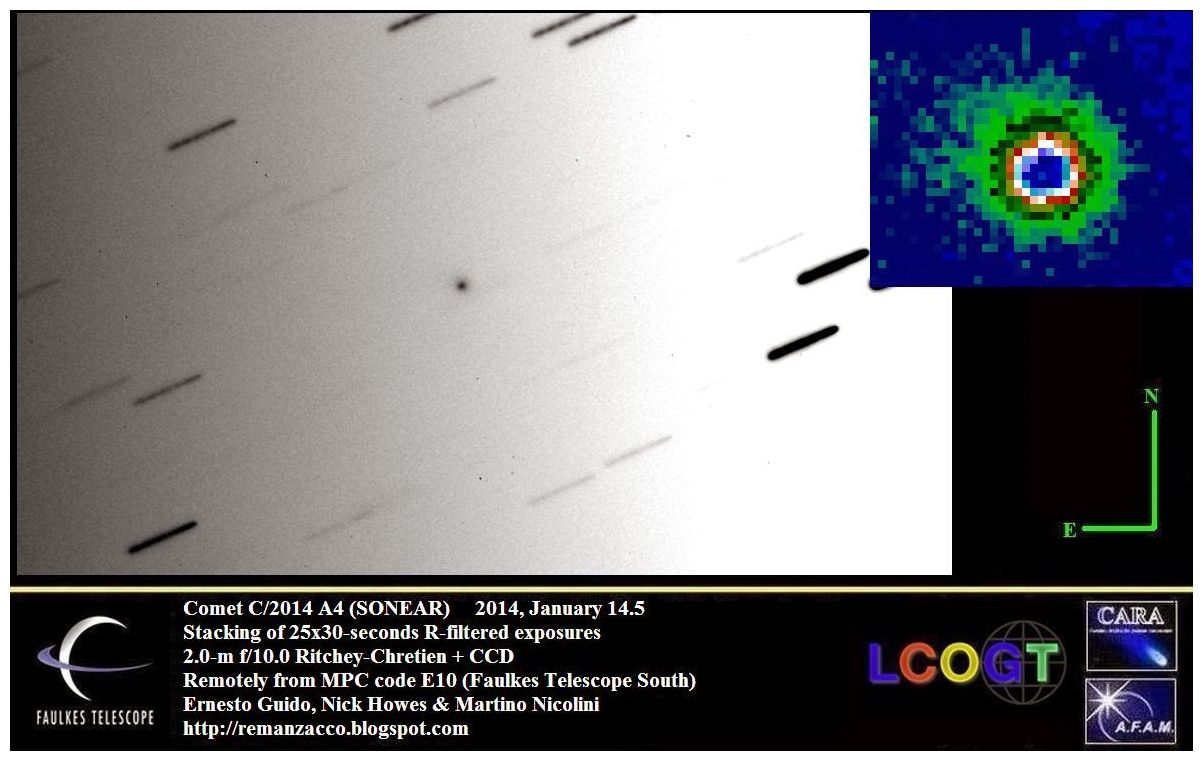
Comet SONEAR
© Remanzacco Observatory

Comet

Retarded science! A chance to get name on asteroid-bound probe that will end up orbiting the sun

Image
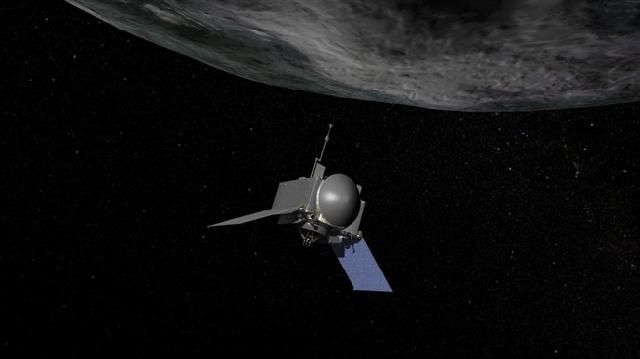
© THE CANADIAN PRESS/HO-NASA/Goddard/Chris MeaneyThis is an artist's concept of NASA's OSIRIS-REx spacecraft preparing to take a sample from the asteroid Bennu.NASA is inviting people around the world to submit their names to be etched on a microchip aboard the spacecraft, which will first travel to an asteroid in 2016.
Here's a chance to have your name on a spacecraft that will eventually spend its time orbiting the sun.

NASA is inviting people around the world to submit their names to be etched on a microchip aboard the OSIRIS-REx spacecraft, which will first travel to an asteroid in 2016.

OSIRIS-REx will use a vision system provided by Canada.

The space probe will spend more than two years at the 500-metre-wide asteroid, named Bennu.

Its main mission is to collect at least 60 grams of material from Bennu's surface and return it to Earth in 2023 in a sample return capsule.

Anyone wishing to participate in "Messages to Bennu!" should submit their name online no later than Sept. 30 at: http://planetary.org/bennu

After a person submits their name, they will be able to download and print a certificate documenting their participation in the OSIRIS-REx mission.

Once the capsule with the sample deploys, the spacecraft will be placed into a long-term orbit around the sun, along with the microchip and every name on it.

NASA says the OSIRIS-REx science mission will help identify the population of potentially hazardous near-Earth objects, as well as those suitable for asteroid exploration missions.

U.S. President Barack Obama has indicated that his goal is to send humans to an asteroid by 2025.

Source: The Canadian Press

Fireball 2

The comet of the black death: Comet Negra, 1347

Image
Number three in our weekly series of Great Comets: The Comet of the Black Death, or Comet Negra. Hard to beat this one for dramatic impact.

The Comet of the Black Death is said to have coincided with the great plague, the "Black Death," that killed half the population of Europe from 1346 to 1350. The plague is thought to have originated in Central Asia and, transmitted by fleas on rats, been carried along the Silk Road into Europe.

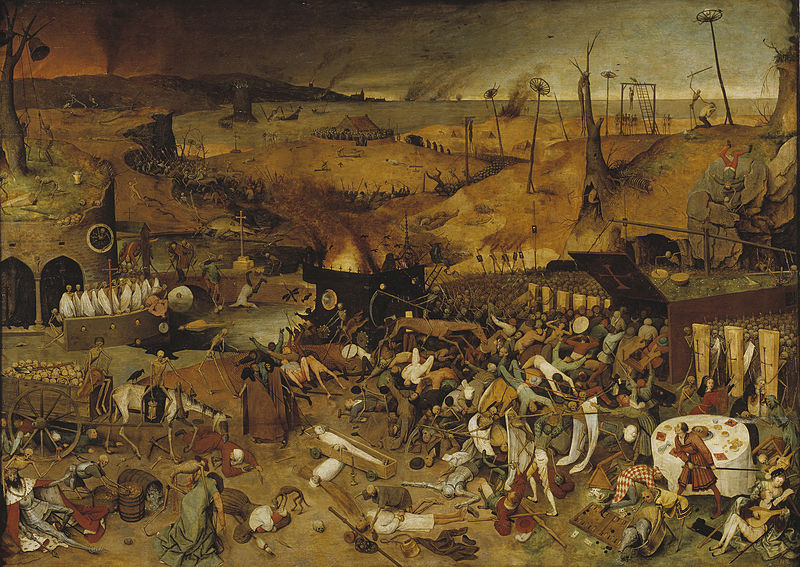
Pieter Bruegel the Elder depicted the Black Death this way, in his 1562 painting "The Triumph of Death":
Image
There are other theories, too, about the origin and spread of the Black Death. One says that a comet or fragments of a comet precipitated the Black Death. If you remember that scientists have said that the last Ice Age was caused by an asteroid impact, it's not much of a stretch to imagine that a piece of a comet striking the Earth could have disrupted the atmosphere enough to initiate the famines and plagues that characterized the Black Death:
"In France . . . was seen the terrible Comet called Negra. In December appeared over Avignon a Pillar of Fire. There were many great Earthquakes, Tempests, Thunders and Lightnings, and thousands of People were swallowed up; the Courses of Rivers were stopt; some Chasms of the Earth sent forth Blood. Terrible Showers of Hail, each stone weighing 1 Pound to 8; Abortions in all Countries; in Germany it rained Blood; in France Blood gushed out of the Graves of the Dead, and stained the Rivers crimson; Comets, Meteors, Fire-beams, corruscations in the Air, Mock-suns, the Heavens on Fire . . ."

Comment: There has been much research that indicates that the plague was actually a result of cometary bombardment. The evidence actually supports what the people said at that time, reporting earthquakes, comets, rains of death and fire, corrupted atmosphere, and death on a scale that is almost unimaginable. For more background information read:

New Light on the Black Death: The Cosmic Connection
New Light on the Black Death: The Viral and Cosmic Connection
Black Death Study Lets Rats Off the Hook


Comet 2

Duck and cover! Americans warned of imminent, deadly meteor strikes

Image
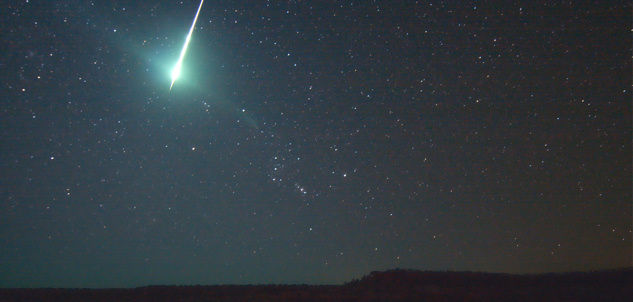
File photo of a fireball
With NASA reporting a "potentially hazardous" asteroid nearly half-a-mile wide possibly heading toward earth, and some upstate New Yorkers claiming they experienced a loud boom and a bright light in the sky last night caused by a meteor, a doctors' organization is offering some timely advice:

Just as when the American populace first prepared for the possibility of a nuclear blast, a person's best option for surviving a meteor strike is the same "duck and cover" created during the 1940s and '50s when nuclear weaponry was still in its infancy.

The warning comes from Physicians for Civil Defense, which issued a statement recently during a meeting of the Emergency Management Agency of Utah.

"All Americans, starting with first responders and emergency managers, need to know this basic life-saving principle: 'Drop and cover if you see a sudden very bright light,'" said the statement from the organization's spokeswoman, Jane Orient, M.D.

Comment: Lest anyone thinks these physicians are pulling their leg:


Question

Field museum's newest meteorite puzzles scientists

Meteorite
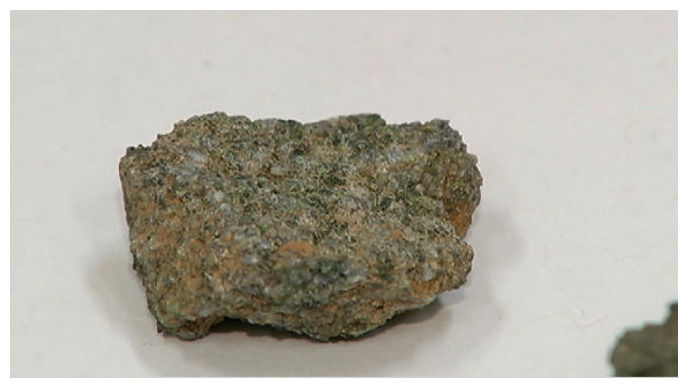
© NBC Chicago
Scientists aren't exactly sure where a mysterious new meteorite came from, but its bright green hue is certainly bringing one super planet to mind.

While it's probably not from Krypton, the newest member of the Field Museum's meteorite collection is puzzling scientists.

While most meteorites look like a black or grey chunk of rock, this one is bright green and looks more gem-like than other meteorites in the collection, according to museum officials. Even more perplexing is the rock's chemical composition, which has proven impossible to classify.

The meteorite, named Northwest Africa 7325, was found in South Morocco in early 2012 and likely comes from an asteroid in the space between Mars and Jupiter, officials said.

Comet 2

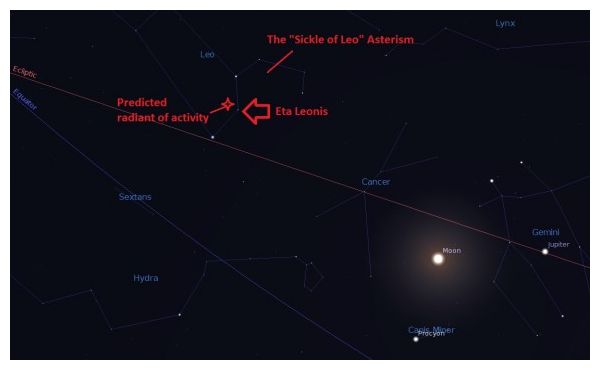
A possible meteor shower from Comet ISON?

ISON-ids
© StellariumThe position of the radiant for any possible “ISON-ids” in Leo. Note the nearby Full Moon the night of January 15th.
Hey, remember Comet C/2012 S1 ISON? Who can forget the roller-coaster ride that the touted "Comet of the Century" took us on last year. Well, ISON could have one more trick up its cosmic sleeve - although it's a big maybe - in the form of a meteor shower or (more likely) a brief uptick in meteor activity this week.

In case you skipped 2012 and 2013, or you're a time traveler who missed their temporal mark, we'll fill you in on the story thus far.

Comet ISON was discovered by Artyom Novichonok and Vitali Nevski on September 21st, 2012 as part of the ongoing International Scientific Optical Network (ISON) survey. Shortly after its discovery, researchers knew they had spotted something special: a sungrazing comet already active at over 6.4 Astronomical Units (A.U.s) from the Sun. The Internet then did what it does best, and promptly ran with the story. There were no shortage of Comet ISON conspiracy theories for science writers to combat in 2013. It's still amusing to this day to see predictions for comet ISON post-perihelion echo through calendars, almanacs and magazines compiled and sent to press before its demise.

Fireball 4

Scientists in Antarctica prepare to collect dust from Comet ISON comet debris

Image
© RIA Novosti / V. Chistiakov.Traffic signs at the Vostok Soviet Antarctic research station in the vicinity of the South Geomagnetic Pole.

Scientist at the Vostok Antarctic station are to gather dust from the comet ISON, which was disintegrated by the sun in late November 2013. They hope their luck will help them find the "basic building blocks" of life.

The Russian scientists manning the station will take three attempts to harvest space dust. The first will be between Tuesday and Wednesday this week, then again between Friday and Saturday, and also sometime in late January, Sergey Bulat from St. Petersburg Institute of Nuclear Physics, told RIA Novosti.

Bulat and his colleagues initially scheduled their dust hunt for December, when the comet was expected to pass Earth on its way back into outer space after grazing the sun. But its destruction called for a change of plan.

"We expected the comet to survive and hoped to gather some large particulates in December. Now if we get something, it would be particulates from the coma [the major part of the head of a comet] and tail left when it was approaching the sun," he explained.

Comment: Forget "finding the basic building blocks of life", the "building blocks" are raining down on above our heads!

Take cover! Meteor fireballs rain down across U.S. - Outbreaks of wildfires reported


Comet

NEO-WISE spots yet another large 'potentially hazardous' asteroid soon making a close approach with Earth

Image
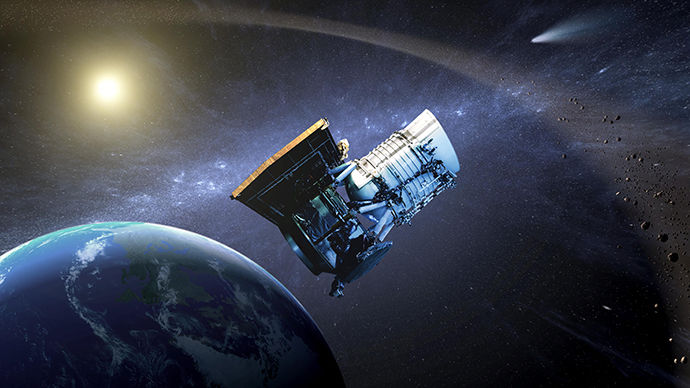
© NASA/JPL-CaltechThis artist's concept shows the Wide-field Infrared Survey Explorer, or WISE spacecraft, in its orbit around Earth. In September of 2013, engineers will attempt to bring the mission out of hibernation to hunt for more asteroids and comets in a project called NEOWISE
A new, "potentially hazardous" asteroid has been discovered by one of NASA's recently reactivated spacecraft - and it's headed in Earth's direction.

The new asteroid, called 2013 YP139, was spotted by NASA's Near-Earth Object Wide-field Infrared Survey Explorer (NEOWISE), and marks the spacecraft's first discovery since being resurrected last year.

According to the Telegraph, the asteroid is still 27 million miles (43 million km) away from Earth, but with a diameter of nearly half a mile (0.4 miles, to be precise), an impact with our planet would cause significant damage. NASA estimates any asteroid with a diameter greater than 0.5 miles could create worldwide consequences upon impact.

The 2013 YP139 doesn't quite raise concern to that level, but its trajectory has attracted the attention of NASA.

Fortunately, the space agency added that the asteroid will miss the Earth this time around, though it will fly by our planet at a distance of 300,000 miles, or about as close as the moon. It's not expected to get any closer for the next century.

Fireball 5

SOTT Focus: 2013 saw a dramatic increase in meteor fireballs - What does 2014 have in store?

Fireball City
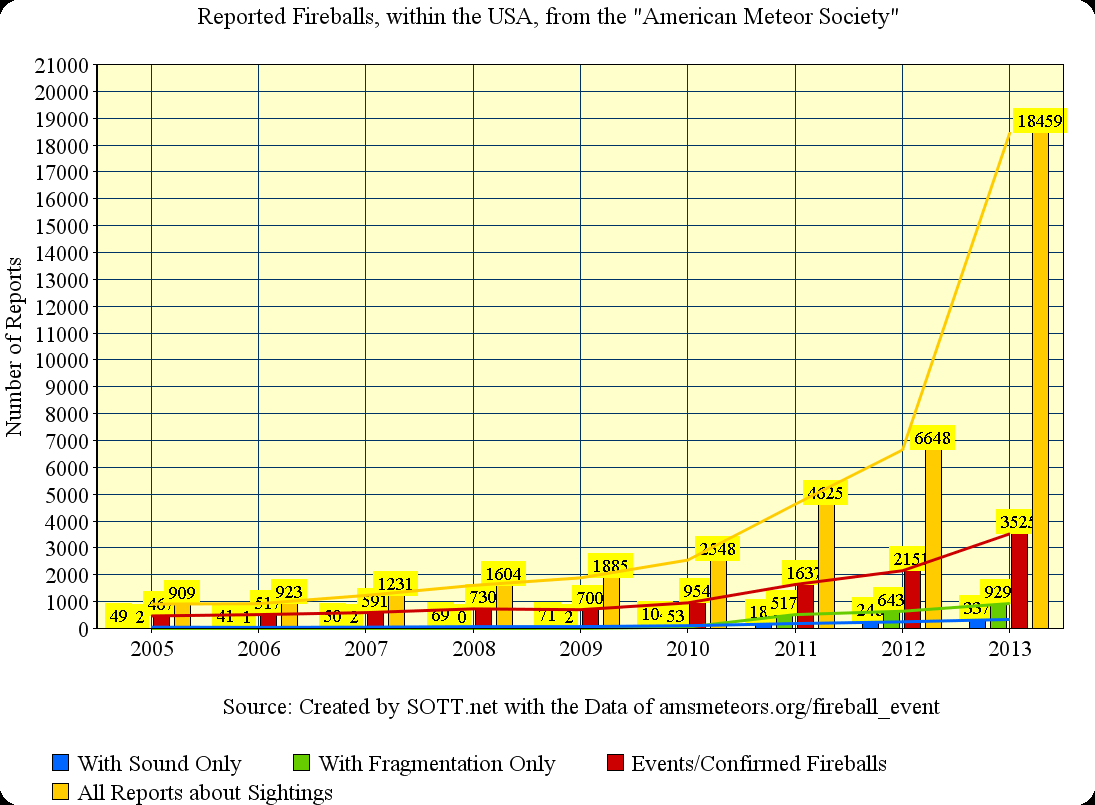
So many new comets were discovered last year that astronomers named 2013 the 'Year of the Comet'. Less popularlized was the noticeable increase in fireball meteors observed in the Earth's atmosphere. Another year has passed and fireballs are still raining down like never before, with their rate apparently increasing exponentially.

SOTT.net has been cataloguing fireball events since 2002, and a couple of other websites have sprung up since then, but in general the lack of record-keeping and media coverage of this phenomenon is shocking, especially given how extraordinary the phenomenon is (or rather, was - apparently it's 'normal' now!) and whatever it may portend for civilization, sometime in the future, if not immediately.

One relatively new resource is the American Meteor Society's 'Fireball Logs', a database where eyewitnesses have been submitting reports of fireball events in the U.S. The AMS does subsequent checks to verify events with the All-Sky Fireball Camera Network set up by NASA's Meteoroid Environment Office (MEO) and other observation networks. Their stats are remarkable, yet they do fit with what we've noticed at SOTT.net in recent years: the numbers just keep going up and up, and at an ever increasing rate!

Using the AMS data, which begins in 2005, I've created the following tables to give readers a visual for what's going on. Check this out:

Fireball Increase 3.0
© SOTT

Comment: See also:


Fireball 2

SOTT Focus: Take cover! Meteor fireballs rain down across U.S. - Outbreaks of wildfires reported

Reports are pouring in from across the United States of multiple meteor fireballs streaking across the sky yesterday evening, January 12th, 2014, from approximately 5pm through 7pm, Eastern Standard Time. Over 170 observation reports were submitted to the American Meteor Society website, in addition to dozens of reports submitted on the Lunar Meteorite Hunters website, from eyewitnesses in northeastern and western states.

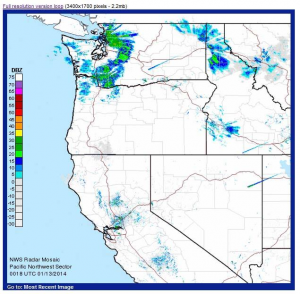
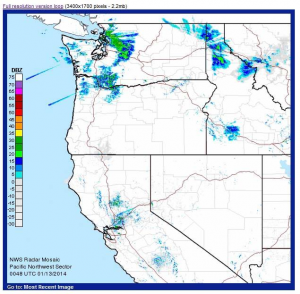
Streaks appearing on NOAA's online radar service apparently indicate that the fireballs came in from a northeast-southwest direction:

Image
© NOAAThe Pacific coast of the US earlier today. Note the blue streak over Washington state and similar on the Nevada-Utah border.

Image
© NOAANote the streaks over the ocean west of Washington state and Oregon.

Comment: Update 16 January 2014

A reader sent us the link to this video report from 'Fire in the Sky News' on the above meteor 'outburst':