Comets


Fireball 3

Best of the Web: Coming to a city near you soon? Chelyabinsk meteor shockwave compilation

Image
It looks like a movie, but it's not

This footage is compiled from multiple locations in Chelyabinsk, Russia when it was hit by the shockwave from an enormous overhead meteor explosion on February 15th 2013. The blast caught up with people in their offices, schools, workshops... one moment they were going about their normal day, the next...


Fireball 5

"Drop and take cover when you see the bright flash from a meteor fireball", U.S. doctors urge

Image
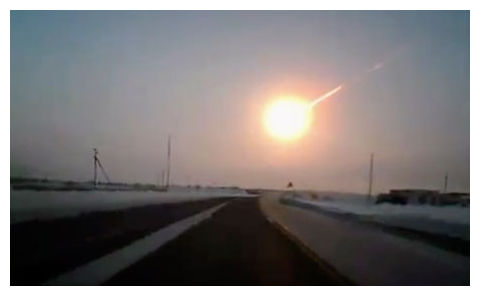
Blast damage in the Russian city of Chelyabinsk last February saw thousands of windows blown in by the shockwave, which arrived a couple of minutes after the bright flash. U.S. doctors working with Federal emergency preparedness programs are encouraging people, once they see a similar bright flash, to get away from windows during those crucial few minutes.
At the time of the Emergency Management Agency of Utah (UEMA) conference on Jan 9, 2014, Physicians for Civil Defense issued the following statement:

All Americans, starting with first responders and emergency managers, need to know this basic life-saving principle: "Drop and cover if you see a sudden very bright light."

Such a light will be followed by a deadly shock wave within seconds. Those who drop and cover will probably survive. Those who do not are likely to be killed or suffer severe injury.

During the 2013 Chelyabinsk meteor explosion, a fourth-grade teacher in Chelyabinsk, Yulia Karbysheva, saved 44 children from potentially life-threatening window glass cuts by ordering them to hide under their desks when she saw the flash. Ms. Karbysheva, who remained standing, was seriously lacerated when the explosion's blast wave arrived and windows shattered. A tendon in her arm was severed, but not one of her students suffered a cut.

"Large meteor strikes are sufficiently probable that both the U.S. and Russia are working on ways to divert them. In 1908 a meteor strike flattened 800 square miles of Siberian forest," stated president Jane M. Orient, M.D.

Comment: Lest anyone thinks these physicians are pulling their leg:


Comet 2

Oceans to Ice: Marine diatoms found in Greenland ice core suggests pummeled planet in 530′s AD

Earlier abstract

Link to current abstract

Dallas Abbott 2013 PP on 530′s Event and Marine Diatoms in GISP2 Ice Core by George Howard


Fireball 4

A new major meteor shower in 2014? Earth might be sandblasted with debris from Comet 209P/LINEAR May 24, 2014

Image
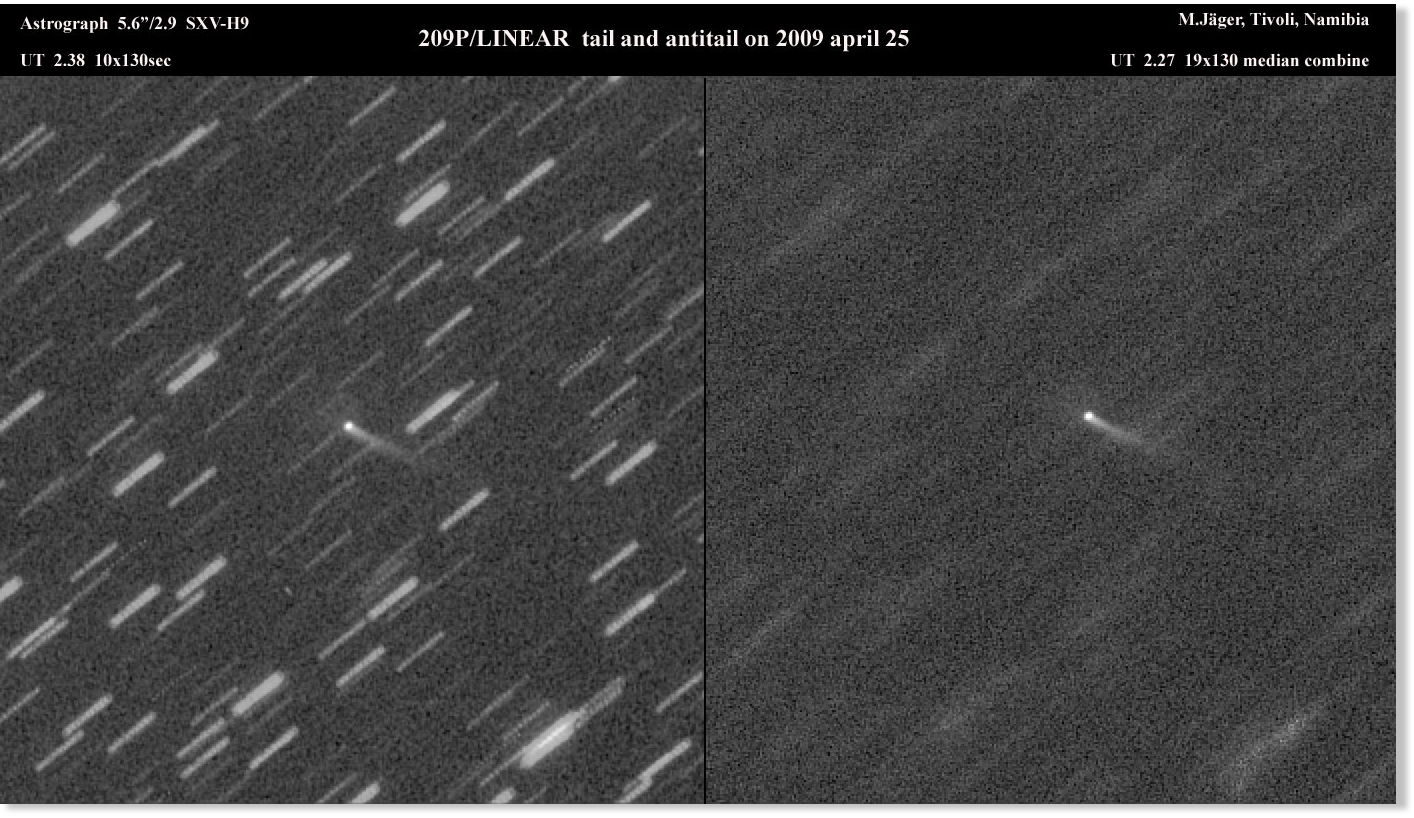
© Michael Jager Comet 209P/LINEAR on April 25, 2009 as captured by Michael Jager in Austria.
The list of major meteor showers hasn't changed much in recent decades, but it has changed a little. Meteor showers are part of nature, after all, and the list of major showers shifts and changes slightly, as all things in nature do, with one shower or another becoming more or less exciting as the years pass. In 2014, though, an exciting new meteor shower might come on the scene. This possible shower stems from a comet - Comet 209P/LINEAR - discovered in 2004. Comet 209P/LINEAR passed near the sun in 2009 and will pass near it again in early May, 2014. On the night of May 24, 2014 - if the predictions hold true - Earth might be sandblasted with debris from this comet, resulting in a fine display of meteors, or shooting stars.


Comment: Wondering what else the Earth may be 'sandblasted' with? Comets and the Horns of Moses


Fireball 2

Huge fireball fragments over Iowa, seen across U.S. Midwest

fireball iowa
A very huge fireball in the Iowa skies awed and amazed several witnesses in Des Moines and across the U.S. Midwest. There were hundreds of reports received by the American Meteor Society (AMS), of a bright ball of fire streaking across the night sky. Experts agree that is very likely a meteor entering and burning up in our atmosphere.

The AMS is a non-profit organization that collects information and reports on any possible meteor sightings. A total of 460 people filed reports with the AMS on the Iowa incident, mostly coming from the area around the Minnesota and Iowa border.

The massive fireball caught the attention of many Iowa residents and the event was even captured on a street camera in the City of North Liberty. According to the AMS, a very bright meteor is actually called a "fireball." The AMS defines a fireball as an object with about the same brightness as the planet Venus in the evening or early morning sky.

As soon as people witness the huge fireball, posts began appearing in social media feeds. People in Tennessee, Missouri, Indiana and Illinois also reported seeing the fireball in the sky. None of the witnesses reported hearing any sound neither before, during, nor after they saw the fireball streaking across the sky.

Comment: It was a meteor fireball, case closed!

A must-read to understand what's going on: Celestial Intentions: Comets and the Horns of Moses


Fireball

Chelyabinsk meteor hit the Earth like a warning shot fired from space

russian meteor
© APThe meteorite fireball that fell over Chelyabinsk briefly burned 30 times brighter than the sun.
The meteorite is providing invaluable information to help protect against larger rocks that might pose a serious threat to Earth

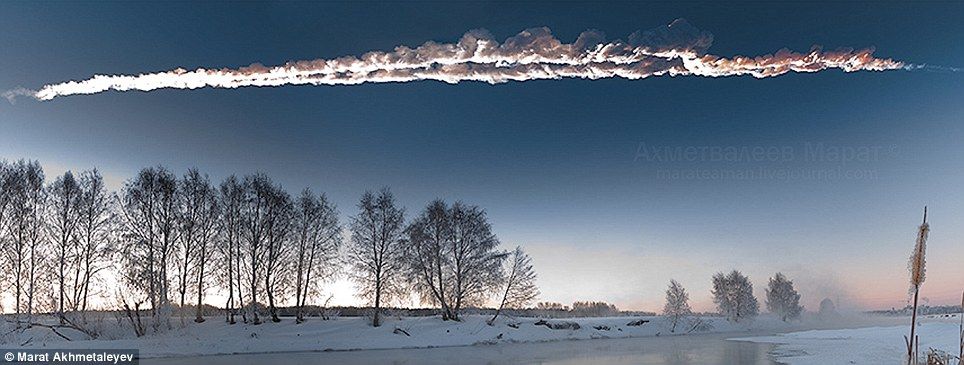
Just after sunrise on 15 February 2013, as commuters made their way along snow-covered roads to Chelyabinsk in south-west Russia, the clear blue sky was torn by a hurtling lump of space rock.

The meteorite appeared without warning, out of the sun, on a shallow trajectory. It thumped into the atmosphere at 12 miles per second and became a fireball. For a moment, the rock burned 30 times brighter than the sun.

Viktor Grokhovsky, a researcher at Ural Federal University, 200km to the north of Chelyabinsk, missed the beautiful, terrifying spectacle that morning, but within minutes was watching video of the event. He spent the rest of the day assembling a search party. The first of several set out at first light the next morning to interview eyewitnesses and recover pieces of the fallen rock.

"It was rather easy to find fragments in the first days after the meteorite fell, because the chunks left holes in the snow," Grokhovsky told the Guardian. But as more snow fell over the next two weeks, the holes became covered over. The search was called off until the snow began to melt in the spring.

Comment: Celestial Intentions: Comets and the Horns of Moses
Killer Space Rocks
2012 saw record number of meteorite falls so far this century

SOTT readers would be well advised to check out just how 'rare' these celestial occurrences actually are these days. Not as 'rare' as the 'experts' want you to believe.

SOTT diligently tracks sightings and impacts here:
Fire in the Sky


Fireball 5

Best of the Web: American Meteor Society receives over 500 reports of Chelyabinsk-like event over U.S. Midwest, 26 December 2013

Image
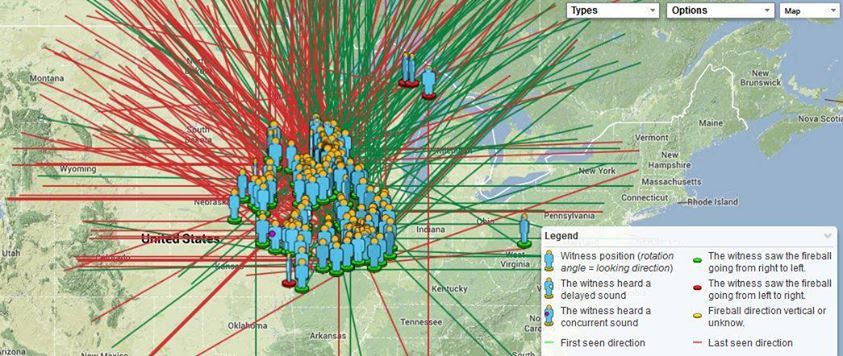
Over 500 reports were sent in to the American Meteor Society website concerning a major fireball event (possibly two) over the U.S. Midwest on December 26th, 2013.


Comment: The Lunar Meteorite Hunters blog received an additional 116 reports about this large meteor fireball over the U.S. Midwest.

Regarding the 'Dual Suns' mentioned by 'Fire in the Sky News' channel host, 'MrMBB333', the Twin Sun theory makes sense to us too:


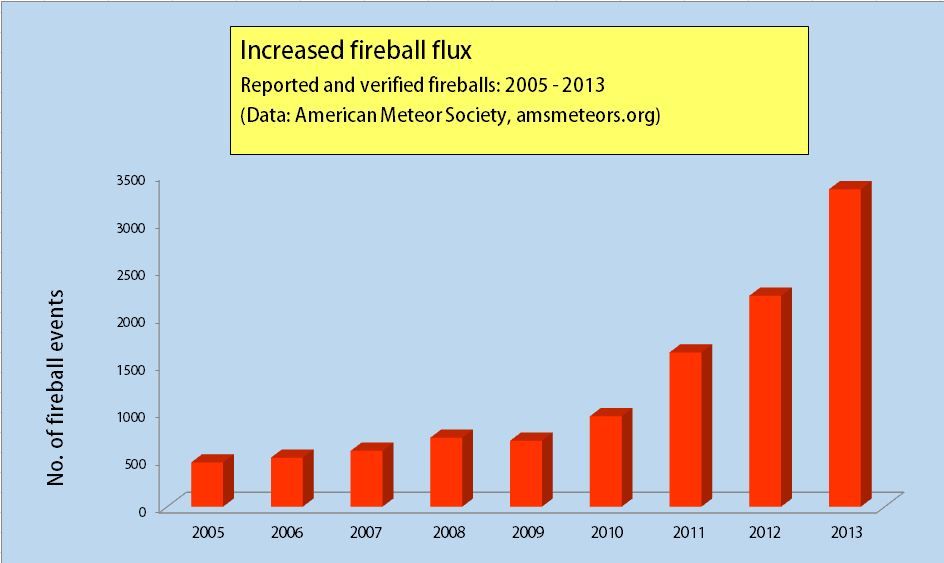
Here's what the AMS fireball data looks like from 2005 to date:

ams fireball
© SOTT.net


Comet

500 years of the greatest comets ever seen - and why there are more to come

When Comet ISON was discovered and a preliminary orbit for it was worked out, it was initially announced that it could be the "comet of the century." Of course, the 21st century is only 12 years old (from 2001) and ISON turned out to be a dud. But out there in the far recesses of space there is certainly some unknown comet worthy of such an honorific title that will ultimately put on a unique and memorable show sometime during this century.

There will always be bright and spectacular comets, but in each century there is always one that will stand above the others. Below I provide my own list of the five most spectacular comets that have appeared in each century starting from the 16th and running through the 20th century. Take note that four of these five dazzlers appeared in the latter half of their century and that the average time between appearances amounts to 97 years. Considering that Comet Ikeya-Seki passed by in 1965, the next prospective "Comet of the Century" might not appear - according to our small sampling - until maybe 2029 at the earliest ... and maybe not even until the next century (in 2103!). Then again, stupendously bright comets are totally unpredictable and can suddenly appear at almost any time.

Greatest Comet of the 16th Century: The Great Comet of 1577

This comet passed to within 16.7 million miles (26.9 million kilometers) of the sun on Oct. 27, but was not sighted until five days later, when it was described in an account from Peru as an exceptionally brilliant object. Contemporary descriptions note that it was seen through the clouds like the moon. By Nov. 8, it was reported by Japanese observers as a "broom star," appearing "as bright as the moon" with a white tail spanning over 60 degrees (your clenched fist held at arm's length measures 10 degrees). The famous astronomer Tycho Brahe first saw the comet as a reflection in his garden fish pond on Nov. 13, and likened its brightness to Venus. The comet was still as bright as zero magnitude in December before it finally dropped below the limit of naked-eye visibility on Jan. 26, 1578. (Magnitude is a measure of a celestial object's brightness, with smaller numbers corresponding to brighter objects.)

Image
A German woodcutting by Jiri Daschitzsky that depicts the Great Comet of 1577 streaking over a village of onlookers.

Comment: And why there are more to come: Comets and the Horns of Moses


Health

Madagascar battles the Black Death

Image
© Peter StephensThe village of Mandritsara, where 20 people recently died from bubonic plague.
Plague leaves dozens dead after one of the worst outbreaks in years.

To most, the plague is a thing of the past - a relic from the Middle Ages, when the disease known as the Black Death wiped out a third of Europe's population. Yet despite being wiped out across much of the globe, it's still very much a reality in parts of Madagascar, where one of the worst outbreaks in recent memory has left dozens dead.

Last week, government officials announced that 39 people have died this fall from pneumonic plague - a rare and extremely deadly strain of the illness that affects the respiratory system. According to Madagascar's health ministry, pneumonic plague can kill a patient within three days of infection, leaving little time for antibiotics to take effect.

The announcement came just days after experts at the Pasteur Institute of Madagascar confirmed that bubonic plague killed 20 people in the northwest town of Mandritsara, and two months after the International Committee of the Red Cross (ICRC) warned that Madagascar was at risk of a plague epidemic.

Comment: See New Light on the Black Death: The Viral and Cosmic Connection for an alternative view on disease propagation by celestial bodies.


Comet 2

New study suggests cometary activity preceded Justinian Plague, wiping out Roman civilization and Western Europe 1,500 years ago

Halley's Comet 1986
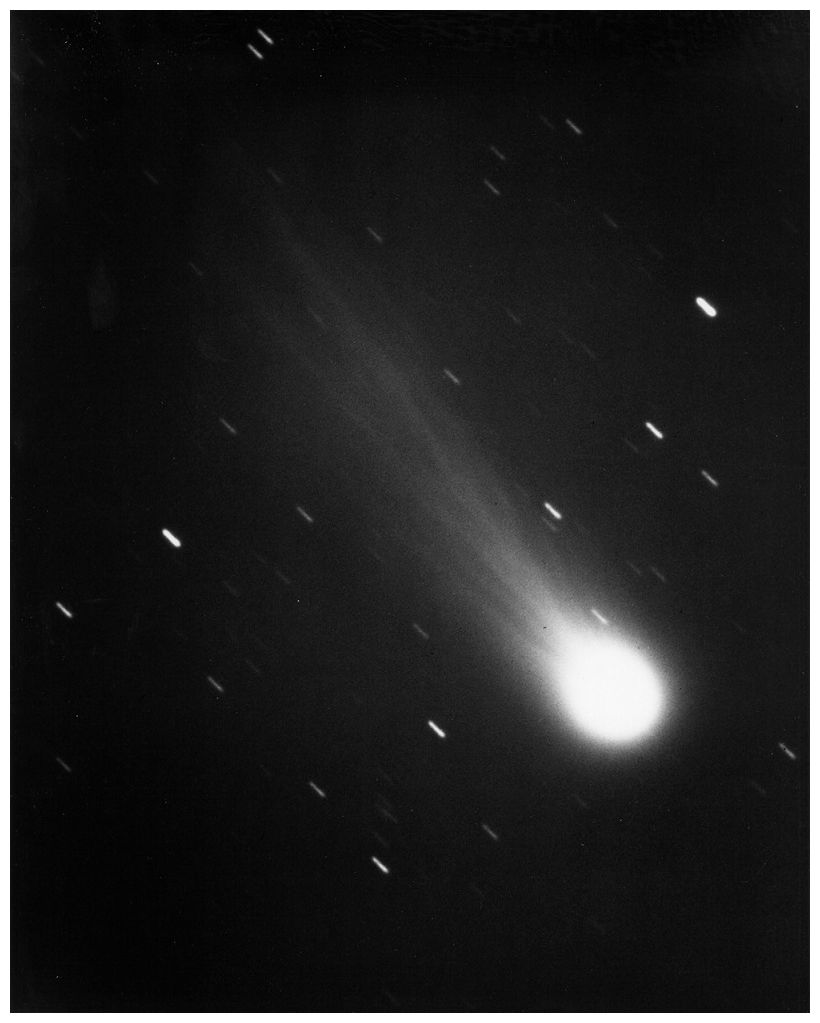
© NASA/JPLThis photograph of Halley's Comet was taken January 13,1986, by James W. Young, resident astronomer of JPL's Table Mountain Observatory in the San Bernardino Mountains, using the 24-inch reflective telescope.
The ancients had ample reason to view comets as harbingers of doom, it would appear.

A piece of the famous Halley's comet likely slammed into Earth in A.D. 536, blasting so much dust into the atmosphere that the planet cooled considerably, a new study suggests.

This dramatic climate shift is linked to drought and famine around the world, which may have made humanity more susceptible to "Justinian's plague" in A.D. 541-542 - the first recorded emergence of the Black Death in Europe.

The new results come from an analysis of Greenland ice that was laid down between A.D. 533 and 540. The ice cores record large amounts of atmospheric dust during this seven-year period, not all of it originating on Earth.

"I have all this extraterrestrial stuff in my ice core," study leader Dallas Abbott, of Columbia University's Lamont-Doherty Earth Observatory, told LiveScience here last week at the annual meeting of the American Geophysical Union.

Certain characteristics, such as high levels of tin, identify a comet as the origin of the alien dust, Abbott said. And the stuff was deposited during the Northern Hemisphere spring, suggesting that it came from the Eta Aquarid meteor shower - material shed by Halley's comet that Earth plows through every April-May.

The Eta Aquarid dust may be responsible for a period of mild cooling in 533, Abbott said, but it alone cannot explain the global dimming event of 536-537, during which the planet may have cooled by as much as 5.4 degrees Fahrenheit (3 degrees Celsius). For that, something more dramatic is required.

Comment: Historical accounts record multiple air blasts, so more likely than one 'random' cometary event is multiple smaller blasts over a period of time. Read Comets and the Horns of Moses to see how cyclical catastrophe unfolded in the Dark Age that came before the post-Roman Dark Age. Same model, same story: the comets don't directly cause the famines which weaken the populations, followed by the plague. The populations are already weakened by 'climate change' and food shortages due to a corrupt and ensconced elite, then one or two larger chunks of space rock deliver the payload - a comet-borne virus or two that humanity has little to no immunity against.