Comets


Snowflake Cold

Another round of Arctic air forecast to deep freeze the U.S.

From Steven Goddard:
Arctic Air Forecast To Deep Freeze The US
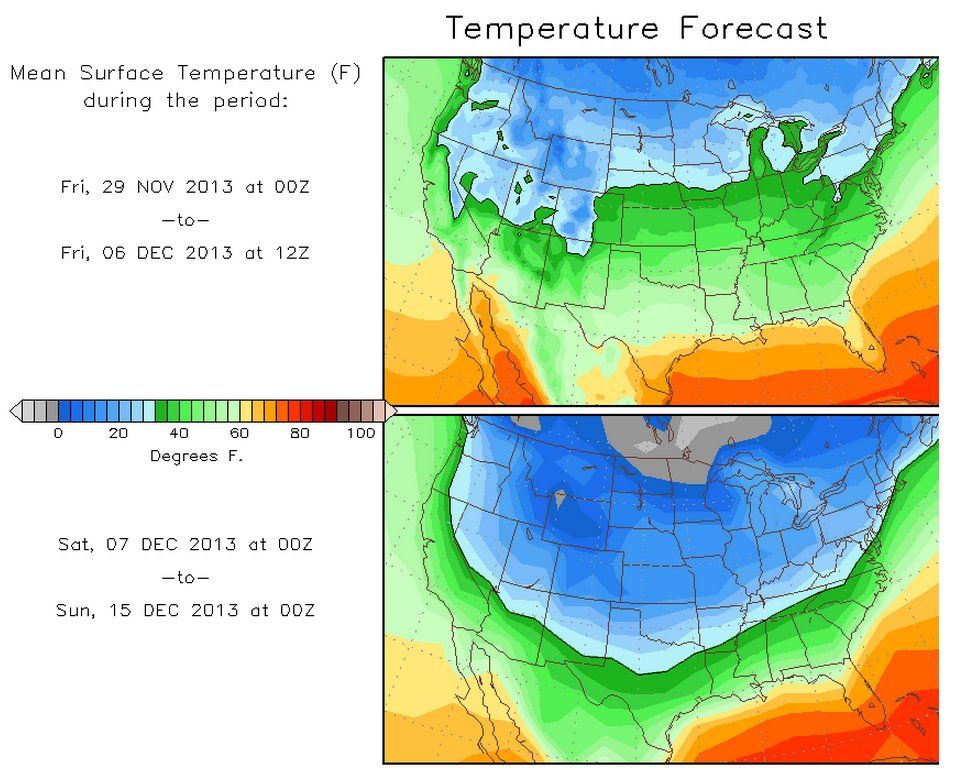
Arctic cold blast
© Steven Goddard

Comet

SOTT Focus: Why didn't Comet ISON melt in the Sun? How NASA and Official Science got it all wrong (again)

Image
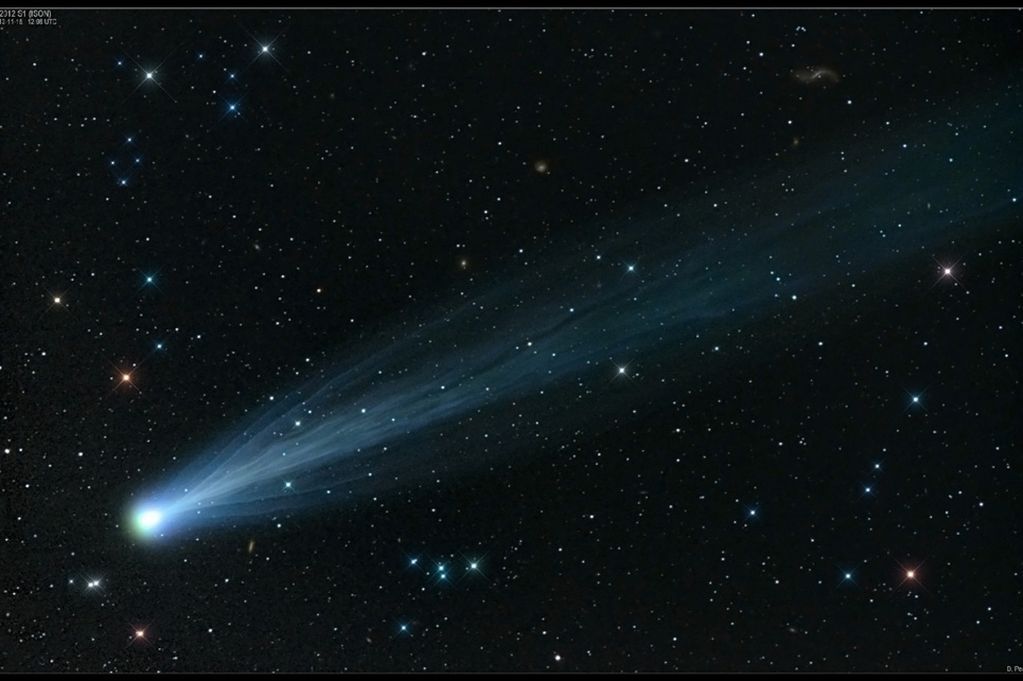
© Damian PeachComet ISON on November 15th, 2013. The field of view is 2.5°, five times the width of the full moon.

Comment:

Editors' Note


This article builds on an excerpt from an upcoming book, to be published by Red Pill Press, which draws on the 'Electric Universe' concept, information theory, astronomy, paleogeology - and much more - to present an expanded cosmology linking so-called 'climate change' and 'Earth changes' with mankind's role in the greater cosmic environment.

Written by Pierre Lescaudron, editor and researcher for SOTT.net, in the following article he provides an explanation for the "weird" and "unexpected" behaviour of Comet ISON to date, particularly regarding its unexpected survival as it went around the Sun on November 28th, 2013.


Comets or Asteroids?
Image
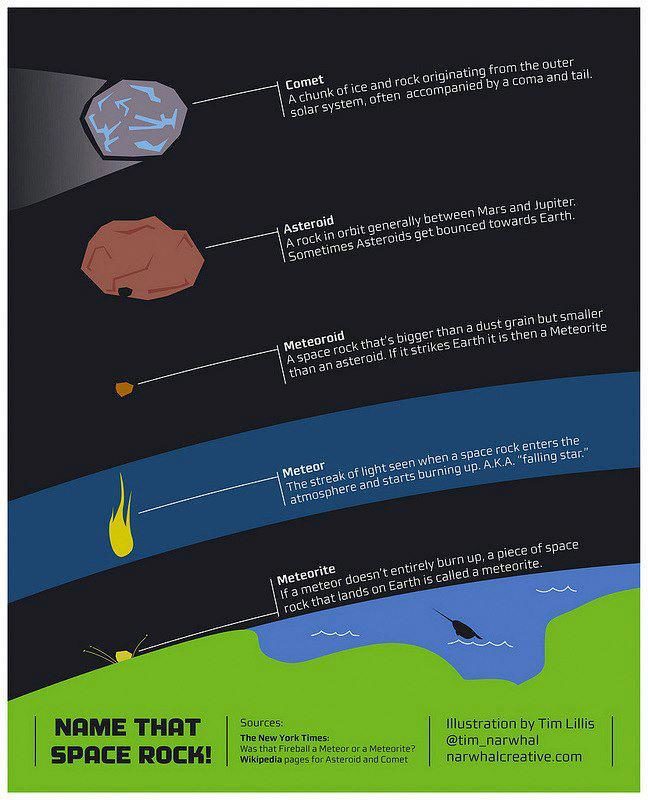
© NarwhallComet, asteroid, meteor and meteorite classification - according to mainstream science.
As depicted in the above illustration, and routinely argued by mainstream science, comets are "chunks of ice and rock", a.k.a. "dirty snowballs". This belief, however, is incompatible with the actual data. For instance, in 2011 Comet Lovejoy plunged into the Sun's atmosphere and emerged on the other side after an hour-long journey through the sun's corona. Its size and brightness didn't seem to have diminished.1 Here are some (pretty typical) comments from observers of this event:
This morning, an armada of spacecraft witnessed something that many experts thought impossible. Comet Lovejoy flew through the hot atmosphere of the sun and emerged intact. "It's absolutely astounding," says Karl Battams of the Naval Research Lab in Washington DC. "I did not think the comet's icy core was big enough to survive plunging through the several million degree solar corona for close to an hour, but Comet Lovejoy is still with us." 2
But if the temperature of the Sun's corona is several million degrees3, and if Comet Lovejoy is no more than a chunk of ice estimated to be just a few hundred meters in diameter,4 how was it possible that it wasn't vaporized?

Comet

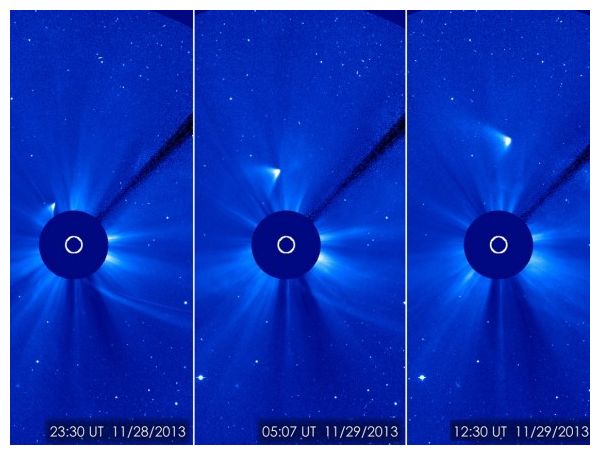
Comet ISON lives!

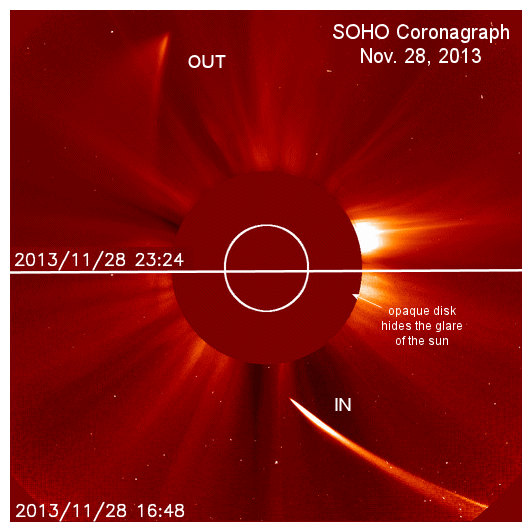
Cancel the funeral. Comet ISON is back from the dead. Yesterday, Nov. 28th, Comet ISON flew through the sun's atmosphere and appeared to disintegrate before the cameras of several NASA and ESA spacecraft. This prompted reports of the comet's demise. Today, the comet has revived and is rapidly brightening. Click to view a SOHO coronagraph movie of the solar flyby (updated Nov. 29 @ 1800 UT):


Before the flyby, experts had made many predictions about what might happen to the comet, ranging from utter disintegration to glorious survival. No one predicted both.

Eye 1

What hypocrites! US supports UN anti-spying resolution

Angela Merkel
© Sean Gallup/Getty ImagesAngela Merkel
Somewhat ironically, the United States Tuesday backed an anti-spying U.N. resolution that was pushed by two countries miffed at the NSA.

After the U.S. reportedly eavesdropped on their elected leaders, Dilma Rousseff and Angela Merkel, Germany and Brazil pushed a U.N. resolution affirming "the right to privacy in the digital age." The resolution states that technological advancements have made it possible for government and corporate spying that "may violate human rights" under international human- and civil-rights declarations "and is therefore an issue of increasing concern."

Surveillance "may threaten the foundations of a democratic society," the resolution reads, referring to the "illegal collection of personal data" and calls on nations to "ensure that measures taken to counter terrorism comply with international law." It also calls for the U.N. High Commissioner on Human Rights to submit a report on protection of privacy rights in the context of digital and mass surveillance.

The U.S. is on board, despite having reportedly recorded phone conversations of world leaders, including Rousseff and Merkel.

The U.N.'s social, humanitarian, and cultural committee passed the resolution Tuesday unanimously without a vote, and the U.S. supported it.

Comet 2

Comet ISON the comeback kid defies predictions (and assumptions)

ISON_1
© ESA/NASA/SOHO/GSFCBright, brighter, brightest: these views of Comet ISON after its closest approach to the sun Nov. 28 show that a small part of the nucleus may have survived the encounter. Images from the Solar and Heliospheric Observatory.
Talk about the Comeback Kid. After Comet C/2012 S1 ISON rounded the sun yesterday afternoon, professional astronomers around the world looked at the faded debris and concluded it was an "ex-comet." NASA wrapped up an hours-long Google+ Hangout with that news. The European Space Agency declared it was dead on Twitter.

But the remnants - or whatever ISON is now - kept brightening and brightening and brightening in images from the NASA/European Space Agency Solar and Heliospheric Observatory. The pictures are still puzzling astronomers right now, almost a day after ISON's closest encounter with the sun.

Comment: The level of puzzlement would drop drastically if mainstream science wasn't so attached to its 'dirty snowball' theory.

The True Origins of Electric Comet Theory
Electric Comet: The Elephant in NASA's Living Room?
Evidence Confirms Electric Comet Model
Comets: The Loose Thread


Comet

Best of the Web: Cancel the eulogy for ISON ... For now

Comet ISON flew through the sun's atmosphere on Nov. 28th and the encounter did not go well for the icy comet. Just before perihelion (closest approach to the sun) the comet rapidly faded and appeared to disintegrate. This prompted reports of ISON's demise. However, a fraction of the comet might have survived. Click on the image below to see what emerged from Comet ISON's brush with solar fire:
ISON
© Spaceweather
In the movie, Comet ISON seems to be falling apart as it approaches the sun. Indeed, researchers working with NASA's Solar Dynamics Observatory said they saw nothing along the track that ISON was expected to follow through the sun's atmosphere. Nevertheless, something has emerged. Whether this is a small scorched fragment of Comet ISON's nucleus or perhaps a "headless comet"--a stream of debris marking the remains of the comet's disintegrated core--remains to be seen.

Comet 2

News and testimonials about the meteor that exploded over Greek island of Kephalonia

meteorite
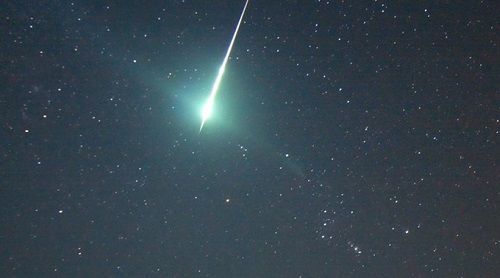
Many residents of Western Greece experienced a unique and incredible phenomenon at 9 pm yesterday [Wednesday] evening. Meteorologists spoke of a meteorite that was to fall in the Ionian sea.

The phenomenon was particularly noticed from the residents of Zante in the regions of Maheradou and Alikon. The residents said that they saw bright streaks across the sky from West to East, followed by an intense noise. However, there were no damages or problems reported even though the testimonies supported that the glow illuminated the homes of areas in Kefalonia.

Comment: Hellas Now offers testimonials from eyewitnesses of the surrounding areas (translation from Greek by our SOTT editors):
From Pirgy:
Regarding the meteorite, it was very noticeable around the Pyrgos area where I live, and also at Poros, where my father was, there was a noise and they were shaken a bit. It was however very noticeable even in my village which is far from the sea and high up.
From Kapandriti:
I was outside on my veranda at that time. The night from black became blue. It was coming from Kapandriti. It looked like fireworks but in the end it got on fire, and after 1-2 minutes there was a loud sound.
From Vlahata:
We also heard the sound, it was very loud... the frames of the house shuttered... as if dynamite exploded nearby... a friend wrote that Vlahata brightened as if it was daytime.
From Zakynthos:
There was a horrible Boom! and we all looked around to see what happened, we thought that it was very loud thunder.

People

Inglewood gunman surrenders to police; hostages safe

Image
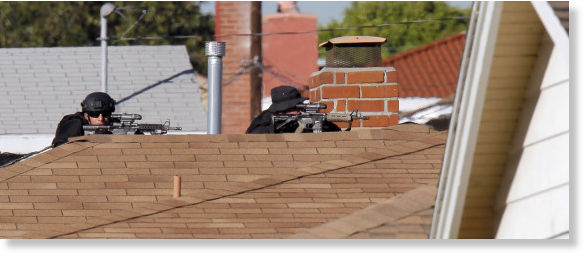
© AP Photo/Nick UtInglewood police snipers take up a position outside a residence, Wednesday, Nov. 27, 2013, in Inglewood, Calif., where a police officer was shot and another received minor injuries in a confrontation with a gunman who barricaded himself inside a home and could be holding a hostage, authorities said.
A gunman fired several shots at a pair of police officers, hitting one, and held two hostages for nearly nine hours - but all came away from the standoff without serious injuries.

The worst injury Wednesday occurred when an Inglewood policeman was shot in his bulletproof vest. He was taken to a hospital in good condition but "in a lot of pain, police Capt. James D. Madia said. He suffered blunt force injuries and was set to spend the night in another hospital as a precaution, police said.

The second officer in was not hit but was hurt when she fell down in the chaos that followed, Madia said. She was treated at a hospital and released.

The 45-year-old gunman and the girlfriend and her 14-year-old daughter that he held hostage in their house all came away unharmed, police said.

Comet 2

Best of the Web: Latest videos: Comet ISON still on course for slingshot around the Sun

Image
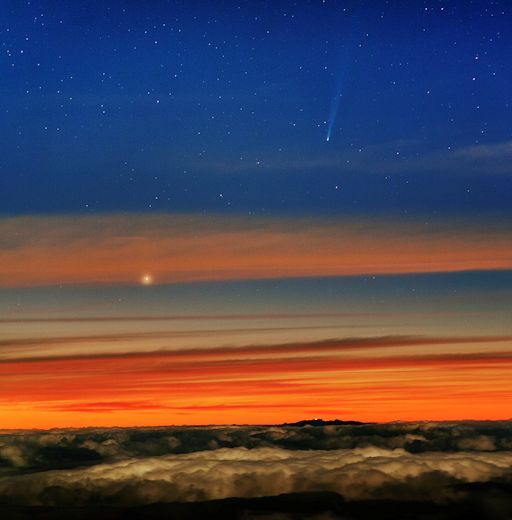
© Juan Carlos CasadaComet ISON seen from Gran Canaria at dawn, 21 November 2013. Visible at lower left is Mercury.
Comet ISON is hurtling toward the sun today at 240,000 mph and, despite the rising heat, the comet appears to be intact. Yesterday, reports of fading spectral lines from the comet's core raised concerns that the icy nucleus might be disintegrating. Current images from NASA and ESA spacecraft, however, show the comet still going strong. Comet ISON has just entered the field of view of the Solar and Heliospheric Observatory (SOHO):


The comet's entrance coincides with a bright CME racing away from the sun's southwestern limb. Astronomers have been wondering what might happen if a CME strikes Comet ISON. This CME, however, will probably miss. The source of the cloud is a farside active region, which is not directly facing the comet.

Snowflake Cold

SOTT Focus: Volcanic eruptions, rising CO2, boiling oceans, and why man-made global warming is not even wrong

Image
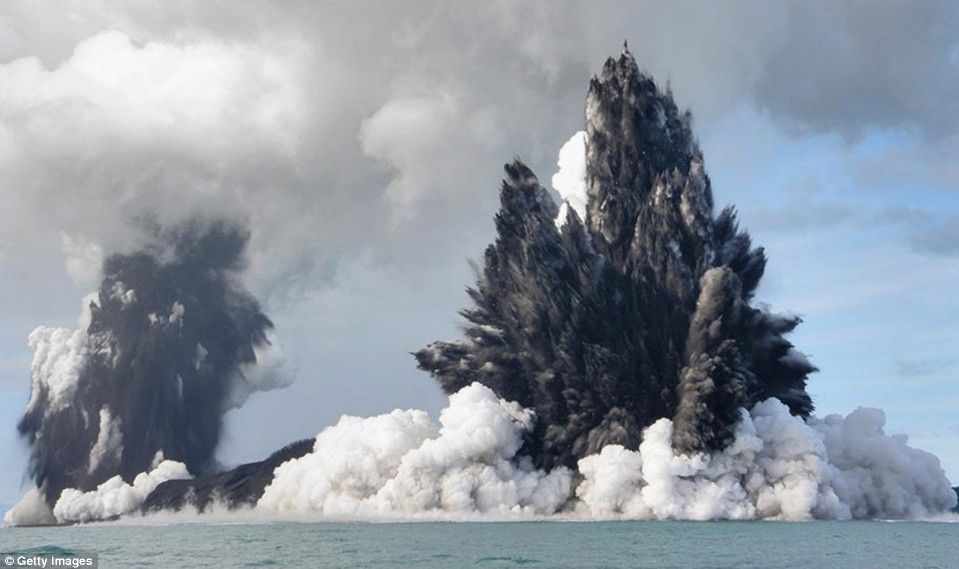
The spectacular eruption of an undersea volcano off the coast of Tonga in the South Pacific in 2009
Perhaps in an effort to ward off yet another long cold winter, officially-sanctioned climate science has been pumping out hot air at exponentially-increasing rates of late. An IPCC report in September told us that global warming "paused" unexpectedly in 1998, and shows no sign of resuming. Actually, the work that went into that report found that warming had stopped altogether, but the wording was altered to describe it as a "pause". You'd think that a pseudo-acknowledgement like this from on-high would dampen the Global Warmists' enthusiasm, but you'd be wrong.

Their driven need to 'fit the facts around the policy' is illustrated by a couple of recent articles that caught our eye. Here USA Today reports on the findings of a study that claims:
"The middle depths of a part of the Pacific Ocean have warmed 15 times faster in the past 60 years than they did during the previous 10,000 years."
Then this BBC article cites "the world's leading experts on ocean acidification", who claim that:
"The world's oceans are becoming acidic at an unprecedented rate and may be souring more rapidly than at any time in the past 300 million years, [...] causing a 30% loss of species in some ocean ecosystems."
And, as you can probably guess, these experts are certain that it's all your fault.

By now you know the drill:

You produce too much CO2 ---> this contributes to the 'greenhouse effect' --> planet heats up --> ice caps melt --> sea levels rise, etc...