Comets


Comet 2

Comet ISON could be no more

ISON
© SOHO/ESA/NASA
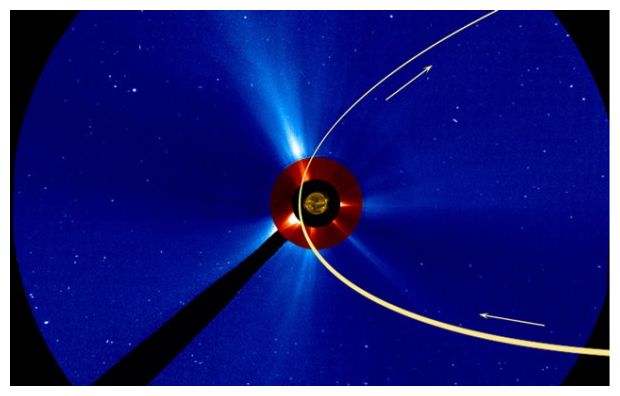
Incoming comet ISON was obviously on a perilous path. The "dirty snowball" was on course to swing by the sun less than one solar diameter above the sun's searing surface on 28 November, Thanksgiving Day in the United States. This view from the SOHO spacecraft dramatically illustrates ISON's close passage through the sun's streaming solar wind and around the sun (here inserted from another image to give a sense of scale).

But astronomers are reporting ominous signs, such as a peak in overall brightness, suggesting that the shrouded ball of ice and dust at the center of the comet has broken up into nothing more than a cloud of dust. Direct confirmation of ISON's disintegration must await spacecraft observations in the next few days.

Comet 2

ISON's close encounter with the sun comes Thanksgiving Day, but its 'action at a distance' is already happening NOW

An enhanced image of Comet ISON, from Hubble Space Telescope data taken in May 2013
© NASAAn enhanced image of Comet ISON, from Hubble Space Telescope data taken in May 2013
For months, all eyes in the sky have pointed at the comet that's zooming toward a blisteringly close encounter with the sun.

The moment of truth comes Thursday -- Thanksgiving Day.

The sun-grazing Comet ISON, now thought to be less than a mile wide, will either fry and shatter, victim of the sun's incredible power, or endure and quite possibly put on one fabulous celestial show.

Talk about an astronomical cliffhanger.

Even the smartest scientists are reluctant to lay odds.

Comment: A "holiday comet", how cute.

Comet ISON isn't going to impact the planet, true. But NASA is completely missing the direct, observable results ISON and countless other comets are having on our environment NOW:

Seven volcanoes in six different countries all start erupting within hours of each other


Comet 2

Comet ISON's current status

Comet ISON
© Compiled November 24, 2013 by Matthew KnightThe latest light-curve for Comet ISON.
In our November 23, the overall message was that not much had changed, and the comet appeared to be keeping it all together as it approached the Sun.

That situation may now have changed.

We are seeing reports online that molecular emission from the comet has fallen dramatically, meanwhile dust production seems to be enormous. What this could indicate is that the nucleus has completely disrupted, releasing an enormous volume of dust while significantly reducing emission rates. Fragmentation or disruption of the nucleus has always been the highest risk factor for this comet so if this has indeed happened then while unfortunate, it would not be a surprise.

However, these reports are new, and while they are undoubtedly valid, we do still need to keep observing the comet to be sure what it happening. Remember: Comet ISON is a dynamically new sungrazing comet, fresh in from the Oort Cloud, and the last time we saw an object like this was never! Furthermore, a sungrazing comet just three days from perihelion has never been studied in this kind of detail - we're breaking new ground here! When we factor in your standard "comets are unpredictable" disclaimer, what we have is a huge recipe for the unknown.

Comet

Comet Ison: Could a break up pose a threat to Earth?

Comet ISON makes solar approach on Thursday, passing a mere 720,000 miles from the solar surface. It'll get hot. This could cause a break-up, with fragments then heading on as yet unpredictable trajectories. Could this pose a threat to Earth? Stuart Clark at the Guardian has the following obs:
ISON
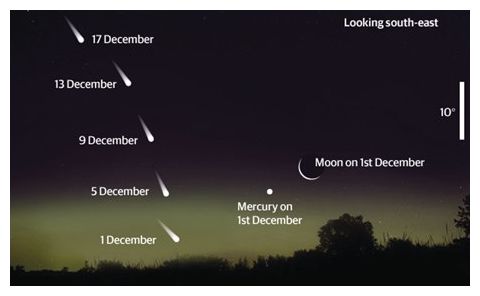
© The GuardianComet ISON's projected position throughout December.
"If it survives an encounter with the sun this week, comet Ison will put on an impressive early morning display in the run-up to Christmas. But anyone hoping for a Bethlehem-style celestial sign on the big day will be disappointed. By then the comet will probably be too faint to see with a naked eye.

Ison is currently speeding towards a fiery encounter on Thursday, which could destroy it. It will pass 720,000 miles above the solar surface, 130 times closer than our planet ever reaches.

The intense sunlight will heat the comet to about 2,700C, speeding up its evaporation. In the past some comets have been seen to vaporise under such an onslaught.

Lovejoy skimmed 85,000 miles above the solar surface. It survived, but with very little of its 0.3-mile-wide nucleus left. Ison is estimated to be two miles wide, and its evaporating ices have already created a tail that stretches 8m miles through space.

"I'm not a gambling man but if I had to bet a fiver, I'd say Ison will survive,' said Brown.

Even if the majority of the comet emerges, fragments could still be blasted off. This would lead to a much more spectacular tail for skywatchers to see in December's sky. For viewers on Earth, the best time to start looking will be in the first and second weeks of December. By then the tail should be extremely well developed and Ison will appear as a ghostly fan shape in the pre-dawn sky.

The comet will also be visible in the western sky at sunset. It will be more difficult to spot at this time, however, because the tail is horizontal and immersed in the twilight. Better to set the alarm clock and rise early, when it will be visible in a truly dark sky."

Comment:

Latest on Comet ISON's status: Comet ISON's current status


Comet

Amazing time-lapse video captures comets that look like swimming tadpoles racing towards the sun ahead of spectacular meltdown this week

  • Images from H-1 camera on NASA's Solar Terrestrial Relations Observatory
  • In the image the comet shows up clearly, appearing to still be intact
For months, all eyes in the sky have pointed at the comet that's zooming toward a blisteringly close encounter with the sun.

And now NASA has released a high resolution image of the streaking comet that look like a swimming tadpole.

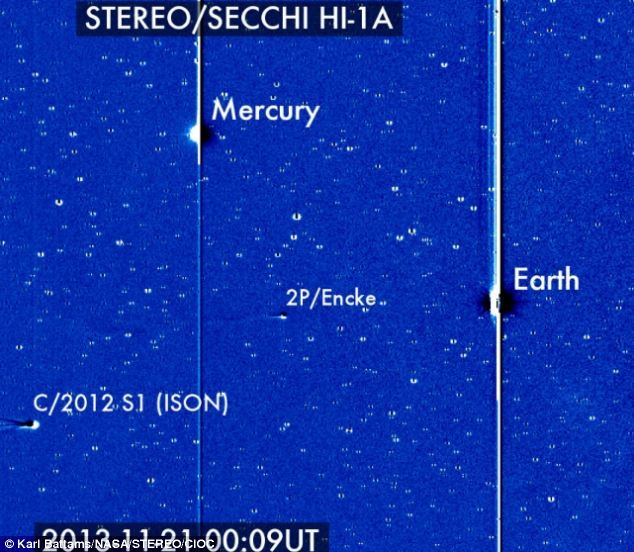
It was captured by the H-1 camera on board NASA's Solar Terrestrial Relations Observatory on November 21.

Image
Appearance: Comet ISON entered the view of NASA's Solar Terrestrial Relations Observatory on Nov. 21, 2013, where it can be seen with Earth, Mercury and comet 2P/Encke


Comet

Will Comet Ison survive its close encounter with the sun?

Image
© Unknown.All eyes will be firmly on the skies this Thursday as the 'star-grazer' brushes the sun's corona

This week will see the moment of truth for Comet Ison, the much-awaited "comet of the century" that could be about to put on one of the greatest celestial light shows in living memory.

For the past year scientists have been tracking Ison's movement as it hurtles towards the inner solar system, and on Thursday it is set to pass through the corona of the sun itself.

The comet is around 4.6 billion years old - forming at the very beginning of the solar system, and has been sitting quietly in the outer reaches of the sun's gravitational field for almost all that time.

Relatively recently, Ison was knocked out of the distant Oort cloud and began its journey towards the sun. That light-year-long trip is very nearly at an end, and astronomers still don't know if it is one that it will survive.

Meteor

Chelyabinsk meteor strike - a wake-up call for the world

Chelyabinsk meteorite
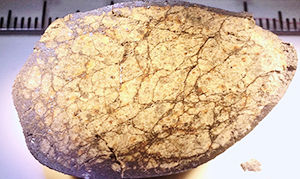
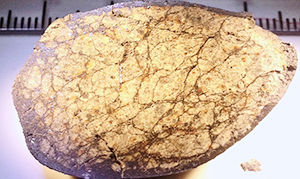
© Qing-zhu YinSlice of future shock: A fragment from the meteorite shows numerous veins from a long-ago impact shock that weakened the original object.
Consumer video cameras and advanced laboratory techniques gave scientists an unprecedented opportunity to study the meteor that exploded over Chelyabinsk, Russia, in February. The explosion was equivalent to about 600 thousand tonnes of TNT, 150 times bigger than the 2012 Sutter's Mill meteorite in California.

"If humanity does not want to go the way of the dinosaurs, we need to study an event like this in detail," says Qing-zhu Yin, professor in the department of earth and planetary sciences at University of California, Davis.

Saying it was a "wake-up call," Yin says the Chelyabinsk meteorite, the largest strike since the Tunguska event of 1908, belongs to the most common type of meteorite, an "ordinary chondrite." If a catastrophic meteorite strike were to occur in the future, it would most likely be an object of this type.

"Our goal was to understand all circumstances that resulted in the damaging shock wave that sent over 1,200 people to hospitals in the Chelyabinsk blast area that day," says Peter Jenniskens, meteor astronomer at SETI Institute.
Their findings are published in the journal Science.

Based on viewing angles from videos of the fireball, researchers calculated that the meteoroid entered Earth's atmosphere at just over 19 kilometres per second, slightly faster than had previously been reported.

Telescope

Electric Universe: Comet Elenin - the Debate that Never Happened


Comment: In light of the news that Comet ISON is flaring spectacularly - something NASA scientists can't explain with their backwards theories about comets being 'dirty snowballs' and 'dust jets' - we're re-running this 2011 article on Electric Comets by David Talbott of Thunderbolts.

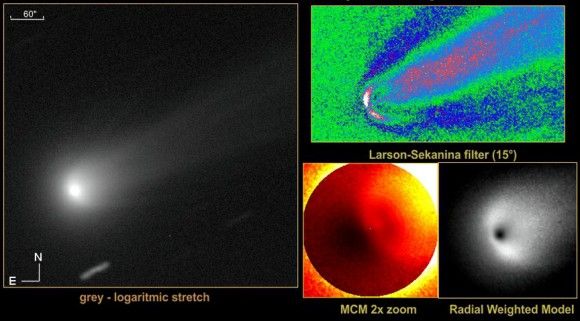
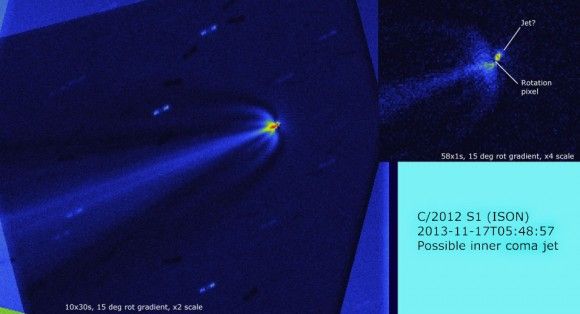
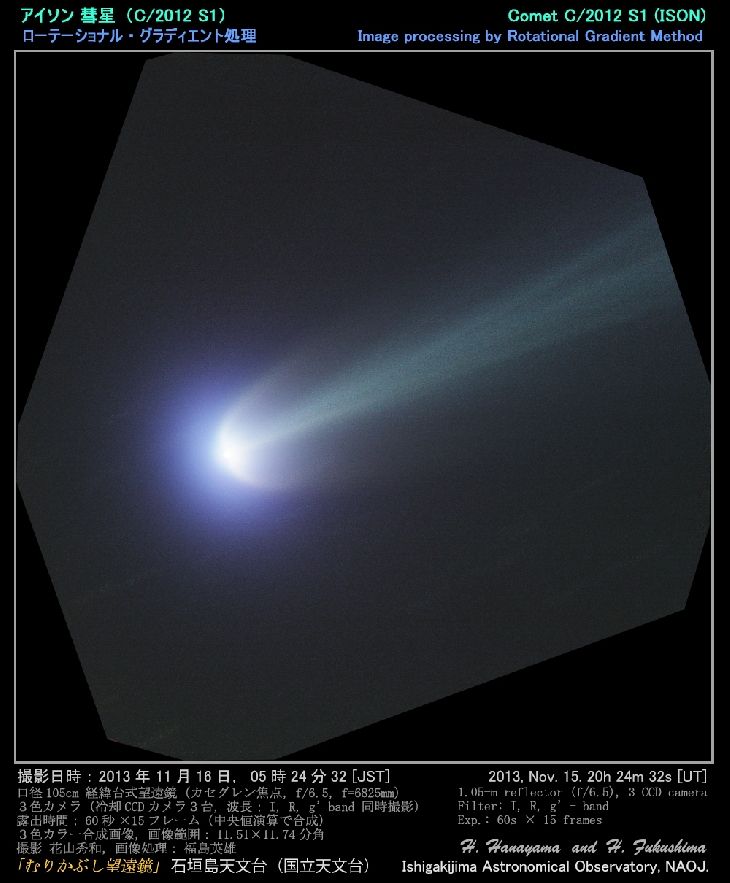
Check out the most recent photos of ISON... this comet's got wings!
Image
Image
Image

The comet Elenin, a subject of intense Internet discussion for several months, seems to have disappointed everyone. I speak here not just of the doomsayers, who were awaiting a frightful specter in recent weeks. You might think these folks would be happy that the celebrated intruder faded fast just when it was supposed to be reaching maximum activity. But in these strange times, Doomsday seems a lot more fun than a minor distraction in our cosmic neighborhood.

Also disappointed are the many scientists who expected a more impressive display from Elenin. That expectation seemed well founded based on the growing coma of Elenin in the months following its discovery in December, 2010. And prior space probes sent to comets helped to feed an illusion about the comet's size. The estimates appear to have missed the mark completely.

Strangely, the popular scientific media, insofar as they've shown any interest in Elenin, are satisfied to simply expose the lunacy of Internet fear-mongering. But is that really all we should be discussing here? Elenin has only one connection to "Doomsday." Like every comet, it reminds us of ancient memories of a truly terrifying and destructive Great Comet, the true source of comet fears and Doomsday anxiety - a verifiable cultural conditioning that has persisted for thousands of years. With every appearance of a comet the ancient fear resurfaces, but this fact adds nothing to scientific discussion of Elenin and its fate.

Comet

Comet swarm incoming! Comet Nevski joins ISON, Lovejoy, LINEAR and Encke as FIVE comets flare brightly for northern hemisphere observers

Comet Nevski
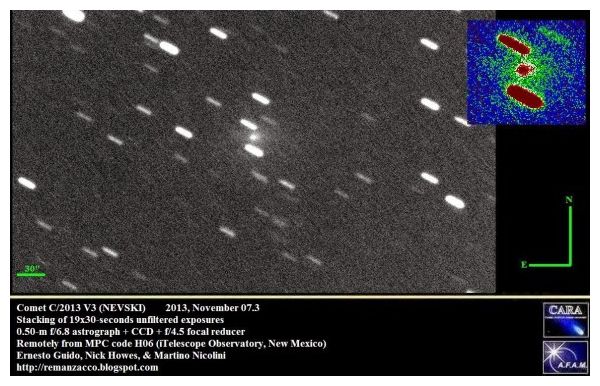
© Ernesto Guido, Nick Howes & Martino NicoliniCapture of Comet Nevski shortly after discovery using the ITelescope Observatory in New Mexico.
Is 2013 truly the "Year of the Comet?" Perhaps "Comets" might be a better term, as no less than five comets brighter than +10th magnitude grace the pre-dawn sky for northern hemisphere observers.

Comet C/2013 V3 Nevski has just brightened up 6 magnitudes - just over a 250-fold increase in brightness - and now sits at around magnitude +8.8. Comet Nevski was just recently discovered by Vitali Nevski using a 0.4 metre reflecting telescope 12 days ago on November 8th. If that name sounds familiar, it's because Nevski discovered the comet from the Kislovodsk observatory located near Kislovodsk, Russia which is part of the International Scientific Optical Network survey which located comet ISON last year. In fact, there was some brief controversy early on in its discovery that Comet C/2012 S1 ISON should have had the moniker Comet Nevski-Novichonok.

At the time of discovery, Comet Nevski appeared to be nothing special: shining at magnitude +15.1, it was well below our +10 magnitude limit for consideration as "interesting," and was projected to linger there for the duration of its passage through the inner solar system. About a dozen odd such comet discoveries crop up per year, most of which give astronomers a brief pause as the orbit and size of the comet become better known, only to discern that they're most likely to be nothing extraordinary.

Comment: Yeh, it is tempting to imagine that all of these comets are somehow related because there are clearly a whole lot of them heading this way all at once!

We've been saying it for years, but we'll say it again...

Something Wicked This Way Comes


Comet 2

Comet ISON - Another Outburst?

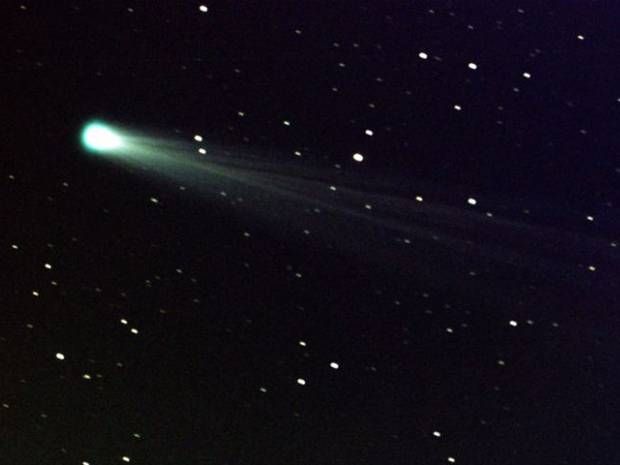
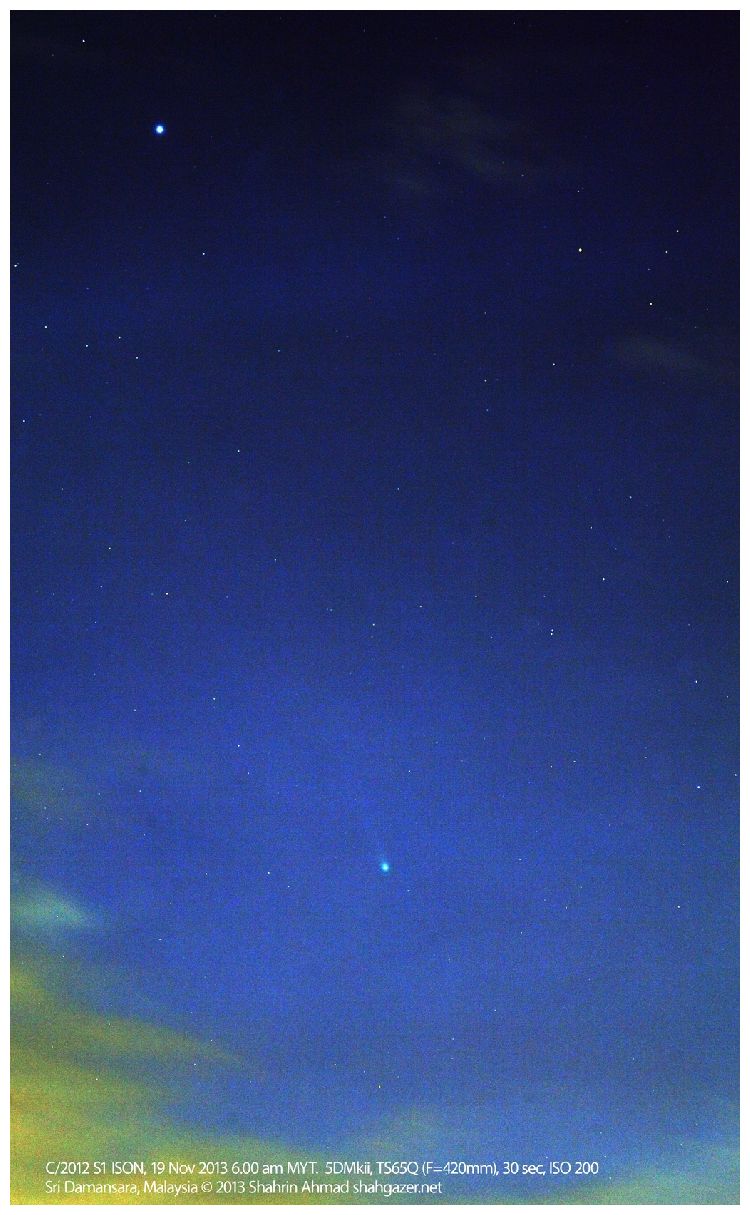
Astronomers working with the TRAPPIST telescope at ESO's La Silla Observatory report that Comet ISON's production of gas and dust surged another six-fold during the early hours of Nov. 19th. This marks the second outburst since Nov. 13th. Experienced observers put the comet's rising magnitude near +4.0, well above the threshold of naked-eye visibility. The problem is, ISON is approaching the sun and becoming increasingly difficult to observe. Shahrin Ahmad of Kuala Lumpur, Malaysia, photographed the comet's green core framed by twilight blue on the morning of Nov. 19th:
Comet ISON
© Shahrin Ahmad
The situation is only going to worsen as the comet plunges toward its Nov. 28th close encounter with the sun. Amateur photography of the comet will be possible for a few more days and, soon, only NASA's fleet of solar observatories will be able to track the sundiver.