Comets


Comet

Comet ISON sprouts a double tail

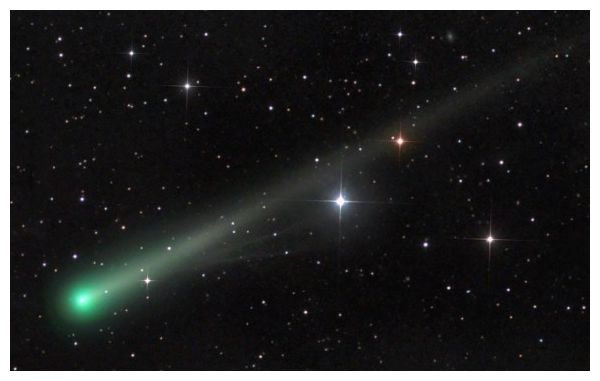
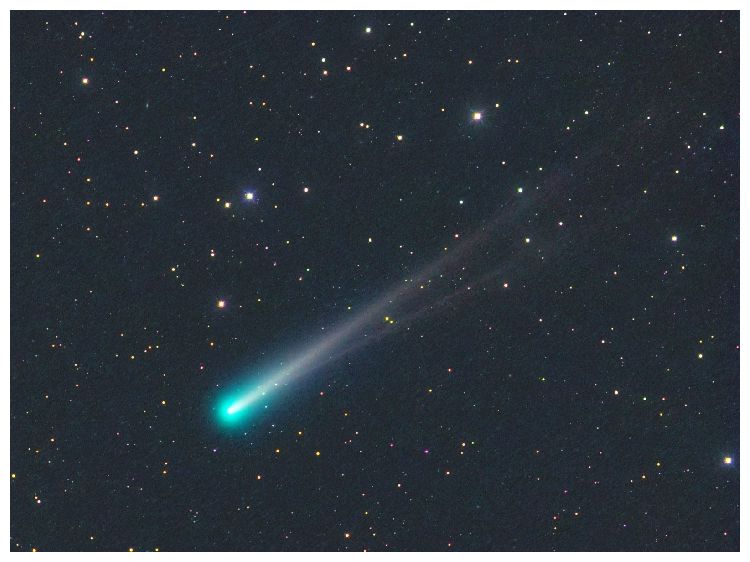
Amateur astronomers are getting a better look at Comet ISON as it dives toward the sun for a Nov. 28th close encounter with solar fire. As the heat rises, the comet brightens, revealing new details every day. This photo, taken Nov. 10th by Michael Jäger of Jauerling Austria, shows a beautiful double tail:

Comet ISON
© Michael Jäger
One tail is the ion tail. It is a thin streamer of ionized gas pushed away from the comet by solar wind. The filamentary ion tail points almost directly away from the sun.

Comet

Brighter than ISON

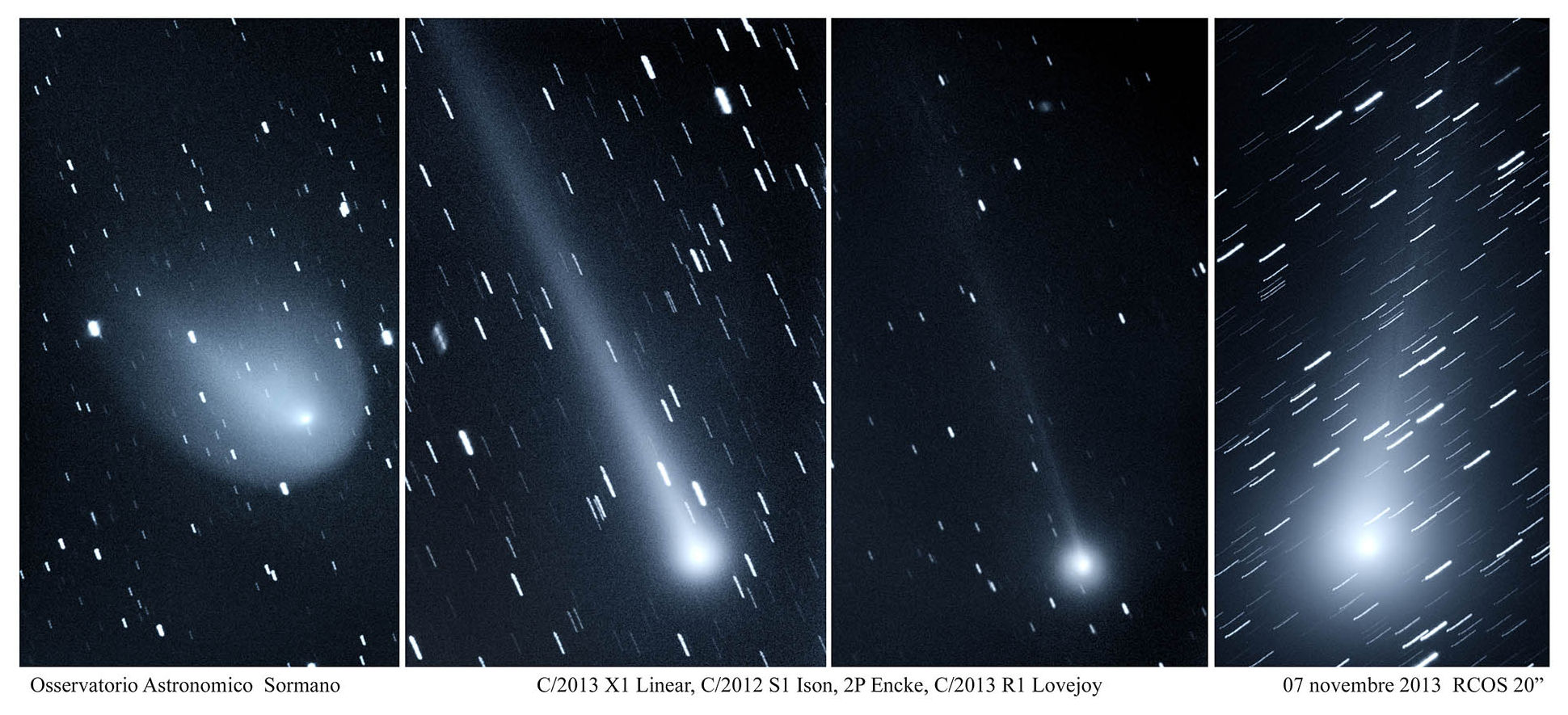
Comet ISON is getting all the press, but it's not even the brightest comet in its own patch of sky. That would be Comet Lovejoy (C/2013 R1), one of four comets now rising in the east before dawn:

4 Comets
© Sormano Astronomical Observatory (Nov. 7, 2013)
Pictured from left to right are exploding Comet LINEAR X1, sungrazing Comet ISON, short-period Comet Encke, and the brightest of them all, Comet Lovejoy. All four are visible in binoculars or backyard telescopes, and Comet Lovejoy (mag. +6.0) is visible to the naked eye from dark-sky sites. Comet ISON is actually one of the faintest of the group; only expanding Comet LINEAR X1 (mag. +8) is more difficult to see.

An apparition of so many comets at once is a rare thing, and amateur astronomers are encouraged to wake up early for a tour of the pre-dawn sky. Dates of special interest include Nov. 15-18 when Comet LINEAR X1 passes by the bright star Arcturus, Nov 17-18 when Comet ISON has a close encounter with Spica, and Nov. 18-20 when Comet Encke buzzes Mercury. These stars and planets make excellent naked-eye guideposts for finding the comets. Meanwhile, bright Comet Lovejoy is approaching the Big Dipper; if you can't see it with your unaided eye, a quick scan with binoculars will reveal it. Sky maps: Nov. 10, 11, 12, 13, 14, 15, 16, 17, 18, 19.

Comet ephemerides: Comet ISON, Comet Lovejoy, Comet Encke, Comet LINEAR X1

Comet 2

Comet ISON now a binocular object

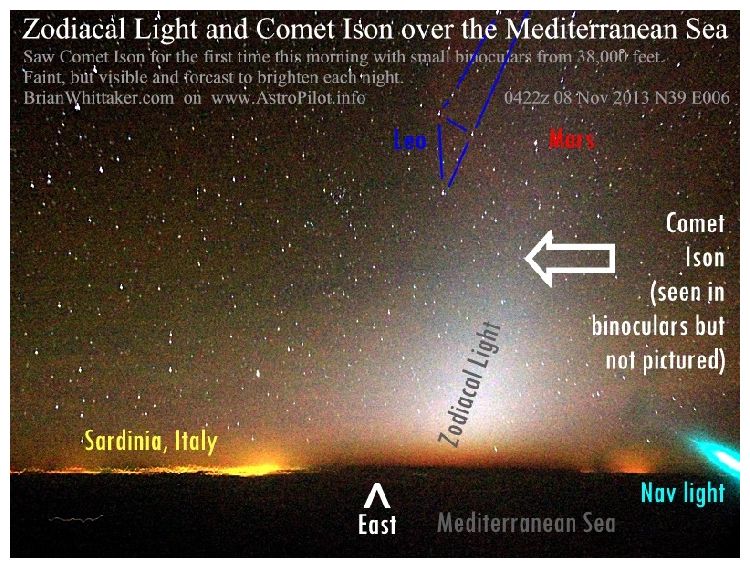
Comet ISON is brightening as it approaches the sun. Multiple observers now report that it is a binocular object. "I finally saw Comet ISON for the first time using small binoculars!" says pilot Brian Whittaker. He was flying 38,000 feet over the Mediterranean Sea on Nov. 8th when he took this picture showing where to look:
Comet ISON
© Brian Whittaker
"It was faint, but is predicted to brighten and move each day," he adds. "Exciting! "

Comet

New Comet: C/2013 V2 (BORISOV)

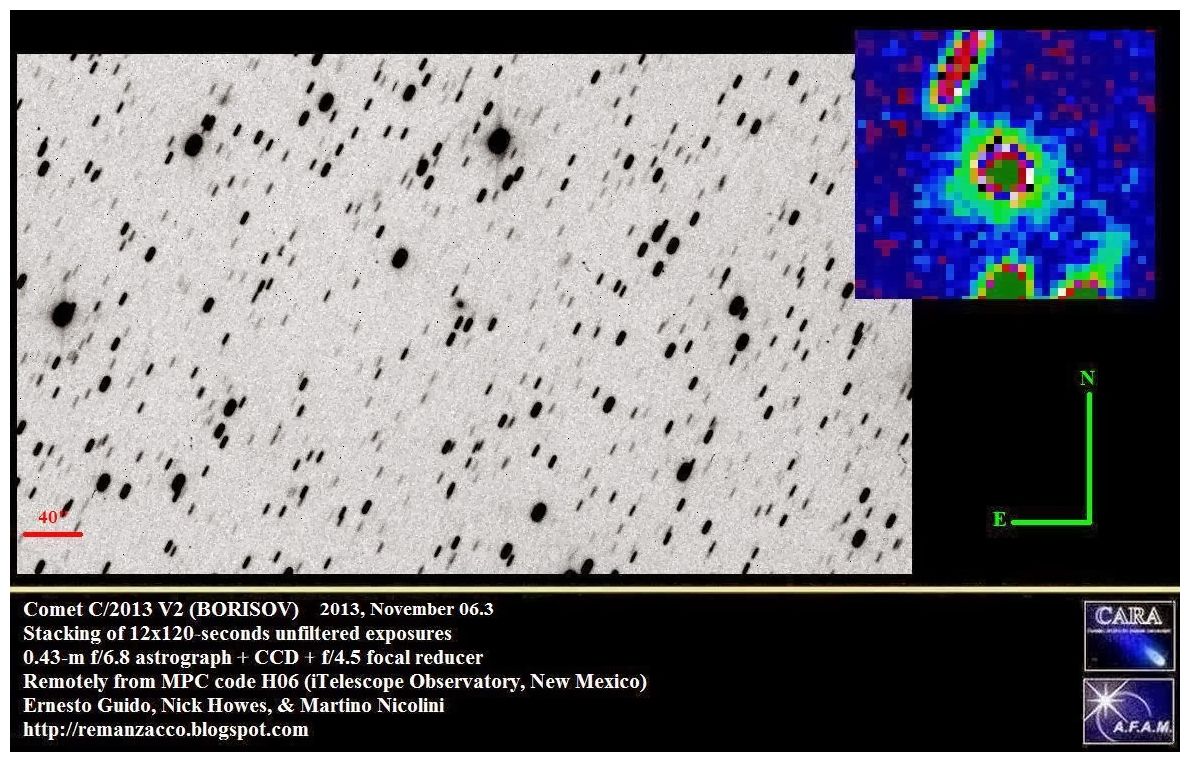
Cbet nr. 3694, issued on 2013, November 08, announces the discovery of a new comet (discovery magnitude ~16.9) by G. Borisov on three CCD images taken with a 0.2-m f/1.5 astrograph on Nov. 6. The new comet has been designated C/2013 V2 (BORISOV).

We performed follow-up measurements of this object, while it was still on the neocp. Stacking of 12 unfiltered exposures, 120-sec each, obtained remotely from MPC code H06 (iTelescope, New Mexico) on 2013, November 06.3 through a 0.43-m f/6.8 astrograph + CCD + f/4.5 focal reducer, shows that this object is a comet: diffuse coma about 15" in diameter.

Below our confirmation image. Click on it for a bigger version.
C/2013 V2
© Remanzacco Observatory
M.P.E.C. 2013-V43 assigns the following preliminary parabolic orbital elements to comet C/2013 V2: T 2014 Oct. 6.00; e= 1.0; Peri. = 87.46; q = 3.80; Incl.= 39.27

Comet 2

New Comet: C/2013 V3 (NEVSKI)

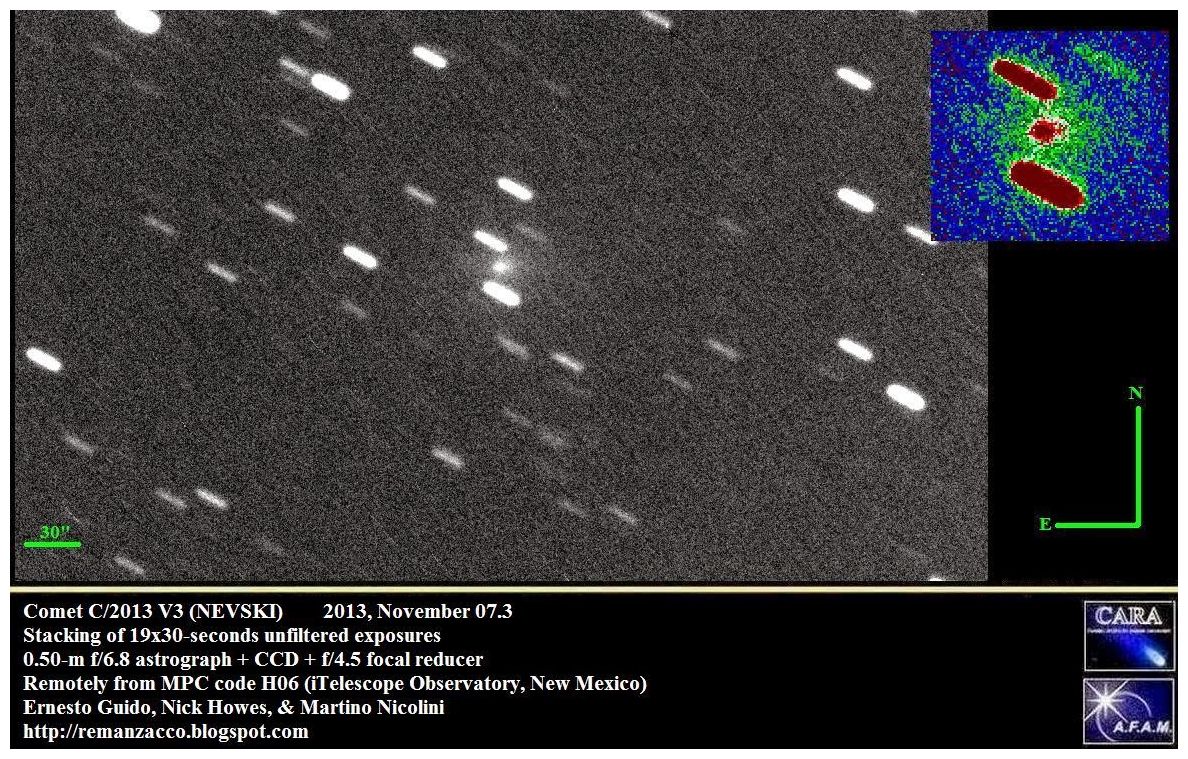
Cbet nr. 3695, issued on 2013, November 08, announces the discovery of a new comet (discovery magnitude ~15.1) by Vitali Nevski on four 180-s CCD exposures obtained on Nov. 7 with a 0.2-m f/1.5 reflector (and confirmed with images taken using a 0.4-m f/3 reflector) at the ISON-Kislovodsk observatory near Kislovodsk, Russia. The new comet has been designated C/2013 V3 (NEVSKI).

We performed follow-up measurements of this object, while it was still on the neocp. Stacking of 19 unfiltered exposures, 30-sec each, obtained remotely from MPC code H06 (iTelescope, New Mexico) on 2013, November 07.3 through a 0.50-m f/6.8 astrograph + CCD + f/4.5 focal reducer, shows that this object is a comet: diffuse coma about 18" in diameter elongated toward PA 275 deg.

Below our confirmation image. Click on it for a bigger version.
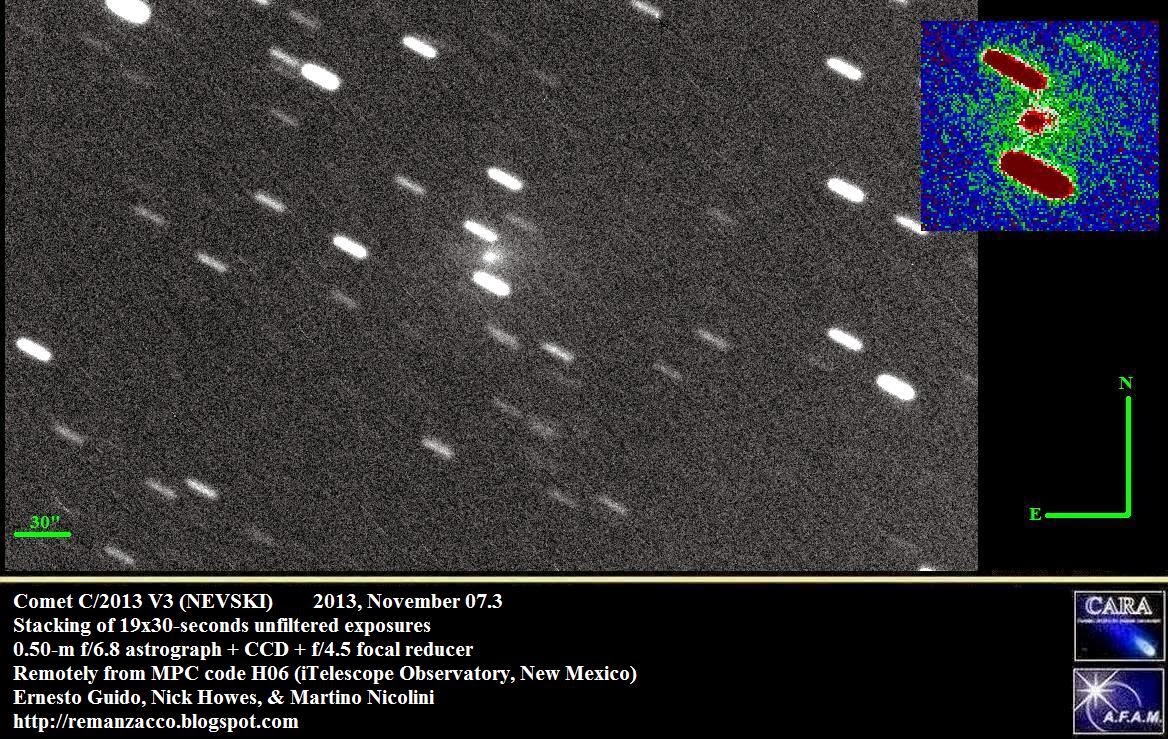
C/2013 V3
© Remanzacco Observatory
M.P.E.C. 2013-V45 assigns the following preliminary parabolic orbital elements to comet C/2013 V3: T 2013 Oct. 23.58; e= 1.0; Peri. = 332.77; q = 1.34; Incl.= 29.44

Comet

The multi-tailed main-belt Comet P/2013 P5

Cbet nr. 3639, issued on 2013, August 27, announced the discovery of a new comet (discovery magnitude ~20.9) in CCD exposures obtained on August 15 by the Pan-STARRS1 telescope on Haleakala. The new comet has been designated P/2013 P5 (PANSTARRS). According to the description in the CBET, the object has a nuclear condensation with a stellar appearance and a thin tail that extends for approximately 30" towards position angle approximately 255 degrees.

Orbiting at the inner edge of the main asteroid belt, with semimajor axis, eccentricity and inclination of 2.189 AU, 0.115 and 5.0° , respectively, the Tisserand parameter relative to Jupiter is TJ = 3.66. So this object belongs to the newly recognized class of body in the solar system known as active asteroids or main-belt comet - MBC.

These objects are remarkable for having both the orbital characteristics of asteroids and the physical characteristics of comets: they look like comets because they show comae and tails but they have orbits interior to Jupiter's and Tisserand parameters substantially larger than 3, like asteroids. While some are suspected to contain water ice whose sublimation is responsible for the expulsion of dust, others are impact-produced while, for a majority, the origin is unknown. (see also our previous post about P/2012 T1 (PANSTARRS) & 596 Scheila).

Fireball 5

Another Chelyabinsk-like meteor strike 7-times as likely as thought, NASA

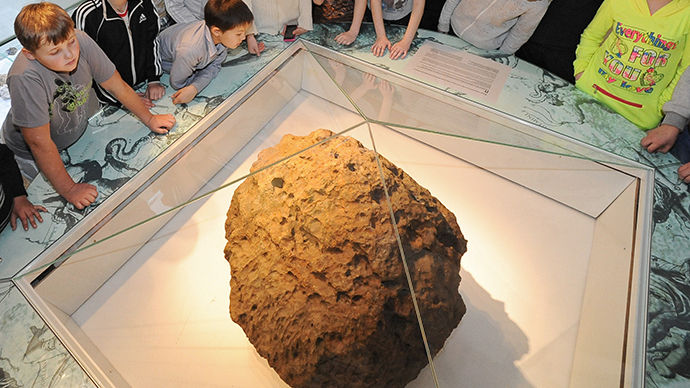
Children look at Chelyabinsk meteorite
© Aleksandr Kondratuk / RIA NovostiChildren look at Chelyabinsk meteorite exhibited at Chelyabinsk Museum of Regional Studies.

New research out of NASA suggests the odds of the Earth being rocked by another meteorite on par with the one that unexpectedly shook Chelyabinsk, Russia earlier this year are higher than previously estimated.

On Wednesday this week, officials with the National Aeronautics and Space Administration announced their latest findings regarding February's meteorite, and it isn't good news for anyone alarmed that another soaring chunk of rock could come ripping through Earth's atmosphere.

Scientists say that the Chelyabinsk meteorite was the largest foreign body to hit Earth in almost a century, and similar ones could soon be on the way. Bill Cooke, who leads NASA's meteoroid environment office at the agency's Marshall Space Flight Center, said during a press conference this week that there is a pretty good chance of seeing something similar in the near future.

Comet

Comet ISON heats up, grows new tail

Comet ISON_1
© Damian PeachTwo faint tail streamers are visible between Comet ISON’s green coma and bright star near center. in this photo taken on Nov. 6. They’re possibly the beginning of an ion tail. Click to enlarge.
I'm starting to get the chills about Comet ISON. I can't help it. With practically every telescope turned the comet's way fewer than three short weeks before perihelion, every week brings new images and developments. The latest pictures show a brand new tail feature emerging from the comet's bulbous coma.

For months, amateur and professional astronomers alike have watched ISON's slowly growing dust tail that now stretches nearly half a degree or a full moon's diameter. In the past two days, photos taken by amateur astronomers reveal what appears to be a nascent ion or gas tail. Damian Peach's Nov. 6 image clearly shows two spindly streamers.

Fireball 5

Surprising recent discoveries of three large Near-Earth Objects

Two surprisingly large Near-Earth Asteroids have been discovered in just the last week or so, as well as a third moderately large asteroid which surprisingly has also gone undetected until now, even though it can pass close enough to the Earth to be classified as "potentially hazardous".

Not since 1983 has any near-Earth asteroid been found as large as the approximately 20-kilometer (12-mile) size of the two new large ones. In fact, there are only three other known near-Earth asteroids that are of comparable size or larger than the two new large ones.
Image
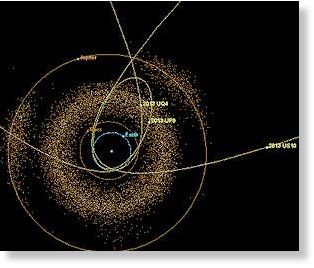
© NASA/JPL-CaltechThe orbits of 2013 UQ4, 2013 US10 and 2013 UP8 are shown in a view looking down on the plane of the solar system. While 2013 US10 and 2013 UP8 orbit the sun in a counter clockwise direction (so called "direct" orbits like all the planets and most asteroids), 2013 UQ4 orbits in a clockwise (retrograde) direction.
It is important to note that none of these three new large near-Earth asteroids can come close enough to the Earth to represent a near-term threat to our planet.

The first of the new large near-Earth asteroid discoveries is named 2013 UQ4, and it is perhaps the most unusual. This approximately 19-kilometer (12-mile) wide object was spotted by the Catalina Sky Survey on Oct. 23 when the asteroid was 435 million kilometers (270 million miles) away from Earth. Not only is this object unusually large, it follows a very unusual highly inclined, retrograde orbit about the Sun, which means it travels around the Sun in the opposite direction of all the planets and the vast majority of asteroids.

Telescope

NASA's Hubble sees 'asteroid' spouting six comet-like tails "dust radiating from it like spokes on a wheel"

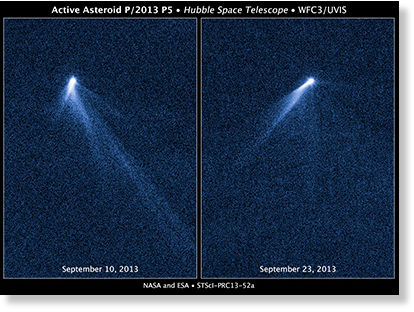
Astronomers viewing our solar system's asteroid belt with NASA's Hubble Space Telescope have seen for the first time an asteroid with six comet-like tails of dust radiating from it like spokes on a wheel. Unlike all other known asteroids, which appear simply as tiny points of light, this asteroid, designated P/2013 P5, resembles a rotating lawn sprinkler. Astronomers are puzzled over the asteroid's unusual appearance.

"We were literally dumbfounded when we saw it," said lead investigator David Jewitt of the University of California at Los Angeles. "Even more amazing, its tail structures change dramatically in just 13 days as it belches out dust. That also caught us by surprise. It's hard to believe we're looking at an asteroid."
Image
© NASA

Comment: See also:

Rare 'asteroid' sporting tail spotted

Crashed asteroid has a tail that keeps getting longer

Asteroid 3200 Phaethon behaving like a comet

The evidence is staring them in the face, but because they cling to the old assumptions, they are unable to see that all space rocks can become electrically charged in an Electric Universe!

To learn the truth about asteroids and comets, get your copy of The Apocalypse: Comets, Asteroids and Cyclical Catastrophes, by Laura Knight-Jadczyk.