
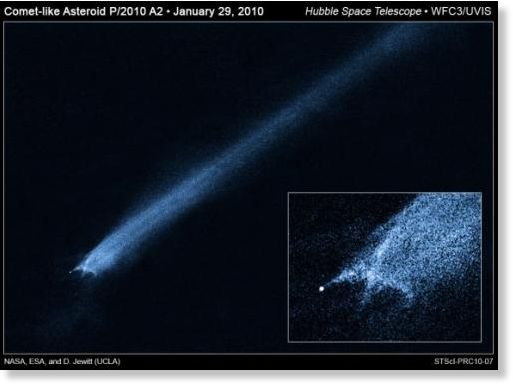
© NASA, ESA, and D. Jewitt (UCLA) Hubble Views of Comet-like Asteroid P/2010 A2.
Using the new wide-field camera at the WIYN 3.5 meter telescope, Rajagopal and his team have found that the peculiar asteroid P/2010 A2′s tail is much longer than was previously supposed. The tail is about a million kilometers long, roughly three times the distance from the Earth to the Moon. The new One Degree Imager (ODI) can currently image an area of the sky about the size of the full moon: a future upgrade will increase the size of the field to about four times as large.
"Three and a half years after the initial disruption, and almost a full orbit around the Sun, the tail is still visible and growing," said Rajagopal. "One of the reasons it is so long is that radiation pressure and gravity are stretching out the tail. It will progressively grow and sweep out into the ecliptic."
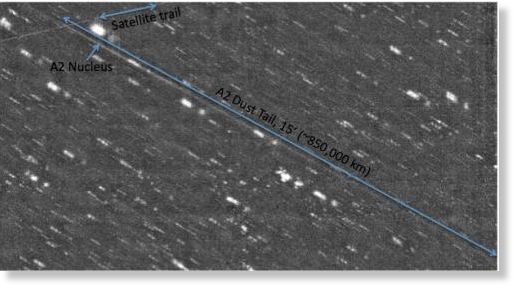
The dust tail on Asteroid P/2010 A2 (LINEAR) has grown to over 1 million kilometers long. Image taken with the new One Degree Imager (ODI), a wide field optical camera at the WIYN telescope on Kitt Peak.
Asteroid collisions are thought to be a commonplace occurrence, and are responsible for kicking up dust in our Solar System and probably other planetary systems, too. Just how much dust is produced, and how frequent the collisions happen is still a hazy topic. But the observations of P/2010 A2 are helping astronomers to better model this phenomenon. By figuring out how much dust is produced by the process of 'collisional grinding,' astronomers can better model the dusty debris disks of other planetary systems, as well as our own.
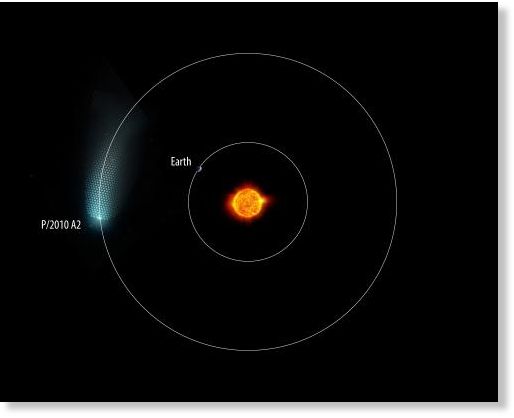
© WIYN telescope A graphic showing the orbit of Asteroid P/2010 A2.
Rajagopal also said this the tail of Asteroid P/2010 A2 is a meteor stream in the making. "It will eventually sweep into the Earth's orbit and give us a meteorite stream, sending some meteorites our way, maybe a million years from now."



Reader Comments
to our Newsletter