Find us on:

Science & Technology


Satellite

U.S. Special Forces getting constellation of mini surveillance satellites to hunt down 'people considered to be dangerous'

night-raid
© USAF
A U.S. soldier participates in a night-raid training mission during Emerald Warrior 2012, an exercise put together by U.S. Special Operations Command.
In September, the U.S. government will fire into orbit a two-stage rocket from a Virginia launchpad. Officially, the mission is a scientific one, designed to improve America's ability to send small satellites into space quickly and cheaply. But the launch will also have a second purpose: to help the elite forces of U.S. Special Operations Command hunt down people considered to be dangerous to the United States and its interests.

For years, special operators have used tiny "tags" to clandestinely mark their prey - and satellites to relay information from those beacons. But there are areas of the world where the satellite coverage is thin, and there aren't enough cell towers to provide an alternative. That's why SOCOM is putting eight miniature communications satellites, each about the size of a water jug, on top of the Minotaur rocket that's getting ready to launch from Wallops Island, Virginia. They'll sit more than 300 miles above the earth and provide a new way for the beacons to call back to their masters.
Sun

Coronal mass ejection and radiation storm May 22 2013

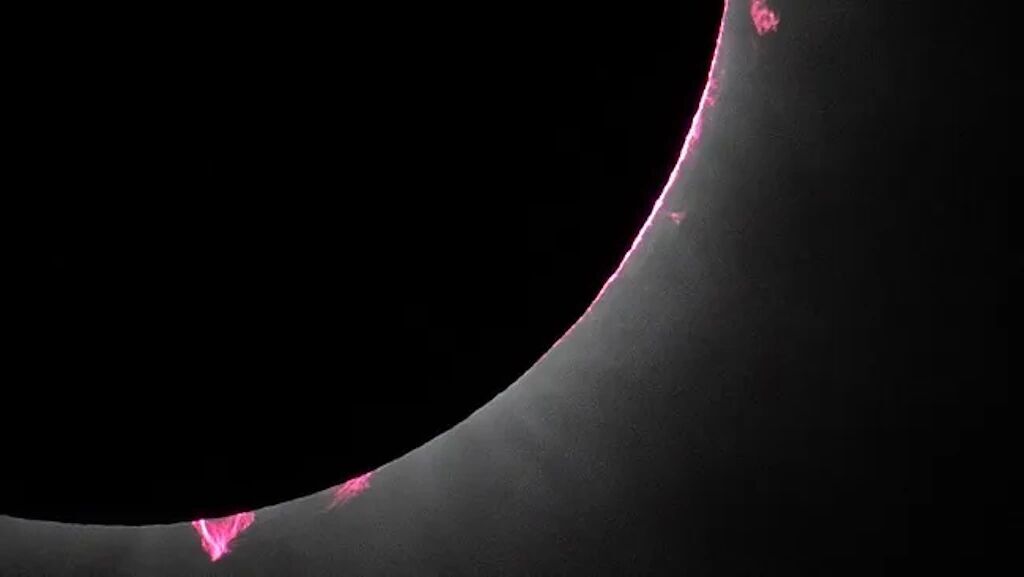
A solar radiation storm is in progress on May 22nd following an M5-class explosion on the sun's western limb. The source of the flare, which peaked at 1332 UT, was departing sunspot AR1745. SOHO coronagraphs observed a magnificent CME emerging from the blast site.

Play the movie again. The speckles dancing across the image are caused by high-energy solar protons striking the CCD camera in SOHO's coronagraph. Those protons were guided toward Earth by magnetic field lines that connect our planet to the blast site. The rain of protons is what forecasters mean by a "radiation storm." This storm ranks S2 on NOAA storm scales.
Pistol

A new 'smart rifle' decides when to shoot and rarely misses

TrackingPoint rifle
© NPR
A new rifle goes on sale on Wednesday, and it's not like any other. It uses lasers and computers to make shooters very accurate. A startup gun company in Texas developed the rifle, which is so effective that some in the shooting community say it should not be sold to the public.

It's called the TrackingPoint rifle. On a firing range just outside Austin in the city of Liberty Hill, a novice shooter holds one and takes aim at a target 500 yards away. Normally it takes years of practice to hit something at that distance. But this shooter nails it on the first try.

The rifle's scope features a sophisticated . The shooter locks a laser on the target by pushing a small button by the trigger. It's like a video game. But here's where it's different: You pull the trigger but the gun decides when to shoot. It fires only when the weapon has been pointed in exactly the right place, taking into account dozens of variables, including wind, shake and distance to the target.


Comment: Weapons like this should not be developed in the first place, let alone being sold to the public.

Info

Physicists create quantum link between photons that don't exist at the same time

Entanglement
© AAAS/Science
Timeless. In standard entanglement swapping (top), entanglement (blue shading) is transferred to photons 1 and 4 by making a measurement on photons 2 and 3. The new experiment (bottom) shows that the scheme still works even if photon 1 is destroyed before photon 4 is created.
Now they're just messing with us. Physicists have long known that quantum mechanics allows for a subtle connection between quantum particles called entanglement, in which measuring one particle can instantly set the otherwise uncertain condition, or "state," of another particle -- even if it's light years away. Now, experimenters in Israel have shown that they can entangle two photons that don't even exist at the same time.

"It's really cool," says Jeremy O'Brien, an experimenter at the University of Bristol in the United Kingdom, who was not involved in the work.

Such time-separated entanglement is predicted by standard quantum theory, O'Brien says, "but it's certainly not widely appreciated, and I don't know if it's been clearly articulated before."

Entanglement is a kind of order that lurks within the uncertainty of quantum theory. Suppose you have a quantum particle of light, or photon. It can be polarized so that it wriggles either vertically or horizontally.

The quantum realm is also hazed over with unavoidable uncertainty, and thanks to such quantum uncertainty, a photon can also be polarized vertically and horizontally at the same time. If you then measure the photon, however, you will find it either horizontally polarized or vertically polarized, as the two-ways-at-once state randomly "collapses" one way or the other.

Entanglement can come in if you have two photons. Each can be put into the uncertain vertical-and-horizontal state. However, the photons can be entangled so that their polarizations are correlated even while they remain undetermined. For example, if you measure the first photon and find it horizontally polarized, you'll know that the other photon has instantaneously collapsed into the vertical state and vice versa -- no matter how far away it is. Because the collapse happens instantly, Albert Einstein dubbed the effect "spooky action at a distance." It doesn't violate relativity, though: It's impossible to control the outcome of the measurement of the first photon, so the quantum link can't be used to send a message faster than light.
Comet 2

What do Comet PANSTARRS and Pinocchio have in common?

While comets can't tell lies, they do sometimes grow long noses. As the weeks click by and our perspective on Comet L4 PANSTARRS changes, its original plume-like dust tail has shrunk and faded while a second tail just won't stop growing. I'm talking about the anti-tail, so called because it points toward the sun instead of away. Like the normal dust tail, an anti-tail is formed from fresh dust blown back from the comet's head by the pressure of sunlight. As the comet continues along its orbital path, last week's dust lingers behind, forming a "trail of breadcrumbs" in its wake. Right now those breadcrumbs look like a light saber straight out of Star Wars. Time exposure photographs show a striking sunward-pointing appendage more than 6 degrees (12 full moons) long. I've been keeping an eye on Comet PANSTARRS here at home and can report that the anti-tail is plainly visible with a telescope under dark skies. Watching it grow from a short nub to the most dominant feature of this remarkable object has been the highlight of many a clear night.

© Damian Peach
Wow – that’s a tail! Comet C/2011 L4 PANSTARRS on May 21, 2013, when its anti-tail (left) had grown to more than 12 full moons in length. Meanwhile, what was once the main dust tail (right) has faded and shortened over the past few weeks.
Info

Insight into the dazzling impact of insulin in cells

Fat Cells
© iStockphoto
Help at hand: Scientists are nearer to understanding what happens in fat cells.
Australian scientists have charted the path of insulin action in cells in precise detail like never before. This provides a comprehensive blueprint for understanding what goes wrong in diabetes.

The breakthrough study, conducted by Sean Humphrey and Professor David James from Sydney's Garvan Institute of Medical Research, is now published in the early online edition of the journal Cell Metabolism.

First discovered in 1921, the insulin hormone plays a very important role in the body because it helps us lower blood sugar after a meal, by enabling the movement of sugar from the blood into cells.

Until now, although scientists have understood the purpose of insulin at a broad level, they have struggled to understand exactly how it achieves its task.

The latest analytical devices called mass spectrometers now provide the tool that has been missing -- the means of looking into the vastly complex molecular maze that exists in every single cell in the human body.

These powerful devices have opened up a field known as 'proteomics', the study of proteins on a very large scale. Proteins represent the working parts of cells, using energy to perform all essential functions such as muscle contraction, heartbeat or even memory.
Question

Neanderthals: Extinction by BBQ?

Neanderthal
© Pierre Andrieu/AFP/Getty Images
A model representing a Neanderthal man is displayed at the National Museum of Prehistory in Eyzies-de-Tayac, Dordogne, France.
Humans today eat gorillas and chimpanzees, so why would our prehistoric ancestors flinch at sitting down to a nicely roasted Neanderthal?

That's the shocking new hypothesis being raised by anthropologists in Spain, who wonder if our closest extinct relative was exterminated in the same way as 178 other large mammals, so-called megafauna, which are suspected of going at least partially by the hand of hungry human hunters.

"Except in its native Africa, in the other continents Homo sapiens can be considered as an invasive alien species," write researchers Policarp Hortolà and Bienvenido Martínez-Navarro of the Universitat Rovira i Virgili in Tarragona, Spain. They published their hypothesis in the May issue of the journal Quaternary International.

Today, there are endless cases of invasive species decimating native species all over the world. So perhaps at the end of the Pliestocene, it was the same when humans spread into Europe and Asia, where Homo neanderthalensis was just another big, slow-reproducing mammal.

"We think that modern humans, who occupied a similar ecological niche as Neanderthals, but with more evolved technology, in their colonization of the new European territories directly competed with Neanderthals for the food and other natural resources," wrote Martínez-Navarro in an emailed response to Discovery News.
Fireball 4

Exploding meteorite may have sealed fate of the mammoths

Mammoth
© Alamy
Scientists have claimed an exploding meteorite may have sealed the fate of the woolly mammoth.
Researchers have found evidence that a large meteorite broke apart in the atmosphere around 12,800 years ago at around the time when mammoths died out.

Studying deposits at 18 archaeological sites around the world they found tiny spheres of carbon they say are characteristic of multiple impacts and mid-air explosions from meteorite fragments.

They claim that millions of tonnes of dust and ash thrown would have been thrown into the atmosphere by the event, which would have choked the atmosphere and altered the global climate.

Their findings cast doubt on claims that it was human hunting that was responsible for the demise of large ice age animals like woolly mammoths, woolly rhinos and sabre toothed tigers.

Many scientists now believe that it was a combination of changes in the climate and pressure from human hunting that led to the mass extinction of many of these species.

However, the cause of the abrupt change in the climate between 12,800 and 11,500 years ago, known as the Younger Dryas by geologists, has been a controversial topic.
Info

Rare particles give clue to ancient Earth

Sand
© Witswatersrand University, Johannesburg
Semi-precious minerals found in a bucket of sand from an island nation have cracked open a clue to the drifting movements and break-up of ancient Earth's massive continental plates.

The particles are zircons and the island - Mauritius - is now thought to be hiding a micro-continent which has been given the name Mauritia.

Zircons can be as old as four billion years and are almost never found in oceans, proving the likelihood that Mauritius sits on top of a fragment of continental plate which remained behind and was covered by huge masses of lava when Madagascar split apart from India about 90 million years ago.

Prof. Lewis Ashwal from Wits University studies the break-up process of continents. He was part of the group of geoscientists from Norway, South Africa, Britain and Germany who recently announced their finding of zircons in Mauritius. They've been working in the area for 15 years.
Fireball

The mammoth's lament: How cosmic impact sparked devastating climate change

Herds of wooly mammoths once shook Earth beneath their feet, sending humans scurrying across the landscape of prehistoric Ohio. But then something much larger shook Earth itself, and at that point these mega mammals' days were numbered.
© Kenneth Tankersley/University of Cincinnati
An environmental scanning electron microscope image of a carbon spherule from Sheriden Cave.

Something -- global-scale combustion caused by a comet scraping our planet's atmosphere or a meteorite slamming into its surface -- scorched the air, melted bedrock and altered the course of Earth's history. Exactly what it was is unclear, but this event jump-started what Kenneth Tankersley, an assistant professor of anthropology and geology at the University of Cincinnati, calls the last gasp of the last ice age.

"Imagine living in a time when you look outside and there are elephants walking around in Cincinnati," Tankersley says. "But by the time you're at the end of your years, there are no more elephants. It happens within your lifetime."

Tankersley explains what he and a team of international researchers found may have caused this catastrophic event in Earth's history in their research, "Evidence for Deposition of 10 Million Tonnes of Impact Spherules Across Four Continents 12,800 Years Ago," which was published in the Proceedings of the National Academy of Sciences.

This research might indicate that it wasn't the cosmic collision that extinguished the mammoths and other species, Tankersley says, but the drastic change to their environment.

"The climate changed rapidly and profoundly. And coinciding with this very rapid global climate change was mass extinctions."