
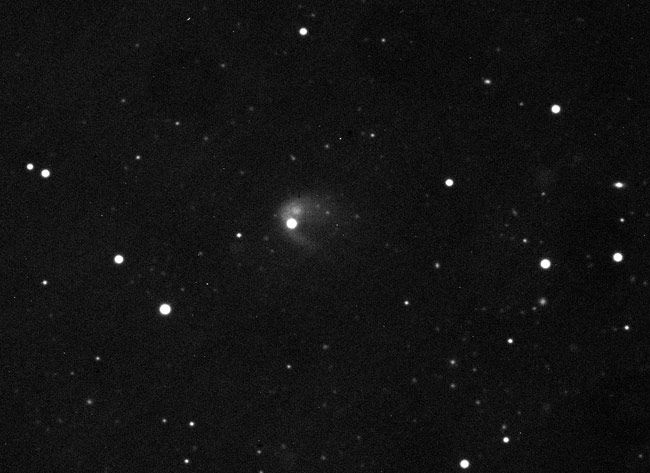
© Kevin HeiderA picture showing the faint tail of the celestial body 596 Scheila, which was once thought to be an asteroid. Government researchers now think it may be a 'dormant comet coming back to life'. What they don't seem able to grok is that comets and asteroids are essentially the same thing.
Using a telescope in the Canary Islands, they spotted an asteroid dubbed P/2012 F5 that displayed a trail like that of comets.
Its emission of dust or gas may have been caused by internal rupture or collision with another asteroid, a release from the Spanish Foundation for Science and Technology reported Wednesday.
"Our models indicate that [the trail] was caused by an impulsive short-lived event lasting just a few hours around the July 1st, 2011, with an uncertainty of 20 days," Fernando Moreno, researcher at the Astrophysics Institute of Andalusia said.
Telescope images reveal "a fine and elongated dust structure that coincides exactly with the synchrone [timing] of that day," Moreno said.
"It could have arisen from collision with another asteroid or rather a rotational rupture" of material gradually breaking free after partial fragmentation of the asteroid, the researchers said.
The said they estimate the asteroid has a radius of between 300 and 450 feet and the dust mass emitted is about half a million tons.



Comment: The answer is staring them in the face: we live in an Electric Universe!
The asteroid "sported a tail" because it became electrically charged.
The Electric Comet: The Elephant in NASA's Living Room?
When Asteroids Become Comets