Comets


Ice Cube

Hmm...Real risk of a Maunder minimum is 'Little Ice Age', says leading scientist

Image
It's known by climatologists as the 'Little Ice Age', a period in the 1600s when harsh winters across the UK and Europe were often severe. The severe cold went hand in hand with an exceptionally inactive sun, and was called the Maunder solar minimum.

Now a leading scientist from Reading University has told me that the current rate of decline in solar activity is such that there's a real risk of seeing a return of such conditions. I've been to see Professor Mike Lockwood to take a look at the work he has been conducting into the possible link between solar activity and climate patterns.

According to Professor Lockwood the late 20th century was a period when the sun was unusually active and a so called 'grand maximum' occurred around 1985. Since then the sun has been getting quieter.

By looking back at certain isotopes in ice cores, he has been able to determine how active the sun has been over thousands of years. Following analysis of the data, Professor Lockwood believes solar activity is now falling more rapidly than at any time in the last 10,000 years. He found 24 different occasions in the last 10,000 years when the sun was in exactly the same state as it is now - and the present decline is faster than any of those 24. Based on his findings he's raised the risk of a new Maunder minimum from less than 10% just a few years ago to 25-30%.

And a repeat of the Dalton solar minimum which occurred in the early 1800s, which also had its fair share of cold winters and poor summers, is, according to him, 'more likely than not' to happen.

Comet 2

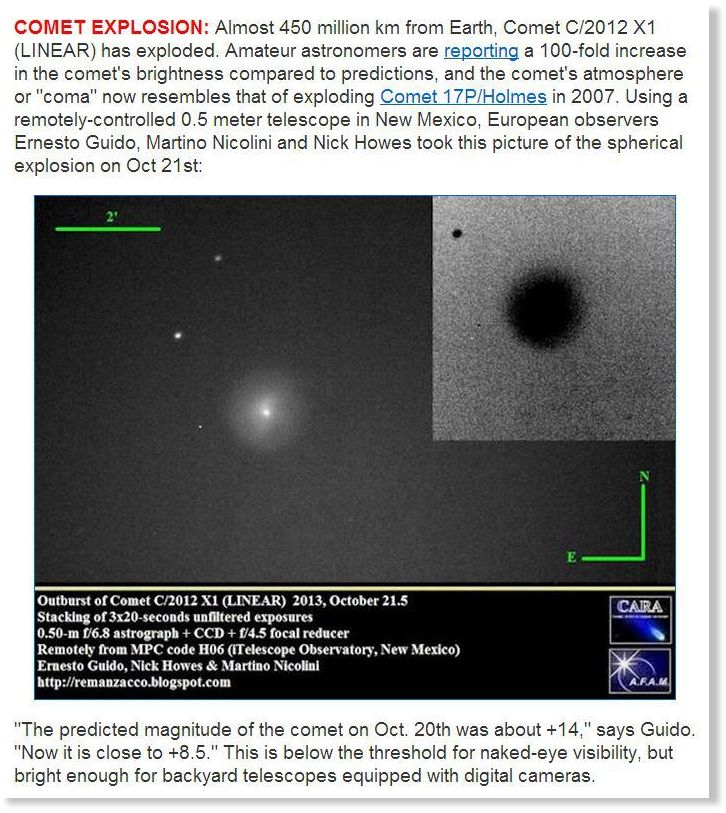
Comet C/2012 X1 (LINEAR), trailing ISON by 3 months, 'explodes' - 100x increase in brightness

This 'LINEAR' C/2012 X1 was discovered after C/2012 S1 - i.e., ISON. 'S' vs. 'X'. This 'LINEAR' (and there are a lot of comets discovered by LINEAR) is still in the asteroid belt. It will not make perihelion till February 21, 2014. So it is trailing ISON by 3 months.

Image

Comet 2

New Comet: P/2013 T2 (SCHWARTZ)

Cbet nr. 3676, issued on 2013, October 22, announces the discovery of a new comet (discovery magnitude ~18.8) by M. Schwartz on CCD images obtained with the 0.41-m f/3.75 Tenagra III astrograph. The new comet has been designated P/2013 T2 (SCHWARTZ).

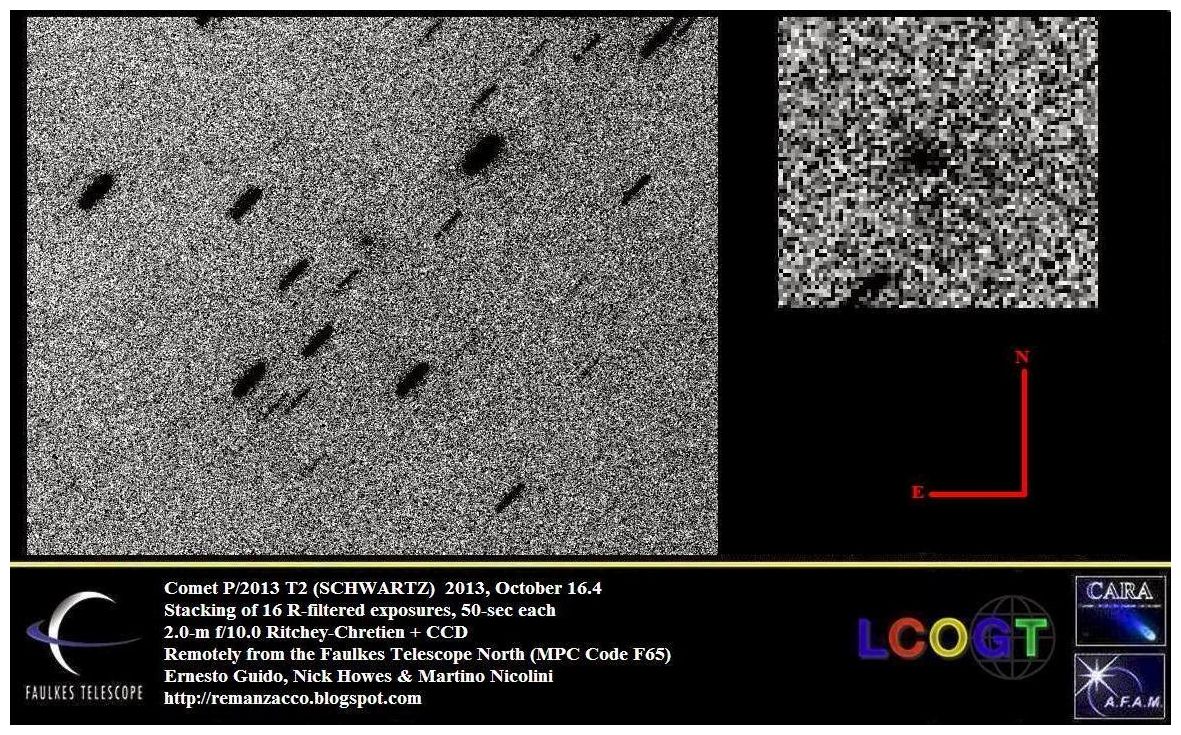
We performed follow-up measurements of this object, while it was still on the neocp. Stacking of 16 R-filtered exposures, 50-sec each, obtained remotely from MPC code F65 (Faulkes Telescope North) on 2013, October 16.4 through a 2.0-m f/10.0 Ritchey-Chretien + CCD (operated by Las Cumbres Observatory Global Telescope Network), shows that this object is a comet: sharp central condensation surrounded by a coma about 6" in diameter.

Below our confirmation image. Click on it for a bigger version.
P/2013 T2
© Remanzacco Observatory
M.P.E.C. 2013-U18 (including prediscovery Catalina Sky Survey data from Sept. 14.4 UT, when the magnitude was given as 17.8-18.6) assigns the following elliptical orbital elements to comet P/2013 T2: T 2013 June 20.65; e= 0.53; Peri. = 342.52; q = 1.60; Incl.= 9.36

Meteor

Huge half-ton chunk of Chelyabinsk meteorite lifted from lakebed

Image
© RIA Novosti / Aleksandr Kondratuk
The largest-discovered fragment of a Russian meteorite, weighing around 570 kilograms, has been lifted from the bed of Lake Chebarkul in the Urals.

The huge meteorite chunk split into three pieces when scientists tried to weigh it. The precise weight could not be established because the heavy object broke the scales.

"The preliminary examination... shows that this is really a fraction of the Chelyabinsk meteorite. It's got thick burn-off, the rust is clearly seen and it's got a big number of indents. This chunk is most probably one of the top ten biggest meteorite fragments ever found," said Sergey Zamozdra, associate professor of Chelyabinsk State University, as cited by Interfax news agency.

He explained that it was important to establish the weight of the fragment in order to learn more about the qualities of the whole of the meteorite.

The lifted chunk was taken to the regional natural history museum. The plan is to have a small sample of it X-rayed to determine what minerals it consists of.

Comet 2

Outburst of comet C/2012 X1 (LINEAR)

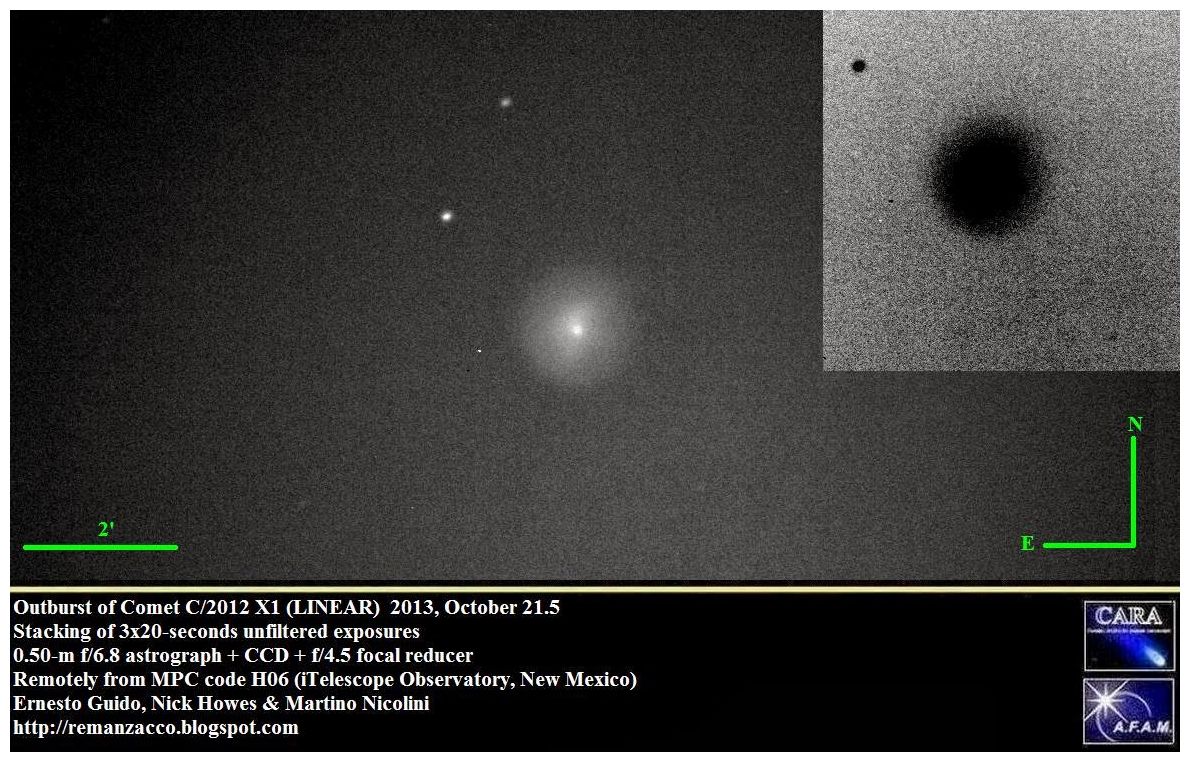
Cbet No. 3674, issued on 2013 October 21, reports an outburst in brightness of comet C/2012 X1 (LINEAR). The magnitude of the comet was measured by H. Sato on on Oct. 20.5 to be total mag 8.5 (as measured within a circular aperture of diameter 85".2) with a brighter center about 10" across. The predicted H_10 magnitude for C/2012 X1 (LINEAR) would be around 14 now.

We performed follow-up measurements of this object on 2013 October 21.51. Below you can see our image of this comet, stacking of 3x20-seconds unfiltered exposures, obtained remotely from MPC code H06 (iTelescope Observatory, New Mexico) through a 0.50-m f/6.8 astrograph + CCD + f/4.5 focal reducer. At the moment of the imaging session, the comet was just +16 degree above the horizon and the Sun was -11 degree. Click on it for a bigger version.
Comet C/2012 X1
© Remanzacco Observatory
Below you can see an elaboration of the original image with the MCM filter. This filter creates an artificial coma, based on the photometry of the original image, and subtract the original image itself in order to highlight the internal zones of different brightness that are very close to the inner core and that would normally be hidden from the diffuse glow of the comet.

Comet

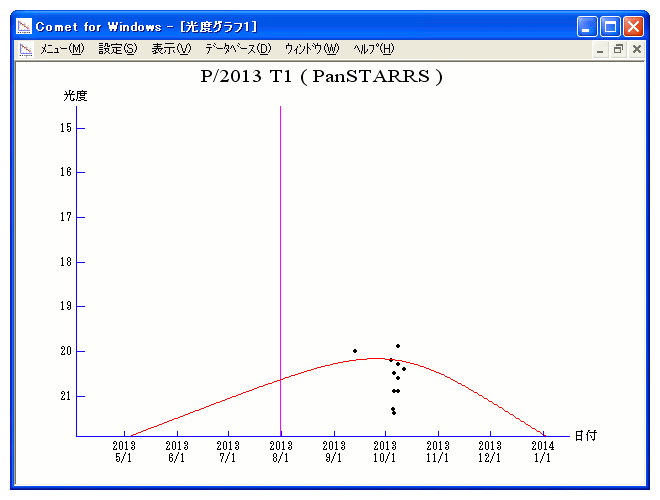
New Comet: P/2013 T1 (PanSTARRS)

Discovery Date: October 5, 2013

Magnitude: 21.8 mag

Discoverer: Pan-STARRS 1 telescope (Haleakala)

P/2013 T1 (PanSTARRS)
© Aerith NetMagnitudes Graph
The orbital elements are published on M.P.E.C. 2013-T110.

Comet 2

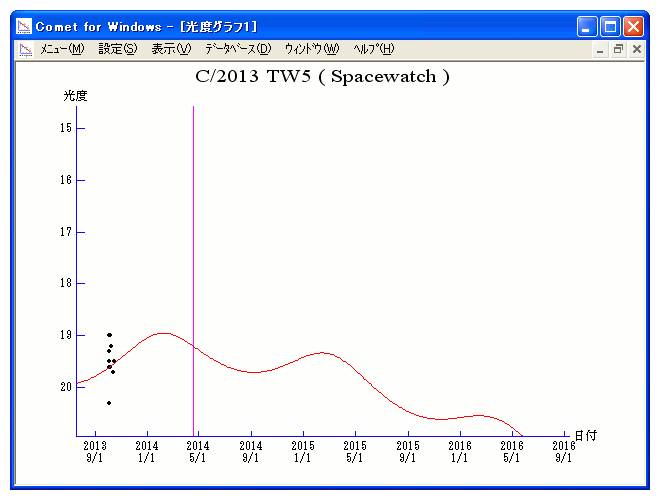
New Comet: C/2013 TW5 (Spacewatch)

Discovery Date: October 3, 2013

Magnitude: 19.6 mag

Discoverer: T. H. Bressi (Spacewatch)
C/2013 TW5
© Aerith NetMagnitudes Graph
The orbital elements are published on M.P.E.C. 2013-T115.

Comet

How many mega impacts have whacked Earth?

Impact Event
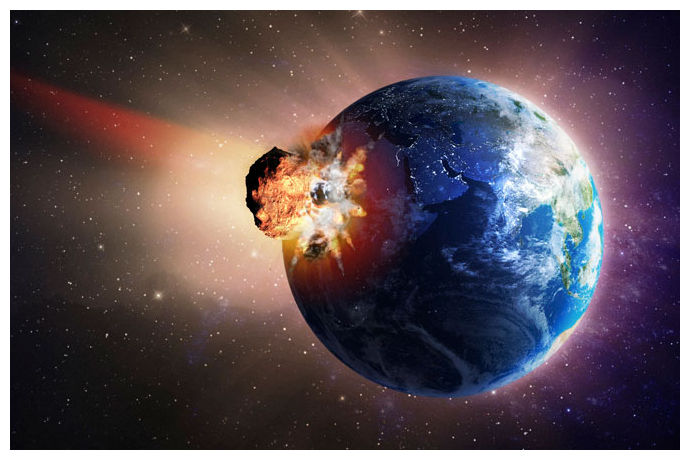
© Andrzej Wojcicki/CorbisAn artist’s illustration of an asteroid impacting Earth.
If you enjoy leaves turning, pumpkin patches and other rites of autumn, thank the giant impact event early in Earth's history which knocked our planet's axis off kilter, creating the seasons that we know and love today. But was there just one planet-tilting impact?

University of Western Ontario geologist Grant Young thinks there were two, separated by billions of years. He has been studying rocks from the Ediacaran Period, 540 to 635 million years ago and says he sees signs of massive changes to Earth's seasons and climate that can best be explained by a axis-shifting collision of a small planetary body into the ocean about 570 million years ago.

That's long after the famous smash up with a Mars-sized body that is credited with creating the Moon around 4 billion years ago and giving Earth its mild tilt and modern seasons. It was also at the time Earth was seeing the earliest animals, or metazoans, come into being.

"I think this might have stimulated the evolution of metazoans," Young told Discovery News.

The scenario he has presented in the October issue of GSA Today is that there was first the collision that created the Moon. But instead of that giving Earth its current tilt (which wobbles a bit, and is currently at 23.5 degrees), that first event knocked the planet over almost on its side. That orientation would give the poles a temperate climate without nights for half the year and the equator much less sunshine all year round.

Fireball 4

Meteor Alert - Several larger meteor events expected! NEO Asteroids close approaches October 2013

Meteor Alert: Several larger meteor events and increased meteor activity expected! - Through the end of OCT2013! Get out and watch and HAVE your security/allsky cameras ON!

BUT WAIT and see what will happen in November 2013!!!
- LunarMeteoriteHunter...Tokyo

NEO Asteroids Close Approaches October 2013

8 known NEOs with an LD of 10 or less. Several more are expected to be discovered this month!
2013 SU24, 2013 SC21, 2013 TQ4, 2013 TO4 2013 TR12, 2013 TX68, 2013 TT5, 2013 TM127

Fireball 4

Brilliant fireball seen over most of Western Australia 14 October 2013

A brilliant meteor seen over most of Western Australia about 7pm yesterday was unusual, but not unexpected, according to Guardian astronomy expert Dave Reneke. Mr Reneke said to expect an intense period of meteor activity over the next week or so, with the 'Orionids' meteor shower.


Comment: The Orionids are certainly on their way, though this 'meteor' was seen over most of Western Australia, which doesn't sound like just a part of the Orionids' meteor activity.


"The Orionids are one of the better showers of the year and are well known to produce 'fireballs,' slow-moving meteors that are actually on fire, producing a variety of colours and long, extended tails," he said. "It was more than likely the cause of the one spotted early last night.

"Once seen, these objects are seldom forgotten!" Mr Reneke said a meteor shower occurred when the Earth passed through the tail of a comet that came by years before. "When the Earth intercepts a debris stream, individual particles travel through the earth's atmosphere and start to burn up," he said.

"This time we are passing through the tail of Halley's Comet that came by in 1986.