Comets


Comet

Best of the Web: A dangerous game of 'cosmic roulette'? Mainstream media now talking about the dangers of asteroids and comets

The following script is from "Cosmic Roulette" which aired on Oct. 6, 2013. The correspondent is Anderson Cooper. Andy Court, producer.


For a long time, astronomers saw the asteroids and comets that come close to Earth as useless debris -- space rocks that blocked our view of distant galaxies. Not anymore. They're now viewed as scientifically important and potentially very dangerous if they were to collide with our planet. The odds of that happening on any given day are remote, but over millions of years scientists believe there have been lots of impacts, and few doubt there are more to come. A former astronaut told us it's like a game of "cosmic roulette," and one mankind cannot afford to lose.

Concern over our ability to detect these objects that come near the Earth grew after an incident in Russia this February, when an asteroid crashed into the atmosphere with many times the energy of the bomb dropped on Hiroshima, narrowly missing a city of one million.

This is video of that asteroid in Russia, barreling toward Earth at 40,000 miles an hour. It exploded into pieces 19 miles above and 25 miles south of the city of Chelyabinsk. People thought it had missed them entirely, until minutes later, when the shock wave arrived. Shattering glass, crushing doors, and knocking some people right off their feet. More than a thousand were injured.

Comment: Ifs, buts and maybes in this game of cosmic roulette have periodically become dead certainties in the course of human history - the collapse of civilizations in the past coincided with Earth encountering larger swarms of cometary and asteroid debris... like the planet is encountering now.


Fireball 3

More sightings of meteor in Indiana

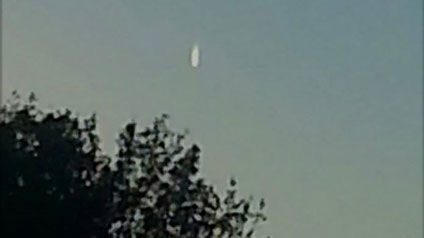
Meteor sighting Friday morning in Anderson by viewer Katie Hobbs-Johnson.
© wthr.comMeteor sighting Friday morning in Anderson by viewer Katie Hobbs-Johnson.
More reports of meteor sightings on Friday night are coming in from Indiana. Nearly 700 people across six states already reported sightings of meteors Friday morning.

The American Meteor Society (AMS) said witnesses from Ohio, Illinois, Indiana, Kentucky, Missouri and Wisconsin reported a bright light moving across the morning sky.

An estimated trajectory computed from the witness reports shows the meteor was traveling from the west to east and ended somewhere over eastern Indiana.

Comment:
See also
Another meteor "fireball" Saturday night over Indiana
Meteor reports centered on Indiana
U.S. sees another bright fireball on September 27
'Very bright' meteor lights up early-morning sky in U.S. Midwest - over 400 online reports submitted


Comet 2

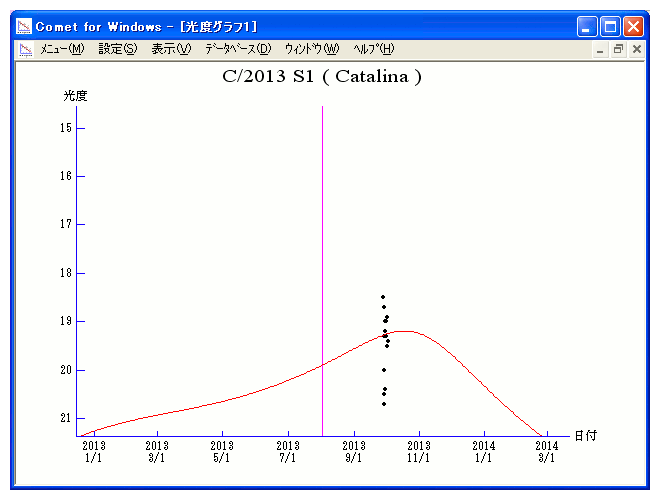
New Comet: C/2013 S1 (Catalina)

Discovery Date: September 28, 2013

Magnitude: 19.0 mag

Discoverer: Catalina Sky Survey
C/2013 S1
© Aerith NetMagnitudes Graph
The orbital elements are published on M.P.E.C. 2013-T27.

Fireball 2

Best of the Web: Are the increasing numbers of meteorites bringing life forms to Earth?

Russian Meteor Still
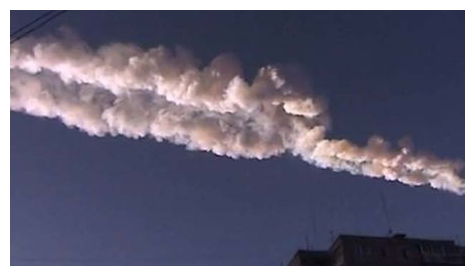
© AFP/Powered By NewslookThis video still image shows the smoke trail created by the meteor that exploded over the Chelyabinsk region of Russia on Feb. 15, 2013.
If it were not scientifically verified, it would be a great storyline for a sci-fi flick, but NASA says alien microbes are hitching rides on meteorites. Some experts are stating that debris from outer space will only be increasing in frequency as they impact Earth in the coming year.

A meteorite's size can range from small to extremely large. When a meteoroid enters the atmosphere, frictional, pressure, and chemical interactions with the atmospheric gases cause the body to heat up and emit light, thus forming a fireball, also known as a meteor or shooting/falling star. They can range from extraterrestrial bodies that collide with Earth or an exceptionally bright, fireball-like meteor regardless of whether it ultimately impacts the surface.

NASA has launched a new website to share details of meteor explosion events as recorded by U.S. military sensors on secretive spacecraft, kicking off the project with new details of this past February's fireball over Chelyabinsk, Russia.

The new "Fireball and Bolide Reports" website, overseen by NASA's Near-Earth Object Program, debuted Friday (March 1) with its first entry: a table with a chronological data summary of the Russian meteor explosion of Feb. 15 gleaned from U.S. Government sensor data. Scientists are calling the event a "superbolide," taken from the term "bolide" typically used for fireballs created by meteors.

Part of the worldwide interest in meteors hitting Earth stems from what is now verifiable evidence that alien lifeforms are coming along for the ride.

In 2010, Duane P. Snyder announced the discovery of the first and only known Ice Meteorite containing Extraterrestrial Life-forms. The Ice Meteorite's particle analysis, its gas analysis, and likely origin including photos of the life-forms found in the melt-water of the meteorite where also exhibited. Dr. Albert Schnieders of Tascon USA Inc, commented that they basically found nearly all elements up to 90u in the sample spherical particles tested.

Comment: To understand the implications of this article see also New Light on the Black Death: The Viral and Cosmic Connection


Fireball

Tanzanians see unusual night skylight - baffles many

Dar es Salaam and Arusha - The sighting of a strange bright light in the sky on Sunday night left hundreds of Tanzanians amazed with astronomy experts connecting the incident with unpredictably heavy rains that pounded Dar es Salaam and other parts of the country on Monday.

The 'strange light in the sky' took a number of Dar es Salaam and Arusha residents by surprise and the incident scared many. Sunday nights normally find some people in big cities enjoying last hours of the weekend in public places but this time round the situation was different as some gave up drinking and rushed home fearing the worst.

Reports from weather stations around the world, however, indicate that Sunday night's sky sighting was that of 'Comet Ison' and the occurrence had been predicted before. The comet may be sighted in different parts of the world between September 29 and October 1.

Dr Noorali Jiwaji, lecturer at the Open University of Tanzania (OUT) at the faculty of Science Technology and Environmental Studies said the incident was likely to have built up moisture sufficiently thus causing the heavy rains on Monday. The last Sunday night, from around 7 pm most parts of the country observed the middle of the circle with a small point of light like a star moving steadily with the cloudy disk thus causing panic to some people.

Fireball

Hmm... It's raining fireballs and NASA shuts down?

What timing... It all gets shut down just as ISON approaches and it's raining fireballs?


Fireball 4

NASA reporting mysterious green patches in sky?


What is it? Some surely natural phenomenon has appeared in a video that, so far, has defied clear identification. The above time-lapse video was made to record Perseid meteors above Hopewell Rocks in New Brunswick, Canada late this summer. The video, which ran from 9:30 pm August 11 to 3:00 am the next morning, records several meteor and satellite streaks beyond a picturesque background. Each image records a 30 second exposure. At about 25 seconds into the video, however, an unusual patchy green glow appears to cover the sky. Possible explanations include airglow, aurora, lighting from an artificial or natural source, or something completely different. This APOD is an attempt not only to solve this intriguing sky riddle, but to measure how powerful the APOD readership is as a citizen-science, collective-intelligence engine. If you have insight into what might be causing this phenomenon, please contribute to the discussion.

Video Credit & Copyright: Kevin Snair, Creative Imagery

Fireball

Breaking News: Meteor sightings in the 1000′s across the U.S. are reported to American Meteor Society

Reports of meteor sightings are coming into the American Meteor Society by the thousands. According to one of the latest reports posted at the American Meteor Society website, "Its been a busy week for the AMS as we are bombarded by fireball reports from all different parts of the country. The latest event took place over Alabama and Georgia last night September 28th 7:30 PM local time. Over 250 witnesses from Virginia, Maryland, Kentucky, Tennessee, North Carolina, Alabama and Georgia have reported the event so far. Below is a heat map of the witnesses who saw the event. Click the image below for the event detail page and witness reports." [1]

Exactly why these meteors are coming into the atmosphere at this time is unknown. NASA and NOAA have yet to publish any reports on this phenomenon, although they did confirm the September 10, 2013 meteor that streaked across the sky in Alabama in theguardian.com article 'Meteor enters atmosphere over Alabama and disintegrates, says Nasa'.An excerpt from the article reads, "Officials at the Marshall Space Flight Center in Huntsville say a baseball-size fragment of a comet entered Earth's atmosphere above Alabama at 8:18pm CDT Monday. Nasa officials say the meteor traveled at a speed of 76,000 mph. They say just three seconds after hitting the atmosphere, it disintegrated 25 miles above the central Alabama town of Woodstock, producing a flash of light. Nasa spokeswoman Janet Anderson says that because it penetrated so deep into Earth's atmosphere, eyewitnesses heard sonic booms." [2]


Fireball

MASTER detection of Near-Earth Object 9 hours before the very close fly-by

Credential Certification: Vladimir Lipunov (lipunov2007@gmail.com)

Subjects: Optical, Asteroid, Near-Earth Object

During the observations of flaring blazar 3C 454.3 in two polarization filters, MASTER-Tunka robotic telescope (double 0.40-m f2.5 reflector + 4kx4k CCD, filed of view 2.1x2.1 deg) has serendipitously detected the Fast Moving Object of 16m visible in both tubes. The object was located near the edge of FOV, about 1 deg south of 3C 454.3. First it was detected on the set of ten 30-sec exposures from 13:20 to 13:37 UT with limiting magnitudes 17.3-17.5. Another set of ten 60-sec exposures was then obtained from 13:44 to 14:05 UT with the limits 18.1-18.2 in both tubes.

The animation of ten 60-sec exposures from the Eastern tube is uploaded here.

The object was moving at the rate of 6.2" per minute in positional angle 71. Astrometry from 8 images was reported to Minor Planet Center using the designation MASD91. Using Find_Orb orbit determination software by Bill Gray (www.projectpluto.com) we have obtained the following orbital elements:
Epoch 2013 Sep 28.0 TT = JDT 2456563.5 Earth MOID: 0.0000 Ve: 0.0772 M 343.67888 (2000.0) Ma: 0.0016 n 0.36126837 Peri. 252.01974 0.22930384 -0.97326783 a 1.95246273 Node 184.78142 0.94166328 0.22520304 e 0.6228503 Incl. 8.98491 0.24635343 0.04509218 P 2.73/996.47d H 27.7 G 0.15 q 0.73637071 Q 3.16855475 From 8 observations 2013 Sept. 27 (44.4 min); mean residual 0".295.

Fireball

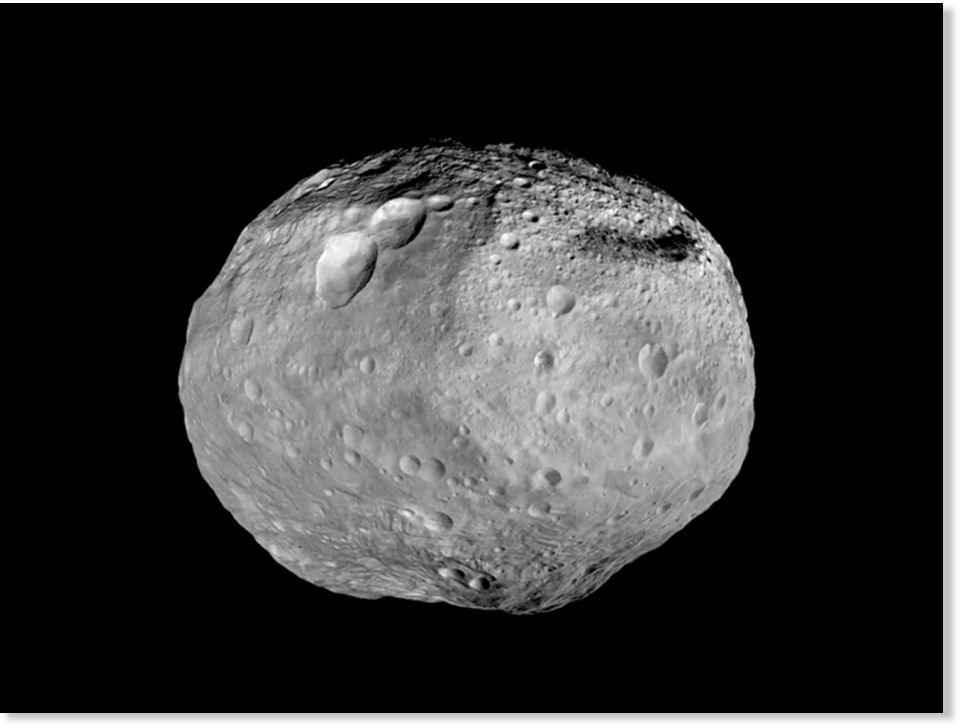
Full view of Asteroid Vesta

As NASA's Dawn spacecraft travels to its next destination, this mosaic synthesizes some of the best views the spacecraft had of the giant asteroid Vesta. Dawn studied Vesta from July 2011 to September 2012. The towering mountain at the south pole - more than twice the height of Mount Everest - is visible at the bottom of the image. The set of three craters known as the "snowman" can be seen at the top left.
Image
© NASA/JPL-Caltech/UCAL/MPS/DLR/IDA
These images are the last in Dawn's Image of the Day series during the cruise to Dawn's second destination, Ceres. A full set of Dawn data is being archived here.

The Dawn mission to Vesta and Ceres is managed by NASA's Jet Propulsion Laboratory, a division of the California Institute of Technology in Pasadena, for NASA's Science Mission Directorate, Washington D.C. UCLA is responsible for overall Dawn mission science. The Dawn framing cameras were developed and built under the leadership of the Max Planck Institute for Solar System Research, Katlenburg-Lindau, Germany, with significant contributions by DLR German Aerospace Center, Institute of Planetary Research, Berlin, and in coordination with the Institute of Computer and Communication Network Engineering, Braunschweig. The Framing Camera project is funded by the Max Planck Society, DLR, and NASA/JPL.