Comets


Fireball

UPS plane 'crash' near Alabama airport - meteorite?

Image
Just wanted to put out a few interesting details about Wednesday's crash of a UPS cargo plane (Airbus A300) near Alabama airport at around 5am on Wednesday 14th August 2013 as it approached Birmingham-Shuttlesworth Airport

From this Chicago Tribune story:
There was a big explosion that lit up the sky. It jarred the earth.
[...]

No distress calls were made to the airport tower, according to April Odom, a spokeswoman for Bell.
[...]

"It was quite a large fire and there were two to three explosions after the plane caught fire, after the crash itself," Bell said.
[...]

Pedro Torres, who lives about two blocks from the crash site, saw "a big flash" from the window of his home when the plane went down.

Comment: Interesting that another meteor just blew over Birmingham, Alabama yesterday as well.
Baseball-sized meteor blows up over Alabama


Comet

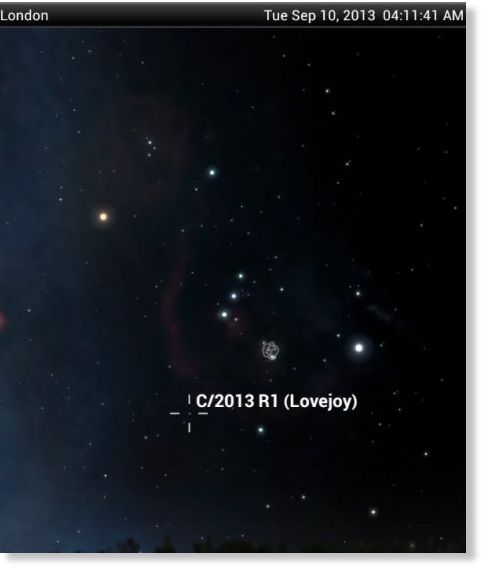
New Comet Lovejoy will occupy the same part of the sky as Comet ISON by November 2013

Image
© Cumbrian SkyComet Lovejoy’s location on the sky’s dome now. It is up in the morning sky, as seen from across the Earth.
Many are anticipating the brightening of Comet ISON, which is now in Earth's predawn sky, not far from the bright planets Jupiter and Mars, but too faint to see without telescopes and/or photographic equipment. Read more about Comet ISON here. In the meantime, on September 9, 2013, noted comet discoverer Terry Lovejoy of Australia announced another new comet, bringing his total number of comet discoveries to four. The newest Comet Lovejoy will be in the same part of the sky as Comet ISON beginning in November. What a cool photo opportunity!

The new comet has been formally labeled as C/2013 R1 Lovejoy. Terry Lovejoy apparently used a relatively small 8-inch (20 cm) Schmidt-Cassegrain reflecting telescope to photograph the new comet for two nights, as this faint object was located on the sky's dome in front of the border between our constellations Orion and Monoceros.

Read Terry Lovejoy's own discovery story here.

Now that the comet has been confirmed by other astronomers, amateur astronomers will be getting excited! Watch this space.

Comet

Near-Earth Object 'Don Quixote' turns out to be yet another comet

Don Quixote
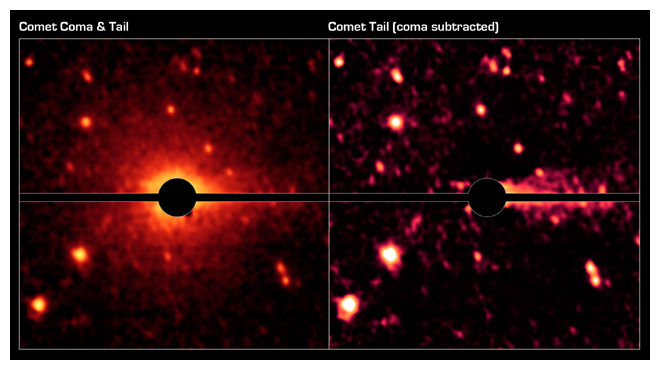
© NASA/JPL-Caltech/DLR/NAUWith the help of NASA's Spitzer Space Telescope, astronomers have discovered that what was thought to be a large asteroid called Don Quixote is in fact a comet.
For 30 years, a large near-Earth asteroid wandered its lone, intrepid path, passing before the scrutinizing eyes of scientists armed with telescopes while keeping something to itself. The object, known as Don Quixote, whose journey stretches to the orbit of Jupiter, now appears to be a comet.

The discovery resulted from an ongoing project coordinated by researchers at Northern Arizona University, Flagstaff, Ariz., using NASA's Spitzer Space Telescope. Through a lot of focused attention and a little luck, they found evidence of comet activity, which had evaded detection for three decades.

The results show that Don Quixote is not, in fact, a dead comet, as previously believed, but it has a faint coma and tail. In fact, this object, the third-biggest near-Earth asteroid known, skirts Earth with an erratic, extended orbit and is "sopping wet," said David Trilling of Northern Arizona University, with large deposits of carbon dioxide and presumably water ice. Don Quixote is about 11 miles (18 kilometers) long.

Comment: There is no such thing as 'dead comets'. 'Asteroids' and 'comets' cannot simply be lumped into two plain categories. The reason why this rock suddenly appeared to be 'alive' is because it has become charged by the solar capacitor!

We live in an electric universe, and comets, like all other things, become charged, and then discharge...


Comet 2

NAU-led team discovers comet hiding in plain sight

For 30 years, a large near-Earth asteroid wandered its lone, intrepid path, passing before the scrutinizing eyes of scientists while keeping something to itself: (3552) Don Quixote, whose journey stretches to the orbit of Jupiter, now appears to be a comet.

The discovery resulted from an ongoing project coordinated by researchers at Northern Arizona University using the Spitzer Space Telescope. Through a lot of focused attention and a little bit of luck, they found evidence of cometary activity that had evaded detection for three decades.
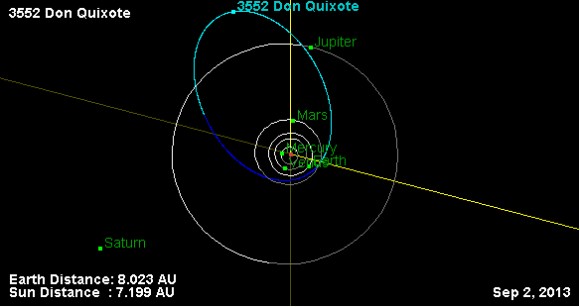
Image
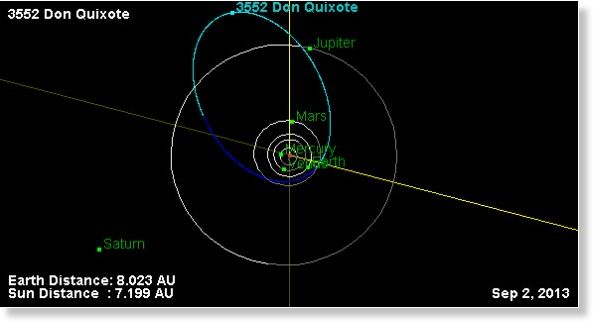
© NASAJPL Near-Earth Object database map of 3552 Don Quixote’s orbit
"Don Quixote's orbit resembles that of a comet, so people assumed it was a comet that had gotten rid of all its ice deposits thousands of years ago," said Michael Mommert, a Ph.D. student of team member Prof. Alan Harris at the German Aerospace Center (DLR) in Berlin at the time this work was carried out. Near-Earth asteroids that are former comets make up roughly 5 percent of the whole near-Earth asteroid population, as found by Mommert and colleagues in a related study. These objects are mostly "dead comets" - comets that had shed the carbon dioxide and water that give them their spectacular comae and tails long time ago.

What Mommert, now a post-doctoral researcher at NAU, and an international team of researchers discovered, though, was that Don Quixote was not actually a dead comet. In fact, the third-biggest near-Earth asteroid out there, skirting Earth with an erratic, extended orbit, is "sopping wet," said NAU associate professor David Trilling, with large deposits of carbon dioxide and presumably water ice.


Comet 2

Balloon sent to edge of atmosphere picks up organisms 'that can only have come from space'

Image
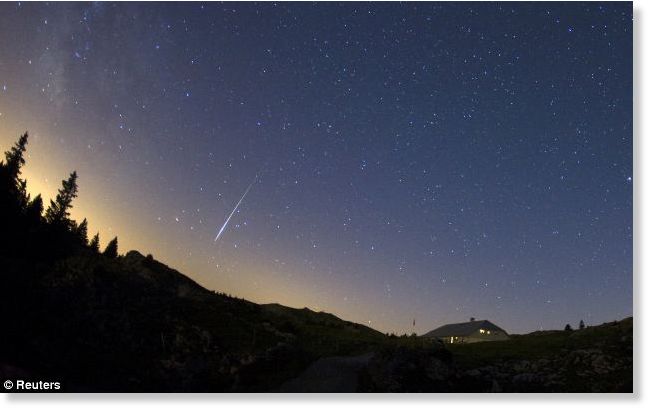
© ReutersProfessor Wickramasinghe, 74, and his team from the University of Sheffield sent a specially designed balloon into the atmoshphere during the annual Perseid meteor shower last month in August
British scientists believe they have found evidence alien life after sending a balloon to the edge of space. The team of scientists sent a balloon 27km into the stratosphere and captured small biological organisms they say can only have come from space. The group, headed up by astrobiologist Professor Chandra Wickramasinghe, claims the 'seeds of life' have been transported between planets by passing meteors.

Professor Wickramasinghe, 74, and his team from the University of Sheffield sent a specially designed balloon into the atmosphere above Chester during the annual Perseid meteor shower. The balloon was carrying sterile microscope slides which were only exposed to the atmosphere at heights of 27km.

When the balloon fell back down to Earth the scientists discovered microscopic aquatic algae on the microscope slides - which they say can only be alien life forms.

Comet 2

New Comet: C/2013 R1 (LOVEJOY)

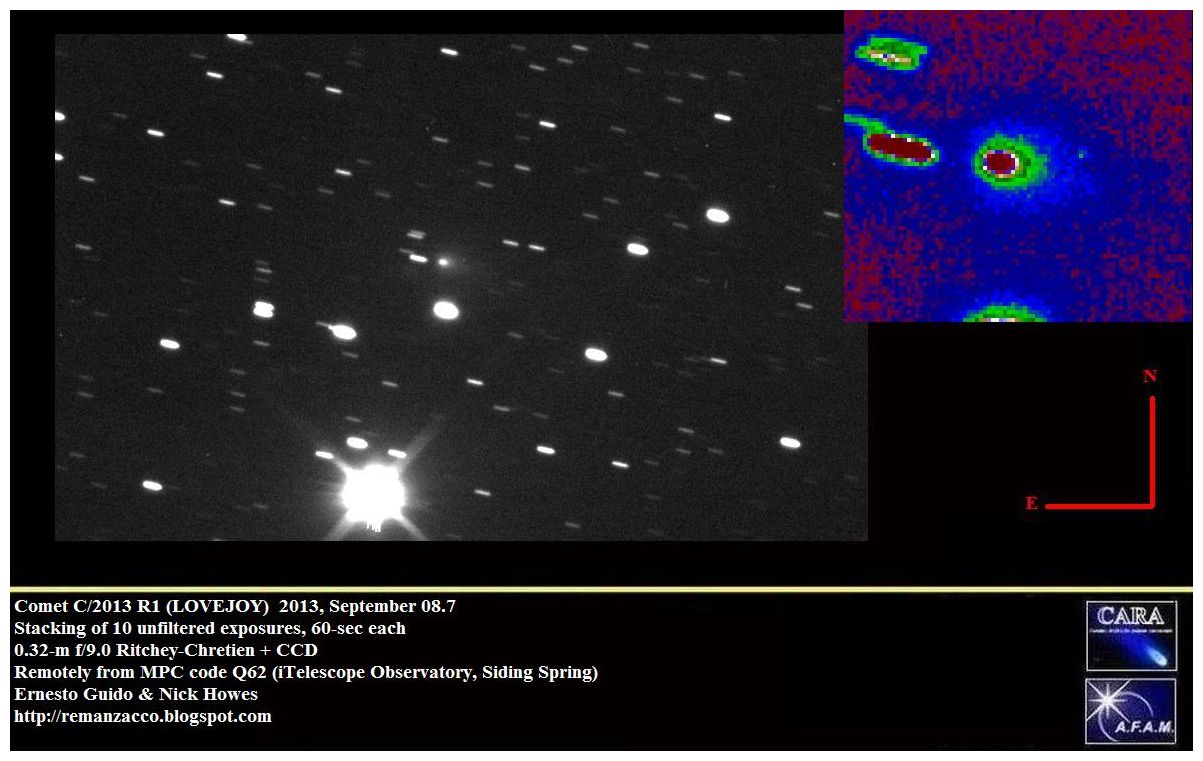
Cbet nr. 3649, issued on 2013, September 09, announces the discovery of a new comet (discovery magnitude ~14.4) by Terry Lovejoy on CCD images obtained with a 20-cm f/2.1 Schmidt-Cassegrain reflector on two nights. The new comet has been designated C/2013 R1 (LOVEJOY).

We performed follow-up measurements of this object, while it was still on the neocp. Stacking of 10 unfiltered exposures, 60-sec each, obtained remotely from MPC code Q62 (iTelescope Observatory, Siding Spring) on 2013, September 08.7, through a 0.32-m f/9.0 Ritchey-Chretien + CCD, shows that this object is a comet: sharp central condensation surrounded by a coma about 25" in diameter and a tail about 40" in PA 245.

Below our confirmation image.
C/2013 R1
© Remanzacco Observatory
M.P.E.C. 2013-R72 assigns the following preliminary parabolic orbital elements to comet C/2013 R1: T 2013 Dec. 25.78; e= 1.0; Peri. = 63.26; q = 0.87; Incl.= 61.94

Comet

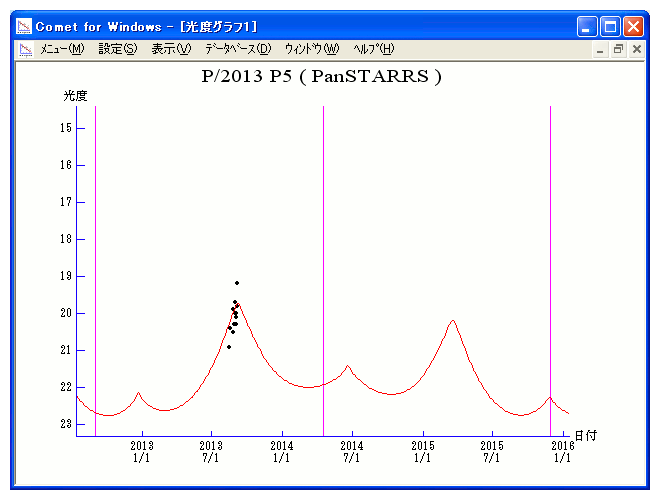
New Comet: P/2013 P5 (PanSTARRS)

Discovery Date: August 15, 2013

Magnitude: 20.9 mag

Discoverer: Pan-STARRS 1 telescope (Haleakala)

P/2013 P5
© Aerith NetMagnitudes Graph
The orbital elements are published on M.P.E.C. 2013-R59.

Info

Meteorite crater in Brazil reveals biggest extinction in Earth history

Perth, Australia - It's well known that the dinosaurs were wiped out 66 million years ago when a meteor hit what is now southern Mexico but evidence is accumulating that the biggest extinction of all, 252.3m years ago, at the end of the Permian period, was also triggered by an impact that changed the climate.

While the idea that an impact caused the Permian extinction has been around for a while, what's been missing is a suitable crater to confirm it. Associate Professor Eric Tohver of the University of Western Australia's School of Earth and Environment believes he has found the impact crater which reveals though the trigger was the same, the details are significantly different.

Last year Dr Tohver redated an impact structure that straddles the border of the states of Mato Grosso and Goiás in Brazil, called the Araguainha crater, to 254.7m years, with a margin of error of plus or minus 2.5m years. Previous estimates had suggested Araguainha was 10m years younger, but Dr Tohver has put it within geological distance of the extinction date.

The Chicxulub crater in Mexico, is 180km in diameter while the Araguainha is 40 kilometres across and was thought to be too small to have caused the chain reaction which brought about such mass extinction.

Fireball 5

Did ancient Earth-chilling meteor crash near Canada?

Impact Event
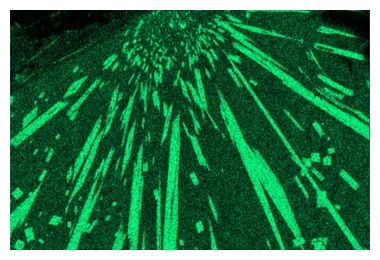
© Mukul SharmaThe high temperatures of the meteorite impact 12,900 years ago produced mm-sized spherules of melted glass with the mullite and corundum crystal structure shown here.
A meteor or comet impact near Quebec heaved a rain of hot melted rock along North America's Atlantic Coast about 12,900 years ago, a new study claims.

Scientists have traced the geochemical signature of the BB-sized spherules that rained down back to their source, the 1.5-billion-year-old Quebecia terrane in northeastern Canada near the Gulf of Saint Lawrence.

At the time of the impact, the region was covered by a continental ice sheet, like Antarctica and Greenland are today.

"We have provided evidence for an impact on top of the ice sheet," said study co-author Mukul Sharma, a geochemist at Dartmouth College in Hanover, N.H. The results were published today (Sept. 2) in the journal Proceedings of the National Academy of Sciences.

Comet

New comet: C/2013 P4 (PANSTARRS)

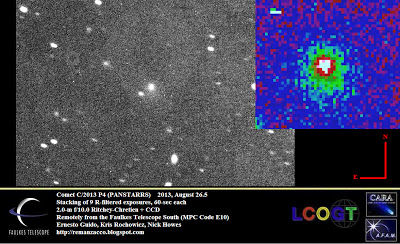
Cbet nr. 3638, issued on 2013, August 26, announces the discovery of a new comet (discovery magnitude ~20.8) by professional survey F51 Pan-STARRS 1 (Haleakala) on CCD images obtained with 1.8-m Ritchey-Chretien on August 15, 2013. After posting on the Minor Planet Center's NEOCP webpage, other CCD astrometrists have commented on the object's cometary appearance. The new comet has been designated C/2013 P4 (PANSTARRS).

We performed follow-up measurements of this object, while it was still on the neocp. Stacking of 9 R-filtered exposures, 60-sec each, obtained remotely, from the Faulkes Telescope South (Siding Spring) on 2013, August 26.5, through a 2.0-m f/10.0 Ritchey-Chretien + CCD (operated by Las Cumbres Observatory Global Telescope Network), shows that this object is a comet: sharp central condensation surrounded by a coma about 15" in diameter elongated in PA 190.

Below our confirmation image
PANSTARRS
© remanzacco.blogspot.frPANSTARRS