Comets


Comet 2

Comets could arise closer to Earth, study suggests

Comet
© NASAArtist’s conception of a comet breaking up.
There's a potential "cometary graveyard" of inactive comets in our solar system wandering between Mars and Jupiter, a new Colombian research paper says. This contradicts a long-standing view that comets originate on the fringes of the solar system, in the Oort Cloud.

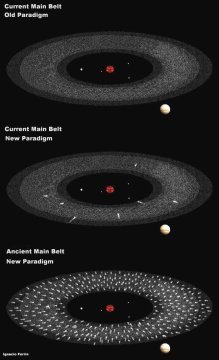
Mysteriously, however, 12 active comets have been seen in and around the asteroid belt. The astronomers theorize there must be a number of inactive comets in this region that flare up when a stray gravitational force from Jupiter nudges the comets so that they receive more energy from the Sun.

The researchers examined comets originating from the main asteroid belt between Mars and Jupiter, a spot where it is believed there are only asteroids (small bodies made up mostly of rock). Comets, by contrast, are a mixture of rocks and ice. The ice melts when the comet gets close to the sun, and can form spectacular tails visible from Earth. (Here's more detail on the difference between a comet and an asteroid.)
Comet 2

Astronomers discovery a graveyard for comets

asteroid belt
© Ignacio Ferrin / University of AnitoquiaThese illustrations show the asteroid belt in the present day and in the early Solar System, located between the Sun (at centre) and four terrestrial planets (near the Sun) and Jupiter (at bottom left). The top image shows the conventional model for the asteroid belt; largely composed of rocky material. The middle image shows the proposed model, with a small number of active comets and a dormant cometary population. The lower diagram shows how the asteroid belt might have looked in the early Solar System, with vigorous cometary activity.
A team of astronomers from the University of Anitoquia, Medellin, Colombia, have discovered a graveyard of comets.

The researchers, led by Anitoquia astronomer Prof. Ignacio Ferrin, describe how some of these objects, inactive for millions of years, have returned to life leading them to name the group the 'Lazarus comets'.

The team publish their results in the Oxford University Press journal Monthly Notices of the Royal Astronomical Society.

Comets are amongst the smallest objects in the Solar System, typically a few km across and composed of a mixture of rock and ices. If they come close to the Sun, then some of the ices turn to gas, before being swept back by the light of the Sun and the solar wind to form a characteristic tail of gas and dust.

Fireball 5

NASA's WISE finds mysterious centaurs may be comets

Centaurs, Comets and Asteroids
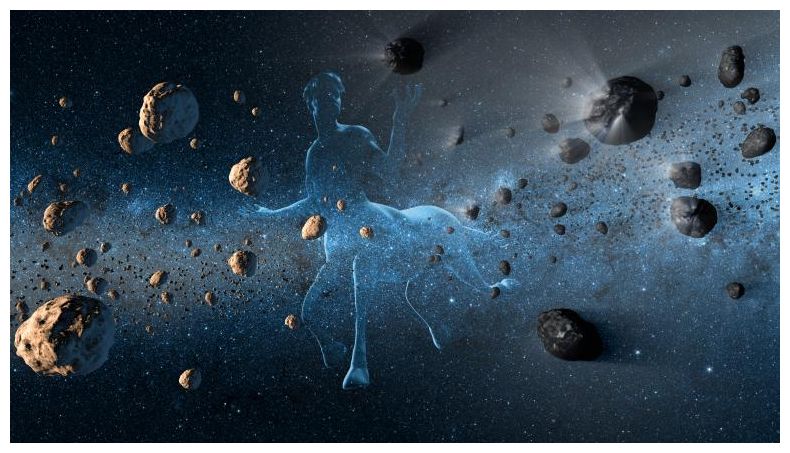
© NASA/JPL-CaltechThis artist's concept shows a centaur creature together with asteroids on the left and comets at right.
Pasadena, California -- The true identity of centaurs, the small celestial bodies orbiting the sun between Jupiter and Neptune, is one of the enduring mysteries of astrophysics. Are they asteroids or comets? A new study of observations from NASA's Wide-field Infrared Survey Explorer (WISE) finds most centaurs are comets.

Until now, astronomers were not certain whether centaurs are asteroids flung out from the inner solar system or comets traveling in toward the sun from afar. Because of their dual nature, they take their name from the creature in Greek mythology whose head and torso are human and legs are those of a horse.

"Just like the mythical creatures, the centaur objects seem to have a double life," said James Bauer of NASA's Jet Propulsion Laboratory in Pasadena, Calif. Bauer is lead author of a paper published online July 22 in the Astrophysical Journal. "Our data point to a cometary origin for most of the objects, suggesting they are coming from deeper out in the solar system."

"Cometary origin" means an object likely is made from the same material as a comet, may have been an active comet in the past, and may be active again in the future.

Blackbox

Martian atmosphere destroyed by sudden 'catastrophic event' like giant impact?

Image
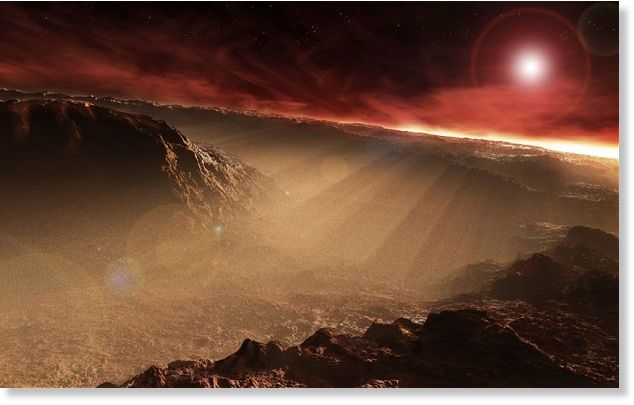
An analysis of data returned by the Curiosity rover, which landed on the planet a year ago, suggests there was a major upheaval which could have been caused by volcanic eruptions or a massive collision which stripped away the atmosphere.

The rover has returned its first measurements of the makeup of gases, including argon, oxygen, nitrogen, carbon monoxide and carbon dioxide, in the Martian atmosphere.

The results, published in two parallel studies in the journal Science, allow scientists to better understand how the Martian climate changed, and understand whether it ever had the right conditions for life.

Dr Chris Webster at Nasa's Jet Propulsion Laboratory in Pasadena, lead author on one of the studies, said the data enabled direct comparisons with the Earth's climate.

"As Mars became a planet and its magma solidified, catastrophic outgassing occurred while volatiles were delivered by impact of comets and other small bodies", Dr Webster said.

"Our Curiosity measurements are - for the first time - accurate enough to make direct comparisons with measurements done on Earth on meteorites using sophisticated large instrumentation that gives high accuracy results."

Comet 2

Canada's Arctic islands yield new clues in ancient mass extinction

Mass Extinction
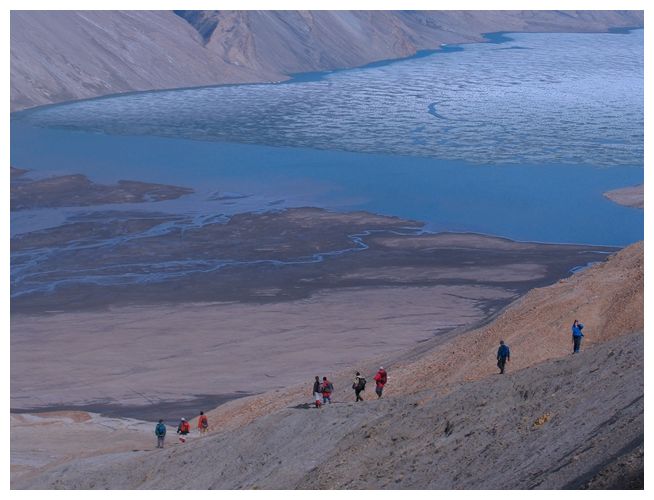
© Stephen Grasby , Postmedia NewsResearchers walk through sediments deposited shortly after the worst extinction event in Earth history, on the shores of Buchanan Lake, Axel Heiberg Island, Nunavut.
Canadian scientists probing two sites in the High Arctic have found fresh evidence pointing to a fiery Siberian suspect in the greatest mass extinction of all time - a planet-wide cataclysm that wiped out more than 90 per cent of the Earth's species about 250 million years ago.

The so-called "Great Dying" at the end of the Permian geological era killed off a larger proportion of species than any of the 25 other mass extinctions scientists have identified from sudden and widespread gaps in the fossil record at certain layers of rock corresponding to specific periods of time.

The precise cause of the biological catastrophe 252 million years ago has been debated by scientists for decades. But nothing else in Earth history compares to the Late Permian disaster, which eclipsed 95 per cent of all marine life and about 70 per cent of species on land.

Some have argued that a massive meteorite strike - like the one widely presumed to have triggered the end of the dinosaur age 65 million years ago - must have been to blame. Others point to extreme climate change linked to ocean acidification, oxygen depletion, mercury poisoning or other species-snuffing effects as the main driver of the extinctions.

And without discounting the other forces as potential contributors to the Great Dying, a growing number of scientists - including several groups of Canadian researchers who are among the world's leading investigators of the die-off - have fingered a prolonged series of enormous volcanic eruptions in northern Asia known as the "Siberian Traps" as the main culprit in the Permian extinction.

Comet 2

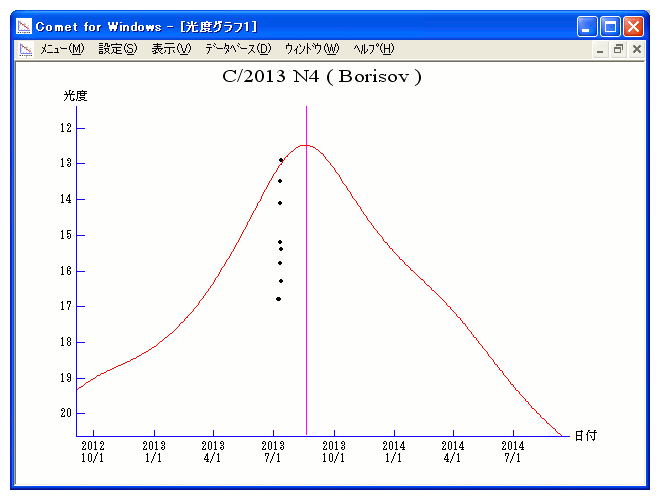
New Comet: C/2013 N4 (Borisov)

Discovery Date: July 8, 2013

Magnitude: 16.8 mag

Discoverer: Gennady Borisov (Crimean Laboratory of the Sternberg Astronomical Institute)
C/2013 N4
© Aerith NetMagnitudes Graph
The orbital elements are published on M.P.E.C. 2013-N51.

Comet

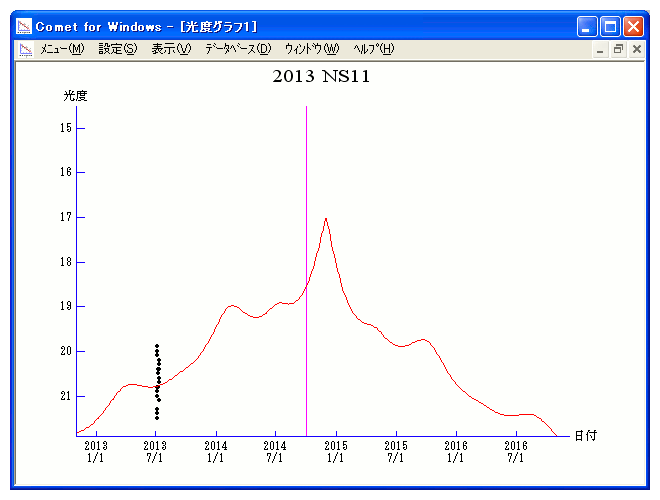
New Comet: 2013 NS11

Discovery Date: July 5, 2013

Magnitude: 21.4 mag

Discoverer: Pan-STARRS 1 telescope (Haleakala)
2013 NS11
© Aerith NetMagnitudes Graph
The orbital elements are published at the MPC Ephemerides and Orbital Elements.

Comet 2

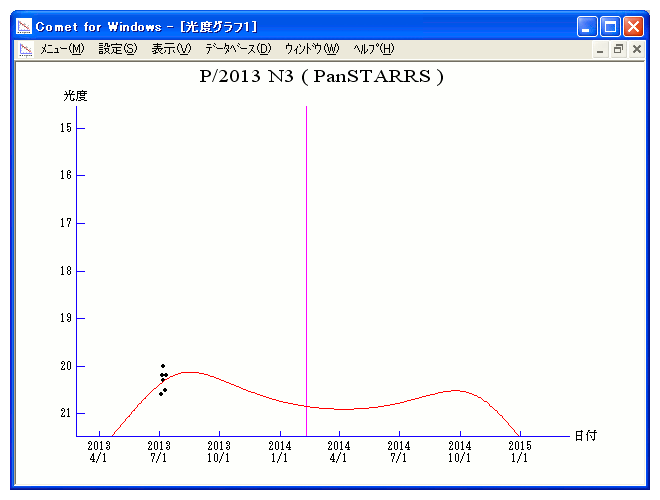
New comet discovered: P/2013 N3 (PanSTARRS)

Discovery Date: July 4, 2013

Magnitude: 20.7 mag

Discoverer: Pan-STARRS 1 telescope (Haleakala)
P/2013 N3
© Aerith NetMagnitudes Graph
The orbital elements are published on M.P.E.C. 2013-N50.

Fireball 5

Iowa impact crater confirmed

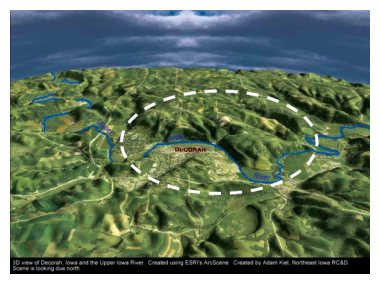
Iowa Crater
© Adam Kiel, U.S. Geological SurveyAn airborne geophysical survey has confirmed the discovery of an impact crater under the town of Decorah in northeastern Iowa.
An airborne geophysical survey mapping mineral resources in the Midwest has confirmed that a 470-million-year-old impact crater nearly five times the size of Barringer (Meteor) Crater in Arizona lies buried several hundred meters beneath the town of Decorah, Iowa.

The crater's existence was first hypothesized in 2008 when geologists examining cuttings from water wells drilled near the town were surprised to find evidence of a previously unknown shale deposit. When geologist Robert McKay from the Iowa Geological Survey investigated further, he found something even more surprising: The shale deposit was nearly a perfect circle, roughly 5.5 kilometers across. Further analysis of sub-shale breccias by Bevan French, a geologist at the Smithsonian's National Museum of Natural History, revealed shocked quartz - a telltale sign of an impact. Together, the evidence added up to an exciting possibility: the existence of a previously unknown impact crater in the Midwest.

Earlier this year, more evidence accumulated when scientists at the U.S. Geological Survey (USGS) and the Iowa and Minnesota Geological Surveys conducted a high-resolution geophysical survey of the region to assess water resources and mineral resources. They were specifically mapping the Northeast Iowa Igneous Intrusive complex, which lies in the Midcontinent Rift System that formed about 1.1 billion years ago, and may contain valuable copper, nickel and platinum group metal resources.

Comet 2

Hubble catches Comet ISON hurtling toward the Sun

Fourth of July is the perfect time to watch fiery masses streak across the sky. This speedy guy, the comet ISON, looks like it pretty much fits that bill. Except that it's actually quite icy at its core, and it's barreling toward the sun at around 48,000 miles per hour, faster than any firework.

This five-second loop of video is a compression of images taken by the Hubble Space Telescope over a period of 43 minutes in May, during which ISON covered 34,000 miles.


At the time, the comet was between the orbits of Mars and Jupiter, 403 million miles away. As it approaches the sun, it will warm up, and its tail of gas and dust will grow longer as the ice of its nucleus sublimates more quickly. It'll get brighter, and we should be able to see it jaunt across the sky with the naked eye by sometime in November.