Comets


Comet

Comet ISON: The timelapse Hubble movie

Comet ISON
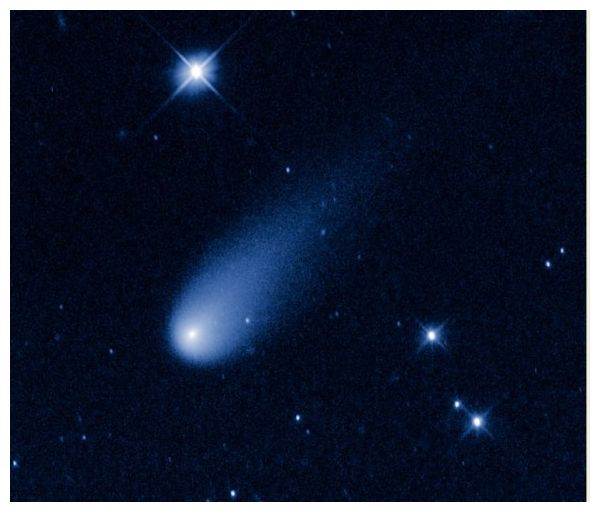
© NASA, ESA, and the Hubble Heritage Team (STScI/AURA)A false-color, visible-light image of Comet ISON taken with Hubble’s Wide Field Camera 3.
The Hubble Space Telescope team has released a video of Comet ISON is tearing toward its encounter with the Sun, zooming at 77,250 km/h (48,000 miles per hour). The comet's motion is captured in a timelapse movie, below, made from a sequence of pictures taken May 8, 2013. On that date, the comet was 650 million km (403 million miles) from Earth, between the orbits of Mars and Jupiter.

This sungrazing comet will comes closest to the Sun in November 2013, and the debate is on whether it will dazzle the skies and be visible in the daytime or fizzle out due to its close proximity to the Sun.

The movie shows a sequence of Hubble observations taken over a 43-minute span, compressed into five seconds. In that 43 minutes, the comet traveled about 55,000 km (34,000 miles). ISON streaks silently against the background stars.

Source: HubbleSite

Fireball 2

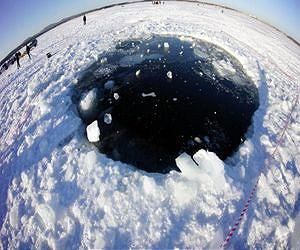
Meteorite fragment from Chelyabinsk explosion located in Urals lake

Image
© RIA NovostiChebarkul Lake
A huge fragment of meteorite that slammed into Russia's Urals region in February was located on the bottom of Chebarkul Lake in the Chelyabinsk Region, a scientist said on Friday.

On February 15, a meteorite landed with a massive boom that blew out windows and damaged thousands of buildings around the Urals city of Chelyabinsk, injuring 1,200 people in the area.

The meteorite broke into approximately seven large fragments and one of them is believed to have fallen into Chebarkul Lake, forming a hole in the ice about eight meters in diameter. In late March, a radar probe of the bottom of the lake has revealed a crater possibly created by a fragment of a meteorite.

Viktor Grokhovsky, a senior researcher with the Urals Federal University was among scientists who measured the magnetic field in the area where a meteorite chunk has presumably fallen. He said that the measurements indicated that an object, most likely a meteorite fragment about 60 centimeters (about two feet) in diameter and weighting approximately 300 kilograms (over 661 lbs), is lying on the bottom of the Chebarkul Lake.

He added that an eyewitness caught on camera how the meteorite exploded above the lake and apparently crashed through the ice, sending a massive jet of water into the air.

Fireball 4

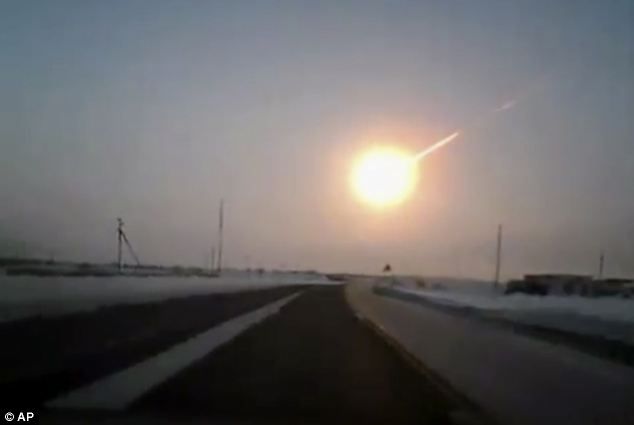
Russian meteor shockwave so powerful it circled globe twice

Image
© apod.nasa.gov
The shock wave from an asteroid that burned up over Russia in February was so powerful that it travelled twice around the globe, scientists say.

They used a system of sensors set up to detect evidence of nuclear tests and said it was the most powerful event ever recorded by the network.

More than 1,000 people were injured when a 17m, 10,000-tonne space rock burned up above Chelyabinsk.

The study appears in the journal Geophysical Research Letters.

The researchers studied data from the International Monitoring System (IMS) network operated by the Comprehensive Nuclear-Test-Ban Treaty Organisation (CTBTO).

The detection stations look out for ultra-low frequency acoustic waves, known as infrasound, that could come from nuclear test explosions. But the system can also detect large blasts from other sources, such as the Chelyabinsk fireball.

Alexis Le Pichon, from the Atomic Energy Commission in France and colleagues report that the explosive energy of the impact was equivalent to 460 kilotonnes of TNT. This makes it the most energetic event reported since the 1908 Tunguska meteor in Siberia.

Comet

FEMA, Russian Emergencies Ministry to join forces against space threat

Image
© Fotolia/Paul Fleet
Russia and the United States will work together to improve protection against meteorites and other space threats, Russia's emergencies minister said on Tuesday following a joint Russia-US working group meeting in Washington.

"We have decided that the US Federal Emergency Management Agency (FEMA) and Russia's Emergencies Ministry will work together to develop systems to protect people and territory from cosmic impacts," Russia's Emergencies Minister Vladimir Puchkov told journalists.

The meeting also covered other kinds of natural emergencies, such as recent years' extreme weather in Russia and United States, but it was cooperation to counter space threats that stole the limelight at the news conference.


Comment: Extreme weather is the result of cosmic climate change, so one can't be dealt with without examining the other. But no doubt they already knew that...


"I believe we can make a technological breakthrough in this area if the Emergencies Ministry and FEMA supervise this project, attracting the finest minds and research groups including in Canada, Europe, China, and Southeast Asia," Puchkov added.

Comment: We feel so much safer now, knowing that our fearless leaders will have "systems" to protect us against space rocks...

Sarcasm aside, the only thing, this far into the unfolding global catastrophe, that could at least mitigate the imminent space threat, is if the U.S. and Russian elites were removed from power by a sweeping tide of peaceful global revolution.

With fireballs raining down and extreme weather increasing by the day, it's clear that their 'Mandate of Heaven' has already been withdrawn:
The Chinese believed that an emperor could reign only while he enjoyed the Mandate of Heaven, that is, while he 'looked after his people'; if for any reason he failed to look after their well-being, Heaven would withdraw its Mandate and the emperor and probably his ruling dynasty would be deposed. ... Heaven would have been seen to withdraw its Mandate when the sky darkened, the crops failed and famine ensued bringing death to large numbers of people. The emperor, guilty or not, gets the blame for failing his people. In the aftermath of a calamitous dust-veil event the political upset could easily lead to the deposing of the ruling regime.


Fireball 2

Ten thousandth near-earth object unearthed in space

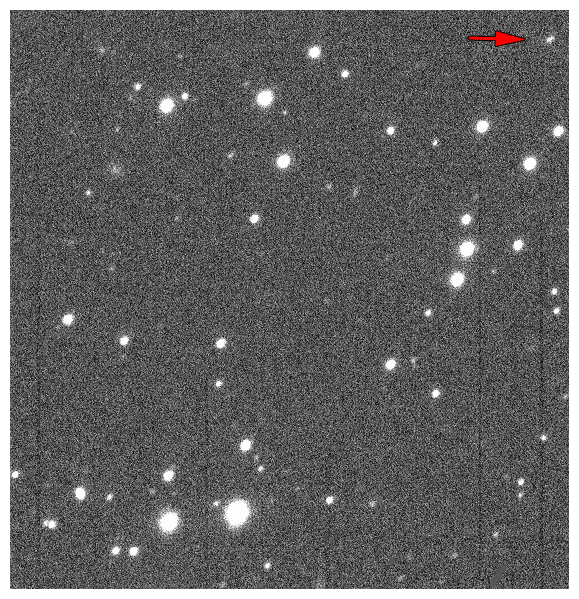
Asteroid 2013 MZ5
© PS-1/UHAsteroid 2013 MZ5 as seen by the University of Hawaii's PanSTARR-1 telescope. In this gif, the asteroid moves relative to a fixed background of stars. Asteroid 2013 MZ5 is in the right of the first image, towards the top, moving diagonally left/down.
Larger Animated Version
More than 10,000 asteroids and comets that can pass near Earth have now been discovered. The 10,000th near-Earth object, asteroid 2013 MZ5, was first detected on the night of June 18, 2013, by the Pan-STARRS-1 telescope, located on the 10,000-foot (convert) summit of the Haleakala crater on Maui. Managed by the University of Hawaii, the PanSTARRS survey receives NASA funding.

Ninety-eight percent of all near-Earth objects discovered were first detected by NASA-supported surveys.

"Finding 10,000 near-Earth objects is a significant milestone," said Lindley Johnson, program executive for NASA's Near-Earth Object Observations Program at NASA Headquarters, Washington.

"But there are at least 10 times that many more to be found before we can be assured we will have found any and all that could impact and do significant harm to the citizens of Earth." During Johnson's decade-long tenure, 76 percent of the NEO discoveries have been made.

Near-Earth objects (NEOs) are asteroids and comets that can approach the Earth's orbital distance to within about 28 million miles (45 million kilometers). They range in size from as small as a few feet to as large as 25 miles (41 kilometers) for the largest near-Earth asteroid, 1036 Ganymed.

Asteroid 2013 MZ5 is approximately 1,000 feet (300 meters) across. Its orbit is well understood and will not approach close enough to Earth to be considered potentially hazardous.

Fireball 2

Covering up the celestial threat: Sonic boom heard in Essex, Cambridgeshire and Hertfordshire

Image
It was probably an overhead explosion from a meteor, like this one over Russia in February
"Loud explosions" heard across the east of England were caused by a sonic boom when a jet broke the sound barrier.

The noise, at 11:30 BST, caused shaking and smashed windows and prompted calls to police in Cambridgeshire, Essex and Hertfordshire.

The Ministry of Defence said a Typhoon jet from RAF Coningsby in Lincolnshire was launched when communication was lost with a Heathrow-bound plane.

It is understood the plane, travelling from the USA, landed without incident.

Air traffic controllers had become concerned but communication was re-established with the passenger airliner and there were no problems on board.

Comment: A sonic boom from a fighter jet does not 'smash windows' or cause 'whole houses' to shake...


Fireball 5

Laughable - NASA announces asteroid 'Grand Challenge'

Image
NASA announced Tuesday a Grand Challenge focused on finding all asteroid threats to human populations and knowing what to do about them. The challenge, which was announced at an asteroid initiative industry and partner day at NASA Headquarters in Washington, is a large-scale effort that will use multi-disciplinary collaborations and a variety of partnerships with other government agencies, international partners, industry, academia, and citizen scientists. It complements NASA's recently announced mission to redirect an asteroid and send humans to study it.

"NASA already is working to find asteroids that might be a threat to our planet, and while we have found 95 percent of the large asteroids near the Earth's orbit, we need to find all those that might be a threat to Earth," said NASA Deputy Administrator Lori Garver. "This Grand Challenge is focused on detecting and characterizing asteroids and learning how to deal with potential threats. We will also harness public engagement, open innovation and citizen science to help solve this global problem."

Grand Challenges are ambitious goals on a national or global scale that capture the imagination and demand advances in innovation and breakthroughs in science and technology. They are an important element of President Obama's Strategy for American Innovation.

Comet 2

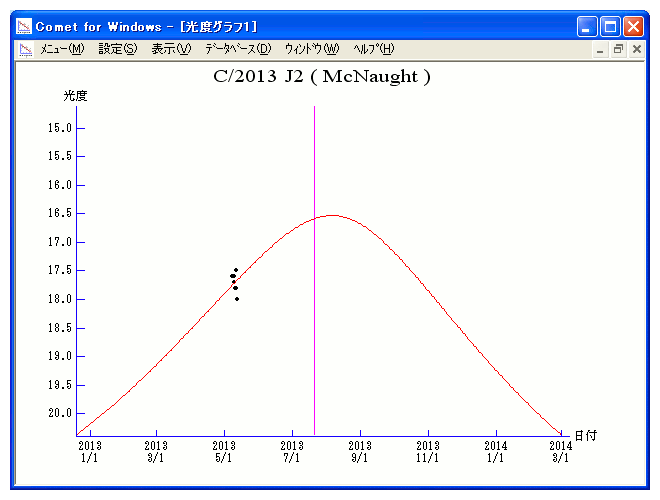
New Comet: C/2013 J2 (McNaught)

Discovery Date: May 8, 2013

Magnitude: 18.2 mag

Discoverer: Robert H. McNaught (Siding Spring)

C/2013 J2
© Aerith NetMagnitudes Graph
The orbital elements are published on M.P.E.C. 2013-K38.

Meteor

A plane mystery: Passenger jet makes emergency landing after being hit by unidentified 'foreign object' at 26,000 feet

Image
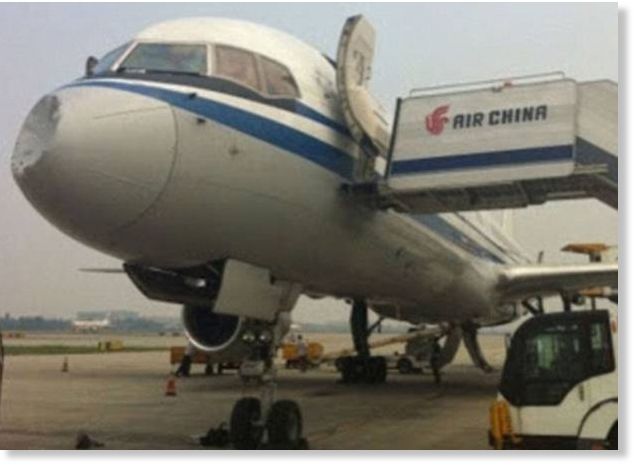
© UnknownA passenger jet has been forced to make an emergency landing after an unidentified “foreign object” smashed into its nose cone at 26,000 feet
A passenger jet has been forced to make an emergency landing, after an unidentified "foreign object" smashed into its nose cone at 26,000 feet.

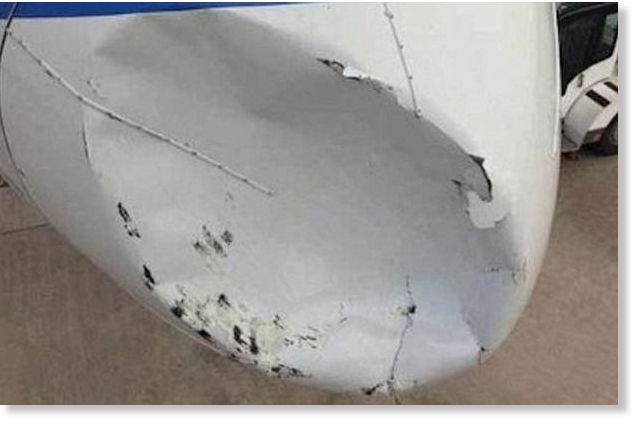
A large dent and scraped paintwork was visible on the Air China Boeing 757 after it landed safely at Chengdu Airport, having been forced to turn back after the pilot said he was struggling to control the plane.

Click here for more images of the damaged aircraft

Investigators are said to be baffled by the dent, reportedly ruling out a bird strike as no blood or feathers were seen around the impact site, but insisting traces of whatever caused the damage are likely to be found under closer inspection.

The plane was flying at around 26,000 feet, climbing over China 20 minutes after take-off during an internal flight between Chengdu and Guangzhou, when passengers are said to have heard a loud bang.
Image
© UnknownA large dent and scraped paintwork was visible on the Air China Boeing 757 after it landed safely at Chengdu Airport
At the time the pilot is thought to have been unaware of the damage, but contacted air traffic control to report stability issues shortly after hearing the noise.

He was instructed to return to Chengdu, where the damaged nosecone was seen and photographed by passengers disembarking the aircraft.

Comment: No mystery here. Just go over articles in the Fire in the Sky category to get an idea.


Comet 2

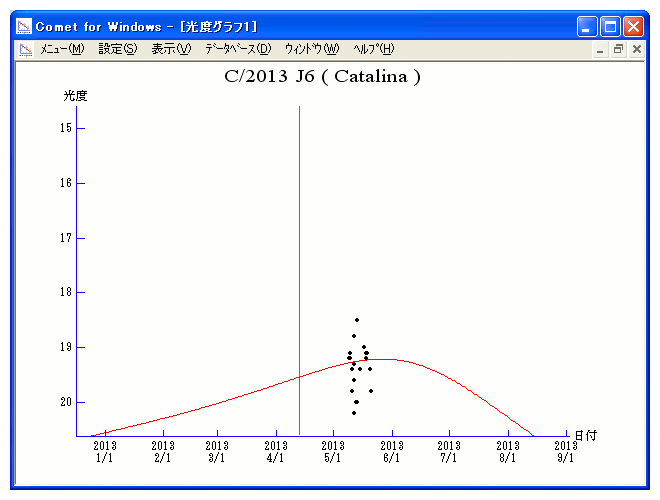
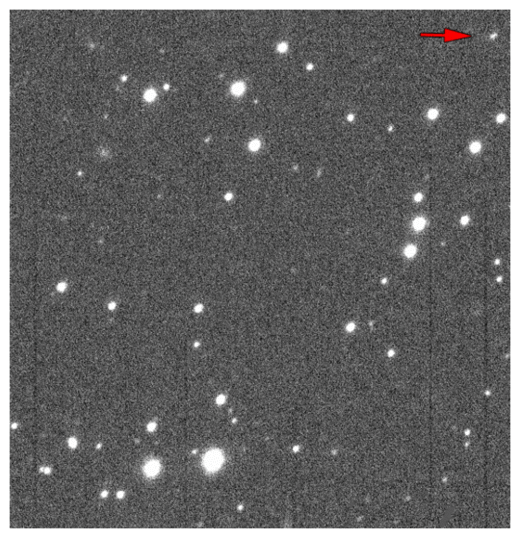
New Comet: C/2013 J6 (Catalina)

Discovery: Date May 9, 2013

Magnitude: 19.3 mag

Discoverer: R. A. Kowalski (Catalina Sky Survey)

C/2013 J6
© Aerith NetMagnitudes Graph
The orbital elements are published on M.P.E.C. 2013-K31.