Comets


Question

Mysterious and well-preserved Oort Cloud object heading into our solar system

2010 WG9
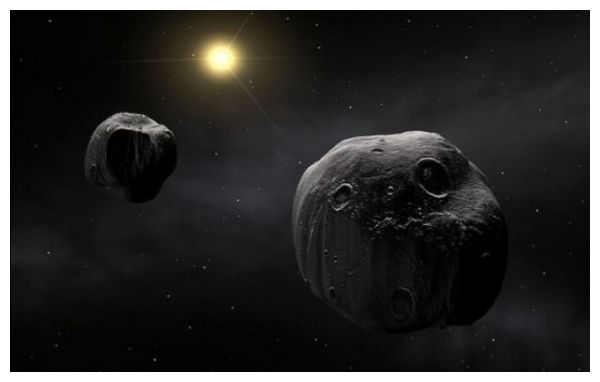
© ESOAn artist’s conception of two tidally locked objects orbiting the Sun from afar. The system: 2010 WG9 may likely look like this.
What if we could journey to the outer edge of the Solar System - beyond the familiar rocky planets and the gas giants, past the orbits of asteroids and comets - one thousand times further still - to the spherical shell of icy particles that enshrouds the Solar System. This shell, more commonly known as the Oort cloud, is believed to be a remnant of the early Solar System.

Imagine what astronomers could learn about the early Solar System by sending a probe to the Oort cloud! Unfortunately 1-2 light years is more than a little beyond our reach. But we're not entirely out of luck. 2010 WG9 - a trans-Neptunian object - is actually an Oort Cloud object in disguise. It has been kicked out of its orbit, and is heading closer towards us so we can get an unprecedented look.

But it gets even better! 2010 WG9 won't get close to the Sun, meaning that its icy surface will remain well-preserved. Dr. David Rabinowitz, lead author of a paper about the ongoing observations of this object told Universe Today, "This is one of the Holy Grails of Planetary Science - to observe an unaltered planetesimal left over from the time of Solar System formation."

Comet 2

New Comet: C/2013 K1 (Christensen)

Discovery Date: May 18, 2013

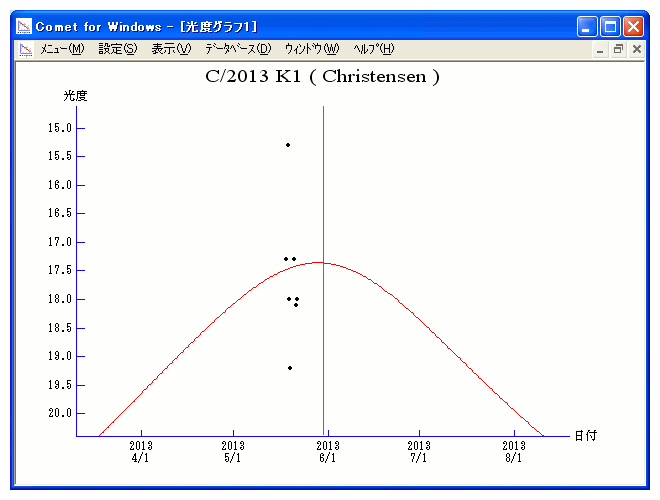
Magnitude: 17.4 mag

Discoverer: Eric J. Christensen (Mt. Lemmon)

C/2013 K1
© Aerith NetMagnitudes Graph
The orbital elements are published on M.P.E.C. 2013-K38.

Fireball

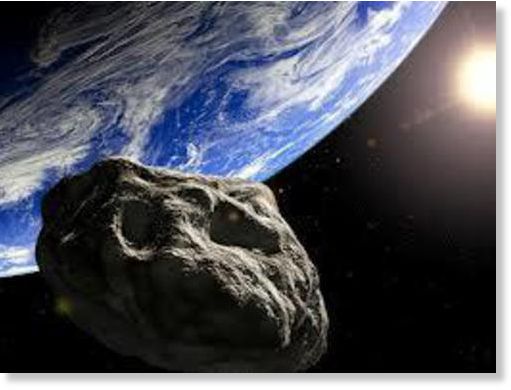
A "Global-Extinction-sized" asteroid to sail past Earth next week - "Comets much more dangerous"

Image
Near-Earth Objects (NEO) have long been a dilemma for scientists, especially since the discovery of 99942 Apophis in 2004. Apophis was first believed to be heading directly towards earth, and created a bit of a stir when people realized that it could hit earth in 2029. However, since then, due to several recalculations and lucky happenstances, the asteroid has only a 1 in 45,000 chance of hitting earth.

Astrophycisist, Sir Martin Rees pf Cambridge University, has famously speculated that the asteroid risk is just one of many reasons why humankind has only a 50/50 chance of making it into the next century. Even so, he says comets are more frightening of a doomsday prospect.

Pound for pound, comets are much more dangerous than asteroids, which have nonetheless gotten more media attention. Comets travel a lot faster through space than Asteroids, which travel at about 25-30 km per second. The speed of a comet approaches a much faster 70 km per second. A relatively small object of just one and a half km in diameter hitting the Earth would release more energy than all the atomic bombs ever detonated and then some. An object of 20 km or more would likely cause mass extinction.

A massive dark, asteroid dubbed 1998 QE2 will make its closest pass to Earth on May 31 at 1:59 p.m. Its 1.7 miles long; its surface is covered in a black substance. If it impacted Earth, it would probably result in global extinction. Good thing it is just making a flyby. Scientists are not sure where this unusually large space rock, which was discovered 15 years ago, originated. But the mysterious sooty substance on its surface could indicate it may be a result of a comet that flew too close to the sun, said Amy Mainzer, who tracks near-Earth objects at Jet Propulsion Laboratory (JPL) in La Canada Flintridge, Calif. It might also have leaked out of the asteroid belt between the orbits of Mars and Jupiter, she said.

Fireball 3

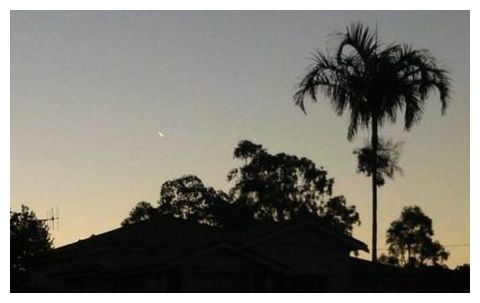
Comet fragment wows stargazers with celestial maneuvers over Australia's Sunshine Coast, 20 May 2013

UFO
© Chelly MilzewskiThis image of the unidentified flying object was was captured by reader Chelly Milzewski on Saltwater Creek Rd in Maryborough about 5.20pm on Monday.
Up to a dozen people have reported seeing a strange light in the sky over Toogoom on Monday evening.

Toogoom resident Maggie MacLeod sparked the influx of reports yesterday when she posted about the "bright, comet-like" UFO on the Fraser Coast Chronicle Facebook page.

"It was going down, then sideways and then the tail disappeared," she said.

"I went up to a group of people on the beach and pointed it out to them ... by this time it was a big red ball in the sky near where the sun had set.

Comment: The eyewitness descriptions are very interesting because they synch with historical accounts of comets doing very strange things high up in the sky during past times of increased cometary flux. Clearly then the ancients were not imagining things... they were witnessing the electrical interaction of cometary bodies that appear to change direction, stand still, suddenly begin spinning, etc. as they discharge the Earth's atmosphere.

See here and here for recent videos of comet fragments pulling off spectacular celestial maneuvers. Note in particular this video report from a very similar event almost exactly three years ago in the same part of Australia.


Fireball 2

Enormous fireball breaks apart over UK and Ireland, 22 May 2013

Initial Meteor Sighting Reports

22 May 2013 - Justin Laffan, Cork City, Ireland 22:42 GMT
6 seconds duration. I was facing north, it traveled east. Bright white colour with a slight green hue. No sound, brighter than the moon. Small fragmentation, like sparks. I was facing directly north, it appeared offset to my right at about a 30 degree inclination, and travelled east, falling about 10 degrees. I lost sight of it after about 6 seconds.
22 May 2013 - Gary Hanratty, Lurgan, Co. Armagh, N. Ireland 22:38 GMT
4 seconds duration. North to south direction. White colour, as bright as the Moon. 5-6 pieces broke off. Awesome.
22 May 2013 - Jessica, Derbyshire, England ~23h
8 seconds duration. Northwest. Fireball with purple and green tail. As bright as the Moon. Yes there was fragmentation.

Comet 2

What do Comet PANSTARRS and Pinocchio have in common?

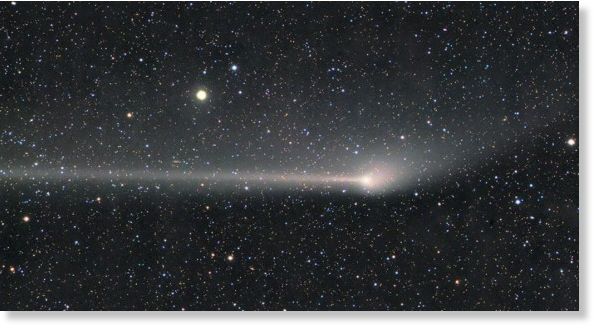
While comets can't tell lies, they do sometimes grow long noses. As the weeks click by and our perspective on Comet L4 PANSTARRS changes, its original plume-like dust tail has shrunk and faded while a second tail just won't stop growing. I'm talking about the anti-tail, so called because it points toward the sun instead of away. Like the normal dust tail, an anti-tail is formed from fresh dust blown back from the comet's head by the pressure of sunlight. As the comet continues along its orbital path, last week's dust lingers behind, forming a "trail of breadcrumbs" in its wake. Right now those breadcrumbs look like a light saber straight out of Star Wars. Time exposure photographs show a striking sunward-pointing appendage more than 6 degrees (12 full moons) long. I've been keeping an eye on Comet PANSTARRS here at home and can report that the anti-tail is plainly visible with a telescope under dark skies. Watching it grow from a short nub to the most dominant feature of this remarkable object has been the highlight of many a clear night.

Image
© Damian PeachWow – that’s a tail! Comet C/2011 L4 PANSTARRS on May 21, 2013, when its anti-tail (left) had grown to more than 12 full moons in length. Meanwhile, what was once the main dust tail (right) has faded and shortened over the past few weeks.

Fireball 4

Exploding meteorite may have sealed fate of the mammoths

Mammoth
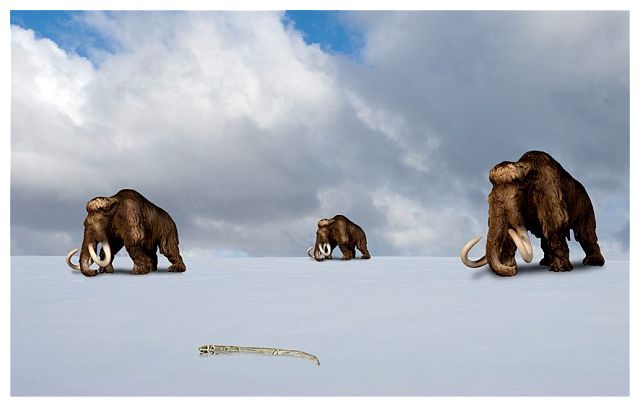
© AlamyScientists have claimed an exploding meteorite may have sealed the fate of the woolly mammoth.
Researchers have found evidence that a large meteorite broke apart in the atmosphere around 12,800 years ago at around the time when mammoths died out.

Studying deposits at 18 archaeological sites around the world they found tiny spheres of carbon they say are characteristic of multiple impacts and mid-air explosions from meteorite fragments.

They claim that millions of tonnes of dust and ash thrown would have been thrown into the atmosphere by the event, which would have choked the atmosphere and altered the global climate.

Their findings cast doubt on claims that it was human hunting that was responsible for the demise of large ice age animals like woolly mammoths, woolly rhinos and sabre toothed tigers.

Many scientists now believe that it was a combination of changes in the climate and pressure from human hunting that led to the mass extinction of many of these species.

However, the cause of the abrupt change in the climate between 12,800 and 11,500 years ago, known as the Younger Dryas by geologists, has been a controversial topic.

Comet 2

Asteroidal belt comets rise from the dead

ABC Comets
© NASA/JPL/Deep Space 1The new study further blurs the line between comets and asteroids.
Astronomers have found a group of comets that have risen from the dead.

The asteroidal belt comets - or ABCs for short - lie in the main asteroid belt between Mars and Jupiter, report astronomers on the on the pre press website ArXiv.org.

Dr Ignacio Ferrin, Dr Jorge Zuluaga and Pablo Cuartas from Columbia's University of Antioquia, say the group of eleven objects behave like comets, but have asteroidal orbits.

They propose the objects they've dubbed 'Lazarus comets' are extinct comets that have been rejuvenated when their orbits changed.

"The asteroidal belt contains an enormous graveyard of ancient dormant and extinct rocky comets, that [are rejuvenated], in response to a diminution of their perihelion distance [closest orbital position to the Sun]," the authors write.

The findings, which are accepted for publication in the Monthly Notices of the Royal Astronomical Society, blurs the line between comets and asteroids.

Comets become dormant when they no longer emit volatile gases - they are then called asteroids. But previous research has shown these dormant comets can be rejuvenated into comets after collisions with asteroids, meteors or other comets, as well as high energy particle impacts.

Ferrin and colleagues now suggest a new comet rejuvenation theory.

Fireball 4

Four unique fireball events fall over U.S. in 24 hour period - wide range reported

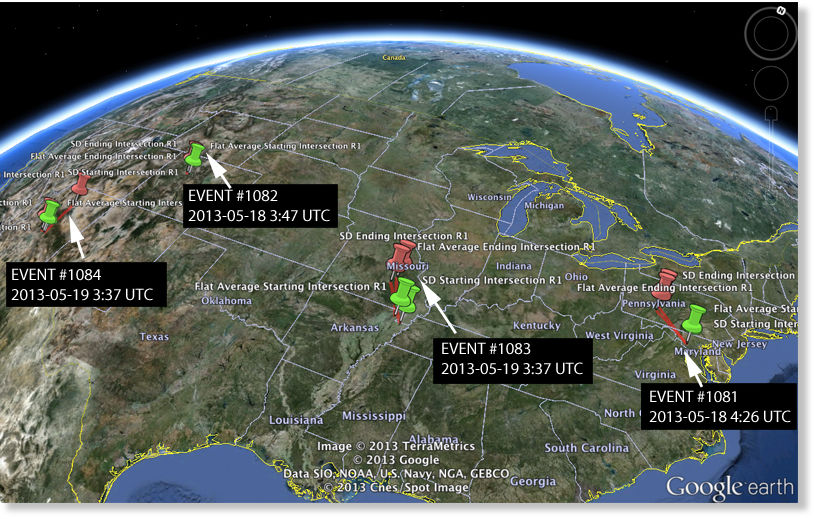
In the last 24 hours the AMS has received confirmed reports about 4 unique fireball events all occurring near 4:00 AM UTC time. The most recent event occurred in Arkansas and Missouri on May 19th near 3:37 UTC. At the same time 3:37 UTC 4 witnesses reported a fireball in Arizona. The distance between these two locations would inhibit witnesses from observing the same fireball from both locations. On May 18th two large fireball meteors were also spotted within an hour of each other, one over the central east coast and another in Colorado. -AMS

Google Earth users can download a KMZ file containing the trajectory estimates for these four events (you must unzip the file before opening in Google Earth). If you witnessed any of these fireball events please fill out an official fireball report.
Image

Fireball 2

Meteorite narrowly misses man in New Zealand


A Whakamarama man has geologists excited after a meteorite soared into his garage moving buckets and narrowly missing his head.

The man, who does not wish to be named, was in his garage talking with his neighbour last Monday when a meteorite soared past his head.

"It must have missed me by a couple of feet. I thought it was a gun shot."

He didn't hear or see the meteorite, but noticed the buckets were moving in the garage. Together with his friend the pair began searching.