Comets


Fireball 5

Huge rock crashes into moon, sparks giant explosion

Moon Impact
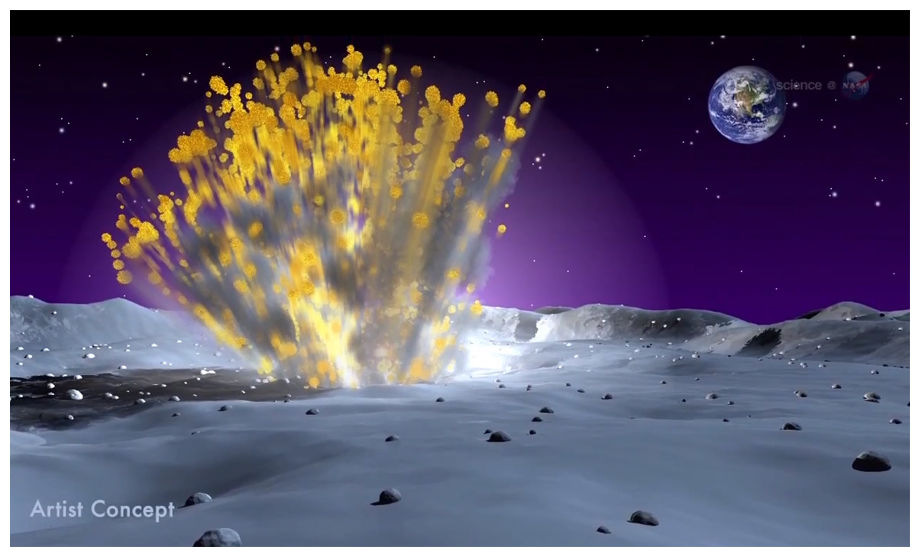
© NASAThis artist's illustration shows a meteor crashing into the surface of the moon. Scientists say hundreds of space rocks impact the lunar surface every year.
The moon has a new hole on its surface thanks to a boulder that slammed into it in March, creating the biggest explosion scientists have seen on the moon since they started monitoring it.

The meteorite crashed on March 17, slamming into the lunar surface at a mind-boggling 56,000 mph (90,000 kph) and creating a new crater 65 feet wide (20 meters).

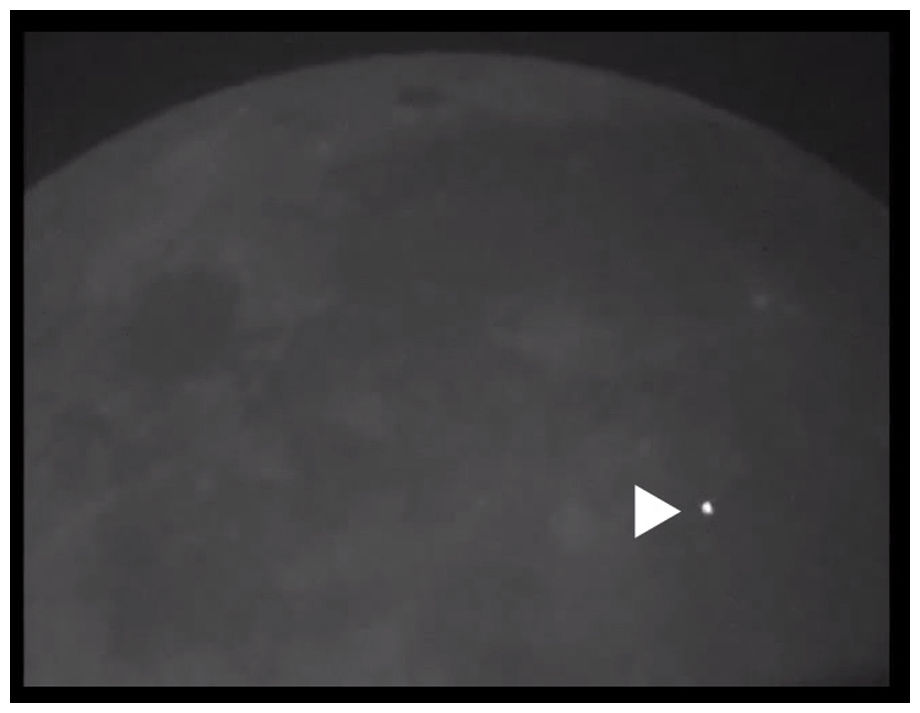
The crash sparked a bright flash of light that would have been visible to anyone looking at the moon at the time with the naked eye, NASA scientists say.

"On March 17, 2013, an object about the size of a small boulder hit the lunar surface in Mare Imbrium," Bill Cooke of NASA's Meteoroid Environment Office said in a statement.

"It exploded in a flash nearly 10 times as bright as anything we've ever seen before."
Moon Impact_1
© NASAThis photo shows the bright flash of the light that resulted from a huge boulder slamming into the moon's surface March 17, 2013.
NASA astronomers have been monitoring the moon for lunar meteor impacts for the past eight years, and haven't seen anything this powerful before.

Scientists didn't see the impact occur in real time. It was only when Ron Suggs, an analyst at NASA's Marshall Space Flight Center in Huntsville, Ala., reviewed a video of the bright moon crash recorded by one of the moon monitoring program's 14-inch telescopes that the event was discovered.

"It jumped right out at me, it was so bright," Suggs said.

Scientists deduced the rock had been roughly 1-foot-wide (between 0.3 to 0.4 meters) and weighted about 88 lbs (40 kg).The explosion it created was as powerful as 5 tons of TNT, NASA scientists said.

When researchers looked back at their records from March, they found that the moon meteor might not have been an isolated event.

Comment: It's rather nice of NASA to just now inform us of this though there were rumors of this event and nothing to attach to it at the time from the MSM. Just for fun, take a peek at the large number of meteor sightings here on the BBM around that same time.


Comet

1998 QE2 asteroid as big as 19 Royal Cruise liners

Nasa scientists are getting excited about seeing the QE2 in the hope it will reveal crucial new insights. But it is not Her Majesty's defunct steam liner which is lying in dock in Dubai which has set stargazers in Houston, Texas, agog. The object is an asteroid flying through space which is as big as 19 of the former royal vessel. It measures 1.7 miles in length.
Image
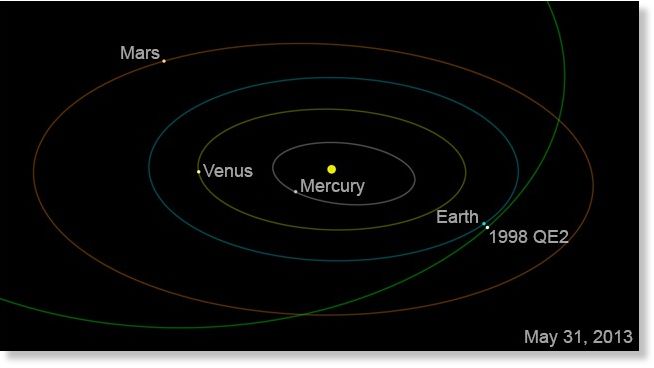
1998 QE2 is set to come close to our world when it flys past in its orbit of the sun, on May 31. Scientists will use the Near Earth Object (NEO) event to help plan for an audacious bid to land on a lump of space rock in four years time as part of asteroid defence planning. Nasa scientist Lance Benner said: Whenever an asteroid approaches this closely, it provides an important scientific opportunity to study it in detail to understand its size, shape, rotation, surface features, and what they can tell us about its origin.

"We will also use new radar measurements of the asteroid's distance and velocity to improve our calculation of its orbit and compute its motion farther into the future than we could otherwise." Earth's upcoming brush with an extra-terrestial object should not contain the risk of causing chaos for us on earth, like the Russian meteor earlier this year. 1998 QE2 shall fly past earth 3.6m miles above our heads. A Nasa spokesman claimed there is no connection between the asteroid and the British royal cruise ship.

Fireball 5

Asteroid 1998 QE2 to sail past earth

Asteroid 1998 QE2
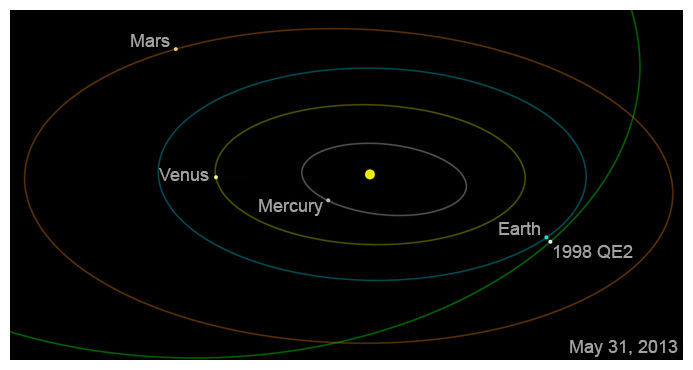
© NASA/JPL-CaltechAsteroid 1998 QE2 will get no closer than about 3.6 million miles at time of closest approach on May 31 at 1:59 p.m. Pacific (4:59 p.m. Eastern).
On May 31, 2013, asteroid 1998 QE2 will sail serenely past Earth, getting no closer than about 3.6 million miles (5.8 million kilometers), or about 15 times the distance between Earth and the moon. And while QE2 is not of much interest to those astronomers and scientists on the lookout for hazardous asteroids, it is of interest to those who dabble in radar astronomy and have a 230-foot (70-meter) -- or larger -- radar telescope at their disposal.

"Asteroid 1998 QE2 will be an outstanding radar imaging target at Goldstone and Arecibo and we expect to obtain a series of high-resolution images that could reveal a wealth of surface features," said radar astronomer Lance Benner, the principal investigator for the Goldstone radar observations from NASA's Jet Propulsion Laboratory in Pasadena, Calif. "Whenever an asteroid approaches this closely, it provides an important scientific opportunity to study it in detail to understand its size, shape, rotation, surface features, and what they can tell us about its origin. We will also use new radar measurements of the asteroid's distance and velocity to improve our calculation of its orbit and compute its motion farther into the future than we could otherwise."

The closest approach of the asteroid occurs on May 31 at 1:59 p.m. Pacific (4:59 p.m. Eastern / 20:59 UTC). This is the closest approach the asteroid will make to Earth for at least the next two centuries. Asteroid 1998 QE2 was discovered on Aug. 19, 1998, by the Massachusetts Institute of Technology Lincoln Near Earth Asteroid Research (LINEAR) program near Socorro, New Mexico.

Fireball 4

Video of huge meteor over England and Wales

A fireball streaking across Britain left stargazers stunned last night. The green-tinged meteor shot over England and Wales in a northerly direction at around 9.45pm. Experts believe the meteor might have formed from debris from Halley's Comet. Many observers took to Twitter to report the phenomenon with sightings apparently recorded in Cornwall, Hampshire, Lancashire, South Wales and Worcestershire.


Suzy Buttress, of Basingstoke in Hampshire, said she spotted the celestial body while driving along the M3.

She wrote on Twitter: "I have just seen the biggest meteor in my life! It was also noticeably green, and appeared very large compared to regular meteors I've seen."

Louise Darnell also reported the unusual event on the social networking site.

She wrote: "Seen the brightest and lowest shooting star ever! It was definitely a UFO..??"

Reports suggested the meteor crossed Britain from the South East towards the North West.

Space scientist Maggie Aderin-Pocock said the meteor's size was unusual.

She said: "It seems that this one was particularly large and particularly bright, which is why it's caught so much attention."

"It's quite likely to be part of the Eta Aquarids, which is the debris left by Halley's Comet. And twice a year we pass through the debris left behind by the comet and when this happens we see more of these shooting stars, but there must have been a large lump left behind which is what caused such a bright meteor to be seen."

Fireball

Electric Universe: Mohenjo Daro

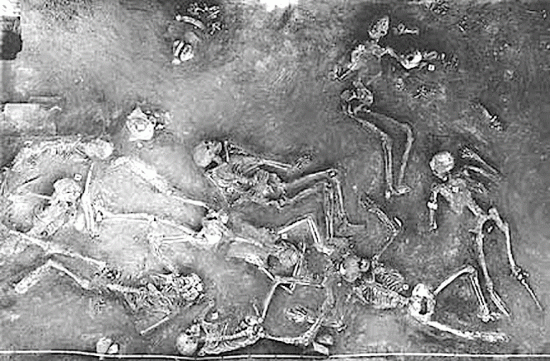
Some of the skeletons found at Mohenjo Daro
© UnknownSome of the skeletons found at Mohenjo Daro
Some have suggested ancient technology glassified these Indus Valley ruins but electricity is a more plausible explanation.

Mesopotamia and the Fertile Crescent region are thought to be the "birthplace" of civilization and the central focus for human culture dating back to the beginning of recorded history. No one knows for sure just how old the generalized composite that we call "society" really is - both because of archeological deficiencies and because of radiometric disconformity - but one of the oldest sites is located in the Indus Valley of Pakistan and appears to date from around 3000-2500 BCE.

There are many ways to date ancient artifacts and there are just as many ways to interpret the results from those techniques. It is not the purpose of this paper to address the difficulties inherent with using carbon 14, tree-rings, stratigraphic distribution, or any other methodology when attempting to place artifacts or habitations within a chronological sequence. Other articles have addressed those issues, as well as previous Picture of the Day discussions about radioactive decay rates and how external, ionizing sources can change isotope ratios.

There is one intriguing aspect to Mohenjo-Daro that sets it apart from most ancient ruins. It is the one anomaly among several at the site that has caused some researchers to suggest that there might have been forces unleashed in the past that are comparable to modern weapons. Walls, pottery and other items found in the city have been turned into a kind of ceramic glass, indicating that they were exposed to thermal energy equivalent to 1500 Celsius. Evidence of ionizing radiation has also been found in some burial sites.

Comet 2

A new view of Comet ISON

Comet Ison
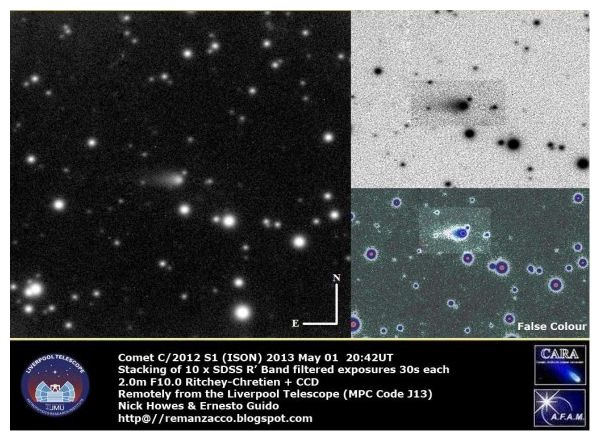
© Ernesto Guido & Nick Howes, Remanzacco ObservatoryView of Comet ISON on May 1, 2013.
Here's a new image of Comet C/2012 S1 ISON, as seen on May 1, 2013 by Ernesto Guido and Nick Howes of the Remanzacco Observatory. They used the 2 meter La Palma Telescope. Their initial approximation of the tail length is around 28 arcseconds, which Howes told Universe Today is bigger than some recent reports from smaller scopes.

As of May 2, Comet ISON was approximately 3.885 AU from the Sun, which is about 581 million kilometers (361 million miles) distant from the Sun. ISON will makes its close approach to the Sun when it passes within 1.2 million km (730,000 miles) of the Sun on November 28, 2013.

Map

Heat map reveals every spot on Earth meteorites have hit

meteorite heat map
© Unknownmeteorite heat map from 2300 BC
There's no doubt that last week's meteorite strike in Russia has many many people wondering which places near them have been impacted by space rocks. Using data from the Meteoritical Society, Javier de la Torre, co-founder of Vizzuality and CartoDB, whipped up a neat little heat map for The Guardian showing every point where scientists have discovered evidence of meteorite impacts.

The map shows 34,513 recorded points on Earth that have been struck by meteorites since 2,300BC. As impressive as that figure might seem, it doesn't include data for where meteorites that haven't left any evidence, like every single one that landed in an ocean, or impact sites that haven't been discovered yet.

Fireball

SOTT Focus: Something impacted the fertilizer plant in West, Texas... most likely a Comet fragment!

Joe Quinn asked recently: Was the West, Texas Explosion a Meteorite Impact?

More information has come to light that suggests exactly that, and, at the very least, strengthens the idea that a 'missile' strike of some kind caused the explosion.

We now have four different video angles of the fire at the fertilizer plant.

In the first three videos, we can see the explosion that happened afterwards. In the last video, we can't see the explosion, but it gives us another vantage point of the site in flames:

Video from viewpoint #1:


Video from viewpoint #2:


Comet 2

'Comet of the Century' could create 'unusual' meteor shower

An incoming comet that may well turn out to be the "comet of the century" could create an unusual kind of meteor shower, scientists say. When Comet ISON passes by the Earth this year, it is possible that the dust sloughed off by the comet's tail will create an odd meteor shower when the planet passes through the stream of tiny particles that once were a part of the comet's tail.

"Instead of burning up in a flash of light, they [the particles] will drift gently down to the Earth below," University of Western Ontario meteor scientist Paul Wiegert said in a statement. [See Photos of Comet ISON]


The specks of dust will be travelling at a speed of 125,000 mph (201,168 km/h), but once they hit the Earth's atmosphere, they will slow to a halt, according to Wiegert's computer models.

Comet

Schoolchildren discover new comet on school trip

Image
© ReutersThe comet was officially registered with the centre and given the name C/2013G9 (TENAGRA)
Astronomy students at Wakefield's Horbury Academy were in Hawaii and Australia for two nights to stargaze through the remote Faulkes telescope as part of a GCSE project.

They focused their study on a space object that had been observed before as a possible asteroid but its classification had not been formally noted.

After studying the data, the group were able to rule out the space matter as an asteroid but also anything that had previously been discovered.

The Year 11 pupils sent off their analysis to the Minor Planet Centre in Massachusetts and were amazed to be told they had discovered a new comet.

The comet was officially registered with the centre and given the name C/2013G9 (TENAGRA).