Comets


Fireball 3

Comet ISON could blast earth with weird meteor shower

comet ison hubble
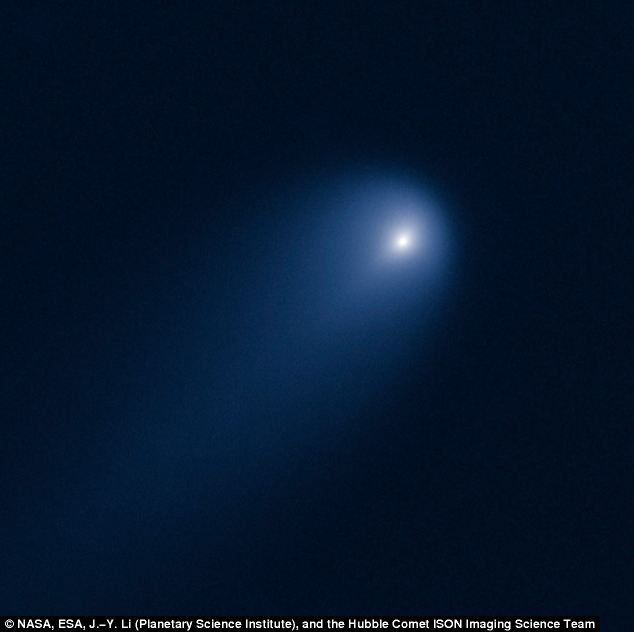
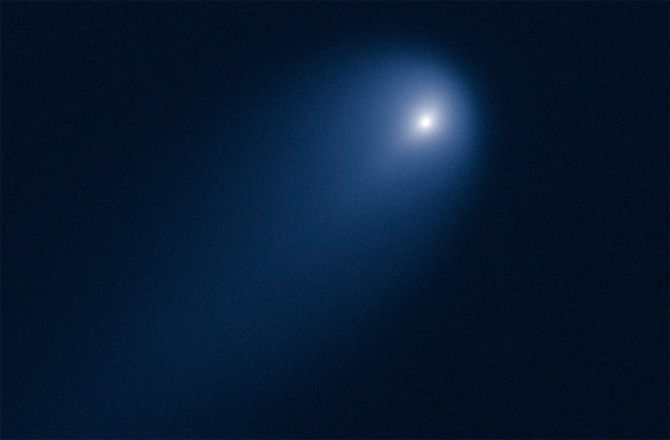
© NASA, ESA, J.-Y. Li (Planetary Science Institute), and the Hubble Comet ISON Imaging Science TeamThis NASA Hubble Space Telescope image of Comet C/2012 S1 (ISON) was photographed on April 10, when the comet was slightly closer than Jupiter's orbit at a distance of 386 million miles from the sun (394 million miles from Earth).
A small but incredibly bright comet heading toward the sun could do more than dazzle Earth's skies when it arrives later this year. Scientists say Comet ISON, already shedding dust at the prodigious rate of about 112,000 pounds per minute, could spark an unusual meteor shower.

Computer simulations predicting the location and movement of the comet's dust trail show Earth will be passing through the fine-grained stream around Jan. 12, 2014.

Some of the particles, which are smaller in diameter than a red blood cell, should be pushed back by the pressure of sunlight, allowing them to be captured by Earth's gravity when the planet plows through the largely invisible stream.

Sherlock

Comet trails?: Ancient DNA reveals Europe's dynamic genetic history

Ancient DNA recovered from a series of skeletons in central Germany up to 7500 years old has been used to reconstruct the first detailed genetic history of modern Europe.

The study, published today in Nature Communications, reveals a dramatic series of events including major migrations from both Western Europe and Eurasia, and signs of an unexplained genetic turnover about 4000-5000 years ago.


Comment: Forced migration and genetic mutation as the fruits of cometary bombardment? For more information on just what a regular occurrence this is, how knowledge of it has been systematically erased from the historical record (and why), read Laura Knight-Jadczyk's Comets and the Horns of Moses.


Jupiter

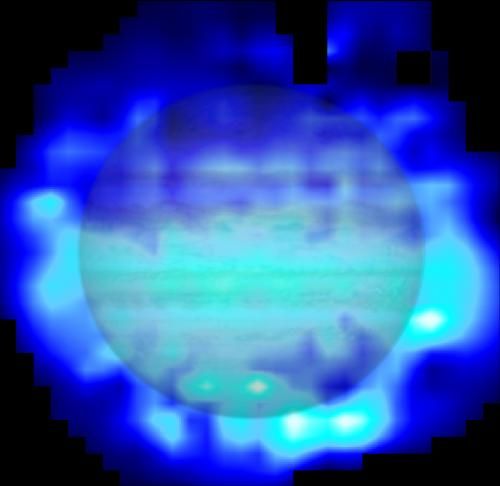
Origin of Jupiter's water mystery solved: The massive 1994 comet bombardment

Jupiter
© European Space Agency
ESA's Herschel space observatory has solved a long-standing mystery as to the origin of water in the upper atmosphere of Jupiter, finding conclusive evidence that it was delivered by the dramatic impact of comet Shoemaker-Levy 9 in July 1994. During the spectacular week-long collision, a string of 21 comet fragments pounded into the southern hemisphere of Jupiter, leaving dark scars in the planet's atmosphere that persisted for several weeks.

The remarkable event was the first direct observation of an extraterrestrial collision in the Solar System. It was followed worldwide by amateur and professional astronomers with many ground-based telescopes and the NASA/ESA Hubble Space Telescope.

ESA's Infrared Space Observatory was launched in 1995 and was the first to detect and study water in Jupiter's upper atmosphere. It was widely speculated that comet Shoemaker-Levy 9 may have been the origin of this water, but direct proof was missing.

Comet

First glimpse of 'comet of the century': Hubble gets snaps ISON that astronomers hope will amaze the world

Comet could shine brighter than Venus or even the full moon in November

Photographed on April 10, when it was 394 million miles from Earth


The Hubble Space Telescope has given astronomers their clearest view yet of Comet ISON, which experts believe could light up the sky in a breathtaking display later this year.

The image of Comet C/2012 S1 (ISON) was photographed on April 10, when the comet was slightly closer than Jupiter's orbit at a distance of 386 million miles from the Sun, and 394 million miles from Earth.

Experts believe it will get dramatically brighter as it swings around the sun in late November, with some claiming the comet could shine brighter than Venus or even the full moon.
Image
Comet C/ISON was imaged with the Hubble Space telescope on April 10 using the Wide Field Camera 3, when the comet was 394 million miles from Earth

Comet 2

Comet ISON meteor shower?


Comet

New Comet: C/2013 G9 (TENAGRA)

Cbet nr. 3478, issued on 2013, April 19, announces the discovery of a apparently asteroidal object (discovery magnitude ~19.6) by M. Schwartz and P. R. Holvorcem on CCD images obtained with the Tenagra II 0.41-m f/3.75 astrograph located near Nogales, AZ, U.S.A.

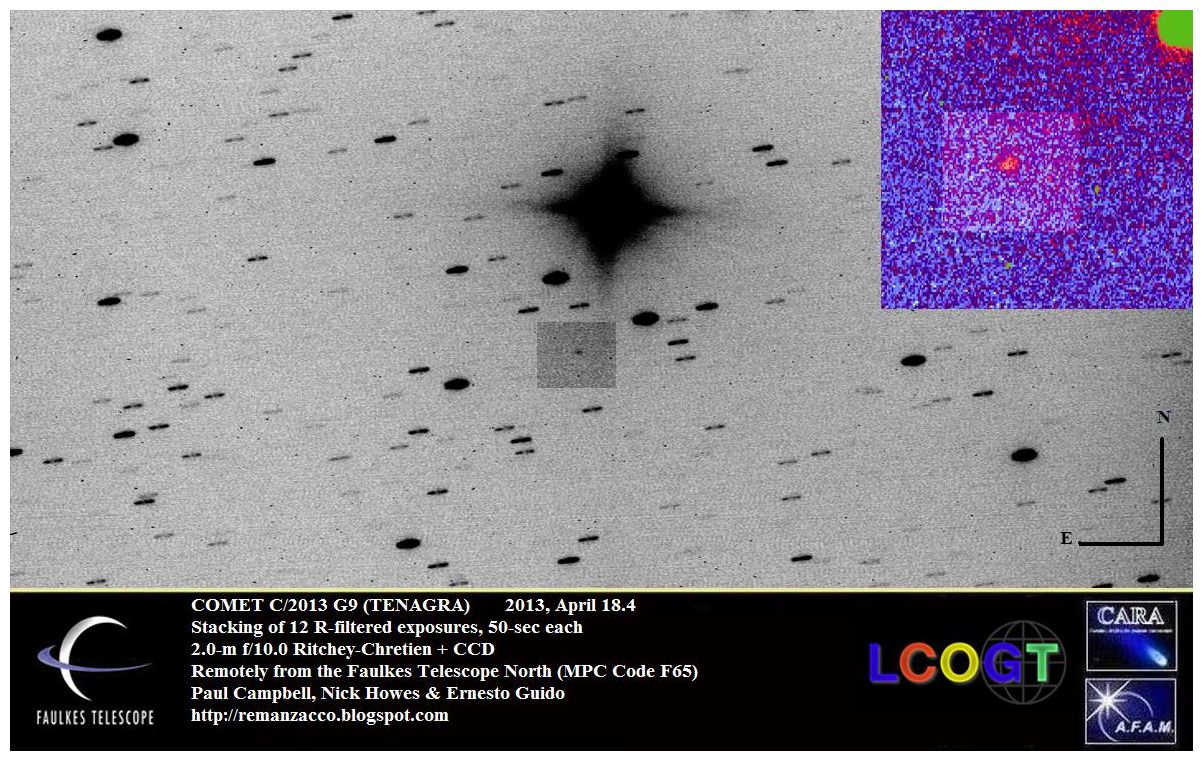
After posting on the Minor Planet Center's NEOCP webpage, this apparently asteroidal object as been found to show cometary features by our team.

Stacking of 12 R-filtered exposures, 50-sec each, obtained remotely from Haleakala-Faulkes Telescope North on 2013, April 18.4, through a 2.0-m f/10.0 Ritchey-Chretien + CCD (operated by LCOGT), shows that this object is a comet: compact coma about 5" in diameter elongated toward PA 110

The new comet has been designated Comet C/2013 G9 (TENAGRA). Below you can see our image.
C/2013 G9 (Tenagra)
© Remanzacco ObservatoryImages of C/2013 G9 (TENAGRA) taken in collaboration with the Faulkes Project and Horbury Academy - Paul Campbell.

Comet 2

New Comet: C/2013 G7 (McNAUGHT)

Cbet nr. 3476, issued on 2013, April 16, announces the discovery of a new comet (discovery magnitude ~18) by R. H. McNaught on CCD images obtained with the 0.5-m Uppsala Schmidt telescope at Siding Spring on april 13.6. The new comet has been designated C/2013 G7 (McNAUGHT).

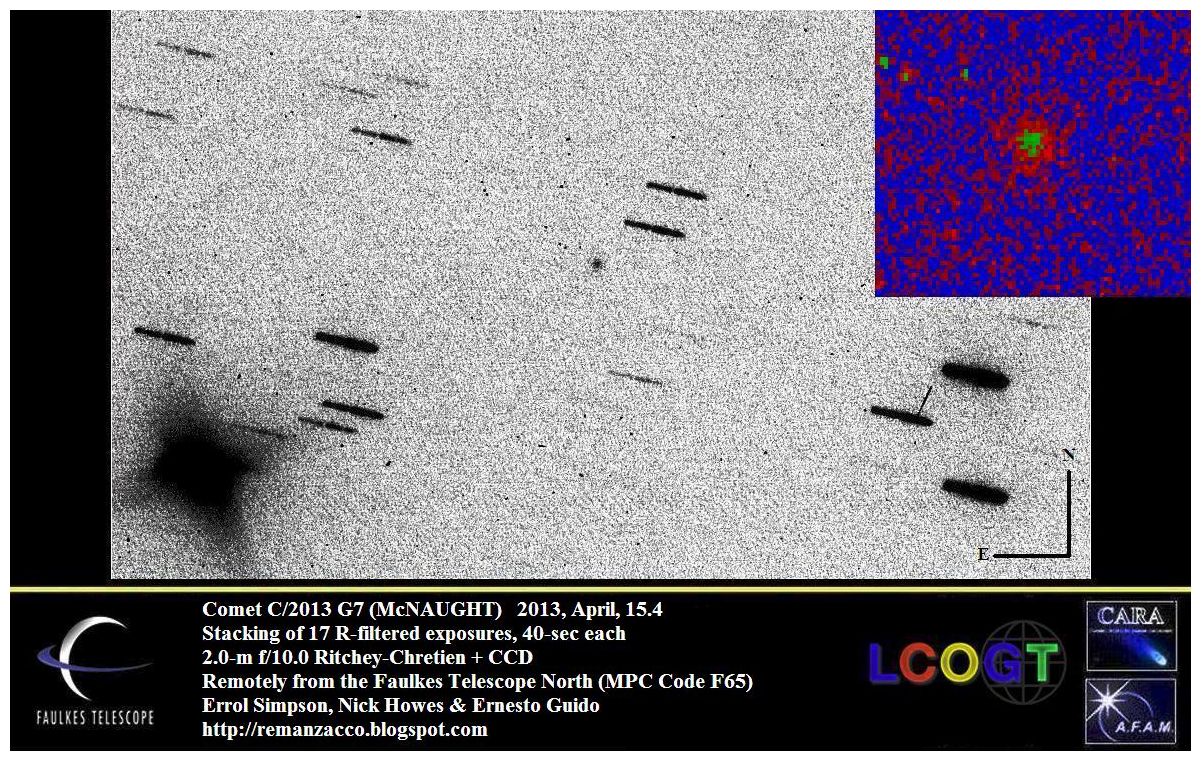
We performed follow-up measurements of this object, while it was still on the neocp. Stacking of 17 R-filtered exposures, 40-sec each, obtained remotely from Haleakala-Faulkes Telescope North on 2013, April 15.4, through a 2.0-m f/10.0 Ritchey-Chretien + CCD (operated by Las Cumbres Observatory Global Telescope Network), shows that this object is a comet: compact coma about 6" in diameter.

Below you can see our image.
C/2013 G7
© Remanzacco ObservatoryImages of C/2013 G7 (McNAUGHT) taken in collaboration with the Faulkes Project and Shooters Hill Post 16 Campus - Errol Simpson.
M.P.E.C. 2013-H10 assigns the following preliminary parabolic orbital elements to comet C/2013 G7: T 2014 Apr. 20.34; e= 1.0; Peri. = 225.32; q = 4.38; Incl.= 104.11.

Comet

Starwatch: Cassiopeia and the comet

Image
© Finbarr Sheahy
The crescent Moon stands in the W at nightfall on the 15th, above and left of the conspicuous Jupiter. Meanwhile, Saturn is climbing clear of the ESE horizon as it approaches opposition on the 28th. Look for Saturn close to the full Moon on the 25th when a slight partial lunar eclipse may darken the N fringe of the Moon's disc at the very beginning of the night.

The constellation of Cassiopeia is at its best as it swims overhead in the middle of our autumn nights, its bright "W" of stars almost drowned in the Milky Way if we are lucky enough to view it against a dark moonless sky. Six months later we find it some 30° high in Britain's NNW sky at nightfall and swinging below Polaris in the N overnight to stand more than 30° high in the NE before dawn. Like the Plough, it is circumpolar from our latitudes so that it never dips below the horizon.

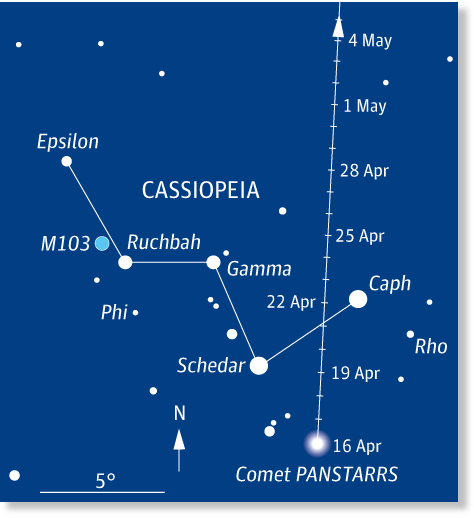
Also circumpolar as it passes through Cassiopeia is the comet of the moment, Comet PANSTARRS, which is fading and receding from the Sun and the Earth after its perihelion on 10 March. Our chart shows its northwards progress between the stars Schedar and Caph in the "W" over the coming days, with ticks marking its position at 00:00 BST each day. Next Saturday night, for example, it lies almost in line between Schedar and Caph, though we probably need binoculars or a telescope to glimpse it.

Fireball 5

Best of the Web: White out! Comet fragment explodes 70 kms above Toledo, Spain - Event seen across whole country


A brilliant ball of flame streaked across the sky above the Spanish capital Madrid, dazzling stargazers and astronomers alike. The celestial display was so bright it could be seen across the entire country.

The eye-popping moment was caught on camera by the Hita Observatory at the University of Huelva at around 11:45pm local time (2145 GMT). The object struck the atmosphere above the Villamuelas district in the province of Toledo, southwest of Madrid.

"The impact was so abrupt that the object immediately caught fire, creating a ball of flame around 100 kilometers above the Earth," Jose Maria Madiedo of the University of Huelva told the Huffington Post. The meteor then shot towards Madrid at over 75,000 kilometers an hour before disintegrating completely at an altitude of 70 kilometers.

The Spanish Institution for the Study of Meteors and Meteorites, which tracked the fireball, classified the meteorite as a piece of a comet that was flying by Earth.


Comment: Flying by Earth? It obviously entered the planet's atmosphere. There have been other occasions in recent years where comet fragments have skimmed the upper layers of Earth's atmosphere and either exploded so far up that few below noticed, or have continued to fly on by. But notice that with each new event, they appear to be reaching closer and closer to the ground...


Comment: "Sparked comparisons"? These celestial events do more than 'spark comparisons'. Each new event fires the curiosity, imagination and alarm bells of millions of people; punches wide gaping holes in the 'reality' of lies built by the psychopathic elites; and hastens the end of their global reign of terror...


Comet 2

New calculations effectively rule out comet impacting Mars in 2014?

C/2013 A1
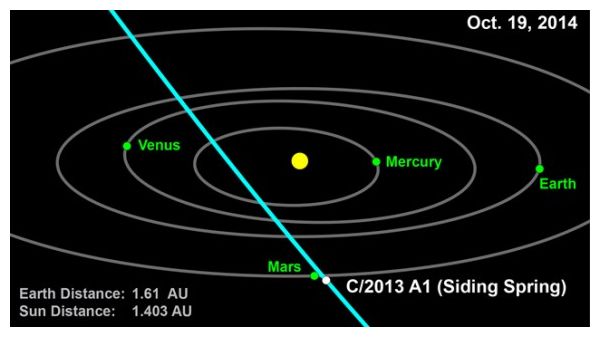
© NASA/JPL-CaltechThis computer graphic depicts the orbit of comet 2013 A1 (Siding Spring) through the inner solar system.
NASA's Near-Earth Object Office says that new observations of comet C/2013 A1 (Siding Spring) have allowed further refinements of the comet's orbit, helping to determine the chances it could hit Mars in October of 2014. Shortly after its discovery in December 2012, astronomers thought there was an outside chance that a newly discovered comet might be on a collision course with Mars.

While the latest orbital plot places the comet's closest approach to Mars slightly closer than previous estimates, the new data now significantly reduces the probability the comet will impact the Red Planet, JPL said, from about 1 in 8,000 to about 1 in 120,000.

The closest approach is now estimated at about 68,000 miles (110,000 kilometers). The most previous estimates had it whizzing by at 186,000 miles (300,000 kilometers).