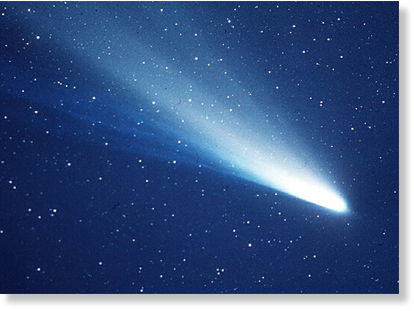
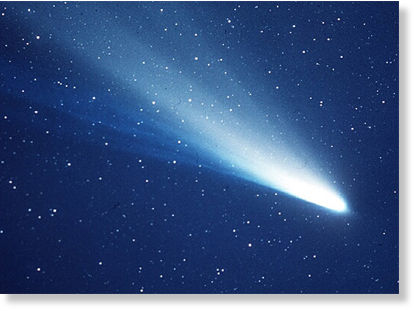
© NASAComets like Halley’s can be a breeding ground for complex molecules such as dipeptides. Comets colliding with Earth could have delivered these molecules and seeded the growth of more complex proteins and sugars necessary for life.
A new experiment simulating conditions in deep space reveals that the complex building blocks of life could have been created on icy interplanetary dust and then carried to Earth, jump-starting life.
Chemists from the University of California, Berkeley, and the University of Hawaii, Manoa, showed that conditions in space are capable of creating complex dipeptides - linked pairs of amino acids - that are essential building blocks shared by all living things. The discovery opens the door to the possibility that these molecules were brought to Earth aboard a comet or possibly meteorites, catalyzing the formation of proteins (polypeptides), enzymes and even more complex molecules, such as sugars, that are necessary for life.
"It is fascinating to consider that the most basic biochemical building blocks that led to life on Earth may well have had an extraterrestrial origin," said UC Berkeley chemist Richard Mathies, coauthor of a paper published online last week and scheduled for the March 10 print issue of
The Astrophysical Journal.
While scientists have discovered basic organic molecules, such as amino acids, in numerous meteorites that have fallen to Earth, they have been unable to find the more complex molecular structures that are prerequisites for our planet's biology. As a result, scientists have always assumed that the really complicated chemistry of life must have originated in Earth's early oceans.



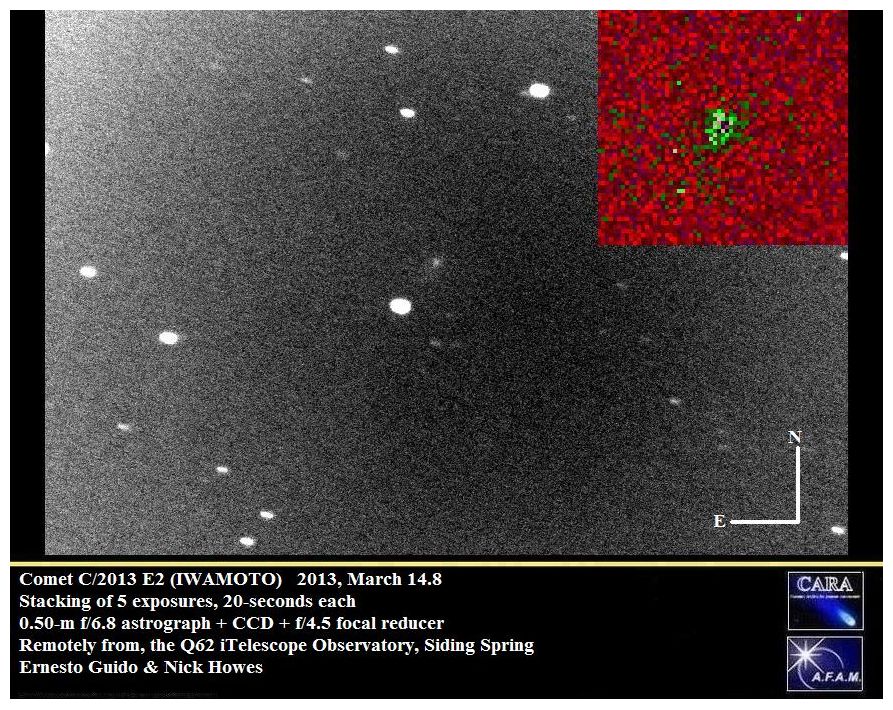

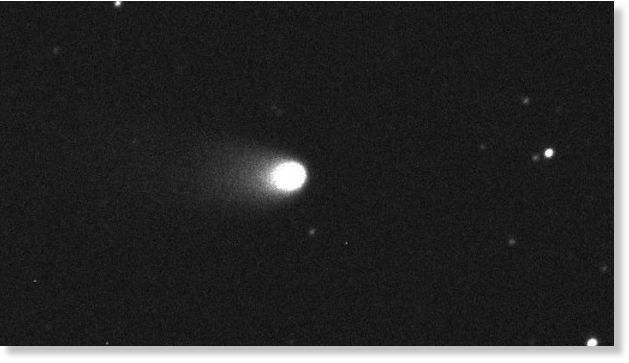

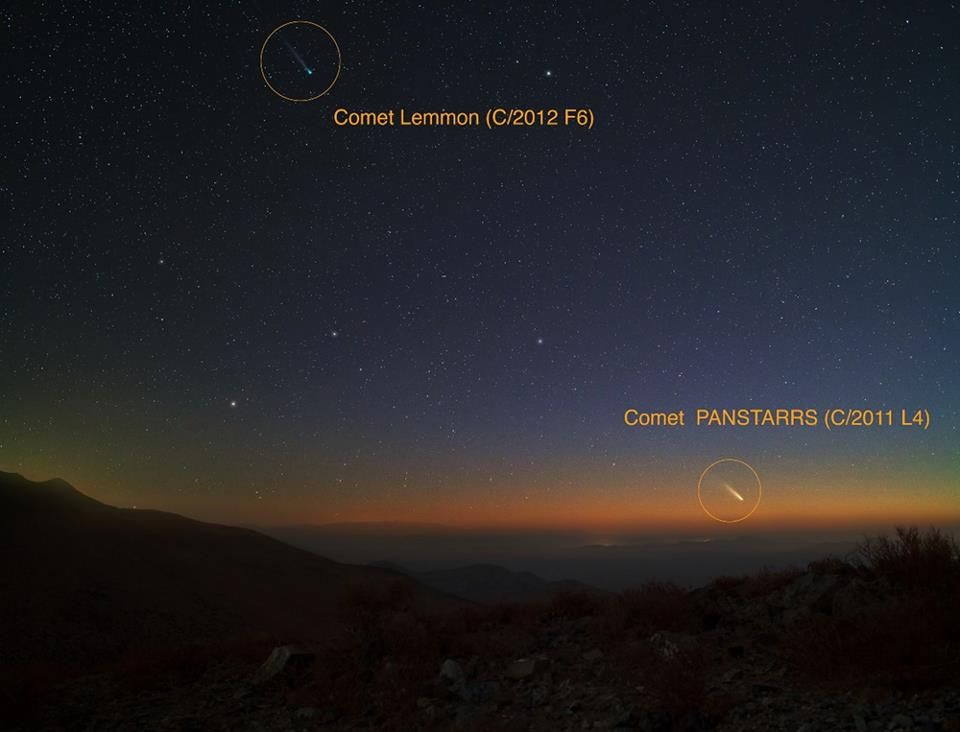




Comment: Sure, we'd all like peace of mind, but we're not going to get it if we exclude the flaming obvious from our investigations. Peter Butler's observation fits well with that of a woman who saw "two dark objects with smoky trails" fall out of a clear sky over Grand Falls-Windsor, Newfoundland at around 7:40 on Sunday evening. It seems that one of these space rocks hit Dawe's Lake, while the other one hit Powderhorn Lake. Between the flash of light, the loud boom, eyewitness sightings and identical descriptions of the 'ice crater' formations, it appears that at least two meteorites survived the fragmentation that followed an overhead explosion somewhere above Newfoundland on March 10th, 2013.
See also:
Large hole in Dawe's Lake, Newfoundland discovered following 'sonic boom'
Update! Witness saw two objects 'with smoke coming from them' fall out of sky near ice crater impact in Newfoundland - man-made 'space junk' ruled out