Comets


Comet 2

NASA: Mars is currently being bombarded by more than 200 asteroids and comets per year!

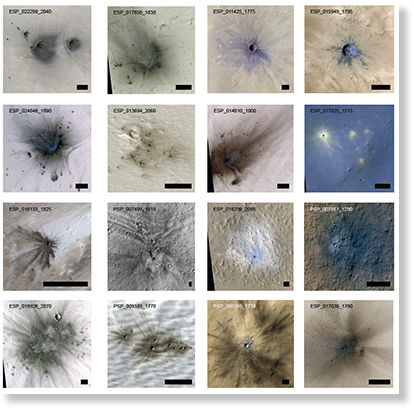
Scientists using images from NASA's Mars Reconnaissance Orbiter (MRO) have estimated that the planet is bombarded by more than 200 small asteroids or bits of comets per year forming craters at least 12.8 feet (3.9 meters) across. Researchers have identified 248 new impact sites on parts of the Martian surface in the past decade, using images from the spacecraft to determine when the craters appeared. The 200-per-year planetwide estimate is a calculation based on the number found in a systematic survey of a portion of the planet.

MRO's High Resolution Imaging Science Experiment (HiRISE) camera took pictures of the fresh craters at sites where before-and-after images by other cameras bracketed when the impacts occurred. This combination provided a new way to make direct measurements of the impact rate on Mars. This will lead to better age estimates of recent features on Mars, some of which may have been the result of climate change.
Image
© NASA
"It's exciting to find these new craters right after they form," said Ingrid Daubar of the University of Arizona, Tucson, lead author of the paper published online this month by the journal Icarus. "It reminds you Mars is an active planet, and we can study processes that are happening today."

These asteroids or comet fragments typically are no more than 3 to 6 feet (1 to 2 meters) in diameter. Space rocks too small to reach the ground on Earth cause craters on Mars because the Red Planet has a much thinner atmosphere.

Comment: Wow. Assuming the spread is relatively across the inner solar system, how many large space rocks or comets hit Earth last year?


Fireball 4

Rare meteor shower may 'outburst' on June 11

Rare Meteor Shower_1
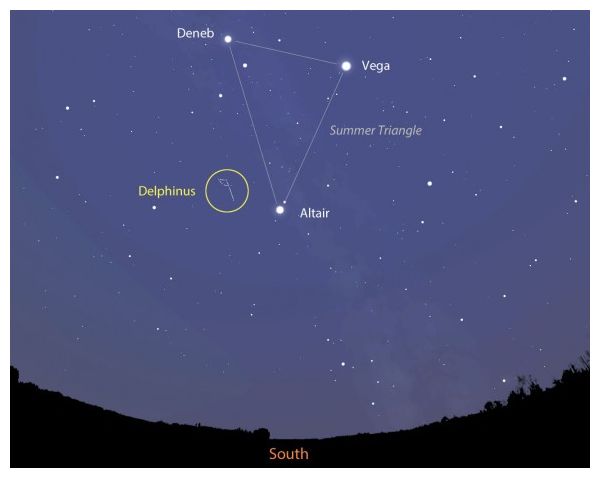
© StellariumThe rare and rarely heard of meteor shower called the Gamma Delphinids will appear to radiate from the constellation Delphinus (del-FINE-us) the Dolphin high in the southern sky shortly before dawn tomorrow morning June 11. This map shows the sky facing south at 3:30 a.m. local time. Delphinus is near the bottom of the bright 3-star figure the Summer Triangle.
Back on June 11, 1930 three members of the American Meteor Society (AMS) in Maryland saw a half-hour-long bright outburst of meteors from the little constellation Delphinus the Dolphin. No one had predicted the shower, but it came out of nowhere and hasn't been seen since. Attempts to catch a repeat performance in subsequent years met with no success.

That may change tomorrow morning, June 11, 2013. Peter Jenniskins, research scientist with the SETI Institute and NASA Ames Research Center, has examined dust outbursts from long-period comets and suggests the Gamma Delphinids may return for a brief moment of splendor, as Earth passes through this stream of cometary debris not seen since 1930.

Comet

Researchers claim that life arrived on Earth via asteroids and comets

comet life
© Unknown

Not so long ago, there was quite a bit of skepticism about the panspermia hypothesis - the idea that life on Earth got started by using alien molecules deposited by stellar travelers like comets or asteroids. At the time, this was presented as the somewhat harebrained imagining of overzealous science fiction fans. The more grounded alternative was to assume that all molecules necessary for life sprung exclusively from the conditions on ancient Earth. These days, however, there is significantly more credence given to the idea that life got a kickstart from alien molecules, and the support is beginning to come from all corners of the scientific world.

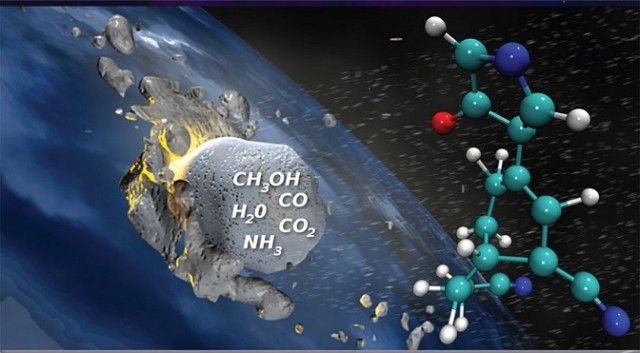
Now, even supercomputers are getting in on the action. A forthcoming study from Lawrence Livermore National Laboratory (LLNL) claims that new supercomputer simulations of comet impacts predict the formation of some of the most crucial organic compounds for life. By making use of new and highly efficient computational models, the researchers were able to look into a comet impact for much longer than ever before - in this case, up to several hundred picoseconds. That might not sound like much, but it's enough to see a wide array of organic molecules come together.

The famous Miller-Urey experiment tried to replicate the conditions of early Earth, and produced many complex organic molecules.

Comet 2

New Comet: C/2013 H1 (La Sagra)

Discovery Date: April 19, 2013

Magnitude: 17.7 mag

Discoverer: J. Nomen (La Sagra Sky Survey)

C/2013 H1
© Aerith NetMagnitudes Graph
The orbital elements are published on M.P.E.C. 2013-K38.

Comet 2

New Comet: 2013 LA2

Discovery Date: June 1, 2013

Magnitude: 21.5 mag

Discoverer: Pan-STARRS 1 telescope (Haleakala)
2013 LA
© Aerith NetMagnitudes Graph
The orbital elements are published on M.P.E.C. 2013-L23.

Fireball 5

June Arietids - The invisible meteor shower you just might see

I've never seen an Arietid meteor and chances are you haven't either. Peaking on June 7-8, the Arietid (AIR-ee-uh-tid) meteor shower is one of the strongest of the year with a maximum rate of 50-80 per hour. But there's a rub. The shower radiant, the point in the sky from which the meteors appear to radiate, is near the sun and best seen during daylight hours. When was the last time you saw meteors in daylight?
Image
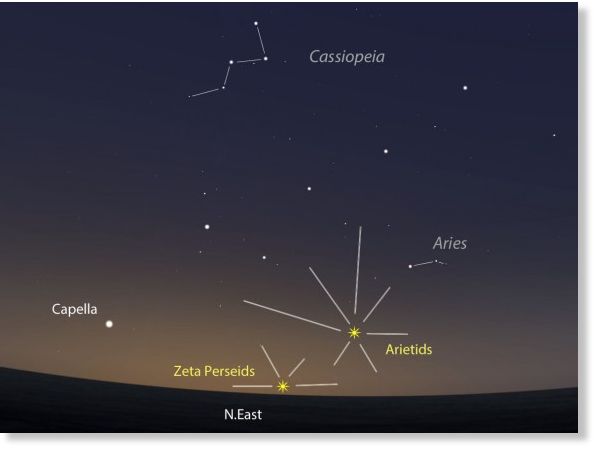
You might just see a few meteors from the combined Arietids and Zeta Perseid showers that peak Friday and Saturday mornings. This map shows the sky facing northeast at dawn for the mid-section of the U.S. Created with Stellarium
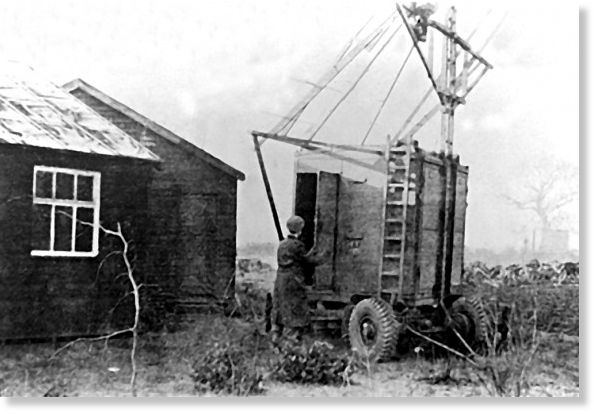
If you're wondering how anyone could discover a meteor shower when the sun is out, it's impossible unless your eyes can see radio waves. The Arietids were first "seen" in 1947 by operators of radio equipment at Jodrell Bank Observatory in England. Meteors leave trails of ionized gases when they rip through our upper atmosphere at tens of thousands of miles per hour and briefly make ideal reflectors of radio waves.
Image
© Jodrell Bank, University of ManchesterEarly scientific exploration of the sky in radio waves at Jodrell Bank Observatory in 1945.

Fireball 3

2011 Draconid meteor shower deposited a ton of meteoritic material into Earth's atmosphere

Every 6.6 years, the comet Giacobini-Zinner circulates through the inner solar system and passes through the perihelion, the closest point to the Sun of its orbit. Then, the comet sublimates the ices and ejects a large number of particles that are distributed in filaments. The oldest of these particles have formed a swarm that the Earth passes trough every year in early October. The result is a Draconid meteor shower - meteors from this comet come from the northern constellation Draco - , which hits the Earth's atmosphere at about 75,000 km/h, a relatively slow speed in comparison with other meteoric swarms.

Josep Maria Trigo, researcher from the CSIC Institute of Space Sciences (ICE), states: "When a comet approaches the Sun, it sublimates part of its superficial ice and the gas pressure drives a huge number of particles that adopt orbits around the Sun, forming authentic swarms. The study shows that in the evening from October 8th to 9th 2011, the Earth intercepted three dense spindles of particles left behind by the comet when it crossed through the perihelion".

The researchers, who published their results in the Monthly Notices of the Royal Astronomical Society magazine, have obtained the orbits of twenty meteors in the solar system. Thus, they have confirmed the origin of the particles that caused the outbreak in that periodic comet. For this, they have count on 25 video-detection stations operated by the Spanish Meteor and Firewall Network (SPMN) and the collaboration of amateur astronomers.

Two of those filaments of meteoroids, which had been theoretically predicted already, have been identified by scientists with those left by the comet in 1874, 1894 and 1900. Nevertheless, researchers have confirmed that there was another dense region intercepted by the Earth which had not been predicted and that involves a new challenge for theoretical models.

In a second article, researchers analyze the chemical composition of six fireballs from that swarm of the comet recorded during the outbreak. José María Madiedo, researcher from the University of Huelva and coordinator of this second study, asserts: "One of them, with an initial mass of 6 kg and nearly half a meter in diameter, named Lebrija in honor of the city it over flew, came to compete with the brightness of the moon that night".

The six analyzed fragments have a possibly similar composition to the carbonaceous chondrites (a type of organic-rich meteorites) but they are much more fragile. Trigo emphasizes: "They don't seem to have suffered any chemical alteration during their brief stay in the interplanetary environment, which turns out to be very interesting to confirm the astrobiological role of these particles in the continuous transportation of water and organic material to the Earth".

Heart - Black

Fire in China poultry plant kills 120

Image
Smoke rises from the Jilin poultry farm where up to 120 people died
A fire at a poultry processing plant in China has killed at least 119 people, officials say.

The fire broke out at a slaughterhouse in Dehui in Jilin province early on Monday.

Accounts speak of explosions prior to the fire, which caused panic and a crush of workers trying to escape. Some exits were said to be locked.

The fire is now said to have been mostly put out and bodies are being recovered.

Sources including the provincial fire department suggest there may have been an ammonia leak which either caused the fire or made fighting the blaze more hazardous.

Other reports speak of an electrical fault.

An injured woman lies on a bed at a hospital in Changchun, after fire broke out at a poultry slaughterhouse in Dehui, Jilin province, on Monday Dozens of injured have been sent to hospital

It is China's deadliest fire since 2000, when 309 people died in a blaze in a dance hall in Luoyang, in Henan province. A labour activist told the BBC it was the worst factory fire in living memory.

About 100 workers had managed to escape from the Baoyuan plant, Xinhua said, adding that the "complicated interior structure" of the building and narrow exits had made rescue work more difficult.

It said the plant's front gate was locked when the blaze began.

Fireball 5

NASA identifies 28 new asteroid families

Asteroids
© WISEAstronomers using data from NASA's Wide-field Infrared Survey Explorer (WISE) have identified 28 new families of asteroids in the main belt between Mars and Jupiter.
The findings are a critical step in understanding the origins of asteroid families, and the collisions thought to have created these rocky clans.

An asteroid family is formed when a collision breaks apart a large parent body into fragments of various sizes. Some collisions leave giant craters. For example, the asteroid Vesta's southern hemisphere was excavated by two large impacts.

Other smash-ups are catastrophic, shattering an object into numerous fragments. The cast-off pieces move together in packs, travelling on the same path around the Sun, but over time the pieces become more and more spread out.

"We're separating zebras from the gazelles," said Joseph Masiero of NASA's Jet Propulsion Laboratory in Pasadena, California, and lead author of the study.

"Before, asteroid family members were harder to tell apart because they were travelling in nearby packs. But now we have a better idea of which asteroid belongs to which family," Masiero said in a statement.

Fireball 4

Alberta couple's retirement project shakes up debate about ancient impact from space

Impact Event
© Getty, YDB Research GroupThere's new evidence of a comet impact 13,000 years ago.
Some retirees golf. Some dream of buying a boat and sailing the world. Anton and Maria Chobot spent 30 years of their retirement digging up artifacts of the Clovis culture on their property near Buck Lake, Alberta, and now, they may have provided some of the evidence needed to settle a long debate in the science community.

Roughly 13,000 years ago, something touched off the 'Big Freeze' - a 1,300-year-long cold snap formally called the Younger Dryas stadial - that caused major climate changes and droughts.

These have been blamed for the extinction of the mammoth and the saber-toothed tiger, and also the downfall of the ancient Clovis culture. However, what that something was has been debated for years.

One idea that's proven popular over the years is that a meteorite or comet struck the planet, somewhere around what is now Hudson Bay. However, if something big enough to melt the Laurentide ice sheet had hit the planet there should have been some indication of it, in the form of a crater, or shocked and melted rocks, or 'impact spherules'. And, until recently, the evidence was lacking.