Comets


Fireball

Another meteor "fireball" Saturday night over Indiana

Image
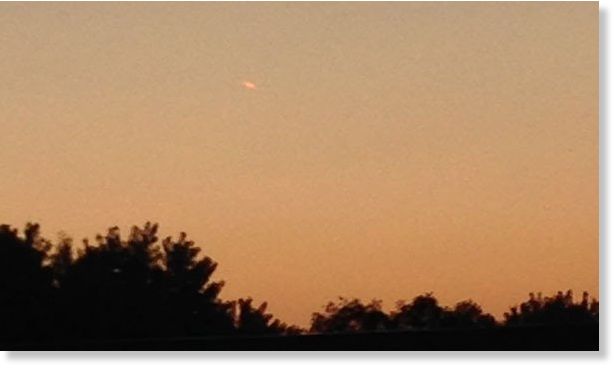
The picture you see is of a meteor "Fireball" over Indiana on Friday night. You might remember that just last week there was one seen over Canada. And then, just last night (Saturday), many News 2 viewers in Middle Tennessee saw another one. This one was also seen over Alabama according to Twitter posts I have seen.

My good friend James Spann in Birmingham says that Bill Cook from NASA says that this was the 15th significant one this month and that is "very unusual". It's hard to catch video like this on your phone because the meteor goes by too fast. The pictures of the Indiana and Canada meteors were taken by police "dash board cams".

A video of Saturday night's from James Spann's Google+ page:
Another video of the fireball over Alabama last night... captured by Melanie Witt... who writes...

"I am a band parent of the Cleveland High School Golden Force Marching Band and videoed the meteor at the band competition in Weaver, Al. We first thought the band playing on the field had shot something into the sky as part of their show but everyone decided it was a meteor. It was an amazing sight!!!"

UPDATE:

A video of last night's "fireball" taken over Alabama and relayed by James Spann of ABC 33/40 Birmingham. He also got some more comments from Bill Cooke, of NASA's Meteoroid Environments Office at the Marshall Space Flight Center in Huntsville:
"I would say the fireball originated in North Alabama and moved east-southeast, finally burning up over Atlanta (we had a bright one over that city 7 days ago!). The video shows that it was about the brightness of the crescent Moon, which means we are talking about a meteoroid a few inches in diameter. hard to be more precise without a speed measurement."

Fireball 4

Multiple fireballs over U.S.: Hundreds of witnesses report fireball events from 30 states, September 22-23

Hundreds of reports of fireballs from 30 states! Also, Japan had a fireball flurry on September 18th, 19th and 20th. Truly amazing things are happening in our skies!


Snowflake Cold

Ancient muddy memories?

ice age ancient legends
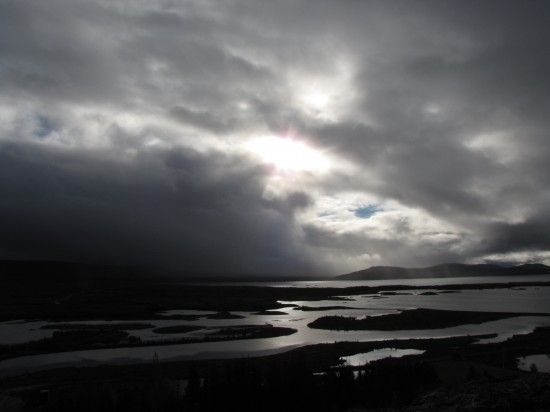
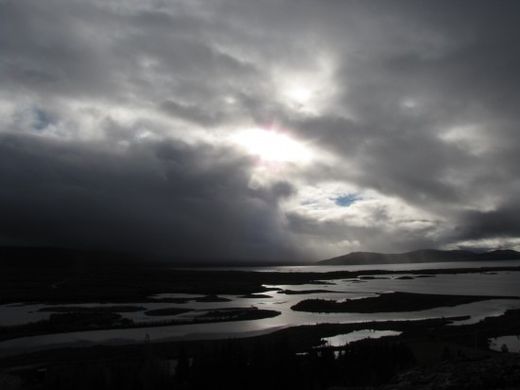
© Marinus Anthony Van Der SluijsEchoes of a primordial landscape? Þingvellir, Iceland.
Many cultures recalled a period of unbearable cold, which they associated with a distant mythical age of 'creation', when the sun did not yet shine or fire had not yet been obtained.

Such tales are hardly surprising for higher latitudes, such as the Viking sagas of Iceland, but present a palaeoclimatological puzzle elsewhere.

For example, the Cherokee (originally along the Tennessee), who should be quite accustomed to climatic extremes, claimed that the first fire was confined to a special tree - arguably an axis mundi - at a time of lasting cold:
'In the beginning there was no fire, and the world was cold, until the Thunders (Ani´-Hyûñ´tikwalâ´ski), who lived up in Galûn´lati, sent their lightning and put fire into the bottom of a hollow sycamore tree which grew on an island. ... This was a long time ago. ... still there was no fire, and the world was cold ...'
Eventually, mythical beings succeeded in acquiring the fire. At tropical latitudes meanwhile, the Quiché Maya (Guatemala) related that their first ancestors were overcome by circumstances most peculiar for central America:
'After that a great downpour began, which cut short the fire of the tribes. And hail fell thickly on all the tribes, and their fires were put out by the hail. Their fires didn't start up again. ... And so again the tribes arrived, again done in by the cold. Thick were the white hail, the blackening storm, and the white crystals. The cold was incalculable. They were simply overwhelmed. Because of the cold all the tribes were going along doubled over, groping along ...'
And the Bibbulmun nation (southwestern tip of Australia) referred to the 'Dreamtime' or the 'ancestral' time (Demma Goomber) as the 'Nyitting times, the cold, cold times of long ago'. As the name says, the Bibbulmun qualified this past era as one dominated by unprecedented cold - and, consequently, by a savage mode of living:

'In that far-off time Australia was not so warm and congenial as it is to-day. It was cold and bleak, and great glaciers of ice covered many of its hills and valleys. ... "the icy cold (nyitting) times of long, long ago". Now, in an icy cold country one must have fires, but there was a time when the Bibbulmun people had no fires, and they had to eat their meat raw and drink the blood of the animals they killed to warm their bodies.

The theme of a cold epoch meshes with the notion of 'primordial darkness' reported universally to have preceded the formation of the present natural environment. Another associated motif is that the embryonic earth was excessively muddy and wet, a necessary consequence of the earth's putative original submersion in primeval waters. In addition, the moist earth is often linked with the aftermath of the deluge and the first appearance of humans and the sun. Though scholars never seem to have compiled the material, let alone considered it, the literature is awash with examples. A selection follows.

Fireball 2

Yet another fireball lights up early-morning sky in U.S. Midwest, American Meteor Society says September 2013 most active month since it began tracking in 2005

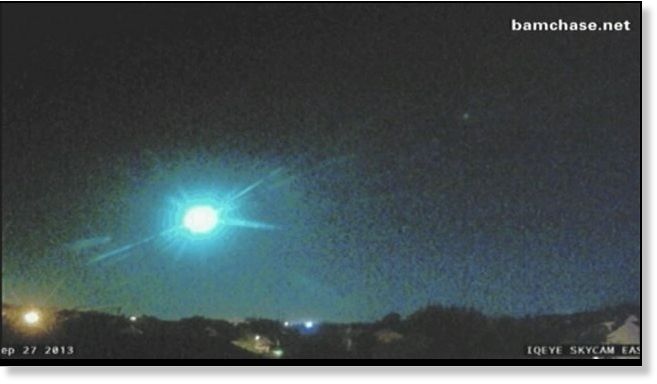
Many Chicagoans' daily commutes were made extraordinary Thursday morning by a fireball that flashed across the sky shortly after 6 a.m. In the seconds before the fireball disappeared, WGN-TV helicopter pilot Mike Sypien saw a burning green and red ball of light, which he described as moving faster than an airplane across the sky."My photographer was like, 'Holy cow, did you see that?' " Sypien said. "It was very vivid. It was very bright. It almost looked like somebody took a flare and threw it across our windshield."

Other news helicopter pilots who were also hovering over traffic exclaimed through their radios simultaneously, Sypien said. People across the Midwest, from Illinois to Tennessee and from Iowa across to Ohio, alerted the American Meteor Society, which received more than 400 online reports by Thursday afternoon.

Reports described the fireball as orange, yellow or white. Many wrote that it exploded as it descended. Almost all said it was like nothing they had ever seen. "I've been flying over 14 years," Sypien said. "I've never seen anything like that. You could not have missed it, I'll tell you."

This was the 13th "significant" meteor event in the United States this month, making September the most active month since the American Meteor Society began tracking them in 2005, according to Mike Hankey, a meteor observer for the society.
Image
© Kevin Keadle, Palatine, IllinoisPhotograph taken by Kevin Keadle of Palatine of a meteor that streaked across the dawn sky in the Midwest this morning.

Comment: The "13th significant meteor" spotted in the U.S. for September? Just scan SOTT's "Fire In The Sky" category - they are being seen in the U.S. and world wide almost daily. Something is afoot on the BBM...


Comet 2

Comet ISON now in range for amateur astronomers

As the comet approaches its date with the Sun (Nov. 28th, 2013), it brightness is growing in magnitude. This has opened the door to backyard astronomers with smaller telescopes to glimpse the possible 'Comet of the Century'.


Credit: NASA

Comet 2

Comet ISON has apparent fling with Asteroid Eros

Slooh.com's Canary Islands Observatory captured asteroid 433 Eros seeming to fly with Comet ISON on September 24th, 2013. This 2nd largest near-Earth asteroid - which has been visited by the NEAR probe - is traveling faster, along a different orbit.


Credit: Slooh.com

Comet 2

Comet ISON still on track for fall spectacle

Comet ISON
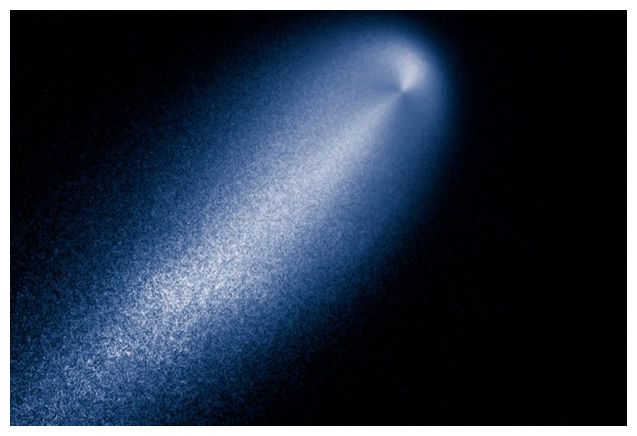
© NASA, ESA, J.-Y. Li (Planetary Science Institute), and the Hubble Comet ISON Imaging Science TeamThis is a contrast-enhanced image produced from the Hubble images of Comet C/2012 S1 (ISON) to reveal the subtle structure in the inner coma of the comet. In this computer-processed view, the Hubble image has been divided by a computer model coma that decreases in brightness proportionally to the distance from the nucleus, as expected for a comet that is producing dust uniformly over its surface. ISON's coma shows enhanced dust particle release on the sunward-facing side of the comet's nucleus, the small, solid body at the core of the comet. This information is invaluable for determining the comet's shape, evolution, and spin of the solid nucleus.
Remember when we, and everyone else in the media circuit, reported about how Comet ISON was fizzling out? Well, forget about it, because a very reliable source tells redOrbit that the comet is still on track to potentially provide a spectacular show in the night sky.

Comet ISON has been closely watched by several astronomers over the past year with great anticipation, but also with a little hesitation. It is a tricky balance, because comets have been notorious for disappointment in the past, particularly when media grabs hold of the subject and helps hype up events like this.

In August, Comet ISON emerged from behind the sun and was first picked up by amateur astronomer Bruce Gary. Reports said that according to Gary's observations, this comet was headed for disappointment, rather than the fall spectacle that news sources hyped it up to be. Since then, not a lot of new information has emerged about the comet from the media outlets, so redOrbit reached out to Karl Battams, an astrophysicist and computational scientist at the US Naval Research Laboratory, to get an update about Comet ISON.

Fireball 4

Did a meteor cross over Western Massachusetts?

Image
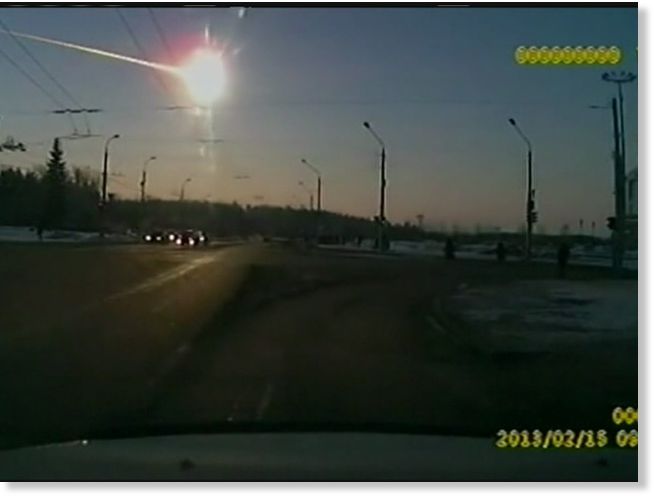
© AP/Nasha gazeta, www.ng.kz Some people saw something interesting light up the skies Tuesday night. Turns out a meteor was seen by many in the northeast at just after 9 o'clock. Image from a video done with a dashboard camera, on a highway from Kazakhstan to Russia
Some people saw something interesting light up the skies Tuesday night. Turns out a fireball, or meteor, was seen by many in the northeast at just after 9 o'clock Tuesday night. Now, so far we haven't been able to track down any pictures or video of Tuesday's fireball, but a much brighter meteor, was seen in the skies over Russia a few months ago.

A fireball is when a cosmic rock enters our atmosphere, burning up upon entry creating brief, but bright light. We get occasional, regular meteor showers in the sky, but those come from predictable comet fragments; this fireball likely comes from a different source.

Richard Sanderson, curator at the Springfield Museums, told 22News, "Many of the bright fireballs we see are chunks of asteroids that have been flung out of the asteroid belt when two asteroids collide and shatter each other and those can occur without warning at any time."

Fireballs usually last for less than a minute and most of the pieces disintegrate before reaching the ground, at that point they would be called meteorites.

If you have any pictures or video of Tuesday night's meteor fireball, please send them to reportit@wwlp.com.

Fireball 5

Newfound asteroid whizzes between the Earth and the Moon this week

Asteroid 2013 RZ53
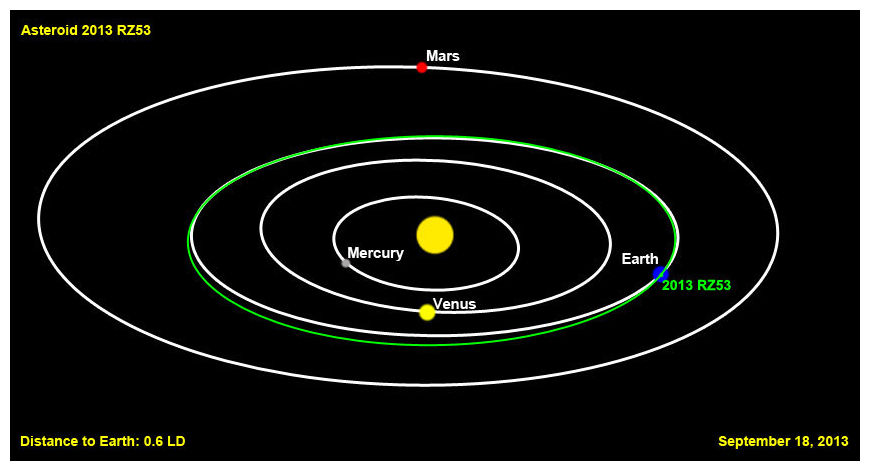
© GeekquinoxThe orbit of Asteroid 2013 RZ53 closely tracks the orbit of Earth.
Discovered just two days ago, a small asteroid will be whizzing past the Earth on Wednesday night, coming within two-thirds the distance to the Moon.

Asteroid 2013 RZ53 was found early Friday morning by astronomers working at the Steward Observatory, at the University of Arizona, as part of the Catalina Sky Survey. Astronomers from Australia and Illinois helped to track the asteroid, and found that it's about 3 metres wide, its orbit is very close to Earth's, and it even flies along with us as we make our way around the Sun. On Wednesday night, 2013 RZ53 will come within 0.6 lunar distances of Earth, or roughly 230,000 kilometres.

2013 RZ53 is an Apollo asteroid. These are a specific type of asteroids that cross Earth's orbit, putting them into a class of 'potentially-dangerous asteroids'. Astronomically speaking, it's coming pretty close to us, but it's well outside the orbit of our satellites, and there's no chance of it hitting the Earth. Still, based on the astronomers backtracking the orbit of this space rock, that's apparently the closest approach it's made since March of 1954.

Comment: Who does the author think he is kidding?!

It clearly shows how much more material is reaching the inner solar system!


Jupiter

It's only thanks to amateur astronomers that we know comets and asteroids are regularly impacting Jupiter

Jupiter Fireball
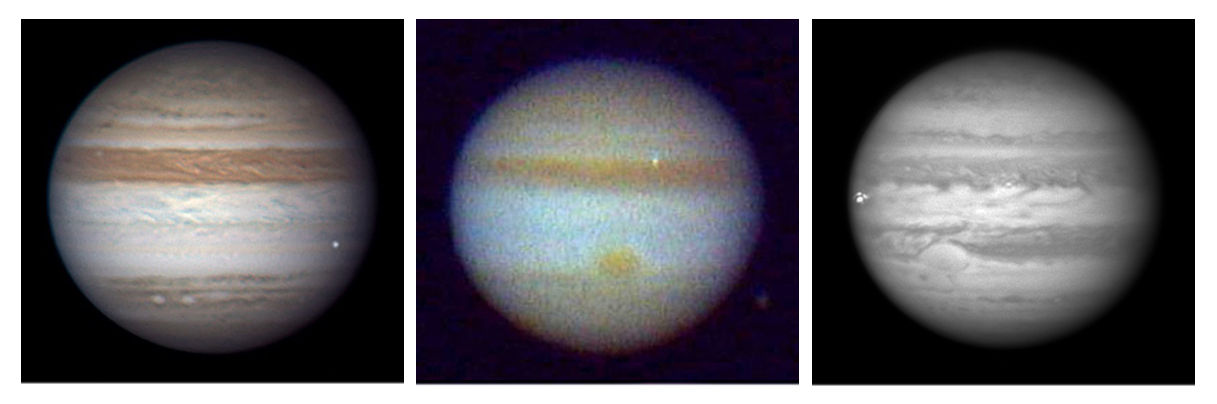
© Hueso/Wesley/Go/Tachikawa/Aoki/Ichimaru/PetersenThe first of these collisions was observed by A. Wesley from Australia and C. Go from Philippines on June, 3 2010. The second object was observed by three Japanese amateur observers (M. Tachikawa, K. Aoki and M. Ichimaru) on August, 20 that year and a third collision was observed by G. Hall from USA on September, 10 2012 after a report of a visual observation from D. Petersen from USA.
Amateur astronomers observing Jupiter with video cameras for the past three years have observed a trio of collisions between small stellar objects occurring around the planet, according to research presented last week at the European Planetary Science Congress (EPSC 2013) in London.

The collisions are similar but smaller in scale than the meteor explosion that occurred over Chelyabinsk, Russia in February, explained Ricardo Hueso of the University of the Basque Country in Spain. Hueso presented a detailed report of these collisions during EPSC 2013, which concluded on Friday.

Such collisions are not uncommon in the Solar System, the researchers explained. Most smaller objects such as asteroids and comets have stable orbits, but some of them travel in orbits that place them at risk of colliding with planets. The smaller the objects, the more numerous they are and the more likely they are to cause collisions.


Comment: Not necessarily. The obvious reason that no one seems to want to spell out is that more material - big and small, 'stable' and 'unstable' - has entered the inner solar system. When it comes down to it, what everyone on this planet is about to learn is that there is no such thing as 'stability' in space!