Strange Skies
S


Nebula

Plasma? Mysterious 'fireball' that crashed in Chile was NOT meteor say scientists

Chile
© National Geology and Mining Service of Chile
Mysterious "fireball"-like objects spotted blazing through the sky over Chile were not meteors, government scientists say, in a finding sure to enthuse UFO buffs the world over.

Residents of Dalcahue, a port city on the southern island of Chiloé, took to social media last week with reports of the unidentified flying objects, some sharing photos of the phenomenon. The "fireballs" reportedly crash-landed at a number of locations around the town.

Chile's National Geology and Mining Service soon gathered scientists to investigate the strange bright objects, dispatching teams to some seven sites on Chiloé to take samples. In a statement issued over the weekend, the scientists concluded they "found no remains, vestiges or evidence of a meteorite" left behind by the "luminous and incandescent" objects.

Comment: See also: And check out SOTT radio's:


Sun

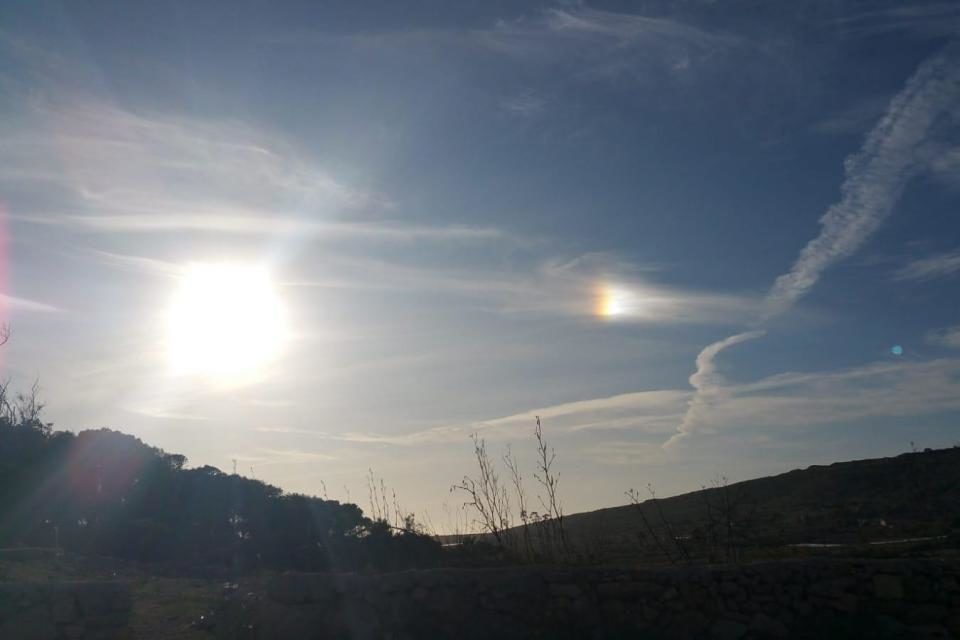
Sundog phenomena seen in the skies of Malta

Sundog over Malta
© Victoria Massalha
Anyone looking up at the sky on Tuesday, just before sunset, would have seen something strange - two suns.

In a rare phenomenon, that seems to have gone unnoticed by many, Malta experienced what is known as a sundog, or mock sun. Victoria Massalha was one of the lucky ones who spotted it while driving home in the Mizieb area.

"I was looking up at the sky on my way home and thought: look, there's a rainbow in the sun," she said.

Ms Massalha managed to take photos and a video of the rare sight and shared them with our readers for all to enjoy.

Nebula

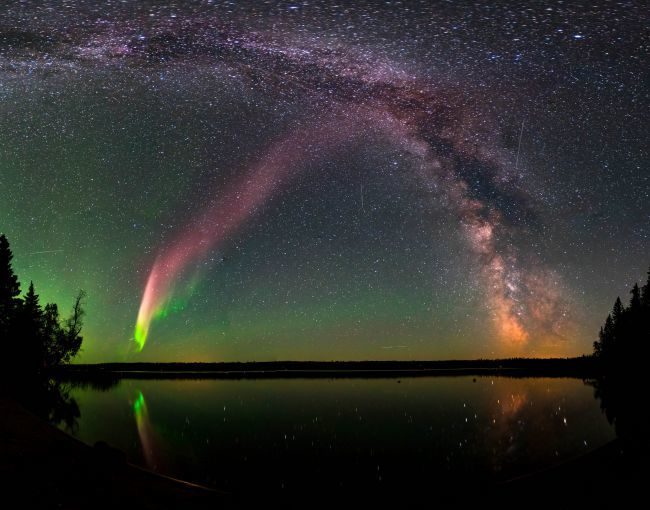
Skywatchers may have spotted mysterious skyglow 'STEVE' lighting up the night sky on Labor Day

Steve appears on Labor Day
© Krista Trinder/NASA
A strong solar storm over Labor Day weekend brought the northern lights farther south than usual, and it may have included something different than the aurora: a solar visitor dubbed STEVE.

Researchers discovered STEVE, short for the Strong Thermal Emission Velocity Enhancement, in 2016. To the casual eye, it appears as a narrow pink or mauve streak in the sky. To scientists, what makes it strange is that its light comes from across the spectrum, without the peaks in particular wavelengths that characterize regular auroras.

"The big thing is we can clearly say now, 'It's not regular aurora,'" University of Alaska Fairbanks researcher Don Hampton, who recently analyzed a STEVE event from 2018, said in a statement. "It's a new phenomenon — that's pretty exciting""

Pretty in pink

In 2016, skywatchers and astronomers alike noticed and photographed odd pink bands that didn't look like usual aurora lights, according to NASA. Further analysis showed that the color wasn't the only unexpected feature of these lights.

Comment: See also:


Sun

Sun halo seen in the skies of Tura, India

Citizens of Tura were treated to a spectacular view of the morning sky on Thursday when a solar halo (also known as a sun rainbow) appeared in the sky around 11 am on Thursday leaving many awestruck with the beauty of our world.

A rare moment for Tura, this spectacular celestial display occurred shortly after a light drizzle around the foothills of Tura peak.
Sun halo over Tura, India
© Cosmos Sangma
Solar halos are seen as a white ring around the sun or moon. These high altitude cirrus clouds are made of mostly ice crystals which refract the sunlight much like a prism while showing the colors of a rainbow.

Question

Mysterious radio burst detected by China's radio telescope

FAST in China
© Asia TimesFAST, the world’s largest single-dish radio telescope, has a certain edge in detecting repeated FRBs.
Is someone or something trying to contact earth?

China's Five-hundred-meter Aperture Spherical Radio Telescope (FAST) has detected a repeating fast radio burst (FRB) — mysterious radio signals from outer space — for the first time, Science and Technology Daily reported.

Scientists on the FAST project with the National Astronomical Observatories of China, part of the Chinese Academy of Sciences, revealed the news to China Daily on Wednesday.

The FRB originated some three billion light years away from Earth. Interference factors including aircraft and satellites have been eliminated and cross validation is being carried out, the scientists said.

FRB is one of the hottest topics in astronomy. It was not until 2007 when the first FRB was discovered by humans. Fewer than 100 FRBs have been detected internationally to date.

There is still no cohesive explanation for the origin of FRB in the international scientific community at present. FRBs mostly only appear once, which makes them very hard to track.

Info

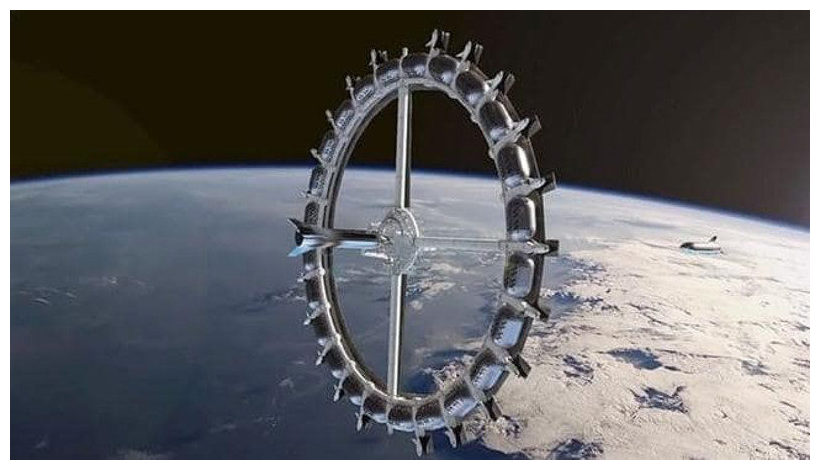
Von Braun Space Station due for 2025

The wheel-like Von Braun Space Station, which is based on the International Space Station, has a lot of new tech, and some not-so-new tech. It's to be a mix of space hotel and seminar and educational centre.
Von Braun Space Station
© Picture courtesy The Gateway FoundationThe proposed space hotel designed by The Gateway Foundation.
The large "cruise liner in space" is mainly for accommodation, and perhaps the ultimate available upmarket corporate events, etc. The Von Braun Space Station is designed by the Gateway Foundation, an interesting mix of obvious promotional zeal and what looks very like idealism.

I was looking for some background for the Gateway Foundation but didn't find any conventional corporate info. The actual ownership and leadership include a few notables who'd have the right to some credibility.

The idea of a luxury space station isn't new in theory, but as a project, it's a whole new ball game or several. You can see the technical specifications on the Gateway page.

Galaxy

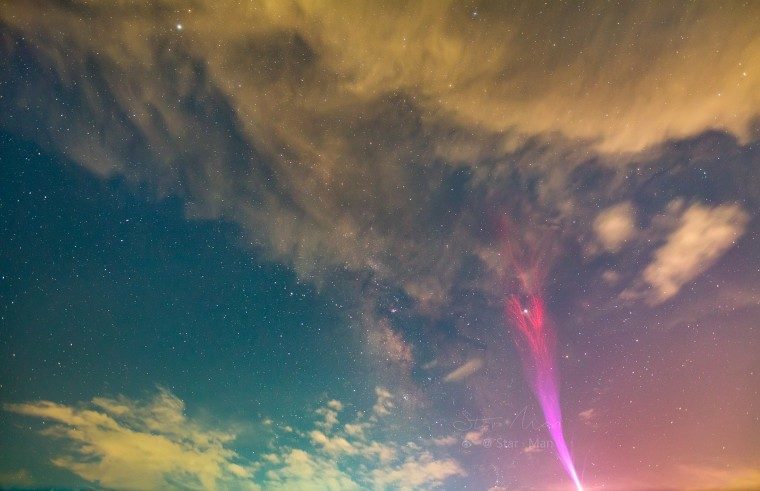
Gigantic jet photographed piercing the sky in China

gigantic jet
You never know what you might see in the wake of a big storm. On Aug. 25th, Chinese astrophotographer Chao Shen of Shaoxing City went outside to photograph the Milky Way. A typhoon named "White Deer" had passed through the day before, and the storm clouds were parting. "I saw the stars--but that's not all," says Shen. "A Gigantic Jet leaped up right before my eyes!"

Think of them as sprites on steroids: Gigantic Jets are lightning-like discharges that spring from the tops of thunderstorms, reaching all the way to the edge of space. They're enormous and powerful.

"Shen definitely caught a Gigantic Jet," confirms Oscar van der Velde of the Lightning Research Group at the Universitat Politècnica de Catalunya. "It looks like it may have reached as high as 90 km above the ground."

"Gigantic Jets are much more rare than sprites," says van der Velde. "While sprites were discovered in 1989 and have since been photographed by the thousands, it was not until 2001-2002 that Gigantic Jets were first recorded from Puerto Rico and Taiwan." Only dozens of Gigantic Jets have ever been photographed.

Comment: Wiki details the difference between a blue jet and a gigantic jet:
Gigantic jets

Where blue jets are believed to initiate between the upper positive charge region and a negative screening layer directly above this region, Gigantic jets appear to initiate between the upper positive and lower negative charge regions in the thundercloud. In a similar process to how blue jets form, the higher charge region is discharged by the leader network before the same occurs in the lower charge region, and one end of the leader network propagates upward from the cloud toward the ionosphere. Gigantic jets reach higher altitudes than blue jets, and the upper portion of the jet changes color from blue to red.
See also:


Sun

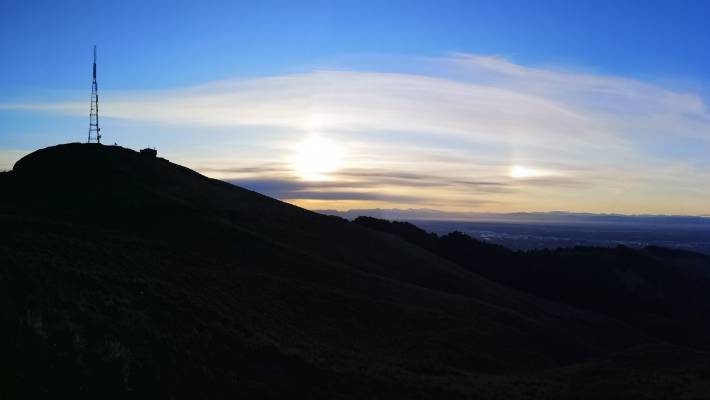
Sun dog lights up sky in Canterbury, New Zealand

Sun dog over Canterbury, NZ
© Ross Day
It looks like something out of a science fiction novel but it's really just a quirk of the clouds that gives the appearance Earth is now orbiting two suns.

Ice prisms in a veil of high cirrus, about 8 kilometres up, refract sunlight and can create many different optical phenomena, including the "mock sun" or "sun dog" photographed by Ross Day near Sugar Loaf on Christchurch's Port Hills close to sunset on Tuesday.

The phenomenon - more properly known as a parhelion - is not especially rare and is one of several tricks of the light generated by hexagonal ice crystals in clouds at such high altitudes.

In the best displays, a whole range of intersecting haloes and arcs may be visible around the Sun.

Rainbow

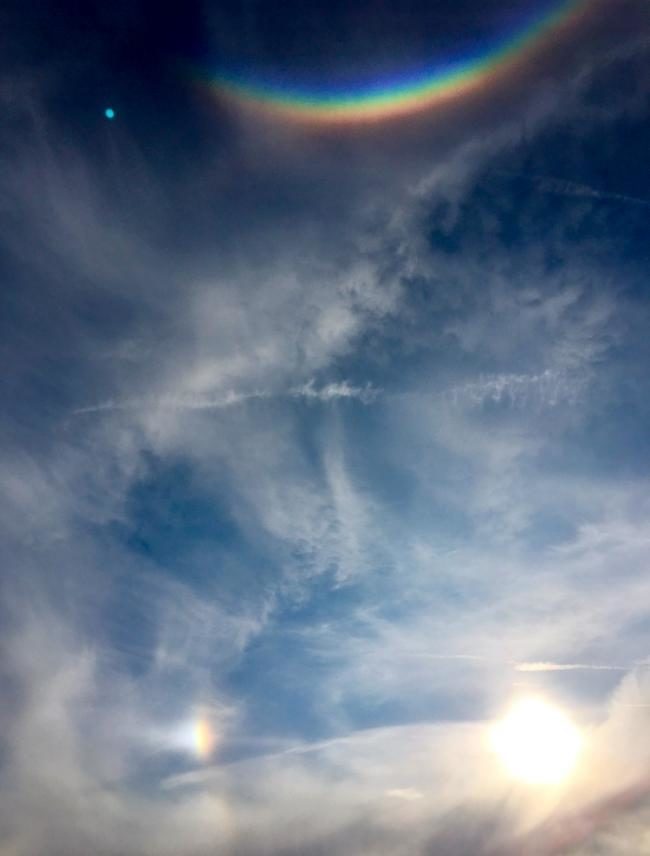
Cooling atmosphere: Circumzenithal arc shines over Brighton, England

circumzenithal arc over brighton
© Sherrie Fox
A natural phenomenon usually seen at the North and South Poles has been spotted in the sky over Brighton.

A circumzenithal arc, shaped like an upside-down rainbow and giving the appearance of a smile in the sky, was seen above the city at around 4pm yesterday. It is shown in the pictures, sent to The Argus by reader Sherrie Fox.

According to the Met Office, circumzenithal arcs are formed when sunlight refracts through horizontal ice crystals at an angle where the light enters the crystal through its flat top face and exits through a side prism face. This is what causes the distinctive upside-down rainbow effect.

Sun

Sun is resource for quantum entanglement, may reveal internal solar processes

CME on Sun
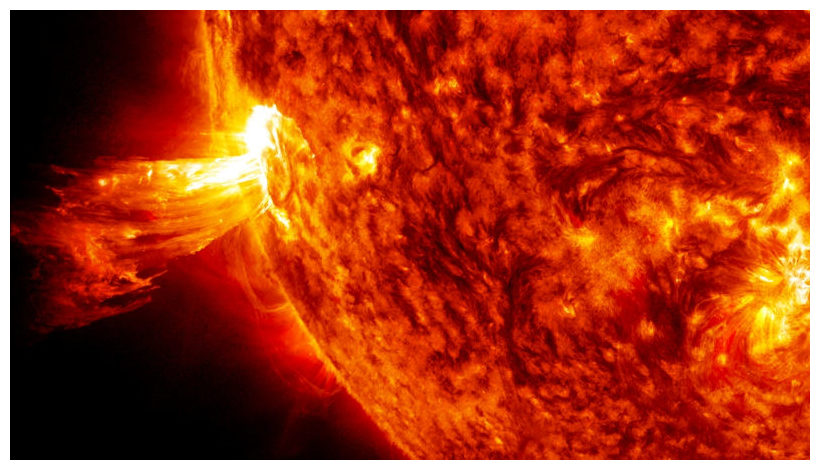
© NOAAA nearby source of quantum photons.
Up until the mid-20th century, light was pretty ordinary. Yes, it was both a particle and a wave, but it didn't do anything very weird. Then scientists, under-employed after the end of World War II, started paying more attention to the properties of light. This was, in part, driven by the availability of surplus searchlights, which could be turned into cheap arrays of light detectors to measure the properties of stars.

That began the photon gold rush, with scientists identifying all sorts of interesting potential behaviors. But actually observing them would require having rather special light sources, which didn't exist. Now, scientists have shown that our own Sun can be turned into one of these light sources.